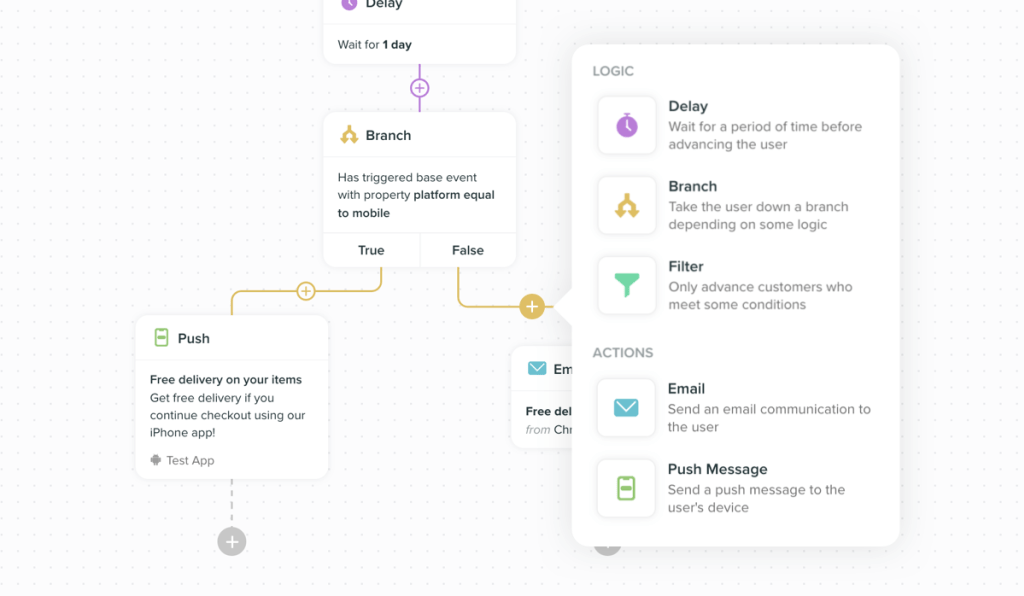
Vero Workflows is an email marketing solution built to make customer engagement simpler with features such as in-app behavior tracking, audience segmentation, and workflow automation.
$54
per month
VWO
Score8.2 out of 10
N/A
VWO is an A/B testing and conversion optimization platform that enables growing businesses to conduct qualitative and quantitative visitor research, build an experimentation roadmap and run continuous experiments on their digital properties. With its 5 capabilities Plan, Track, Test, Analyze, and Target, it brings the entire CRO (conversion rate optimization) process at one place. VWO helps online businesses follow the process- and data-driven conversion…
$49
per month
Pricing
Vero Cloud
VWO
Editions & Modules
Starter
$54
per month
Pro
$219
per month
Growth
$549
per month
Enterprise
$1,429
per month
Subscription
$99.00
per month
TESTING
Get a Demo
The classic VWO A/B testing solution
CONVERSION OPTIMIZATION
Get a Demo
The all-in-one platform for all your optimization needs
ENTERPRISE
Get a Demo
Customized solution with advanced AB testing and conversion optimization capabilities
Offerings
Pricing Offerings
Vero Cloud
VWO
Free Trial
Yes
Yes
Free/Freemium Version
No
No
Premium Consulting/Integration Services
No
Yes
Entry-level Setup Fee
Optional
No setup fee
Additional Details
15% discount applied with an annual subscription, paid upfront.
—
More Pricing Information
Community Pulse
Vero Cloud
VWO
Considered Both Products
Vero
No answer on this topic
Wingify Pvt Ltd
Verified User
Chose VWO
The A/B testing with VWO making edits to the website page is a feature I've not seen elsewhere and allows us to test product changes without requiring previous developer time. Unbounce is a lot more intuitive and easy to use but it requires to build pages from scratch rather …
A de minimis incentive was given to thank the reviewer for their time. The incentive was not used to bias or drive a particular response, nor was the incentive contingent on a positive endorsement. More Info
Vero tends to play nice with companies that have their websites as the primary source of truth. This allows them to send as many events as they need and develop more complex workflows that introduce conditionality into Vero emails. However, for those that rely more on Salesforce, it might have more limited applications. The product is fairly easy to use, so it's easy for multiple people on the team to pick it up and do what they need for their respective groups. On the other hand, creating email templates will require some knowledge of HTML/CSS, unless those are copied from another source. That would require another product of course that provides more robust layout editing features and templates.
A de minimis incentive was given to thank the reviewer for their time. The incentive was not used to bias or drive a particular response, nor was the incentive contingent on a positive endorsement. More Info
It works better for either small or big companies because small companies can start with the free plan which is very decent and has everything they need. Also for big companies who get the best paid plans they get a lot of premium functionalities, the insight module, outstanding reports. But for medium size companies who can only afford the basic paid plan, it may not be the best tool as it is very limited. For example, they cannot analize a/b tests for new and ruturning visitors, neither based on the users device category.
A de minimis incentive was given to thank the reviewer for their time. The incentive was not used to bias or drive a particular response, nor was the incentive contingent on a positive endorsement. More Info
A de minimis incentive was given to thank the reviewer for their time. The incentive was not used to bias or drive a particular response, nor was the incentive contingent on a positive endorsement. More Info
VWO is pretty easy to implement on websites and doesn't require a heavy technology lift
The VWO interface is pretty intuitive and let's non-technical users make variants for testing
The VWO reporting dashboard is excellent for determining statistical significance and understanding whether differences in conversion rates are meaningful or not
A de minimis incentive was given to thank the reviewer for their time. The incentive was not used to bias or drive a particular response, nor was the incentive contingent on a positive endorsement. More Info
While Vero offers some WYSIWYG editing, it's on the limited side, as it mostly allows you to edit copy, but not necessarily the layout.
The UI/UX has improved dramatically over the course of the last few years, but it can still lag from time to time and experience sluggishness.
While reliability is really good, it does have lapses from time to time that will introduce delays into emails being sent out. Once or twice, the system went completely down for a period of time.
A de minimis incentive was given to thank the reviewer for their time. The incentive was not used to bias or drive a particular response, nor was the incentive contingent on a positive endorsement. More Info
The user interface within VWO does take a bit of time to get used to, especially as it pertains to switching back and forth between tests. When running multiple experiments on a site at a time, a clear and succinct dashboard for everything in one place would be helpful (as opposed to needing to switch between A/B, multivariate, etc).
A de minimis incentive was given to thank the reviewer for their time. The incentive was not used to bias or drive a particular response, nor was the incentive contingent on a positive endorsement. More Info
It's great value and we think we've ironed out all the major teething troubles. However, if we experience any more bugs or problems that significantly slow us down then we're seriously considering switching to Optimizely, which I haven't personally tested but have heard great things about from my CRO peers
I gave Visual Website Optimizer a rating of 8 because it is overall a great product to use. Setting up and keeping track of various tests is easy and straight forward. The only reason why this product is not rated higher is because the support documents online leave a lot of room for improvement.
A de minimis incentive was given to thank the reviewer for their time. The incentive was not used to bias or drive a particular response, nor was the incentive contingent on a positive endorsement. More Info
VWO doesn't appear to slow down our website at all, though some customers with adblockers like UBlock Origin have been known to not see entire pages if VWO is making changes to the page at a macro level (background, font, etc). This is rare though.
A de minimis incentive was given to thank the reviewer for their time. The incentive was not used to bias or drive a particular response, nor was the incentive contingent on a positive endorsement. More Info
While their online document support is lacking a simple email to their support team will almost always get responded to the next day. It has however taken more than one email to explain the problem to the support team till they understood the problem. The solution I was given also only half fixed the problem the rest I figured out on my own.
Training was good, just limited to the onboarding process. They walked through all of the steps it takes to get started in VWO and each of the modules, along with giving us ideas for starting our first test. I feel like it could be better if there was a guided process within the VWO program to continue to educate you along the way, and a way to turn that off for experienced users.
A de minimis incentive was given to thank the reviewer for their time. The incentive was not used to bias or drive a particular response, nor was the incentive contingent on a positive endorsement. More Info
Overall, the implementation of VWO is straightforward. If you've got a straightforward way of deploying code to all of your test pages, either a good CMS or a TMS, then implementation should be a breeze. There is no tweaking to be done to the code itself, and once deployed it has the flexibility to cope with different VWO modules (tracking, conversion analysis, session analysis) without modification.
A de minimis incentive was given to thank the reviewer for their time. The incentive was not used to bias or drive a particular response, nor was the incentive contingent on a positive endorsement. More Info
Vero's price tag is far more attractive but for what you will find to be clear and obvious reasons. Vero has no CRM unlike HubSpot and Infusionsoft. Vero also has limited tracking unlike the seemingly endless possibilities offered from HubSpot which as we all know comes with at a significant cost, often not feasible by a small startup company.
A de minimis incentive was given to thank the reviewer for their time. The incentive was not used to bias or drive a particular response, nor was the incentive contingent on a positive endorsement. More Info
There are significant differences in each platform when it comes to Optimizely and vwo. From a functionality and performance perspective they each have their pros and cons. It is important to go through the feature sets of each and ensure the solution you select will work specifically with your business objectives and conversion rate optimization goals
A de minimis incentive was given to thank the reviewer for their time. The incentive was not used to bias or drive a particular response, nor was the incentive contingent on a positive endorsement. More Info
The product seems infinitely scalable for our needs (small business) and we've never had any issue with loading VWO-edited elements. I will say, though, that online customers with ad blockers have been known to not see certain VWO elements as their third-party scripts are disabled.
A de minimis incentive was given to thank the reviewer for their time. The incentive was not used to bias or drive a particular response, nor was the incentive contingent on a positive endorsement. More Info
The overall costs of using Vero have been much lower than using two comparable products that handle transactional emails and newsletters, respectively. MailChimp has relatively recently integrated their Mandrill product for transactional emails, so that's worth looking at as well.
Using a single product for many things lowers the learning curve, as team members only have to learn one product well, rather than several.
While infrequent, Vero's outages have impacted our operations at times. If absolute reliability is crucial to your business, then you may have to find a larger provider with a more robust infrastructure. As mentioned, though, it hasn't been a big problem for us.
A de minimis incentive was given to thank the reviewer for their time. The incentive was not used to bias or drive a particular response, nor was the incentive contingent on a positive endorsement. More Info
A de minimis incentive was given to thank the reviewer for their time. The incentive was not used to bias or drive a particular response, nor was the incentive contingent on a positive endorsement. More Info