Adobe Workfront, acquired by Adobe in late 2020, is a web-based project-management tool. It is designed for both IT and marketing teams, but can be implemented for any kind of project. Workfront offers all the features standard to project management platforms, as well as resource allocation, automation, and agile workflow.
N/A
Asana
Score 8.5 out of 10
N/A
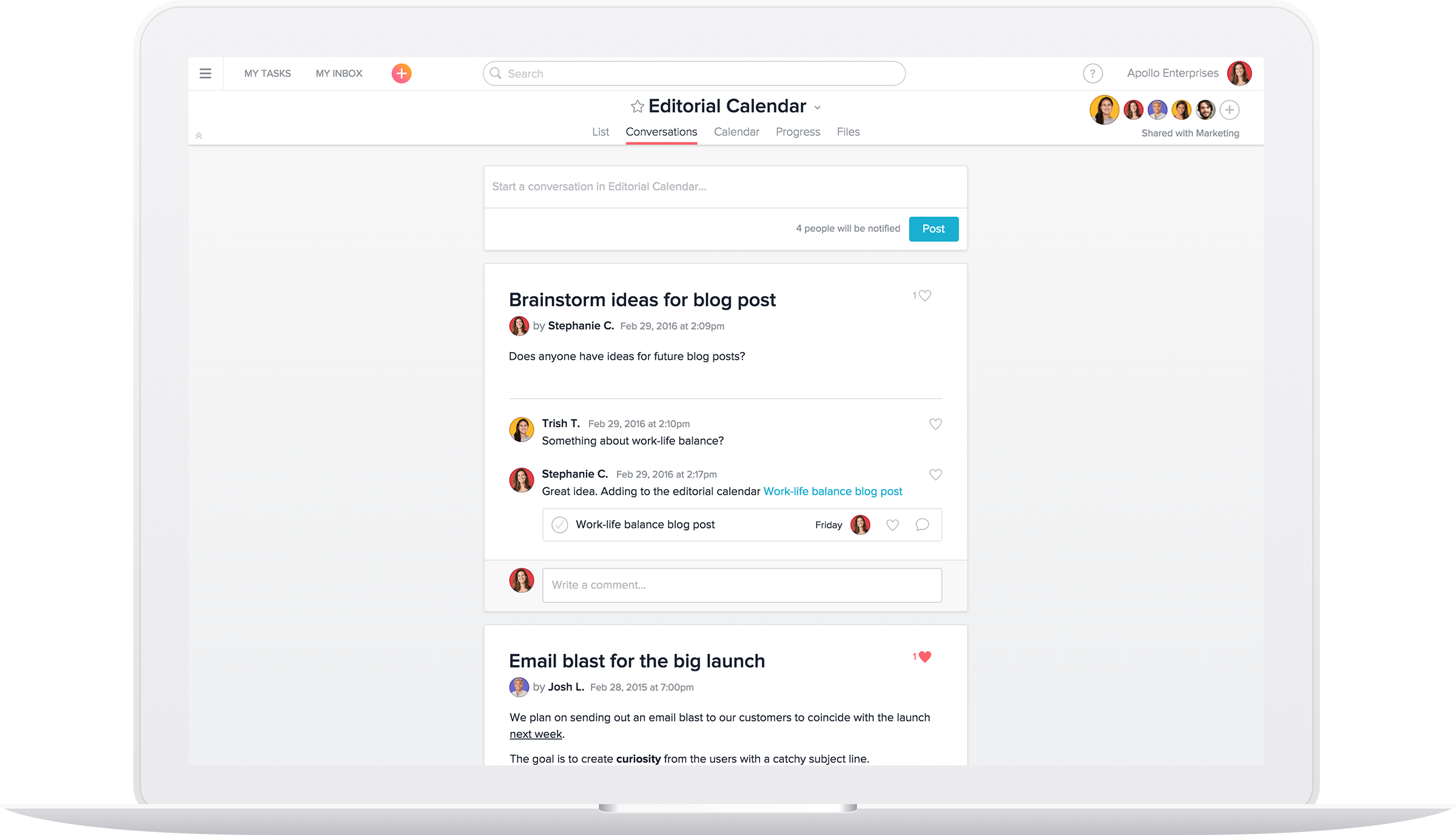
Asana is a web and mobile project management app. With tasks, projects, conversations, and dashboards, Asana lets an entire team know who's doing what by when, enabling workload balancing. Users can also add integrations for GANTT charts, time tracking and more.
WorkFront feels like a chore to use as compared to friendly/easy Asana. Workfront is much more complex and the interface is busy and off-putting for many (but has much more functionality). It has a much more robust predecessor functionality which is one of the main reason we …
We also use Wrike and Asana. Workfront is way better for in-depth reporting compared to Asana, but lacks the intuitive task management that Asana offers. Asana is just easier to use. Workfront is night and day better than Wrike in almost every aspect. Better reporting, …
I would find that feature-to-feature comparisons and extensive features put Workfront at the same class level as Workamajig. It may come down to preferences and UX of the platform that would make for the ultimate decision on which to go with for project management needs. Asana …
Workfront is more robust and versatile than Asana and Smartsheets, which is why we did not go with those tools. It is pretty comparable to Wrike in many ways. We use Workfront over Wrike because we are set up in Workfront already.
My organization used Adobe Workfront due to familiarity with other Adobe products. But it was more manual than the system is replaced (DaVinci Workflow) so it was a struggle for my team at first. Using Asana currently, but we don’t have the full version with proofing so can’t …
Workamajig is great specifically for marketing project management. Jira is great specifically for software development project management. However, if you want all of the company on the same PM software, you need something less purpose-built. Asana is good for both, but lacks …
I like the look and feel for Adobe Workfront better. It's cleaner and easier to read my work order. Asana looks a bit TOO complicated to navigate and often time it's harder to find things.
But I do like Asana's tabs better than Adobe Workfront. I like Adobe Workfront's pin …
I like both Jira and Asana. They both help streamline campaign processes and provide visibility into the work being completed by multiple departments. However, with Workfront, it syncs with other Adobe products, giving it an edge over other products.
It gave better structure for marketing/creative operations where intake, approvals and governance actually matter. Compared to Asana/Monday/Trello, it felt heavier but it handled standardised workflows, audit trails and stakeholder drived demand reliably.
We needed a single …
I love that Workfront is easy to configure and change as your organization grows. It's easy to stay up to speed with and make changes based on system changes and your organization changing. I also am in love with the reporting and custom data features. Custom forms and the …
Compared to other software which the organization had implemented before, Workfront has proved to be the best because of its detailed project reporting capabilities. Also, its ability to facilitate virtual proofing has been of great benefit to our project planning team. …
Our team chose to implement Workfront for its detailed project reporting capabilities. Furthermore, Workfront's ability to perform complex virtual proofing is a huge benefit to our work team. Overall, my team's experience has been extremely positive as we continue to implement …
Since our team has over 5 separate divisions (each with different specialties), service dozens of clients and work with more than 40 different vendors - Workfront had the depth of features for project managers that we needed for this type of complexity.
Workfront beats them all hands down. Asana was too simplistic for our needs, Wrike was very clunky and didn't handle the finances very well. Clarizen didn't have document approvals and collaboration that we needed. Workfront was a great mix of ease of use, complexity, and …
For agile, I prefer the Atlassian suite, but for waterfall projects, Workfront was the right choice. In choosing Workfront (then AtTask), I made a weighted grid of features and benefits of a number of project management tools, including WorkZone, Asana, Celoxis, MS Project, …
Asana: Lacked a level of management above projects and tasks. Timesheets, expense tracking, and reporting capabilities are not native. All require 3rd party applications, often at an additional cost. Unable to create custom data. Lacks a scheduling feature. Basecamp: Lacked a …
The other agency we were working with selected Asana as it's a tool with easy access. Other more broad project management tools require contracts and setup time, this is easy to create an account and login to. We used it for one project and it helped give a full picture of the …
Asana is very simple and straight forward, other more expensive products offer more features but require you to do project management their way. Asana provides a nice interface for task management.
Features
Adobe Workfront
Asana
Project Management
Comparison of Project Management features of Product A and Product B
Adobe Workfront
7.3
421 Ratings
5% below category average
Asana
8.4
179 Ratings
9% above category average
Task Management
8.5421 Ratings
9.2179 Ratings
Resource Management
7.4379 Ratings
8.1152 Ratings
Gantt Charts
6.5331 Ratings
9.261 Ratings
Scheduling
8.0372 Ratings
8.4162 Ratings
Workflow Automation
7.5377 Ratings
9.2132 Ratings
Team Collaboration
8.1400 Ratings
9.4178 Ratings
Support for Agile Methodology
6.9271 Ratings
8.57 Ratings
Support for Waterfall Methodology
7.2279 Ratings
8.57 Ratings
Document Management
7.3378 Ratings
8.6150 Ratings
Email integration
7.2323 Ratings
8.7142 Ratings
Mobile Access
5.7312 Ratings
8.8149 Ratings
Timesheet Tracking
7.7299 Ratings
6.16 Ratings
Change request and Case Management
7.3300 Ratings
8.44 Ratings
Budget and Expense Management
7.1258 Ratings
7.277 Ratings
Professional Services Automation
Comparison of Professional Services Automation features of Product A and Product B
Since I work remotely from my laptop, when I am finished with work, I enter my hours and submit my time at the end of the week. It's quick, it's easy, and it helps me keep a record of how many hours of vacation and sick time I have used. But when I am on the go, it is a hassle to record my time on my phone because of the lack of responsive design.
The usability of Asana is broad since it's available in a variety of platforms that are widely used nowadays. I think that it would be great for people who are constantly on the move and switching devices, since it has allowed me to work from my phone, too. I also think that Asana has proven itself to handle a large quantity of work
Through it, we were able to communicate and cooperate with the rest of the team to complete the work in the required manner and at the appropriate time.
Workfront is sometimes a bit clunky to use, but overall it works well for our teams when it comes to project management and collaboration across multiple, involved teams. It also has flexibility that allows us to adapt it to diverse use cases, some of which aren't necessarily always the first things that one would think of using workfront for.
Workfront is overly complex, but it is functional as a tool to keep track of projects. It is a shame that sometimes it takes a lot of clicks to find anything. Workfront is slowly modernizing its interface but at the same time, hides certain information away thus making the experience feels worse.
It is very user-friendly. Takes a new employee an hour to start figuring out how the system works. That's an important factor. You don't want to encounter the issue where employees need a week to understand how the system works. For example, JIRA, I tried using it for a week and I still don't understand the complicated layout. Asana has a simple interface. Once you see it, you get it type of program.
I have found that Adobe Workfront is a reliable resource, because in the post 6 years of using it, rarely has it been unavailable to our team. I think I could count on one hand the number of times the site has been down over my time using it with my team.
I think overall, Adobe Workfront performs well. There have been some times when it doesn't load or run as quickly as our team would like. This is frustrating when it is such a crucial tool that our team utilizes on a daily basis. It can show our workflow when it lags.
I know that this particular company has it's own Adobe Workfront employee that builds out things they need from the software, and meets with them regularly to troubleshoot. I'm not part of this process, but it's refreshing to see Adobe provide this level of customer service to people, and they're expedient.
I haven't had to use their support so I can't rate it. The fact that I haven't needed them reflects the ease of use of the product. I would recommend that any new users schedule a complete demo of the product to ensure that they are using it to it's fullest (there's a lot of useful features).
The training is very easy to use and you can simply choose the topics included in the course(s) that are most important to your training needs. After each training course, you are tested on what you have learned. If you need a refresher course, they provide Course Catalogs as well as instructor-led courses & workshops.
Most people learn as you go, a lot of this stuff requires trial and error throughout so my suggestion is to provide as much information in the upfront and keep it as simple as possible. You can add other tools and features as you go but everyone should have the basics down so no bad habits can start to develop. Be persistent with everyone, and don't be afraid to correct and talk through steps again so everyone is on the same page
Much increased functionality and templating aspects. While I liked JIRA's setup, the Workfront is so much more flexible. The moving away from Jira i was able to show the possibilities of what a full pm software could accommodate and how it all connected in. Also, the pluses of connectivity with the Adobe suite for our creative teams were excellent. From providing updates within other programs, it allowed a much more fluid working process and instant communication.
Asana is a top-tier project management software that helps us organize and track projects from start to finish. It allows us to apply tasks/to-dos to multiple projects without duplication, divide complex projects into smaller tasks, and track project progress. It also helps us organize work on Kanban boards or linear lists. It stands out from the crowd in a big way compared to the competition.
As I stated earlier, I didn't have to pay for Workfront myself- I'm a user under a large organization. I know it's not cheap to implement, I don't know how the price scales for a small-business, but I do like the product enough that I'm going to look into it in the future for my own company.
Our organization has thousands of users that use Workfront and it seems to hold up very well. I have not encountered any issues using it and I think it makes it very easy for multiple people to be involved in a project and keep things organized and clear for everyone involved.
Increased efficiency in threaded updates to Outlook emails - no time wasted looking for things in email vs Workfront - they automatically are in both places.
Time tracking allows us to average out how much time tasks & deliverable types take, allowing better long-term forecasting.
Planning has given us a system of record for campaigns, allowing us to easily find historic plans and/or view calendar views of upcoming ones.