Adobe Workfront, acquired by Adobe in late 2020, is a web-based project-management tool. It is designed for both IT and marketing teams, but can be implemented for any kind of project. Workfront offers all the features standard to project management platforms, as well as resource allocation, automation, and agile workflow.
N/A
monday.com
Score 8.3 out of 10
Mid-Size Companies (51-1,000 employees)
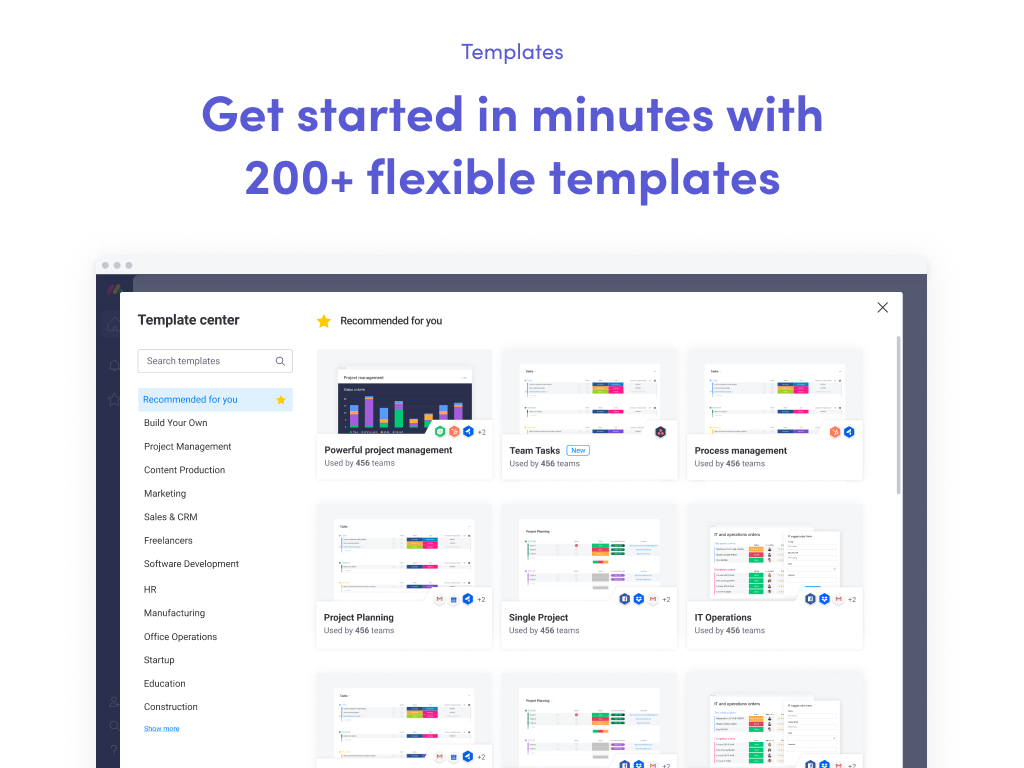
monday.com Work OS is an open platform designed so that anyone can create the tools they need to run all aspects of their work. It includes ready-made templates or the ability to customize any work solution ranging from sales pipelines to marketing campaigns, CRMs, and project tracking.
monday.com is better suited for a smaller company like the one I am working within. There are several other project management platforms that work within the Project Management space, but it's about personal preference. All of them have their pros and cons. Workfront is nice …
For me, monday.com is a bit more intuitive and user-friendly oriented, but Adobe Workfront has more tools to administrate the available budget of the project, the utilization and occupation of the team members and the general progress of the project. However, it would be great …
monday.com gives a slighly easier view of projects and ability to organize and access each project within a given task and timeline. Adobe Workfront is simple to use and manage, but I feel monday.com has a lower onboarding process and ability for teams to learn quick. Either …
Adobe Workfront simply offers a better user experience than Microsoft Project and monday.com. The ease of use, simplified training, and custom configuration made it the ideal choice for an organization of 100+.
Adobe Workfront doesn't stack well with these other tools. monday.com and Airtable have great interfaces and are very easy to set up and use. That is what my team currently uses.
It gave better structure for marketing/creative operations where intake, approvals and governance actually matter. Compared to Asana/Monday/Trello, it felt heavier but it handled standardised workflows, audit trails and stakeholder drived demand reliably.
We needed a single …
My organization used Adobe Workfront due to familiarity with other Adobe products. But it was more manual than the system is replaced (DaVinci Workflow) so it was a struggle for my team at first. Using Asana currently, but we don’t have the full version with proofing so can’t …
Reporting options are available and amazing. Project templates are extremely helpful.
Verified User
Project Manager
Chose Adobe Workfront
Clarizen seemed to provide roughly the same product. They quoted a bit more expensive, and not many improvements. The implementation cost was not worth it. AtTask also did a better job at Gantt Charts for each project rather than just 1 for all projects in Clarizen, which was …
monday.com
Verified User
Director
Chose monday.com
Workfront offered a more intuitive user interface, which made team adoption easier. It also included additional products that aligned well with the needs of our Dev, Work Management, and Service teams.
Airtable served us well for data management. However, our senior management told us Project Managers we would no longer be using Airtable. monday.com serves us well with project management AND light-weight database usage.
Workfront served we Project Managers very well. However, …
Since I work remotely from my laptop, when I am finished with work, I enter my hours and submit my time at the end of the week. It's quick, it's easy, and it helps me keep a record of how many hours of vacation and sick time I have used. But when I am on the go, it is a hassle to record my time on my phone because of the lack of responsive design.
Another feature I love in the free plan is the “Sort” feature, which enables me to sort all my clients by name alphabetically. Or sort by date, status, progress notes, etc. I make extensive use of the text column, where I can keep ongoing, detailed notes on the progress of a particular client's work and the information I am still waiting on. I have it open automatically every day, and my tasks are listed there for me to follow through on.
Intuitive board functionality with a variety of column types and customizations to address different use-cases, such as templates for user lifecycle management, checklists for onboarding.
Extensive automation capabilities to reduce tedium in more complex boards, such as our company's computer asset inventory board, to ensure devices are kept organized within the board for quicker reference.
The ability to connect boards and mirror info across them allowed us to build out a cross-functional, quasi-ticketing system enabling more efficient processing of requests that involved action items from different departments and/or teams.
We could use both the many board functions in tandem with the WorkForm feature to create an IT ticketing system that could be replicated and tailored for other teams needs.
The management of holdable items, continuously drops in incorrect places or doesn't show the 'correct way' to handle in the wished place, it happens with the dragable items on dashboards
The 'favorites' menu on desktop is now with 'Use my IA feature' everywhere and has removed the Fav section of for the boards in the sidebar. It was so useful when there were hundreds of Tables and only work on or update 3 - 4 of them (it is still visible on the mobile version, by the way)
The errors after using for a while, like 90 minutes, I am writing something and unexpectedly the app says something is wrong and I need to reload the page, and the thing I was doing doesn't still local storage as in other use cases
Workfront is sometimes a bit clunky to use, but overall it works well for our teams when it comes to project management and collaboration across multiple, involved teams. It also has flexibility that allows us to adapt it to diverse use cases, some of which aren't necessarily always the first things that one would think of using workfront for.
Teams involved in content creation, such as marketing or editorial teams, could use monday.com to manage the entire content lifecycle. Boards might track content ideas, assignments, drafts, reviews, approvals, and publication schedules, helping teams collaborate and keep content production on track.
Workfront is overly complex, but it is functional as a tool to keep track of projects. It is a shame that sometimes it takes a lot of clicks to find anything. Workfront is slowly modernizing its interface but at the same time, hides certain information away thus making the experience feels worse.
monday.com was pretty easy to use from the get-go. Their automation templates are really easy to get things set up. A few of my monday.com boards are essentially upgraded spreadsheets that are much easier to digest and automatically send out reminder email to myself and my team.
I have found that Adobe Workfront is a reliable resource, because in the post 6 years of using it, rarely has it been unavailable to our team. I think I could count on one hand the number of times the site has been down over my time using it with my team.
I think overall, Adobe Workfront performs well. There have been some times when it doesn't load or run as quickly as our team would like. This is frustrating when it is such a crucial tool that our team utilizes on a daily basis. It can show our workflow when it lags.
Everything performs fairly well. Every now and then there are user errors where an employee will not click "ok" on a note they've created and simply exit out (I do wish that something was in place to prevent this, such as a pop "are you finished?")
I know that this particular company has it's own Adobe Workfront employee that builds out things they need from the software, and meets with them regularly to troubleshoot. I'm not part of this process, but it's refreshing to see Adobe provide this level of customer service to people, and they're expedient.
I personally haven't found their customer success managers to be proactive or useful as the primary user of our monday.com account. This is different from a few years ago, when I had a contact that I reached out to as-needed (we are an enterprise account). I don't get a lot of touchpoints with anyone from monday.com and rarely submit tickets.
The training is very easy to use and you can simply choose the topics included in the course(s) that are most important to your training needs. After each training course, you are tested on what you have learned. If you need a refresher course, they provide Course Catalogs as well as instructor-led courses & workshops.
To have someone walk you thru the features and capabilities of Monday.com is priceless. Someone also coming along later in the contract to see if you are maximizing the program to suit your company needs is beyond helpful. The staff that have provided this training are fun, creative and very patient.
Most people learn as you go, a lot of this stuff requires trial and error throughout so my suggestion is to provide as much information in the upfront and keep it as simple as possible. You can add other tools and features as you go but everyone should have the basics down so no bad habits can start to develop. Be persistent with everyone, and don't be afraid to correct and talk through steps again so everyone is on the same page
We signed up for the accounts. Created the accounts. Ran the trial version and tested it live while we were running multiple projects and found that it was fitting our needs perfectly. When the trial ended and we were asked to purchase the full version, we did. We have found other ways to use it and it's a breeze.
Much increased functionality and templating aspects. While I liked JIRA's setup, the Workfront is so much more flexible. The moving away from Jira i was able to show the possibilities of what a full pm software could accommodate and how it all connected in. Also, the pluses of connectivity with the Adobe suite for our creative teams were excellent. From providing updates within other programs, it allowed a much more fluid working process and instant communication.
monday.com gives us the most flexibility when it comes to its features -- to create templates and quickly modify or customize. While limited in its overall functionality, it is secure and does what it is supposed to do well. An ability to interpret documents given to it -- not just its own assets -- would take monday.com to the next level.
As I stated earlier, I didn't have to pay for Workfront myself- I'm a user under a large organization. I know it's not cheap to implement, I don't know how the price scales for a small-business, but I do like the product enough that I'm going to look into it in the future for my own company.
Our organization has thousands of users that use Workfront and it seems to hold up very well. I have not encountered any issues using it and I think it makes it very easy for multiple people to be involved in a project and keep things organized and clear for everyone involved.
For it to work across multiple departments and sites, I would like to see improvements made with integrations and automation. For this question, I am acknowledging not only the addition of internal triggers/automation, but also an expansion on external ones.
Increased efficiency in threaded updates to Outlook emails - no time wasted looking for things in email vs Workfront - they automatically are in both places.
Time tracking allows us to average out how much time tasks & deliverable types take, allowing better long-term forecasting.
Planning has given us a system of record for campaigns, allowing us to easily find historic plans and/or view calendar views of upcoming ones.