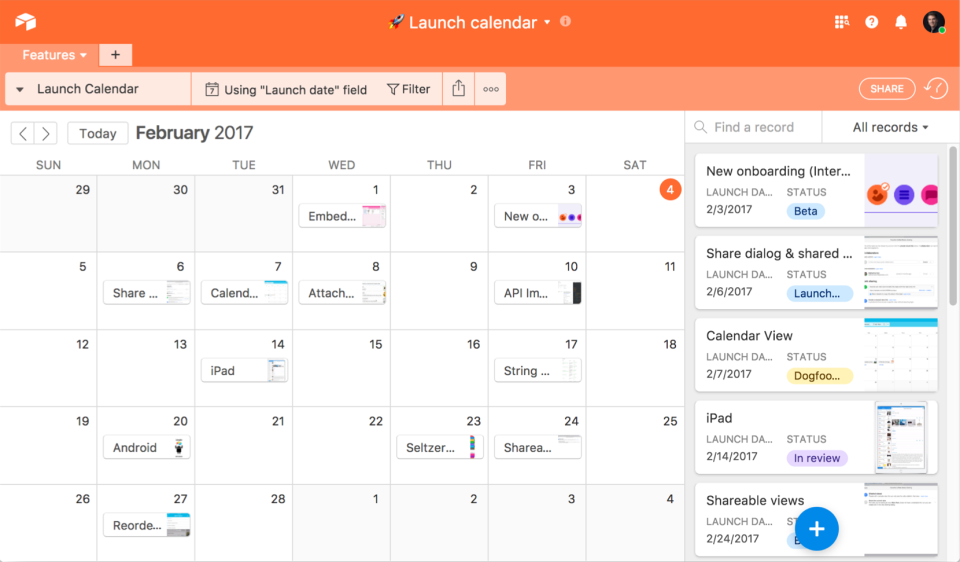
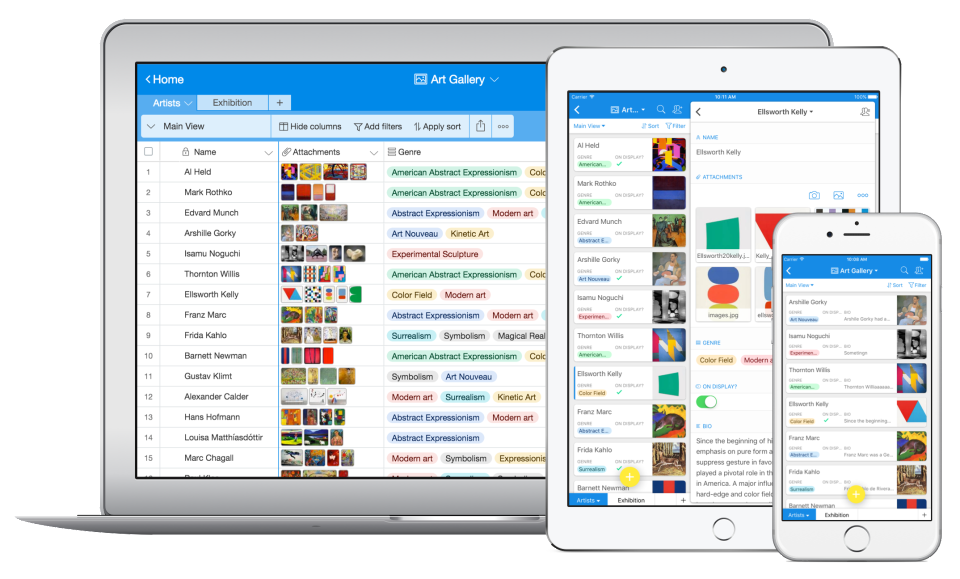
Airtable is a project management and collaboration platform designed to enable content pipelines, product management, events planning, user research, and more. It combines spreadsheet,database, calendar, and kanban functionality within one platform.
$24
per month per seat
Google Sheets
Score 8.9 out of 10
N/A
Google Sheets is the spreadsheet app available on Google Workspace, or standalone, with a free plan for personal use and accessible via mobile apps for iOS and Android.
N/A
Planful
Score 8.6 out of 10
Enterprise companies (1,001+ employees)
Planful is a cloud-based enterprise performance management (EPM) suite. It includes financial applications for modeling, planning, consolidation, reporting and analytics.
I have tried Trello, monday.com, Meister Task, and even Google Sheets. They are all great and solid applications. Some even have really nice user interfaces. However, none of them have met my primary need of being able to view my current projects and associated deadlines at a …
There's a saying that spreadsheets were never meant to be databases, and Airtable provides the missing piece for nontechnical users who need to hear that saying. It's more performant and provides more custom view options, for example, than Excel or Google Sheets.
AirTable does a great job at Project Management. You can easily create tasks and set up reminders, including automated reminder emails, when deadlines draw near. You can group the tasks and can also group tasks in a variety of ways (not started, pending, completed or …
Airtable is the best for structuring, automating and interacting with data, but only for internal use. For public-facing needs, other apps are required for their support of custom domains and styling.
Airtable is far more sophisticated than Sheets or Excel in terms of its functions. The interface is also much easier on the eyes. People are less familiar with it and there is a bit of a learning curve, but overall, Airtable empowers us to do more and to better understand our …
I find Google Sheets very similar to Excel in functionality and performance. The advantage is that it’s a cloud-based program rather than a local download. Airtable is more advanced but harder to use and not universally accepted like Google sheets, making Google sheets the more …
In some ways, SeaTable and Airtable provide a little more functionality beyond what Google Sheets provides. It is a little easier to set up different views of different types, not just table formats. They also make it easier to make groups and subgroups with the data set …
Verified User
General Manager
Chose Google Sheets
Google Sheets is the easiest to access to use, and is arguably the most powerful with its third-party integrations. Additionally, Google Apps Script enhances the ability of Google Sheets to process data in custom ways. For instance, integrating zap year to connect via Web hook …
My organization uses Google Sheets instead of Microsoft Excel because we are a Google shop. Sheets permissions are especially easy via existing Google Workspace groups. We're a very collaborative company that values easy browser-based simultaneous document editing and …
Airtable is an ideal platform for small and growing businesses to keep track of just about EVERYTHING they need to keep things running smoothly. It's a great way to keep tasks organized, and keep everyone on the same page with progress on all things. Our company finds the kanban particularly useful, as products go through a lifecycle from ideation to retirement, it's good to keep a database of what is in production, what's working, and what we've tried before. I can see the platform being challenging with much larger businesses, but for the small to medium businesses I've used the platform with, it is ideal.
Google Sheets is well suited in two main areas: is free to use and you don't need to buy a license to use it, comparing to the most direct competitors ; collaboration is in my opinion the best advantage, with multiple people working together and seeing others working in real time. It's less appropriate in low connectivity environments (offline capabilities)
I think it is a useful tool from a reporting standpoint. It does a good job of data aggregation from different sources, even if slow at times. I think the tools for building forecasting and budgeting templates are straight forward but allow for a level of complexity that make it both easy to use but also allow for complex builds so that our models can take into account many different variables that drive our daily performance.
Airtable has capabilities commonly found in spreadsheet applications, but also has some of the features found in databases.
The ability to filter fields. I set up a filter on the status field, so when a project is marked, complete, on hold, or canceled, that record is hidden from my current projects table view. If it is marked complete, the record is moved to the completed projects table view. In this way I can easily access a record of past projects
Being able to duplicate tables and create alternate views
Collapse and expand records. When I collapse the rows, I can easily scan current projects, next steps, project status, and due dates. When I expand the row, or field, I can see more detailed information about that field or record very easily. I can also expand or open the entire record. This is is helpful, when I am entering a lot of information to multiple fields in that record.
Collaborative planning : In the initial phase of project, Team leads and architects create a permission matrix along with the naming convention simultaneously, seeing who is editing / adding the details in real-time.
Cost tracking : We use this tool to track cloud resource usage monthly costs, so that we can analyse it and send out comms for high cost based resources. By storing cost data here, it's easy for use to store data of last couple of years.
Flexible documentation : For change logging of different scenarios we would need different / ad-hoc columns to be added on the fly, which makes using this tool much simpler then reputed third party tools.
Creating forecasts for the month, quarter, and year
Creating new variables by using variables pre-defined and that are new in the system
Having a very simple setup in the reports section - not straying away from the old Excel model which most people are used to. I can speak for a lot of people when I say that tools that look new can easily be frightening! 😅
We will 10/10 renew the use of Airtable because it has brought great value to our team. Not only is Airtable affordable, but it's also user-friendly and helps our team be efficient. We no longer need to rely on Excel spreadsheets being passed from person to person via email. Furthermore, we aren't dealing with corrupt Excel spreadsheets and the need to salvage data when a file is accidentally altered.
I am not involved in the purchase/selection process, but my organization is a Google shop, and Sheets meets most of our spreadsheet needs and works seamlessly with our other tools. I don't anticipate our switching anytime soon.
Our new Comptroller understands the value of Planful, and we plan to utilize it further in the organization to enhance external reporting. Strangely enough, Planful had not previously been embraced by the former CFO, who argued that we were running two sets of books (of course, we were not). Fortunately, the before mentioned reconciliation of EBITDA to Net Income demonstrated that to the banks.
IMO the usability of this product is its greatest asset. The UI is clean and the menus are intuitive to the point where I'd feel confident having a non-spreadsheety colleague take on building an Airtable for the first time with next to no training. I can't say that about every table-like software product that I've used such as Notion.
It can easily handle most uses and functions. It is only for very large datasets or advanced analysis that it either lacks the proper functions or performance begins to slow. Most employees who continue to use competitors' products do so out of preference, familiarity with the user interface, or other surface-level reasons.
The tool is extremely adaptable, and it enables very quick querying to give us opportunity to gain live insights into the business. Given its adaptability, we are also able to create scenario analyses very quickly in rapidly changing environments. The formatting also enables us to provide this information in a very consumable manner.
I have rarely experience downtime, compared to other tools, and given how much time we spend on the tool. Even if there were to be, their updates on it are very timely, and our support team are able to provide any questions regarding
Like most Google products, Google Sheets rarely has outages or slowness, and when it does, connection is always momentarily restored. I can't recall a time when I've been unable to access Google Sheets but able to access other sites just fine. That said, errors aren't uncommon when handling large data volume. You know what they say about using spreadsheets as databases, but sometimes it's just the most convenient option, especially for smaller or one-off projects, and not being able to store large amounts of data hampers our ability to move quickly with scrappy prototypes or full solutions. It would be great if we could better integrate our data manipulation (Apps Script) with big data in the sheet.
I only give a 9 rating rather than a 10 rating because it seems that every day around 2pm we see a slowdown in the use of Planful. I have requested our internal IT department verify that it is not an internal issue and have been assured it is the tool. We have not yet reached out to Planful to do extensive research to solve this issue.
I never had any issues with load time, even with the integrations that we use today (google sheets) However, I'm curious if adding additional layers of integrations would slow down performance. We do carry quite a bit of data in Airtable, but, again, no impact on overall performance
Again, Google Sheets is no exception to Google's general high speed and reliability, but load times can be slow for larger amounts of data. I've used Sheets with Zapier and have used the Python API, and speed has never been an issue.
Again, the system is very reliable and, for the most part, runs very quick and smooth. When running larger queries, it does take some time, and during budgeting season our users experienced slower loading times, but nothing that raises concerns outside of normal network issues. Occasionally, as with any software we use, it will crash and you have to restart, but that does not happen very often.
Airtable has great support. They have a variety of support features to answer any questions. They have great self teaching instructions for templates and product tours. They also have support for teams and project management. They also have a fantastic customer help line. They are able and willing to answer customer questions and never have customers waiting long
I have never contacted Google Sheets support, but Google Sheets makes it very easy to report an issue or suggest a feature from Sheets itself (Help > Help Sheets improve), and I've had mostly good experiences with support for other Google products.
Sometimes we get great help when using Planful's support team and other times we don't. In particular, there is one person that often responds to our support tickets who is less than helpful, hence the reason for the 5 out of 10 rating. As a result, most of the time we reach out to our Planful consulting group as they provide faster and better support
My team has attended training offered several times before/during the Planful Perform conference. This training has been extremely useful and we always learn something we didn't know prior to the training. The trainers are always very knowledgeable and more than willing to help each and every user after the training with specific questions regarding their environment.
Recorded trainings were provided by the Airtable team. Great as an evergreen resources to new team members and for anyone that wants to refresh their Airtable knowledge
Planful provides a lot of online training support. There's so many options for training. Admin Learning Courses, User Learning Courses. Plus they have several webinars devoted to the tool and the new features they release. New Releases can be practiced in a Sandbox Environment prior to going live in Production
Training all users was an important part of the implementation, which did take considerable time and effort. At first glance without training, the content calendar can be overwhelming because of the amount of data. The features within Airtable seem to be endless but our team was able to identify the most important to be successful.
After going through the initial implementation with Host Analytics and a re-implementation with Cervello (due to an ERP change, not due to a poor initial implementation), I've learned that you really must rely on your internal staff to bear most of the implementation burden. Use the vendor or partners for ideas and best-practice suggestions, and some of the easy-but-time-consuming work. Since you will ultimately be using and maintaining the application, you should be able to do most of it yourself.
Airtable was a really good fit for this specific use case as it provided a huge number of collaboration features in an intuitive and pleasant-to-use interface. The free tier worked initially with our work, and the upgrade pathway was fair and made sense for us.
I have found that I can do almost everything I could have done in Microsoft Excel faster and easier in Google Sheets. We recommend Google Sheets in 99.9% of our use cases and feel it meets the needs of our workers very well. I am sure there are other spreadsheet creation programs out there, but because we are already in the Google environment, adopting Google Sheets in very easy.
Prior to joining the company, we tried to implement Vena but were unsuccessful. There we're a few reasons it didn't work out, but a lot of it related to the implementation team they provided. In just the first week with Planful, we achieved more progress than we did in several months with Vena.
I'm not involved with the purchase, but I assume everything goes smoothly and that the pricing structure is predictable and reasonable. We do not get surprise fees.
There are TONS of opportunity to scale, but I think it's a matter if you have the time and resources to do so because the initial setup can be fairly time consuming and prioritized dedication
Google Sheets works very well with multiple users. It's convenient to see in real-time who is collaborating in a sheet, down to the specific cell that they're viewing/editing. Linking Sheets across departments is convenient with the IMPORTRANGE function.
From our experience, Planful is only used in 2 overhead departments in our organization. We easily added another overhead department, but they decided against using Planful for their workforce and financial planning. Removing them from our environment was extremely easy.
Through this platform, I always have the idea bout which of my team member is working on which particular part of the project, I can easily track their progress, and also I can easily correct them where it is required by adding sticky notes, by sending the attachments and URLs.
Don't need to pay for windows 365 license as it is free
Has a positive impact since I am not cursing excel for annoying problems(I don't want the new Pivot table format, I want to use Classic and I don't want to expand/collapse arrows. "x$#%")
[Haven't] looked at return on investment on work, but has "simplified" for basic and medium spreadsheets.