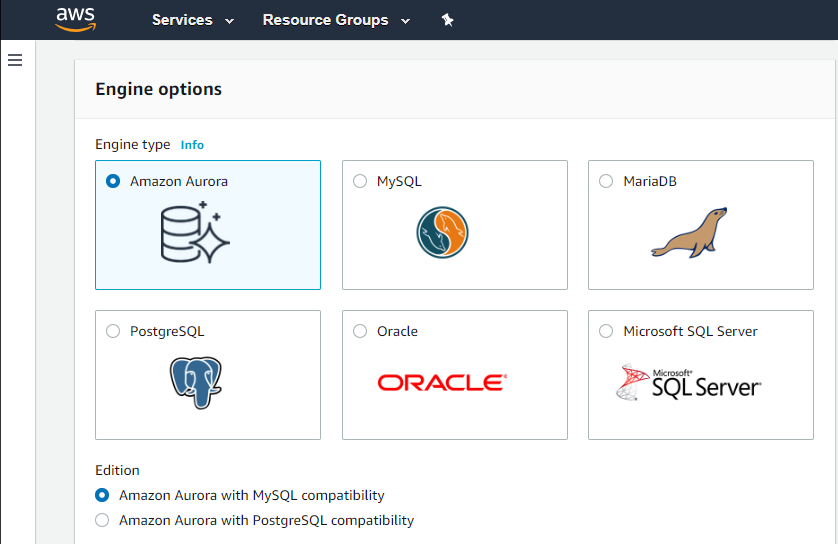
Amazon Relational Database Service (Amazon RDS) is a database-as-a-service (DBaaS) from Amazon Web Services.
N/A
Amazon Web Services
Score 8.5 out of 10
N/A
Amazon Web Services (AWS) is a subsidiary of Amazon that provides on-demand cloud computing services. With over 165 services offered, AWS services can provide users with a comprehensive suite of infrastructure and computing building blocks and tools.
$100
per month
DigitalOcean
Score 8.6 out of 10
N/A
DigitalOcean is an infrastructure-as-a-service (IaaS) platform from the company of the same name headquartered in New York. It is known for its support of managed Kubernetes clusters and “droplets” feature.
$5
Starting Price Per Month
Pricing
Amazon Relational Database Service (RDS)
Amazon Web Services
DigitalOcean
Editions & Modules
Amazon RDS for PostgreSQL
$0.24 ($0.48)
per hour, R5 Large (R5 Extra Large)
Amazon RDS for MariaDB
$0.25 ($0.50)
per hour, R5 Large (R5 Extra Large)
Amazon RDS for MySQL
$0.29 ($0.58)
per hour, R5 Large (R5 Extra Large)
Amazon RDS for Oracle
$0.482 ($0.964)
per hour, R5 Large (R5 Extra Large)
Amazon RDS for SQL Server
$1.02 ($1.52)
per hour, R5 Large (R5 Extra Large)
Free Tier
$0
per month
Basic Environment
$100 - $200
per month
Intermediate Environment
$250 - $600
per month
Advanced Environment
$600-$2500
per month
1GB-16GB
$5.00
Starting Price Per Month
8GB-160GB
$60.00
Starting Price Per Month
Offerings
Pricing Offerings
Amazon RDS
Amazon Web Services
DigitalOcean
Free Trial
No
Yes
No
Free/Freemium Version
No
Yes
No
Premium Consulting/Integration Services
No
No
No
Entry-level Setup Fee
Optional
No setup fee
No setup fee
Additional Details
—
AWS allows a “save when you commit” option that offers lower prices when you sign up for a 1- or 3- year term that includes an AWS service or category of services.
1: If your company is already deeply involved in the AWS ecosystem, such as AWS Lambda, Amazon S3, or Amazon Redshift, leveraging Amazon RDS might result in a more seamless integration of services. AWS offers a broad set of cloud services, which makes it easier to design and …
Amazon Relational Database Service (RDS) is very well integrated with AWS services like CloudWatch, Lambda, IAM, Secrets Manager, S3, etc. It is AWS managed database service. It provides a serverless version using Aurora with auto-scaling features. Its features like …
Amazon Web Services is much more mature than all of the cloud service providers out in the market. It has 300+ services that solve almost all of your cloud problems.
Initially, we were with GoDaddy hosting but made a switch to a dedicated server with Bluehost. Our reasoning was that we would get more value from a dedicated server, however, as our SAAS grew we realized cloud computing was the way to go. We ended up choosing AWS over Digital …
For a small to mid level business to maintain production level servers Heroku, Digital Ocean, and Linode are quite reasonable even though they don't provide the same level of security and GUI options as AWS (I think Heroku actually runs on AWS). Once you hit the tipping point …
The flexibility and innovation are the keys. Amazon Web Services provides all the solutions I need in one [place]. With other providers I don't have enough flexibility to create my architecture of services as I need them. Only Amazon Web Services pre-configures services ready …
Amazon has a very complex UI and many products to offer. They haven't polished up their UI and it has a much greater learning curve compared to DigitalOcean. However, Amazon Web Services (AWS) does have more comprehensive cloud computing services, which forces some companies to …
DigitalOcean is cheaper and more flexible than DreamHost, but DreamHost is easier to maintain than DigitalOcean. DigitalOcean has many more server options and templates/images than DreamHost. Amazon Web Services is much more confusing to use. The DigitalOcean website is much …
DigitalOcean is an inexpensive product as compared to other products available in the market. The UI is easy and the beginner can also understand the UI with the step by step guide. It provides a lot of custom features and the user needs to pay only for what they are using. …
Vultr is a new player in the game. They don't advertise their hardware model and for that reason, people may not trust them. I have run few benchmarks on Vultr, they performed slightly better than DigitalOcean but they aren't trustworthy. Their transparency index is very low …
As I have said, DigitalOcean was slightly more expensive than something like HostGator, but the amount of customization and quality of service make it worth any difference. AWS was always a pain to set up and use, but DigitalOcean makes it cake.
I've tried both AWS and Azure and, while they're both great solutions, they are much more challenging to setup and maintain. The idea that my billing could spike because of something unexpected leaves me a tad uneasy. For our solutions I'd rather pay the $10/mo with …
DigitalOcean can be seen more like a Rackspace or a similar provider. They aren't offering more extended services such as AWS Redshift of something on a larger scale. They are great for just vanilla virtualization and maintaining uptime for those resources across a large set of …
Initially we started using DigitalOcean due to their pricing point as we were in development phase. Slowly when we used it, we starting liking it a lot as it is very fast & easy to get started, compared to the other Cloud Providers we've used. Also they have blogs and …
AWS: Too complex to set things up. Period. Mediatemple: Great features, services and customer service. Prices are a bit high for what they offer. Linode: Outstanding features and customer support. Difficult to start with for novice users.
If your application needs a relational data store and uses other AWS services, AWS RDS is a no-brainer. It offers all the traditional database features, makes it a snap to set up, creates cross-region replication, has advanced security, built-in monitoring, and much more at a very good price. You can also set up streaming to a data lake using various other AWS services on your RDS.
This is something that is actually common across most cloud providers. A comprehensive understanding of one's use cases, constraints and future directions is key to determining if you even need a cloud solution. If you are a 2-person startup developing something with a best-scenario audience of 1k DAU in a year, you would very likely best served by a dirt-cheap dedicated Linux server somewhere (and your options to graduate to a cloud solution will still be open). If, however, you are a bigger fish, and/or you are actively considering build-vs-buy decisions for complicated, highly-loaded, six-figure requests per minute systems, global loadbalancing, extreme growth projections - then MAYBE you solve all or part of it with a cloud provider. And depending on your taste for risk, reliability, flexibility, track record - it might be AWS.
DigitalOcean is perfect for hosting client websites, running marketing tools, and managing media storage with Spaces and CDN. The use of Droplets to quickly launch landing pages or WordPress sites for campaigns is a Godsend. It’s great for fast, cheap, and scalable solutions. But for complex microservices or projects needing strict compliance (like HIPAA), DigitalOcean may not always be the best fit, but that depends heavily on your project.
Automated Database Management: We use it for streamlining routine tasks like software patching and database backups.
Scalability on Demand: we use it to handle traffic spikes, scaling both vertically and horizontally.
Database Engine Compatibility: It works amazingly with multiple database engines used by different departments within our organization including MySQL, PostgreSQL, SQL Server, and Oracle.
Monitoring: It covers our extensive monitoring and logging, and also has great compatibility with Amazon CloudWatch
It is a little difficult to configure and connect to an RDS instance. The integration with ECS can be made more seamless.
Exploring features within RDS is not very easy and intuitive. Either a human friendly documentation should be added or the User Interface be made intuitive so that people can explore and find features on their own.
There should be tools to analyze cost and minimize it according to the usage.
Some products/services available on other Cloud providers aren't available, but they seem to be catching up as they add new products like Managed SQL DBs.
While they have FreeBSD droplets (VMs), support for *BSD OSs is limited. I.e. the new monitoring agent only works on Linux.
There are no regions available on South America.
They don't seem to offer enterprise-level products, even basic ones as Windows Server, MS SQL Server, Oracle products, etc.
We do renew our use of Amazon Relational Database Service. We don't have any problems faced with RDS in place. RDS has taken away lot of overhead of hosting database, managing the database and keeping a team just to manage database. Even the backup, security and recovery another overhead that has been taken away by RDS. So, we will keep on using RDS.
We are almost entirely satisfied with the service. In order to move off it, we'd have to build for ourselves many of the services that AWS provides and the cost would be prohibitive. Although there are cost savings and security benefits to returning to the colo facility, we could never afford to do it, and we'd hate to give up the innovation and constant cycle of new features that AWS gives us.
I've been using AWS Relational Database Services in several projects in different environments and from the AWS products, maybe this one together to EC2 are my favourite. They deliver what they promise. Reliable, fast, easy and with a fair price (in comparison to commercial products which have obscure license agreements).
AWS offers a wide range of powerful services that cater to various business needs which is significant strength. The ability to scale resources on-demand is a major advantage making it suitable for businesses of all sizes. The sheer volume of options and configurations can be overwhelming for new users leading to a steep learning curve. While functional the AWS management console can feel cluttered and less intuitive compared to some competitors which can hinder navigation. Although some documentation lacks clarity and practical examples which can frustrate users trying to implement specific solutions.
I honestly can't think of an easier way to set up and maintain your own server. Being able to set up a server in minutes and have fully control is awesome. The UX is incredibly intuitive for first-time users as well so there's no reason to be intimidated when it comes to giving DigitalOcean a shot.
AWS does not provide the raw performance that you can get by building your own custom infrastructure. However, it is often the case that the benefits of specialized, high-performance hardware do not necessarily outweigh the significant extra cost and risk. Performance as perceived by the user is very different from raw throughput.
I have only had good experiences in working with AWS support. I will admit that my experience comes from the benefit of having a premium tier of support but even working with free-tier accounts I have not had problems getting help with AWS products when needed. And most often, the docs do a pretty good job of explaining how to operate a service so a quick spin through the docs has been useful in solving problems.
The customer support of Amazon Web Services are quick in their responses. I appreciate its entire team, which works amazingly, and provides professional support. AWS is a great tool, indeed, to provide customers a suitable way to immediately search for their compatible software's and also to guide them in a good direction. Moreover, this product is a good suggestion for every type of company because of its affordability and ease of use.
They have always been fast, and the process has been straight-forward. I haven't had to use it enough to be frustrated with it, to be honest, and when I have an issue they fix it. As with all support, I wish it felt more human, but they are doing aces.
Amazon Relational Database Service (RDS) stands out among similar products due to its seamless integration with other AWS services, automated backups, and multi-AZ deployments for high availability. Its support for various database engines, such as MySQL, PostgreSQL, and Oracle, provides flexibility. Additionally, RDS offers managed security features, including encryption and IAM integration, enhancing data protection. The pay-as-you-go pricing model makes it cost-effective. Overall, Amazon RDS excels in ease of use, scalability, and a comprehensive feature set, making it a top choice for organizations seeking a reliable and scalable managed relational database service in the cloud.
Amazon Web Services fits best for all levels of organisations like startup, mid level or enterprise. The services are easy to use and doesn't require a high level of understanding as you can learn via blogs or youtube videos. AWS is Reasonable in cost as the plan is pay as you use.
DigitalOcean is an inexpensive product as compared to other products available in the market. The UI is easy and the beginner can also understand the UI with the step by step guide. It provides a lot of custom features and the user needs to pay only for what they are using. Amazon has a complex UI and is on the expensive side. DigitalOcean is simple to use and is easily manageable and the servers can easily be set up without additional cost and such.
Using Amazon Web Services has allowed us to develop and deploy new SAAS solutions quicker than we did when we used traditional web hosting. This has allowed us to grow our service offerings to clients and also add more value to our existing services.
Having AWS deployed has also allowed our development team to focus on delivering high-quality software without worrying about whether our servers will be able to handle the demand. Since AWS allows you to adjust your server needs based on demand, we can easily assign a faster server instance to ease and improve service without the client even knowing what we did.
Positive - Elastic computer instances make it possible to pay for only for what you need.
Positive - Competitive pricing - some of the products that DigitalOcean offers are much cheaper than those offered by competitors.
Negative - Having to go to other cloud computing platforms for more specific, advanced services like Computer Vision optimized services, GPU cloud compute instances, etc...