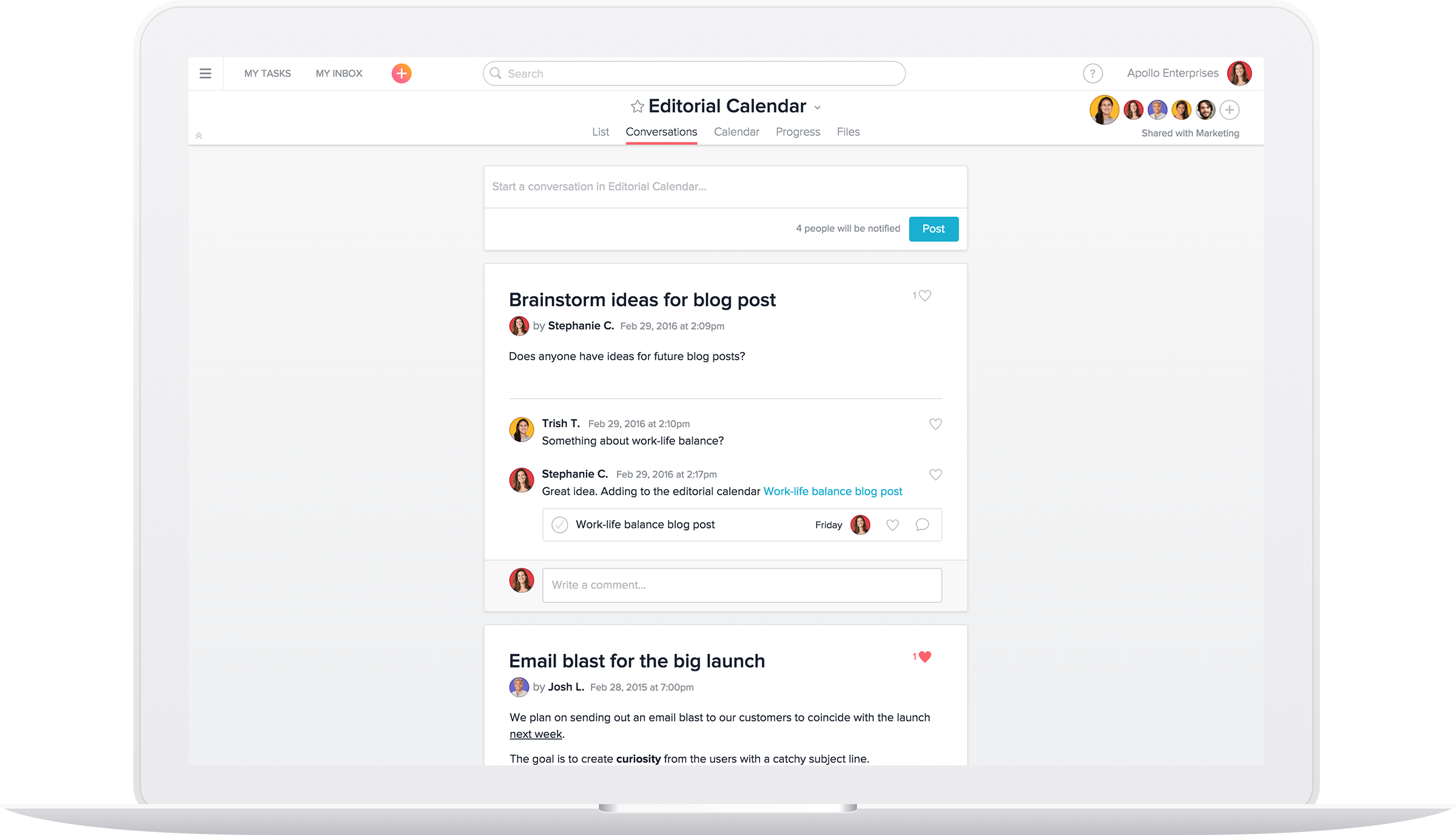
Asana is a web and mobile project management app. With tasks, projects, conversations, and dashboards, Asana lets an entire team know who's doing what by when, enabling workload balancing. Users can also add integrations for GANTT charts, time tracking and more.
$13.49
per month per user
Optimizely Content Marketing Platform
Score 6.9 out of 10
N/A
Optimizely Content Marketing Platform brings teams together in a single, AI-powered workspace to share plans, collaborate on assets and execute campaigns.
Asana is a highly effective instrument for managing teams and projects. The paid edition provides a multitude of features that can be tailored and used in accordance with the organisation's specific requirements.
Email integration facilitates notifications that remind team …
Overall for the money Asana brings a lot of value for organizations who want to do more with less and need a task and project management solution as a small company is growing and scaling to get to the next level. In the space when we evaluated didn't find a lot of other …
Against Jira it offers a more modern experience with less complex user interfaces. The admin and setup experience is also way faster with less (or no) legacy complexity.
Against other modern players like Linear and Basecamp it offers way more integrations so we can pull in data …
Asana is a top-tier project management software that helps us organize and track projects from start to finish. It allows us to apply tasks/to-dos to multiple projects without duplication, divide complex projects into smaller tasks, and track project progress. It also helps us …
Asana provides a mix of features between notion and Jira. Unlike Notion, it helps ease up the collaboration on vast projects and between multiple teams. Jira proved to be a little expensive with similar set of features if not more and which is why we thought of going with Asana.
I believe that Asana is more professional than Trello. I used Trello a long time ago, but it looked more suitable for a student project rather than for a professional team or business environment. I believe it has great features to help companies in different stages and of …
Since I have tried the two applications and saw their advantages and disadvantages, I see that Asana is much better in terms of dealing with files, ease of use, and the many features and characteristics that it has. Also, I noticed that it does not consume much space on my …
Side by side with the other two Asana by far beats Monday.com and is comparable and slightly better than ClickUp. Monday is completely browser-based and is hard to navigate and figure out how to set up. Asana and ClickUp are the exact opposite. Both are easy to set up and …
I like how extensive the capabilities are for Asana. With other softwares it seems there are many things lacking. I feel like Asana is also a very user friendly platform and aesthetically pleasing which is important in a modern office. We have many young people entering our …
Asana compared to Jira is certainly better in terms of user experience, since most of the people can start using it basically without having any kind of training or previous explanation, which makes it really useful not only for people already used to project management but …
Asana is amazing for a remote team, that we are currently as its accessible seamlessly to all our team member no matter where they are in the world. Its very easy to onboard new members to this platform as its very intuitive and easy for new people to get a hang of it. It has …
Basecamp was a great tool, but it was paid and things like recurring tasks and opening new projects was a pain. Asana, as a free tool, has been better for our organization as it serves the basic functions very well and is not complicated otherwise. I really like the …
I use mainly Microsoft Dynamics, CRM, customer insights, journeys for marketing, email automation or marketing automation. I use Seismic. We're looking to launch an events platform, which I'm not using yet, but that will be a tool that I will want to integrate with the other …
To be fair, I never used another product like it. I was brought in my current role just to roll out the use of CMP across the business. They had it for a year or two and they didn't have a dedicated resource to help roll it out across the organization. I had no experience with …
Honestly, I'd rather use Smartsheet paired with a digital asset management tool. It’s more flexible, easier to navigate, and better suited for mid-size teams that need to move quickly without the overhead and complexity that comes with Optimizely. We currently have Optimizely …
I think for a full picture view and collaboration and organization for project managment that monday is the preference. However, I liked the options to build workflows in Optimizely which is something I struggle with more on the Monday side (that said, it could be I'm just not …
Cheaper, and it has its own location finder tool, promotion codes can also be set up directly in Optimizely Content Marketing Platform as it also has an e-commerce setting. Redirections can be managed within Optimizely Content Marketing Platform, as well as vanity URLs or short …
We haven't yet explored the CMS or other products within the suite but we see the potential to move all of our tools to Optimizely One. I see this really helping us gain clarity in the end to end content lifecycle, and help us use our resources and bandwidth more strategically.
Optimizely Content Marketing Platform is continually developed and improving and is part of the larger suite of Optimizely products. Kapost has not been competitive since they were acquired by Upland.
Optimizely Content Marketing Platform is better for shared content development and approval processing. It provides better transparency and history for a specific piece of content than Asana, Trello and Smartsheet, though it competes closely with Monday in this regard. The …
I think both of them are great tools but we saw ourselves performing efficiently and with a great turn around time with Optimizely Content Marketing Platform. I have also used the other tool for a very brief time so was unable to explore the features completely to evaluate. …
Ultimately I think Monday.com with canva works a bit better for our organization. It is more versatile. I enjoy being able to use forms from outside sources. Canva is very versatile in images and design. Hootsuite works well for posting to multiple social accounts but recently …
Optimizely Content Marketing Platform allows users to perform A/B testing for their marketing campaigns which isn't available in Hubspot and Sprinklr. This helps to gather valuable data and insights on what works best in their campaigns and what doesn't. Optimizely Content …
CMP is purpose built for content creation and delivery, not a general-purpose or developer platform hacked to manage content development. This specificity helps to assure users are focused on the purpose of the platform as well as the embedded tools to assure the work is done …
The other digital asset management platforms did not offer a task collaboration feature at the time. The other task management platforms do not offer digital asset management. Both were truly needed for our business.
The usability of Asana is broad since it's available in a variety of platforms that are widely used nowadays. I think that it would be great for people who are constantly on the move and switching devices, since it has allowed me to work from my phone, too. I also think that Asana has proven itself to handle a large quantity of work
I think it's really well suited for organizations that have either big marketing teams that are scattered across different regions and different time zones because it helps everyone be aligned in terms of what is happening at any given time. That to me is one of the best things it can offer. The second thing is the management of the processes. You are not constantly reinventing the wheel when you work in marketing, you tend to have a process for doing certain jobs. For example, if you need to do an email or if you need to do a webinar, you will know what steps you need to take in order to deliver that. If you have lots of stakeholders that need to review things and need to approve things before they can go live, the CMP is the best tool for this because it keeps track of everything that is happening. You can assign steps to your legal team or your regulatory team and they have to go into the platform, be able to review whatever it is that you need them to review or approve. It keeps track of when that happened. There's no guesswork. You eliminate having to send things by email, by teams, by smoke signals. It's all in one place and if you ever needed to go back into things, everything gets saved there as well. All your working files up to your final files are all saved within the platform. You can manage your versions, you can reuse things in the future. There's so many possibilities for it. It depends on what you're trying to do, but at bedtime, if I do anything, no matter what you're trying to do, you'll find the right application within the platform to be able to make your job alive easier.
Customer Service: They'll contact you with a "we're looking at your issue" email within the hour, even on weekends and holidays. Beyond solving your issues/problems with the software, they'll also follow up later to make sure you don't have additional associated issues.
Live Analytics: You're given a snapshot of how your blog content is doing at any point in time, since they've been tracking your posts/content. You can compare this month's traffic to last year's trafffic during this same month. Other data points include: Unique Visitors, Average Attention Time, Pageviews, Engagement Rate, etc...and you'll even get referral traffic source. There's much more that I'm leaving out here.
CMP User Interface (UI): Love the easy to use interface to upload blog posts, to use for editing and publishing content, and broadcasting social shares. Besides easily identifiable icons, you can create/edit content in the WYSIWYG or use the html view to make sure everything looks exactly how you prefer. Another cool thing is that the CMP auto-embeds live links of social updates (like Youtube, Twitter, Instagram) for more dynamic blog posts.
I just can't see us getting it off of Asana any time soon, despite the many headaches it has caused us. We have too much data in there, too much time & training invested into it, too much at stake to move. If we were just starting out today, fresh, I don't know for certain that I would absolutely go the same direction, but I *think* I still would. I just haven't seen anything better yet. Maybe if Podio's support staff hadn't treated me like a worthless nuisance to them, I might feel differently, but the fact is that their task management is simply inferior to Asana's. That can't be denied, and in fact Podio said it themselves: "Tasks are a simple function. They cannot be customized. Tasks in Podio can be used for quick to-do's for you and your team members." In our operation, however, prompt task completion is a big deal; one task can't be completed until another one is done first, and closing the gaps between those tasks is critical in meeting deadlines and servicing our customers. Asana gets us there, the others don't.
It is very user-friendly. Takes a new employee an hour to start figuring out how the system works. That's an important factor. You don't want to encounter the issue where employees need a week to understand how the system works. For example, JIRA, I tried using it for a week and I still don't understand the complicated layout. Asana has a simple interface. Once you see it, you get it type of program.
The editorial calendar is the one I check multiple times every day. It gives me a clear picture of what's in progress, what's due, and where things can be moving faster. And, there's no need to open a separate doc or ask anyone for a status update. Also, the workflows are another super useful thing. Being able to assign specific reviewers to specific steps and know that nothing moves forward until they've acted has eliminated many repetitive processes.
Optimizely Content Marketing Platform's performance is generally good. Nothing that has impacted production. Page load speed doesn't typically lag longer than a few seconds. Reports take some time but not any longer than we're used to with other platforms. We have not experienced lag when integrating with other platforms
I haven't had to use their support so I can't rate it. The fact that I haven't needed them reflects the ease of use of the product. I would recommend that any new users schedule a complete demo of the product to ensure that they are using it to it's fullest (there's a lot of useful features).
Training was clear and concise. It was intuitive and helped me understand how to navigate the platform. Options to dive in on each action or skip to learn about areas of regular use. Resource links available to when I had additional questions or needed more training in a specific area. Overall, the training allowed me to use the platform without interruption
Asana is a top-tier project management software that helps us organize and track projects from start to finish. It allows us to apply tasks/to-dos to multiple projects without duplication, divide complex projects into smaller tasks, and track project progress. It also helps us organize work on Kanban boards or linear lists. It stands out from the crowd in a big way compared to the competition.
I use mainly Microsoft Dynamics, CRM, customer insights, journeys for marketing, email automation or marketing automation. I use Seismic. We're looking to launch an events platform, which I'm not using yet, but that will be a tool that I will want to integrate with the other systems I'm using. Customer Insights Journeys is probably the biggest other tool that I use that I'm trying to be an SME in.
Optimizely is generally a reliable platform for A/B testing and digital experience management. It's helpful for it's stability, flexibility, and comprehensive features, which is helpful when managing an enterprise website
It certainly has helped. I think there is guardrails in how you use CMP, what you are putting in. It needs to be the right way of how you want to work, otherwise you're going to create a mess within CMP. So creating that framework outside and implementing it into the system I think is quite important. Again, that's our way of working, but I think it has helped us.