Buffer is a social sharing tool. When browsing content, clicking on the Buffer icon automatically stores the content and schedules posts to social media channels throughout the day.
$6
per month per channel
CoSchedule Marketing Suite
Score 10.0 out of 10
N/A
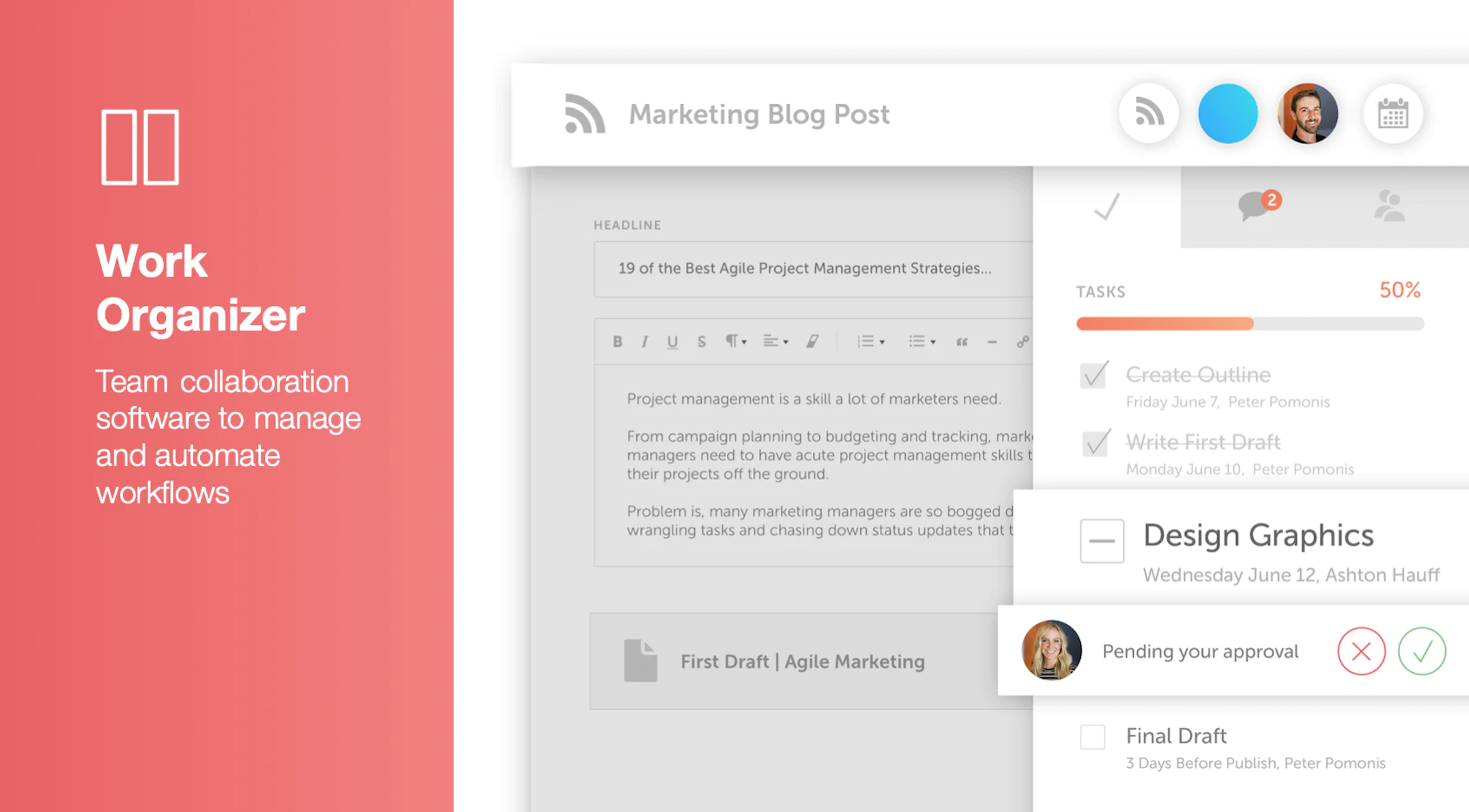
CoSchedule provides a content calendar, content optimization, and contentmarketing products, with users among 50,000 marketers worldwide, helping them organize their work, deliver projects on time, and prove marketing team value.
N/A
X Pro
Score 7.9 out of 10
N/A
Replacing the former TweetDeck, X Pro is a social media dashboard application for management of Twitter accounts.
N/A
Pricing
Buffer
CoSchedule Marketing Suite
X Pro
Editions & Modules
Free
$0
Essentials
$6
per month per channel
Team
$12
per month per channel
No answers on this topic
No answers on this topic
Offerings
Pricing Offerings
Buffer
CoSchedule Marketing Suite
X Pro
Free Trial
Yes
No
No
Free/Freemium Version
Yes
Yes
Yes
Premium Consulting/Integration Services
No
No
No
Entry-level Setup Fee
No setup fee
No setup fee
No setup fee
Additional Details
A discount is offered for annual billing.
—
—
More Pricing Information
Community Pulse
Buffer
CoSchedule Marketing Suite
X Pro
Considered Multiple Products
Buffer
Verified User
Manager
Chose Buffer
Buffer has a clear, easy to use interface and a reliable scheduling calendar.
We selected this tool to maintain the activity of publication in social networks at a low cost and good productivity, we consider that it adds to our objectives of brand awareness or discovery, since it allows us to keep our channels active with information and content that we …
Buffer and Hootsuite are considered as best tools for managing your social media accounts . The only difference which I feel between the two is Buffer is [more] focused on pre-scheduling and Hootsuite is a advanced version of Buffer you can say it allows you full -fledged …
While you can use TweetDeck with other social networks, its primary focus is on Twitter, and they’ve developed a robust feature set to cater to managing Twitter. If your business is multi-networked, then you'll need Buffer.
In my opinion, Buffer stacks up quite well compared to these alternatives. It stacks up best in the price arena because Buffer is more competitively priced than these alternatives. Buffer is capable of doing almost everything these alternatives are capable of. You can set up a …
Buffer is more user-friendly and offers a queue, where you can shuffle your updates and schedule them for the future. You can also schedule slots that get the most engagement with your audience, which is extremely helpful when you're trying to hit KPI's. I didn't use Sprout's …
We started off using TweetDeck and then migrated to Hootsuite. These apps work fine for monitoring partner posts and hashtags that are relevant to our brand but their sharing and scheduling utilities were clunky and inefficient. I'd still be using them for social media …
When [it comes to] comparison I found all these platforms competitive and having great features altogether. All features are the same like monitoring, scheduling, Analysing but TweetDeck mainly analyzes on Twitter whereas on Hootsuite and Buffer, [it only] allows [you to] …
Verified User
Employee
Chose X Pro
Sprinklr is a one-stop space for all social media platforms and Tweetdeck only offers use with Twitter. However, Sprinklr has been unreliable for us in the past for scheduled posts and is a bit more complicated to navigate - hence we alternate between TweetDeck and Sprinklr. Spr…
It helps me save hours by devoting only half an hour in a month's worth of posting, in addition to that it is quite simple to use. Buffer for scheduling social posts well in advance, but I have begun using it instead of posting natively on the social apps themselves because it makes it super easy to post the same messages to more than one platform.
CoSchedule is great for businesses or agencies who need an overview of all their marketing efforts, and who want to establish collaboration between multiple departments. The calendar view is one of the best we've worked with and makes it easy to see exactly what's happening. There is some slight clunkiness when it comes to admin-related tasks, and a few things aren't easy to find, but there's great support.
TweetDeck is ideal for complex media organisations / newsrooms where you want to keep track of several users accounts, or switch between multiple user and/or title accounts. It is perfect for those who want to follow conversations in real-time via many channels, at a glance. It is also useful for those who want to schedule tweets to provide around the clock coverage even when unmanned. Now that it paid-for is less suited to smaller organisations with tight budgets.
TweetDeck is the best platform to schedule tweets - it is far better than the website itself. The process is remarkably easy and scheduling a day's worth of tweets takes no more than 10 minutes.
Tracking news is very easy on TweetDeck due to being able to create multiple columns each focusing on a different subject. Columns can be created using handles, searches, hashtags, and trends, and this makes TweetDeck a great platform as a news editor.
Expensive Analytics: The upgrade you need to access your analytics is quite expensive, and I have come across other tools that provide the same or even more for a lesser priced plan.
No Media Library: The one feature I have found on another social media planning tool that I wish Buffer had is a media library. This allows you to upload photos you aren't using right away to have them readily available when you do decide to use them. This is not a feature in Buffer.
The platform seems sluggish as of late, likely as a result of the robust amount of data we are entering and the number of filters we're creating.
Social media scheduling exists, but we do run into publishing errors more often then we'd like.
Task templates when updated are not retroactive, so when you create projects for an entire year and then change a template, you need to go back and change them manually.
TweetDeck has an editing feature for scheduled posts only if there is no image attached. When a post with an image needs editing, users must instead delete the entire post and reschedule it with the edits needed.
TweetDeck has a real-time display, however users often need to refresh the window manually to get scheduled posts to appear in the appropriate column.
TweetDeck users can scroll side to side to view all off the types of columns selected. This functionality often leads to traveling back to a previous page unintentionally.
I am giving buffer this rating because of a couple issues that it has compared to other platforms. It does not always post to instagram and you will need to go in an manually post. Also, one of the biggest qualms that we have with buffer is the price it costs to have robust analytics
As I previously mentioned, if TweetDeck were to increase some features and integrations, cleaned up its interface, and developed a tool to measure ROI, it would remain competitive with HootSuite and Hubspot. Altogether, it is an effective tool for the job of scheduling and monitoring your impact on Twitter, it falls behind other competitors that offer a more robust solution.
We use Buffer for certain website content that should be shared on social networks, having this tool helps us to do it faster and easier since we can send the publications from the internet browser and the stack of scheduled messages. It is really fast and easy for all team members who share access to the account, so at the same time that we analyze the information that we can share, the message stack is prepared
The interface is very intuitive, from setting up social profiles, to posting, to tags, to optimizing for best day/time to post. It's super easy to scan the aggregate analytics. The calendar is very easy to grok at a glance, and the more advanced functionality is intuitive to set up.
It's a pretty easy tool to use I find a few of the columns to be a bit repetitive. If you are managing more than one account you'll start to find yourself having easily 10 plus columns all tracking all different information which creates nice track lanes to keep all that relative information in one column or "view". With the amount of data that is pushed out, if you are following a large number of accounts, it's extremely easy to lose valuable posts in your feeds. As you begin building out your columns they get the point where you only look at one or two and the rest seem to be lost. Overall, this a free tool and there are other social monitoring tools that are out there but are in the multiple thousands of dollar range
TweetDeck tends to be available for use majority of the time...however, I've had times where it would get stuck in a loop and then post my Tweet multiple times.
Buffer performs well on both desktop and mobile platforms. The one area as I have stated before is that it does not always want to automatically push to Instagram and the user will have to go do it manually. Buffer works very well pushing to other platforms. The instagram issue is the only reason buffer does not get a 10 on this section
I didn't have to use their official support, but I can say that they put out a lot of content online to help users. Their YouTube page has quite an array of tutorial videos explaining how things work and how to get the most out of their tools. If you're struggling, before picking up a phone or blasting off an email, try searching for your problem on YouTube or their forums.
I've never had to contact customer support. Tweetdeck has always worked like a charm for me. And, if I have had a problem, I've simply deleted the column, then recreated it and it worked again. While it's not without its glitches every once in a great while, it's worked like a charm.
We were very satisfied with the implementation of Buffer. We had no issues switching from the platform that we were using over to buffer. Our staff did not even miss a beat when it came to posting content. It was an easy transition and I feel that is something that buffer has really done well. They have an "out of the box" usability platform
I also used Combin which is easy and free to use. However, Combin only posts when the computer is active and connected to the internet. So, posting while you are not actively using your computer at that moment is not possible, therefore Buffer is much more efficient as you can even post while being on vacation without working.
CoSchedule provides collaborative planning of projects. The calendar view is very well designed. Meetings and tasks can be scheduled and tracked easily. Whatever is being done, no matter how big the task/project is, it gives a bird-eye view of everything. Additionally, it also integrated very well with WordPress. Their customer service team is also very helpful.
Several years ago I used the Hootsuite Free service. I found Tweetdeck to be preferable because of its user interface, and greater functionality. Moreover, I recall Hootsuite bombarding me with emails that were just irrelevant. TweetDeck just does what it does, without hassle. Its UI and functionality for multiple accounts seems to be the best I've tried.
Buffer does what it say on tin as they say! you can always count on Buffer. Buffer can be scale to 25 social account with 2,000 scheduled post which is enough for most agencies or businesses
It has saved me about 1 hour per day to keep things organized from Asana to WordPress.
By not having a functioning Google Doc import feature, it costs me about 30 minutes for each blog post to copy paste all the content, images, etc.
By bundling too many features into their plans, many of which we don't use (e.g. social media scheduling), we lose a little ROI because we are not using the full feature set. We use and prefer Buffer for social media, so when CoSchedule raised their price $40+ per month on features we would not be using, that hurt.