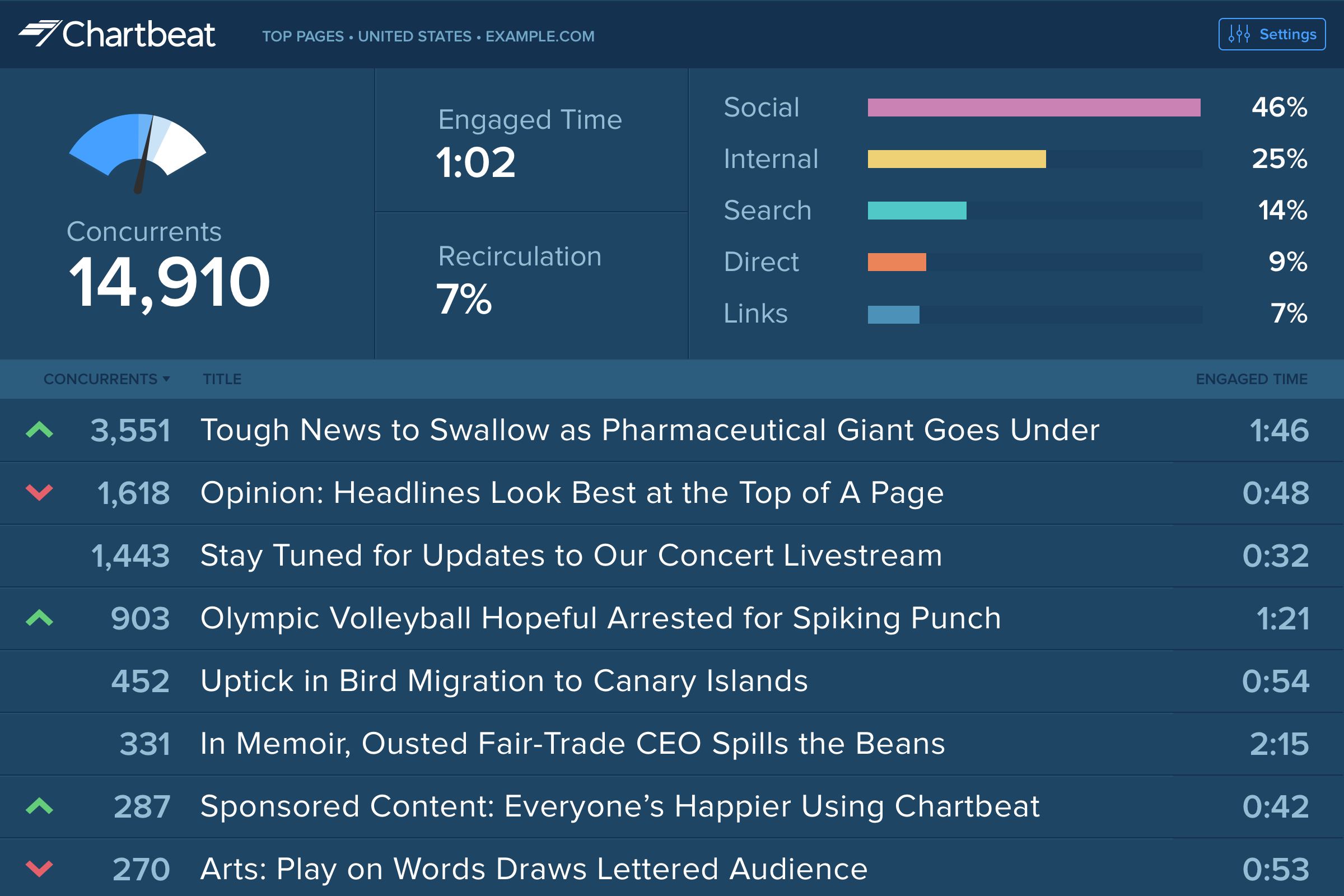
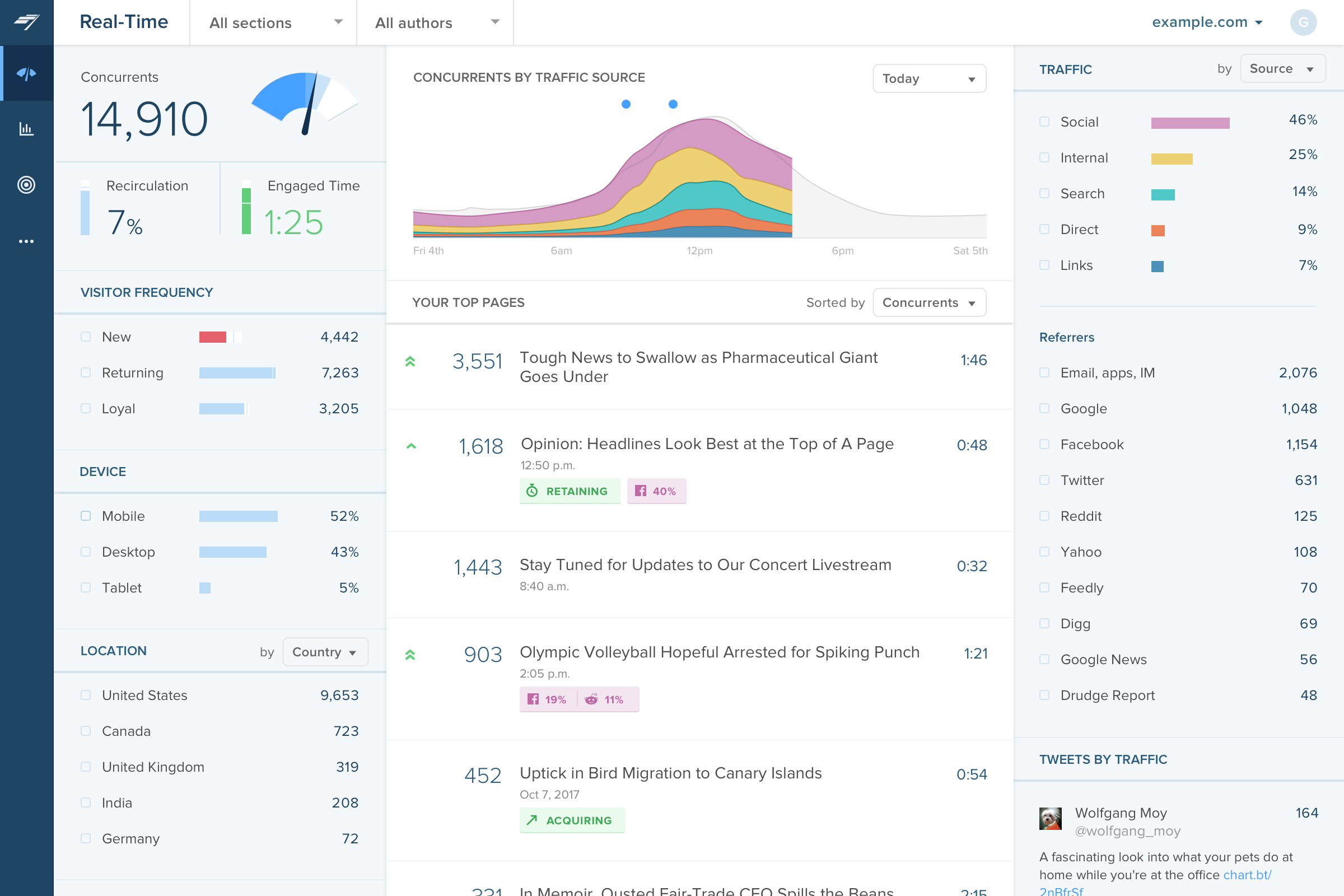
Chartbeat delivers real-time analytics, insights, and transformative tools for content teams around the world, to help improve audience engagement, inform editorial decisions, and increase loyalty.
N/A
Parse.ly
Score 7.8 out of 10
N/A
Parse.ly is a content optimization platform for online publishers. It provides in-depth analytics and helps maximize the performance of the digital content. It features a dashboard geared for editorial and business staff and an API that can be used by a product team to create personalized or contextual experiences on a website.
$499
per month
Webtrends Analytics
Score 4.4 out of 10
N/A
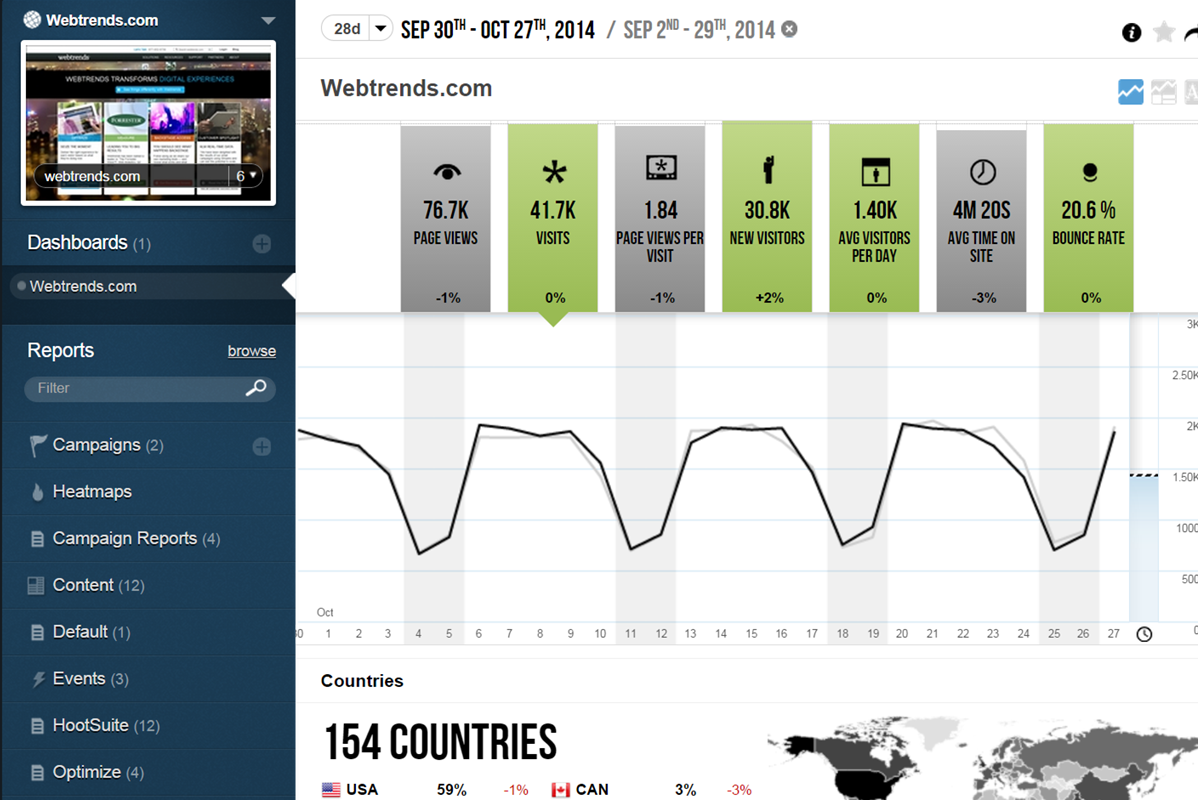
WebTrends provides an enterprise web analytics platform and, according to Forrester, has a strong focus on support for mobile and social channels and a very open platform. Webtrends competes directly with Adobe Site Catalyst, IBM Coremetrics. and comScore DigitalAnalytix.
N/A
Pricing
Chartbeat
Parse.ly
Webtrends Analytics
Editions & Modules
No answers on this topic
No answers on this topic
No answers on this topic
Offerings
Pricing Offerings
Chartbeat
Parse.ly
Webtrends Analytics
Free Trial
Yes
Yes
No
Free/Freemium Version
No
No
No
Premium Consulting/Integration Services
Yes
Yes
No
Entry-level Setup Fee
No setup fee
Required
No setup fee
Additional Details
Chartbeat pricing is based on monthly site page views. Discounts are applied to multi-year contracts. The Basic Plan includes the Real-time Dashboard, Historical Dashboard, Heads Up Display, Reports, Big Board, iOS and Android app, and Real-time API endpoints.
The Plus Plan includes all of the Basic Plan features, plus ONE of the following Premium features: Headline Testing, Advanced Queries, or Multi-Site View.
The Premium Plan includes all of the Basic Plan features, plus ALL Premium features: Headline Testing, Advanced Queries, Multi-Site View, and enterprise-level support and custom trainings.
In a previous job I had use of Parse.ly and, while at the time I thought it was a very useful tool, it wasn't as detailed as the Chartbeat metrics. Chartbeat gives you more insight into concurrents on your website at a given time, rather than just individual stories, and when …
Larger analytics suites like Google Analytics and Omniture simply do not provide the kind of real-time data that Chartbeat does. I have used Parse.ly which has some interesting real-time features as well; I would say Parse.ly is similar in terms of ease of use, though Chartbeat …
Other products like Chartbeat that I've used are Parse.ly, GA, and Omniture. Parse.ly is the only tool, in my opinion, that offers more real-time data, but the interface is lacking and isn't as intuitive as Chartbeat.
I used Parse.ly before I used Chartbeat. We shifted away from Parse.ly because it's social standing wasn't as good, it was mostly for site readership and we needed a bigger concentration on social media that Parse.ly couldn't provide. It's not listed, but we now use Social Flow …
Chartbeat is certainly better at visualizing content and segmenting the data all on one screen. We can filter by section, author, channel and more without leaving the main dashboard page. Combining properties together in roll up groups is another key feature. We're able to …
When I referenced a Parse.ly competitor earlier in my review, I was referencing Chartbeat, the platform used in every newsroom I encountered before my current employer switched to Parse.ly. Both get the job done, but as I said earlier, whether it be reality or perception, Chartb…
Parse.ly is easier to understand with more detail that is relevant to the team. Google Analytics, while some parts of the business still use it in conjunction with Parse.ly, can be confusing with so many options to choose from. Chartbeat doesn't have as many features as …
Parse.ly was already used at my company when I started, we stayed because they'd done a lot of work on their end to make sure that our site's architecture was properly read in our system. We appreciated the work they put into making the system work for us. I did miss the …
Having used both Parse.ly and Chartbeat I personally just think Parse.ly is a better product. The UI is better and the features are more optimal and well thought out, again fitting publisher needs very well. In addition, whilst Chartbeat is certainly an improvement on GA in …
Parse.ly does pretty well compared to Chartbeat, particularly when it comes to historical information and analysis options that are easy for employees to use after some short training. The onboarding for Parse.ly is intuitive, and the scheduled reports take away basically all …
Parse.ly seems to be more user-friendly than Adobe and is on the same user-friendly level as Chartbeat. Chartbeat had features that I would love to see integrated into Parse.ly like an overlay feature that showed where website users were dropping from that page. Chartbeat also …
Parse.ly is easier to use and more self-explanatory than Google Analytics. The site essentially explains itself upon visiting it. Chartbeat was quite good but I believe Parse.ly provides more granular details on web traffic and gives the user more insights into how and why …
Firstly, I didn't make the business decision to use Parse.ly. I'm just an employee using it. However, the first thing you notice is the change in appearance. Parse.ly's dashboard looks far more complicated than Chartbeat's and the black, white, and green theme [are] not as …
Doesn't come with an integrated overlay like Chartbeat, but is more intuitive (just) than GA. Seems more accurate and detailed than Chartbeat but less than GA. It's my go-to for day-to-day traffic engagement but monthly I'm more likely to look at in-house GA-generated reports.
Verified User
Employee
Chose Parse.ly
Parse.ly provides clearer insights into what stories are performing strongly in real time. Its interface is more user-friendly and it is easy to compare different time periods, titles or author statistics. Chartbeat had a website overlay to show where readers are going on site, …
Verified User
Manager
Chose Parse.ly
Parse.ly is the most comprehensive interface and system.
Parsely has the best UI, best reports, best real-time data, and the best historical data that I've used. I'd never go back to any of the tools I've used before.
Verified User
Manager
Chose Parse.ly
One of the things users first say when they start with Parse.ly is how easy it is to navigate through a lot of data thanks to the design. Parse.ly also has several data points and metrics that their competitors do not track. The automated reporting also makes it much easier to …
As GA and AA are more general purpose digital analytics tools, they can be configured to do any type of web analytics tracking. However, Parse.ly is custom-made for editorial teams and newsrooms. Parse.ly is far more intuitive and easy to use. It's a fantastic tool for …
Verified User
Program Manager
Chose Parse.ly
It's not as powerful or reliable as Google Analytics (e.g. it's missing demographic data, and doesn't integrate with Google Search Console or AdWords), but it meets most of the basic requirements that we need. It's a difference user experience in general, and slightly more …
The main point of benefit is the realtime data. This is vital to our team as we are publishing a lot of content per day, so we have a busy homepage to manage and it's important to know which content is performing well. We also like to get an understanding as quickly as possible - which Chartbeat offers - of where traffic is coming from. Often we will see an example where a page is getting high traffic from Google, for example, and we know that might not need to be placed so prominently on the homepage because the traffic is arriving to us externally anyway. Without that depth of understanding what is performing best and why - updated immediately, unlike in Google Analytics now - our homepage would not be as well optimised for users coming to us direct
Parse.ly is a great tool for publishers who want to track engagement and audience behaviour across websites. With Parse.ly, we can easily track metrics like pageviews, time spent on page, and scroll depth to see which content is resonating with our audience and optimize our content strategy accordingly. Our marketers found Parse.ly to be an excellent tool for tracking the effectiveness of our campaigns. We can use Parse.ly to track metrics like referral sources, conversion rates, and engagement by audience segment to see which channels and tactics are driving the most engagement and conversions.
Scenarios 1. If you want to use web server log files as input to your web analytics, then Webtrends will provides a good product, with great ease of implementation. Don't even think about being cheap on hardware, and make sure Webtrends runs on real servers, not in a VM environment. 2. If you want to use Data Tagging, similar to Google Analytics or Site Catalyst, Webtrends has a powerful product, just be prepared to pay. 3. If you are new to Web Analytics, but it is the strategic direction, start with Webtrends on Premises. Questions to Ask 1. What are you trying to accomplish? 2. Can you place a dollar value on the benefit that you expect/need from Webtrends? 3.Can you live with Webtrends running SaaS?
Control privacy, data sharing and competitive industrial knowledge using Webtrends on premises
Great control over custom reports, custom dimensions and metrics
Flexible tool which allows multiple methods of data capture. To my knowledge it was the first tool with a Tag Builder / Tag Management function built in via a supporting website.
Source of traffic needs improvement. Search and social make sense, but "internal" and "links" is a grey area. It would be helpful to define those with an organization and provide an information icon so users can easily remember what each of those buckets is tracking.
More ways to customize the real-time board. For example, with video content, that's great that I can see a user has started a video, but what is the completion rate, was that only on O&O or can that track Facebook, too?
Would like to see demo (age) information included as a way to slice the data so I can see what's working with my older and younger demo.
The big downside, the elephant in the room, is that it does not (as of right now) have on-demand segmenting, drilldowns, etc. You have to think of what you want in advance and create those reports then analyze some data. This is huge. You can, of course, re-analyze old data after creating new reports but you still have to wait. (This deficiency may become obsolete with the release of Webtrends Explore later this month (May 2014).)
It has fewer mature integrations with other products and databases than competitors do, although I'm told it works with SharePoint better than anything else does.
Its attribution modeling capability is behind Google Analytics'. In my humble opinion, this could be changed quickly if Webtrends would make some tweaks to its standard visitor history files (i.e. preserve the order in which past visits were sourced beyond the single most recent one, rather than storing all those past sources as a randomized list).
It doesn't incorporate statistical tests, confidence intervals, or statistical associations. However, this same criticism can be applied to its competitors (other than A/B Testing products). It's a tabulation program, as they all are. In this respect, web analytics tools as a group are relatively primitive. Sorry to bring this up as a criticism of Webtrends but it's my pet peeve about the whole industry and I just have to say it. (p.s. take advantage of the heavy-duty Webtrends Scheduled Export functionality to get really granular data that you can feed to a stats program to get significances.)
Although the documentation, help screens, phone support and the knowledge base have improved tremendously in recent years, there is still a pretty steep learning curve because it is different from the tools that entry-level users may have already been exposed to. This can be a shock and many users are alienated at first because they just don't get some of the fundamentals at first. I'd like to see much better help screens that are thoroughly interlinked with the KB and documentation. Having superb online support would make a world of difference with the adoption of this basically powerful tool.
I gave Chartbeat a 5 for a renewal rating, because, while it delivers clear and understandable content, Google Analytics also provides many of the same features for free. For a small to medium website, I believe it would be more cost effective to use Google Analytics. A website with a high amount of traffic, however, could merit spending the money on Chartbeat to maximize their potential.
As an employee, this is difficult for me to comment as I am not directly funding or making these business decisions. However, it is a tool many get on with for surface level data that is useful to editorial teams.
I would be willing to try Webtrends again AFTER some research from other users. I would need to see that users mention better and faster customer support on questions and issues that arise while using the software. The software is capable of vast and incredible things, but if it isnt properly set up and supported during use, it is just a big hassel and waste of everyones time and money.
I am able to "set it and forget it," keeping it up on my monitor for either constant checking or just keeping an eye on the numbers during the day. I'm also able to keep track of what times are perfect to post a story and which stories rack up the most traffic.
The Parse.ly platform is very user-friendly and easy to use. User management is simple, and reporting setup only takes a few minutes. They provide very helpful documentation for implementing the scripts on your site and have great customer support to help with custom development such as implementing their content recommendation engine.
If I could give it a 0, I would. Not having an intuitive user interface made it impossible to convince non-analytic business users to use the tool on their own. Even as a seasoned analyst, frequent calls were needed to get what should be simple tasks done. Account managers don't understand the tool either, and have to refer you to technical support
The v9 admin interface and v10 reporting interface work as well as expected, but have a tendency to be pokey, especially for bulky reports and whenever you're connected to wifi. I much prefer using the REST API for all reporting for this reason, which simply dumps out the data and doesn't bother with the user interface.
I have had limited experience of support for Chartbeat but whenever I have needed help it has been there. Recently there was an issue of seeing different forms of data in real time - app and otherwise effectively, and the issue was being clearly dealt with and communicated back to us.
I rate this question this way solely because I haven't requested any support. I feel where I will eventually get support would be when we take Parse.ly up on some training that is being offered. We are looking to do that at some point after the first of the year and when our schedules support it.
I once went on to Twitter to ask for help from my network of analytics people, and Webtrends themselves responded. They have been an excellent partner in making sure that their product is being used to the best of it's ability and I greatly appreciate that. Both Omniture and Google Analytics, do not have that level of support over social media
The in-person training was comprehensive enough to get you started, but I strongly recommend having a more experienced person when beginning with the tool.
Webtrends provides several free webinars over the course of the year, many of which I would expect to pay for. The people providing the webinars seem to have a good feel for real-world application of the product.
Careful planning and patience. Use a non-public test site to fine tune tags and reporting. Despite best laid plans, there will be surprises when you collect the data, run the analysis and begin generating reports using the tool. Perform a tag audit to ensure tags fire as desired.
Omnilytics is more robust, detailed, and catered for an intermediate media user, while I think Chartbeat is a more user-friendly and beginner-oriented piece of technology. That being said, there is an impressive amount of lift for Chartbeat, and it's evident that simplicity is the key to using a software daily (which is absolutely the point in the content world).
Parse.ly does pretty well compared to Chartbeat, particularly when it comes to historical information and analysis options that are easy for employees to use after some short training. The onboarding for Parse.ly is intuitive, and the scheduled reports take away basically all of the inconvenience associated with regular metrics reviewing. But Chartbeat wins in its social audience tracking because it can source traffic to a specific social post, which can show you exactly how your audience is coming to your content and where you need to put your content to be sure you get that audience.
Webtrends has its work cut out for itself considering you have the behemoth Google Analytics and Google Analytics Premium having a strong offering and brand recognition for the price of free. After reviewing the paid service I'd suggest you start off with GA as a cheaper alternative that is just as robust, if not much more flexible in regards to the reporting and goal tracking needs for our company.
Sometimes in meetings our editorial director will point out stories that didn't perform well. To us, that means readers don't really care about the topic, so we'll pivot away from writing about that in the future. That might not be "business objectives" though.
Webtrends has had a positive impact on site visitation because it allowed us to understand the sources by domain for site traffic and find out ways to increase visits from those domains.
Webtrends has also allowed us to understand areas of optimization on the site, which has had a positive impact on the overall user journey on the site, likely leading to longer site duration and engagement.