Google Analytics is perhaps the best-known web analytics product and, as a free product, it has massive adoption. Although it lacks some enterprise-level features compared to its competitors in the space, the launch of the paid Google Analytics Premium edition seems likely to close the gap.
$150,000
per year
Google RCS Business Messaging
Score 8.0 out of 10
N/A
Google's Business Communications service, RCS Business Messaging, provides SMS with branding, rich media, interactivity, and analytics. With RBM, businesses can bring branded, interactive mobile experiences to the native Android messaging app.
N/A
Webtrends Analytics
Score 4.4 out of 10
N/A
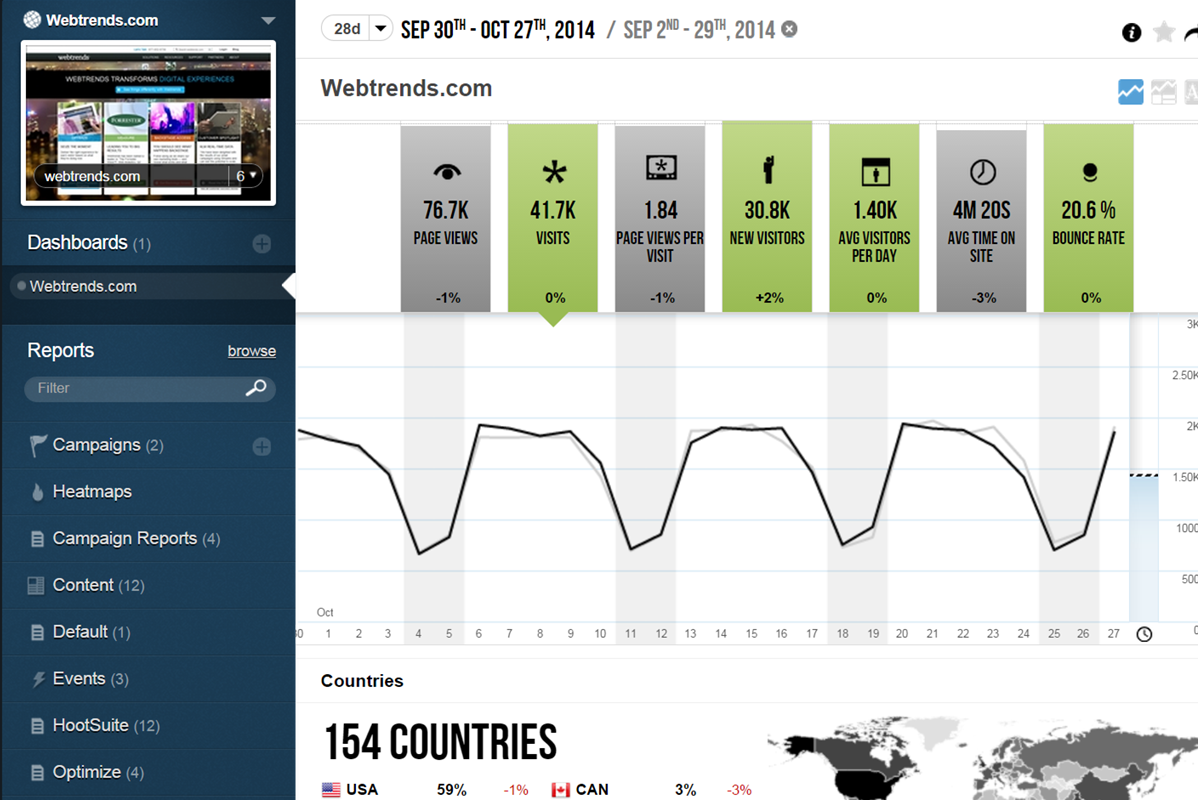
WebTrends provides an enterprise web analytics platform and, according to Forrester, has a strong focus on support for mobile and social channels and a very open platform. Webtrends competes directly with Adobe Site Catalyst, IBM Coremetrics. and comScore DigitalAnalytix.
Wix and other website platforms have a built-in analytic tool, but it is not as sufficient as Google Analytics, so I always use GA as the main source of information about sales. Most of the analytic tools on web platforms can't visualize user flows, which is very important when …
The entry threshold is lower and Google Analytics can be used to grant access even to technically intermediate users who can draw basic conclusions on their own.
Google Analytics is for me the default one to implement especially for business starting in analytics. The time (aka cost) of implementation is very low and it provides results in a matter of hours. The integration with the Google ecosystem is also a plus especially when …
Microsoft Clarity is speedy, extremely tidy, and straight to the point, and it contains everything a SME would need to maintain a healthy SEO without the need for technical understanding; its UI is far superior to GA, and it also provides additional capabilities like as …
Webtrends as a platform is older than Google Analytics and still quite good. If you have a company that is used to using Webtrends, it's likely still a good fit for you. Google Analytics has a lower entry cost and more accessible training to new Users, so that's why I would …
Adobe Analytics is good but it is more suited to people who are fully and technically into reporting and the solutions it provides. Google Analytics on the other hand provides a much easier way of setting up the Analytics. Most of the data reporting, charts and visualisations …
Ease of use: Google Analytics is known for its user-friendly interface and straightforward setup process, making it accessible for beginners. Adobe Analytics has a steeper learning curve and requires more technical expertise. Features: Adobe Analytics offers a more comprehensive …
Universal GA is free to use, offers a good amount of data, and is relatively easy to use. Other products may not offer the detail needed (Google Tag Manager), or require payment (Adobe Target)
Built-in reports are beneficial but you can create custom reports if you need more details with different dimensions and metrics it also provides insights which is just little data about your site traffic in sentence format its the best way to know which strategy you are on …
Adobe and Google Analytics are fairly similar. Google Analytics was more widely known among my team. Most of us have used it in some capacity in the past. It's also easy to navigate, and there are loads of free training out there on how to use the platform.
Google provides a wide suite of products that all tie into Google Analytics. Some that I use most often are Tag Manager, Ads and Datastudio. All of these connect directly with Analytics and allow me to accomplish my goals. For example, Ads will connect and show me what Ads are …
I have not used Adobe Analytics as much, but I know they offer something called customer journey analytics, which we are evaluating now. I have used Semrush, and I find them much better than Google Analytics. I feel a fairly nontechnical person could learn Semrush in about a …
Adobe Analytics and Google Analytics 360 are both paid/premium options for website tracking. Though there are certain use cases when these might make sense (you operate entirely in the Adobe suite, you're a massive company/site that doesn’t mind the price tag on Google …
Google Analytics provides everything you need in terms of straight forward analytics needs. The tool is not very flexible compared to other software such as adobe, and if you want to upgrade to premium or add in a bunch of custom situations, that can be become very [tedious] …
Google Analytics is easy to use and widespread, it's a must-have software for all businesses. The price point compared to other software that we use is very reasonable, and the suite of services and training tools/certifications available for free is hard for other software …
Adobe Analytics has been in the market for a long time; some people still know it as Omniture or SiteCatalyst. It seems that some great ideas from Google Analytics, such as Enhanced Ecommerce and the new way of measuring events with GA4, are adapted from the traditional Adobe …
GA will always have an advantage with data, because it's the source, but other companies do a better job of specializing in certain areas or providing better UX/UI. HubSpot is the king of the latter and SEMrush is ideal for making organic improvements based on data. Ahrefs are …
We have been using Adobe Analytics for a while but the system seemed to be more complex when compared to super user friendly Google Analytics. Moreover, the option to add custom metrics and dimensions is lacking in Adobe Analytics. Google Analytics is good with transactional …
Google Analytics is really unique so it's hard to have competitors - especially when Google Analytics is free (unless you are part of a huge company so in the case you will need the Premium version). Other products like SemRush are good as third party tools and figure out the …
I used Facebook Analytics for mobile and web games but Facebook Analytics was discontinued. Google Analytics is more universal and is suitable for both web and native mobile applications. Facebook Analytics is more suitable for apps and games on web and mobile. For mobile …
Webtrends has its work cut out for itself considering you have the behemoth Google Analytics and Google Analytics premium having a strong offering and brand recognition for the price of free. After reviewing the paid service I'd suggest you start off with GA as a cheaper …
Compared to WebTrends, Google Analytics has a slicker interface, provides live site usage data, and is easier to jump into with basic usage. These days users expect to be able to create their own reports as needed, rather than have an "expert" do it for them. They are used to …
Using Omniture at my current place of employment and using google analytics as a backup at both, Webtrends is the clear superior product. I go back to how easy the UI is to navigate and how simple it is to get user level data that isn't duplicated or doesn't try to pigeon hold …
We currently use WebTrends, Google Analytics, Kissmetrics and ClickTale. I would like us to consolidate our activities to be focused on just Webtrends as it covers all of the requirements we have very well.
We've used Google Analytics - and Webtrends really wipes the floor with them. The data we get from Mixpanel can be mirrored in Webtrends - which is something we're working on at the moment with the Webtrends team. As for competitors to Webtrends, we did consider Adobe and …
I have only had significant experience with Google Analytics (GA) and WebTrends in this space. Overall - it is easier to learn and modify GA reports as a casual user - I always struggled with the fact that GA only offered partial data (sampling based).
Webtrends was selected because of the price for Google Analytics Premium ($110k per year) and Adobe Omniture Analytics (twice the price). Clearly, it needed the Visitor Data Mart to get additional capability that you would expect as part of a Web Analytics suite. In our case, …
Webtrends as the pioneer WA tool from the early 90s stands tall among its competitors paid and free. Choose it when you need good product support from the vendor and you need flexibility for data collection methods.
I actually did not personally select Webtrends, but rather fell into an organization already using the tool. In general, the reasons for staying with Webtrends vs another tool involve the price point issue and the types of users and support needed. You may be able to get all …
I find Google Analytics to be very limiting. This may also be the way that the reports have been structured by our organization. It is viewed as an older way to obtain the metrics we are after and no new projects are implemented through Google Analytics.
Webtrends is just an option, depending on client budget. It's a simple analytics tool that does the job but we always recommend Omniture whenever possible.
Honesty, there is no reason that a company wouldn’t want to implement Google Analytics. The regular version is completely free, is very easy to configure, and provides immense volumes of website data. There are also tangible benefits to the other Google tools it can connect to, and it integrates with any BI/data platform that you might use. The only time I’d advise not using standard Google Analytics is if you’ve purchased Google Analytics 360.
Scenarios 1. If you want to use web server log files as input to your web analytics, then Webtrends will provides a good product, with great ease of implementation. Don't even think about being cheap on hardware, and make sure Webtrends runs on real servers, not in a VM environment. 2. If you want to use Data Tagging, similar to Google Analytics or Site Catalyst, Webtrends has a powerful product, just be prepared to pay. 3. If you are new to Web Analytics, but it is the strategic direction, start with Webtrends on Premises. Questions to Ask 1. What are you trying to accomplish? 2. Can you place a dollar value on the benefit that you expect/need from Webtrends? 3.Can you live with Webtrends running SaaS?
Webtrends Analytics makes complex situations understandable to a non-technical audience. The vast capabilities and ways to slice data is both a great tool, but can also cause a user/users many hours of frustration.
Visual data display is clean, to the point, and not overly convoluted with unneeded variables and standard (defualt) settings. Everything the end user sees is customizeable.
Exports of raw data collections was easy and accurate. Once the parameters of data collection are finally set up and working, its easy to get what you want from the UI and is delievered in a variety of options.
While raw data is nice to have, I do wish there was an easier way to provide reports from Google Analytics directly. Something that could answer questions straight-forward for people.
I would appreciate "helpful hints" or a cheat sheet of some sort, so when quickly searching for something such as time on a certain page, I can find it quickly.
Webtrends is not great at providing statistical data for analysis. You need to enable Log File Delivery or create an analysis export to perform this. This could theoretically be done with Streams.
Webtrends has difficulty identifying multi-visit users due to the inherent fragility of cookie-based tracking.
Webtrends Analytics does not provide Pathing capabilities for segments, only for the aggregate. However, this can be worked around with Scenario functionality selectively fired by a tag management system.
Segmentation by high-cardinality parameters tends to cause issues with table limits. Even after scrubbing and scrutinizing data, we commonly see up of 10K rows per dimension. Due to this, we use Webtrends Analytics to roll up data into larger segments and export all of our log data into our database for heavy duty number crunching.
Having used Google Analytics for the last 9 years, I have no intention of discontinuing my service. Google Analytics is a fantastic product that provides me with almost everything I could wish for. The positives in this product outweigh any negatives that you might find. I can not think of a single reason to not immediately start using Google Analytics for your business.
The obstacles to renewing are 1) finding people to manage it who know it well and 2) frustration because of the lack of on-the-fly analysis. Usually, renewal prices are reasonable and the cost of switching to something else when you have a somewhat complicated setup far outweigh the renewal costs, especially if your implementation is sound and your reports are humming along. A lot of renewal decisions are going to hinge on the new product that will start to roll out this month.
Google Analytics provides a wealth of data, down to minute levels. That is it's greatest detriment: find the right information when you need it can be a cumbersome task. You are able to create shortcuts, however, so it can mitigate some of this problem. Google is continually refining Analytics, so I do not doubt there will be improvements
If I could give it a 0, I would. Not having an intuitive user interface made it impossible to convince non-analytic business users to use the tool on their own. Even as a seasoned analyst, frequent calls were needed to get what should be simple tasks done. Account managers don't understand the tool either, and have to refer you to technical support
We all know Google is at top when it comes to availability. We have never faced any such instances where I can suggest otherwise. All you need is a Google account, a device and internet connection to use this super powerful tool for reporting and visualising your site data, traffic, events, etc. that too in real time.
This has been a catalyst for improving our site's traffic handling capabilities. We were able to identify exit% from our sites through it and we used recommendations to handle and implement the same in our sites. We have been increasing the usage of Google Analytics in our sites and never had any performance related issues if we used Analytics
The v9 admin interface and v10 reporting interface work as well as expected, but have a tendency to be pokey, especially for bulky reports and whenever you're connected to wifi. I much prefer using the REST API for all reporting for this reason, which simply dumps out the data and doesn't bother with the user interface.
The Google reps respond very quickly. However, sometimes they can overly call you to set up an apportionment. I'm very proficient and sometimes when I talk to reps, they give beginner tutorials and insights that are a waste of time. I wish Google would understand my level of expertise and assign me to a rep (long-term) that doesn't have to walk me through the basics.
The Webtrends Support Engineers are expert at what they do, and we get to speak to someone on the support team quickly. They provide great solutions when available, and when there is no solution, which can happen, they describe work-arounds.
The in-person training was comprehensive enough to get you started, but I strongly recommend having a more experienced person when beginning with the tool.
love the product and training they provide for businesses of all sizes. The following list of links will help you get started with Google Analytics from setup to understanding what data is being presented by Google Analytics.
Webtrends provides several free webinars over the course of the year, many of which I would expect to pay for. The people providing the webinars seem to have a good feel for real-world application of the product.
Make sure to put the tracking code on every page. Ideally this would be part of a template or "include" so you can update the code on all pages (or at least within pages of the same category) at once.
Careful planning and patience. Use a non-public test site to fine tune tags and reporting. Despite best laid plans, there will be surprises when you collect the data, run the analysis and begin generating reports using the tool. Perform a tag audit to ensure tags fire as desired.
I have not used Adobe Analytics as much, but I know they offer something called customer journey analytics, which we are evaluating now. I have used Semrush, and I find them much better than Google Analytics. I feel a fairly nontechnical person could learn Semrush in about a month. They also offer features like competitive analysis (on content, keywords, traffic, etc.), which is very useful. If you have to choose one among Semrush and Google Analytics, I would say go for Semrush.
Webtrends has its work cut out for itself considering you have the behemoth Google Analytics and Google Analytics Premium having a strong offering and brand recognition for the price of free. After reviewing the paid service I'd suggest you start off with GA as a cheaper alternative that is just as robust, if not much more flexible in regards to the reporting and goal tracking needs for our company.
Google Analytics is currently handling the reporting and tracking of near about 80 sites in our project. And I am not talking about the sites from different projects. They may have way more accounts than that. Never ever felt a performance issue from Google's end while generating or customising reports or tracking custom events or creating custom dimensions
Webtrends has had a positive impact on site visitation because it allowed us to understand the sources by domain for site traffic and find out ways to increase visits from those domains.
Webtrends has also allowed us to understand areas of optimization on the site, which has had a positive impact on the overall user journey on the site, likely leading to longer site duration and engagement.