ignio AIOps, from Digitate in Santa Clara, is a solution designed to improve business agility by creating a unified view of the IT estate, connecting business functions to applications and infrastructure. This is combined with behavior profile of systems and applications that is continuously learnt using this blueprint. ignio aims to improve the transparency of complex Enterprise IT landscapes.
N/A
Kissflow
Score8.3 out of 10
Enterprise companies (1,001+ employees)
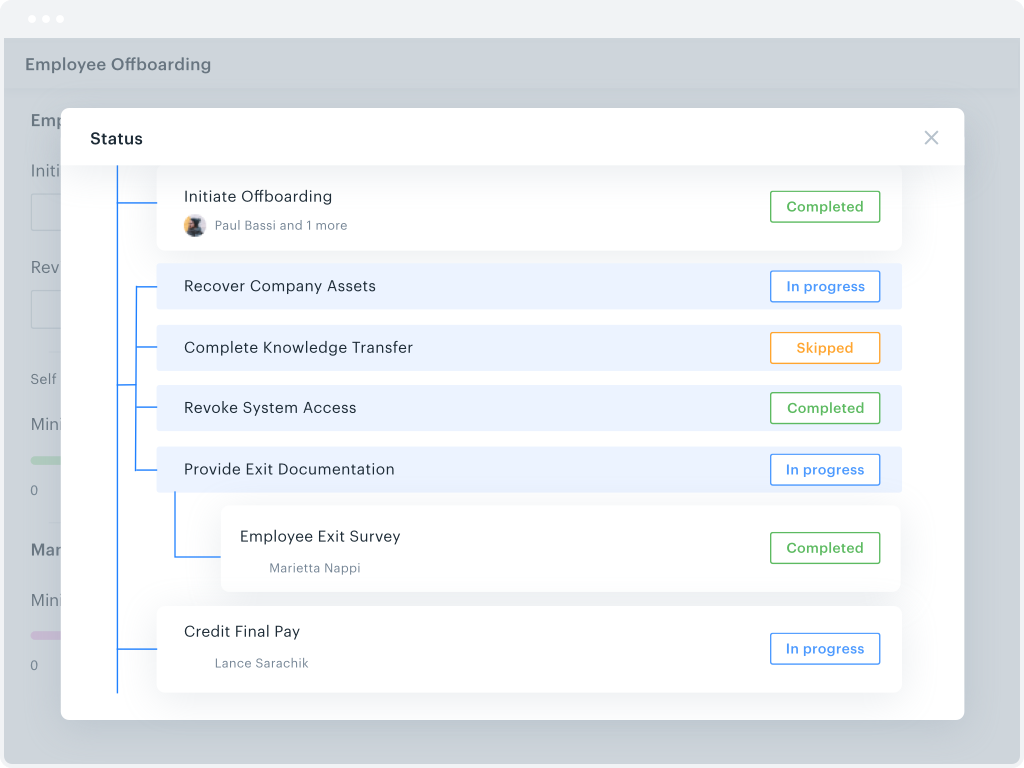
Kissflow is a low-code platform for custom application development tailored to business operations. Kissflow empowers process owners and IT developers to automate and build processes and applications for internal business operations.
It's good for issue resolution, user access request automation, standard report generation, health checks, executing self-healing as configured in the attributes. Currently not good at real-time monitoring to trigger an action. Health checks have to be on a scheduled basis.
We've used Kissflow [School Cloud] in order to track parent requests for transportation in the SpEd department. It has been user friendly for parents to input a request and staff to review, double check school sites and locations, and set up specific routes to meet the needs of students and communicate the info back to parents.
A de minimis incentive was given to thank the reviewer for their time. The incentive was not used to bias or drive a particular response, nor was the incentive contingent on a positive endorsement. More Info
They know what they are. You aren't going to get a Workflow program that also wants to be a CRM. You will get the equivalent of an electronic assistant going from station to station, taking care of business and giving you the end result.
Paper. It reduces the amount of paper needed for menial tasks tremendously. You can automate an entire process. As an educational institution, you may still need paper copies, but you aren't waiting for John Doe to sign Line 3, then Jane Doe to initial, and so on and so on with a paper form.
Tracking. If you need to know where things are in the process, the fact that this program is dedicated to workflow makes it incredibly easy to identify where people are in the sales flow.
Customer appreciation. When your workflow is stronger, faster, and better, the customers feel it. They feel like you are right there with them and getting things moving.
A de minimis incentive was given to thank the reviewer for their time. The incentive was not used to bias or drive a particular response, nor was the incentive contingent on a positive endorsement. More Info
There is a lot more the desktop tool can do. For example, we need to apply an upgrade to get the tool to talk to our infrastructure while employees are working from home. The tool was initially installed with the assumption that the desktops would be in UserLand. Instead after COVID-19 the desktop/laptops have been used for over a year on people's home networks. As of right now, we have to sync when the devices are connected to VPN. Moving forward with the upgrade, we will be getting this data over TLS when they are connected to the untrusted networks.
The concept of ignio AlOps requires OCM efforts within most operational teams. This isn't necessarily the fault of the tool itself, but when implementing ignio, or any AIOps tool, the team will get a lot of pushback as an outside team is centralizing the operational improvements. The tool should have a centralized intake process that will allow the collection, ranking, and management of automation opportunities. ignio AlOps should then simulate the proposed efficiencies from implementing something within the backlog. Right now a lot of local teams are having a hard time getting on the same page as the enterprise teams, and a common methodology for prioritizing (even if overly simplistic) would go a long way to enterprise planning.
These tools are very new and things get added to them all the time. There should be a way for the product's stakeholders and process owners to understand the additional value ignio AlOps is gaining over time.
Workflow Design: There isn't a copy/paste function when creating the workflow, and you can't move a workflow task between parallel branches. This becomes a pain point when an item has 98% of what you need, but you can't copy it and place it in another branch to make the last tweaks. Instead, it needs to be completely recreated
Interface: While I like the current design features, which make it easy for an end-user to find their tasks and items, it would be nice to also have some flexibility within the platform. Things like being able to groups apps under a category or tailoring the look and feel of the page a little more would be a welcome addition.
A de minimis incentive was given to thank the reviewer for their time. The incentive was not used to bias or drive a particular response, nor was the incentive contingent on a positive endorsement. More Info
A de minimis incentive was given to thank the reviewer for their time. The incentive was not used to bias or drive a particular response, nor was the incentive contingent on a positive endorsement. More Info
ignio AIOps version upgrades were a heavy lift. Having to learn a new language versus an industry standard language took time. More consideration on overall internal long-term support needs to be determined.
A de minimis incentive was given to thank the reviewer for their time. The incentive was not used to bias or drive a particular response, nor was the incentive contingent on a positive endorsement. More Info
The system has room to grow as it's limited by not being able to edit POs after they've been approved. The system is great for registrations and syncing to other systems while including the attachments. The reporting from Kissflow is also easy to setup to link to other platforms such as Looker
A de minimis incentive was given to thank the reviewer for their time. The incentive was not used to bias or drive a particular response, nor was the incentive contingent on a positive endorsement. More Info
A de minimis incentive was given to thank the reviewer for their time. The incentive was not used to bias or drive a particular response, nor was the incentive contingent on a positive endorsement. More Info
We have built a healthy relationship with the vendor support team throughout the implementation phase, all incidents raised were resolved within the SLA without a fail
I haven't encountered a need for support with KiSSFLOW. It's not a perfect platform, but it's functional, dependable, and reasonably intuitive. I can't fault a support team just because their product works!
A de minimis incentive was given to thank the reviewer for their time. The incentive was not used to bias or drive a particular response, nor was the incentive contingent on a positive endorsement. More Info
I am happy with the way team has implemented and shared the product for our organization. However, would like to see it get extended to the other line of business too.
KiSSFLOW is much easier to set up, less coding and easier to explain to those that are being trained. The company already had SharePoint, but it is a very difficult system to set up. A class had to be taken, along with getting books in order to understand the process of the workflow. With KiSSFLOW, it is simple to understand, the helpdesk is quick with their response, help topics are laid out simply and you can even talk with someone on that side to ask your questions. Overall, KiSSFLOW is a much easier workflow and system to use.
The only real hard number savings that we have had with KiSSFLOW is the money we have saved in forms being printed, especially multi-part forms. So for a small college like us that it probably in the $5000 to $10000 per year range. We have certainly saved money in increased efficiencies of the processes that we have moved to KiSSFLOW. But that is harder to calculate.