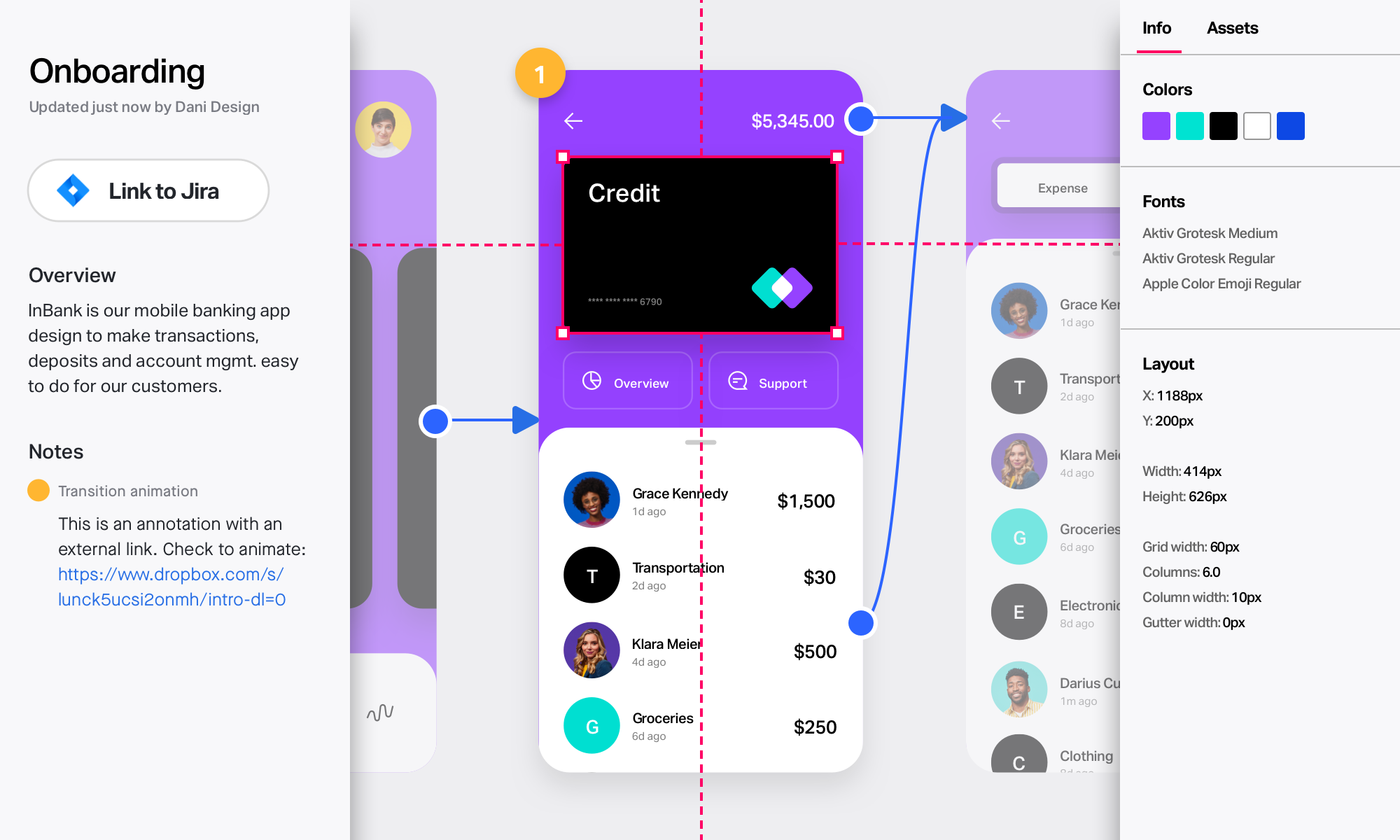
InVision is a collaborative design and prototyping platform with features such as freehand drafting mode and interactive mockups, collaboration, idea management, user testing, and integration with Slack and other collaboration tools. According to the vendor, 1 million designers are using the free version.
$0
Miro
Score9 out of 10
N/A
Miro is a web-based Collaborative Whiteboard platform that provides teams with an infinite digital canvas for visual planning, diagramming, and workflow mapping. The platform integrates a spatial user interface with automated drawing tools and natural-language processing (NLP) to structure freeform ideas into defined project workflows and database schemas.
$10
per month per user
Pricing
InVision
Miro
Editions & Modules
Free
$0
Pro
$7.75
per user/per month
Enterprise
Contact Sales
1. Free - To discover what Miro can do. Always free
$0
2. Starter - Unlimited and private boards with essential features
$8
per month (billed annually) per user
3. Business - Scales collaboration with advanced features and security
$16
per month (billed annually) per user
4. Enterprise - For work across the entire organization, with support, security and control, to scale
contact sales
annual billing per user
Offerings
Pricing Offerings
InVision
Miro
Free Trial
No
Yes
Free/Freemium Version
No
Yes
Premium Consulting/Integration Services
No
No
Entry-level Setup Fee
No setup fee
Optional
Additional Details
—
Monthly billing also available at $10 per month for the Starter plan, or $20 for the Business plan.
Product Manager in Information Technology at Total Wine & More (Wine and Spirits, 5001-10,000 employees)
Chose InVision
I have only used InVision as a tool for designing mockups. I wouldn't be able to draw a fair comparison to other tools since I have more experience with InVision.
A de minimis incentive was given to thank the reviewer for their time. The incentive was not used to bias or drive a particular response, nor was the incentive contingent on a positive endorsement. More Info
Miro
Verified User
Chose Miro
I used InVision for a while - it was interesting but without many features, the work was still very manual, the tool was soon discontinued at the company I worked for. I've used FigJam, it's a good tool, but very simple in features, which is why Miro is so important, we always …
A de minimis incentive was given to thank the reviewer for their time. The incentive was not used to bias or drive a particular response, nor was the incentive contingent on a positive endorsement. TR verified that a representative sample of customers was invited. More Info
Platform Owner II in Information Technology at Project Management Institute (Professional Training & Coaching, 501-1000 employees)
Chose Miro
I think we all found Miro a lot easier to use than Mural. It's a different concept entirely than Figma and InVision but it acts as the first step in our design process. We typically start in Miro before going to Figma.
A de minimis incentive was given to thank the reviewer for their time. The incentive was not used to bias or drive a particular response, nor was the incentive contingent on a positive endorsement. TR verified that a representative sample of customers was invited. More Info
A de minimis incentive was given to thank the reviewer for their time. The incentive was not used to bias or drive a particular response, nor was the incentive contingent on a positive endorsement. TR verified that a representative sample of customers was invited. More Info
Verified User
Chose Miro
I dislike Mural and InVision as they have fewer functionalities and seem less intuitive for clients to work with. Miro has network effects that most clients have used before. However, we as consultants tend to be able to use each: if our client uses Mural, we do too. But in our …
A de minimis incentive was given to thank the reviewer for their time. The incentive was not used to bias or drive a particular response, nor was the incentive contingent on a positive endorsement. TR verified that a representative sample of customers was invited. More Info
Verified User
Chose Miro
Miro has much more plugins and integrations when compared to InVision Freehand. The fact Miro is a stand-alone program actually has a lot of advantages. FigJam is catching up nowadays just because it's built-in Figma so everything is closely integrated. But it is also a pro …
A de minimis incentive was given to thank the reviewer for their time. The incentive was not used to bias or drive a particular response, nor was the incentive contingent on a positive endorsement. TR verified that a representative sample of customers was invited. More Info
Verified User
Chose Miro
InVision allows quick walkthroughs to gather client input.
A de minimis incentive was given to thank the reviewer for their time. The incentive was not used to bias or drive a particular response, nor was the incentive contingent on a positive endorsement. TR verified that a representative sample of customers was invited. More Info
Verified User
Chose Miro
There are so many reasons why I prefer Miro to FigJam. The connections are essential to me articulating my thought process. I have never said this about a piece of software before, but everything I make inside Miro is beautiful. Often, I recreate visual deliverables made in FigJ…
A de minimis incentive was given to thank the reviewer for their time. The incentive was not used to bias or drive a particular response, nor was the incentive contingent on a positive endorsement. TR verified that a representative sample of customers was invited. More Info
Verified User
Chose Miro
We adopted Miro before we moved from Sketch to Figma, which is part of why it beat out FigJam for us. It was already somewhat entrenched before FigJam became available to us. Also the licensing model and the fact that Miro is available to and used by most everyone in our corp …
A de minimis incentive was given to thank the reviewer for their time. The incentive was not used to bias or drive a particular response, nor was the incentive contingent on a positive endorsement. TR verified that a representative sample of customers was invited. More Info
Verified User
Chose Miro
We still use Figma for component building and prototyping. We can use Miro for easier wireframing. InVision is just a less good miro
A de minimis incentive was given to thank the reviewer for their time. The incentive was not used to bias or drive a particular response, nor was the incentive contingent on a positive endorsement. TR verified that a representative sample of customers was invited. More Info
Digital Marketing Manager in Marketing at eHealthcare Solutions (Hospital & Health Care, 11-50 employees)
Chose Miro
We tested every product, but the biggest problem we encountered was that most of them required plugins in order to centralize all of our work. Other problems included the products' excessive price, which was higher than Miro's. Last but not least, Miro offered us an all-in-one …
A de minimis incentive was given to thank the reviewer for their time. The incentive was not used to bias or drive a particular response, nor was the incentive contingent on a positive endorsement. TR verified that a representative sample of customers was invited. More Info
Graduate Teaching Assistant in Corporate at Johns Hopkins University (Higher Education, 5001-10,000 employees)
Chose Miro
Miro seems to be the OG of whiteboard-based brainstorming collaboration software. Some competitors may offer more or different features. The learning curve is not steep, so a group can easily switch apps if needed, but the saved files may not necessarily be compatible between …
A de minimis incentive was given to thank the reviewer for their time. The incentive was not used to bias or drive a particular response, nor was the incentive contingent on a positive endorsement. TR verified that a representative sample of customers was invited. More Info
Design Coach in Information Technology at VDAB (Government Administration, 1001-5000 employees)
Chose Miro
Miro has a low barrier to start and onboard. Miro is focussed on collaboration and not design. Miro has advanced workshop tools and features that help organising workshops. Miro has an intuitive way of working that encourages team members to set up boards themselves and …
A de minimis incentive was given to thank the reviewer for their time. The incentive was not used to bias or drive a particular response, nor was the incentive contingent on a positive endorsement. TR verified that a representative sample of customers was invited. More Info
Verified User
Chose Miro
Way more features and integrations. The one thing I liked about Freehand was how it would style shapes.
A de minimis incentive was given to thank the reviewer for their time. The incentive was not used to bias or drive a particular response, nor was the incentive contingent on a positive endorsement. TR verified that a representative sample of customers was invited. More Info
Verified User
Chose Miro
Miro has many more features and tools than Conceptboard and Mural, and it is also more pleasant to use. Now, when I have to compare it to Freehand, it becomes a bit more difficult to find significant differences. Miro wins in having more templates, but Freehand had better …
A de minimis incentive was given to thank the reviewer for their time. The incentive was not used to bias or drive a particular response, nor was the incentive contingent on a positive endorsement. TR verified that a representative sample of customers was invited. More Info
Founder & Managing Director at erjjio (Design, 1-10 employees)
Chose Miro
Miro is the best for sharing ideas on an infinite canvas with a clean and uncluttered whiteboard area, and crucially (unlike the others) clients don't need to register or login to Miro in order to view and comment on a board.
A de minimis incentive was given to thank the reviewer for their time. The incentive was not used to bias or drive a particular response, nor was the incentive contingent on a positive endorsement. More Info
Verified User
Chose Miro
Miro had the best features (frameworks, AI, Integrations) and was the easiest to use.
A de minimis incentive was given to thank the reviewer for their time. The incentive was not used to bias or drive a particular response, nor was the incentive contingent on a positive endorsement. More Info
Verified User
Chose Miro
Miro has more features and is more flexible than other products. Freehand, for example, seems to be too focused on wireframes. Additionally, it is now adopted by the entire company, not just the design area, which is how I previously used the other mentioned products.
A de minimis incentive was given to thank the reviewer for their time. The incentive was not used to bias or drive a particular response, nor was the incentive contingent on a positive endorsement. TR verified that a representative sample of customers was invited. More Info
Verified User
Chose Miro
Miro has more features and is more flexible than other products. Freehand, for example, seems to be too focused on wireframes. Additionally, it is now adopted by the entire company, not just the design area, which is how I previously used the other mentioned products.
A de minimis incentive was given to thank the reviewer for their time. The incentive was not used to bias or drive a particular response, nor was the incentive contingent on a positive endorsement. TR verified that a representative sample of customers was invited. More Info
Verified User
Chose Miro
Trello works okay for the narrow purposes I have tried: running retrospectives. I have used the other products for the same types of usecases that I use Miro for. They just really suck. The main problem is that it feels way, way clunkier to use the board. What Miro excels at is …
A de minimis incentive was given to thank the reviewer for their time. The incentive was not used to bias or drive a particular response, nor was the incentive contingent on a positive endorsement. TR verified that a representative sample of customers was invited. More Info
UX Manager in Information Technology at ADP (Information Technology & Services, 10,001+ employees)
Chose Miro
Miro is much more flexible in terms of plugins, much scaleable, and very handy in terms of usage, AI tool in it helps a lot to quickly get the template and make life more easier. I found the Miro is much more advanced than any tool I used in the past. I love this.
A de minimis incentive was given to thank the reviewer for their time. The incentive was not used to bias or drive a particular response, nor was the incentive contingent on a positive endorsement. More Info
Verified User
Chose Miro
As compared to other tools Miro is easier to use, has an easy learning curve, can be used by folks in a variety of roles from engineering to designers, has an intuitive UI, easy single sign-on integration, has an easy to use desktop app version that helps to speed up the work.
A de minimis incentive was given to thank the reviewer for their time. The incentive was not used to bias or drive a particular response, nor was the incentive contingent on a positive endorsement. TR verified that a representative sample of customers was invited. More Info
Verified User
Chose Miro
Miro stands out as a brainstorming and collaboration tool that supports cross collaboration and multiple inputs exceptionally well. It is especially good at providing templates to accelerate kick offs and diagraming logic with smart, connectors.
A de minimis incentive was given to thank the reviewer for their time. The incentive was not used to bias or drive a particular response, nor was the incentive contingent on a positive endorsement. TR verified that a representative sample of customers was invited. More Info
Verified User
Chose Miro
Its all combined in to one. Specially the Monoverse of templates is awesome.
A de minimis incentive was given to thank the reviewer for their time. The incentive was not used to bias or drive a particular response, nor was the incentive contingent on a positive endorsement. TR verified that a representative sample of customers was invited. More Info
Verified User
Chose Miro
Miro's onboarding and the learning curve were fast. The tool was easily customizable for specific disciplines.
A de minimis incentive was given to thank the reviewer for their time. The incentive was not used to bias or drive a particular response, nor was the incentive contingent on a positive endorsement. More Info
InVision is well suited for design reviews and immersing yourself in the experience of an app-to-be. As a Product Manager, it's difficult to take abstract concepts, user pain points, and business needs, and produce a vision for an app without a visual aid to communicate a vision. InVIsion offers PMs, designers, and developers the opportunity to sketch a vision, communicate about it with inline commenting, and shareable with other stakeholders.
A de minimis incentive was given to thank the reviewer for their time. The incentive was not used to bias or drive a particular response, nor was the incentive contingent on a positive endorsement. More Info
We work on a lot of materials across different media. Sketches could be on real paper and later scanned, or on iPad and photoshops. Prototypes could be digital CAD models or 3D-printed models and later captured with cameras. Renderings be in another programs. So having Miro as whiteboard and being able to put all kind of materials (in forms of pictures or links) in one place and arrange them in a structural way is a huge productivity advantage for us.
A de minimis incentive was given to thank the reviewer for their time. The incentive was not used to bias or drive a particular response, nor was the incentive contingent on a positive endorsement. TR verified that a representative sample of customers was invited. More Info
A de minimis incentive was given to thank the reviewer for their time. The incentive was not used to bias or drive a particular response, nor was the incentive contingent on a positive endorsement. More Info
A de minimis incentive was given to thank the reviewer for their time. The incentive was not used to bias or drive a particular response, nor was the incentive contingent on a positive endorsement. TR verified that a representative sample of customers was invited. More Info
A de minimis incentive was given to thank the reviewer for their time. The incentive was not used to bias or drive a particular response, nor was the incentive contingent on a positive endorsement. TR verified that a representative sample of customers was invited. More Info
Sometimes locating information on a bigger board is quite difficult as the information starts to look less sorted. So there can be a little bit of improvement in terms of bigger boards
Complex features are hard to navigate and implement without a proper hand. A little bit of intuitivity can help fix that, especially for beginners
In my opinion, a few more formatting tools for a legal workflow would really be a great add on
A de minimis incentive was given to thank the reviewer for their time. The incentive was not used to bias or drive a particular response, nor was the incentive contingent on a positive endorsement. More Info
Miro saves my day. I would spend at least 4x more time on documenting my projects and work without this tool. It support my day to day role and helps me be successful while saving my capacity. It is not only very easy to start working on it without additional training required, but also adapts to any use case that I might need to implement
A de minimis incentive was given to thank the reviewer for their time. The incentive was not used to bias or drive a particular response, nor was the incentive contingent on a positive endorsement. TR verified that a representative sample of customers was invited. More Info
Easy for prototyping, sharing for comments and review changes with version. lags a bit when the design is heavy and large design models learning curve is shorter so saves time with new stakeholders responsiveness could be better and auto modeling can be introduced Not much advance features that can be used
A de minimis incentive was given to thank the reviewer for their time. The incentive was not used to bias or drive a particular response, nor was the incentive contingent on a positive endorsement. More Info
What elevates usability for me is how easily the software keeps everyone on the same page during the live session. When a team member is explaining a complex diagram, I can simply click on their avatar to instantly track their cursor and see the exact same perspective they are looking at, which is awesome.
A de minimis incentive was given to thank the reviewer for their time. The incentive was not used to bias or drive a particular response, nor was the incentive contingent on a positive endorsement. TR verified that a representative sample of customers was invited. More Info
I have not encountered events where Miro is not available. It is quite nice and reliable to be fair, even on my freemium version (startup) I don't have reliability issues. It does have sometimes where the screen refresh or "freezes" or "consumes a lot of data" and we have to rewind windows and the likes, this instances are very less
A de minimis incentive was given to thank the reviewer for their time. The incentive was not used to bias or drive a particular response, nor was the incentive contingent on a positive endorsement. More Info
I took the loading quickly to be related to availability which I commented on before, so ditto with those comment on load time here. Although to reemphasize, Miro doesn't crash or just refuse to load like some other programs. The weak point of Miro for me is integration of files like Word, Excel, or PowerPoint (especially the later two). When you embed these, it gets slow, and complicated to bring them up while you're in the application.
A de minimis incentive was given to thank the reviewer for their time. The incentive was not used to bias or drive a particular response, nor was the incentive contingent on a positive endorsement. TR verified that a representative sample of customers was invited. More Info
I didn't need to contact InVision support, as I've never needed it. They have an intuitive UI, and most of the questions are answered in their help portal or in tutorials online. Since many people use it, there a great resources available on for example YouTube. No problems so far with InVision.
A de minimis incentive was given to thank the reviewer for their time. The incentive was not used to bias or drive a particular response, nor was the incentive contingent on a positive endorsement. More Info
We have never reached out to or contacted support because Miro's platform has been incredibly intuitive and user-friendly. The comprehensive resources available, such as tutorials, documentation, and community forums, have provided all the guidance we needed. The seamless integration with our existing tools and the reliability of the platform have ensured that we rarely encounter issues that require external assistance. This self-sufficiency has allowed us to focus more on our projects and collaboration without interruptions. Overall, our experience with Miro has been smooth and efficient, eliminating the need for additional support
A de minimis incentive was given to thank the reviewer for their time. The incentive was not used to bias or drive a particular response, nor was the incentive contingent on a positive endorsement. More Info
There was a series of webinars which Miro hosted with our organization that went over the basics, then progressively became more advanced with additional sections. The instructors were knowledgeable, and provided examples throughout the sessions, as well as answered peoples' questions. There was ample time and experience on the calls to cover a range of topics. The instructors were also very friendly and sociable, as well as honest. Of course Miro isn't a "God-tool" that does absolutely everything, but the instructors were aware and emphasized the strengths where Miro had them and sincerely accepted feedback.
A de minimis incentive was given to thank the reviewer for their time. The incentive was not used to bias or drive a particular response, nor was the incentive contingent on a positive endorsement. TR verified that a representative sample of customers was invited. More Info
Easy to learn, Miro has a series of videos on YouTube that effectively taught this program to my team members and me. The program is drag-and-drop and works excellently. People pick up on how to use it efficiently, and it's great for organizing ideas more freely. This product is more challenging for some older audiences who are not accustomed to using a touchpad, but for most, it was very easy to use.
A de minimis incentive was given to thank the reviewer for their time. The incentive was not used to bias or drive a particular response, nor was the incentive contingent on a positive endorsement. TR verified that a representative sample of customers was invited. More Info
We only tested out using Adobe XD for similar uses and found it to be more challenging to fit within our processes. It didn't have as robust a set of capabilities as InVision and wasn't as easy to use enterprise wide. I recall also having issues with working with Sketch.
A de minimis incentive was given to thank the reviewer for their time. The incentive was not used to bias or drive a particular response, nor was the incentive contingent on a positive endorsement. More Info
I like that Miro is something that anyone from any department can pick up, use and understand. You do not need specific domain knowledge. Miro has clean UI so running complex exercises becomes easier and can be easily shared across tools/platforms. Managing large number of participants on Miro is easier. FigJam on the other side is simpler and suits the needs of quick and simple brainstorm
A de minimis incentive was given to thank the reviewer for their time. The incentive was not used to bias or drive a particular response, nor was the incentive contingent on a positive endorsement. TR verified that a representative sample of customers was invited. More Info
Maybe is possible now so... Could be useful to manage in some way source code for the projects? not to edit so when we make solutions with different components in MIro, maybe each component could redirect to the source code of this component
A de minimis incentive was given to thank the reviewer for their time. The incentive was not used to bias or drive a particular response, nor was the incentive contingent on a positive endorsement. TR verified that a representative sample of customers was invited. More Info
InVision helps our team better and more professionally portray the value and the work we do as designers, leading to more company buy-in in supporting and funding our work. In the past, we would create PowerPoints with screenshots to portray a user workflow that we would share out to stakeholders. Once we began to use this app, where stakeholders could click through and comment as though they were “real” users, stakeholders began to better understand our work, designs, and workflows. This has led to more productive conversations that, in turn, lead to more effective end products that have more consistently served our business goals in tangible ways.
InVision helps us save production time, effort, and cost, as we are able to solve design issues early in the process by having clickable prototypes to show to internal stakeholders and external users. It’s, understandably, difficult for people to provide effective feedback on screenshots. Using the clickable prototypes we created in InVision, we are able to get more effective feedback to solve user workflow issues before we spend time and money developing problematic designs (and later having to redesign them).
It’s easier to market designs to potential buyers with clickable prototypes than with screenshots. With these prototypes, we’ve been able to sell more digital products before product release dates, which has helped to secure many contracts and new business relationships that continue to this day.
A de minimis incentive was given to thank the reviewer for their time. The incentive was not used to bias or drive a particular response, nor was the incentive contingent on a positive endorsement. More Info
A de minimis incentive was given to thank the reviewer for their time. The incentive was not used to bias or drive a particular response, nor was the incentive contingent on a positive endorsement. TR verified that a representative sample of customers was invited. More Info