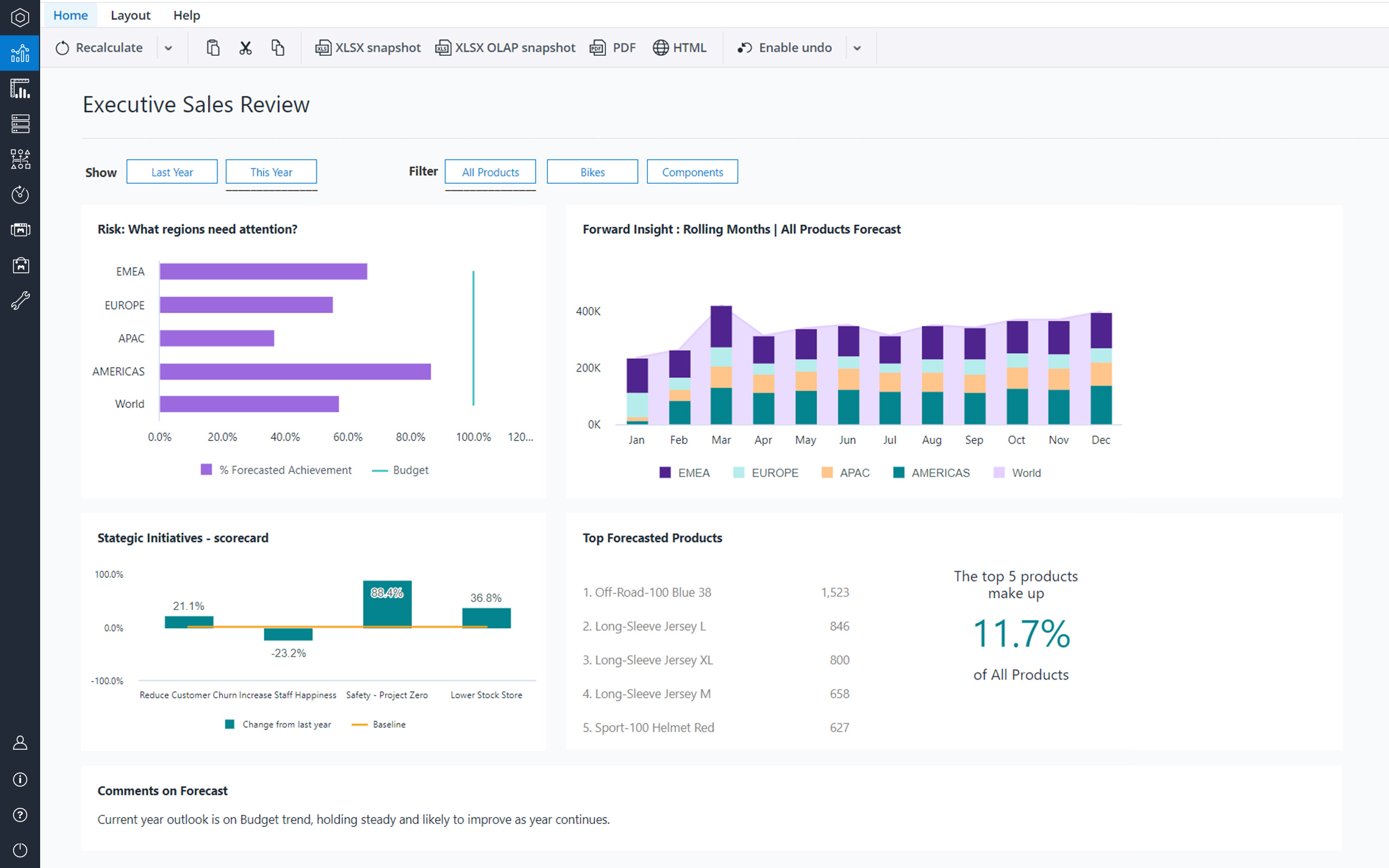
Jedox is a Business Intelligence and Corporate Performance Management solution. According to the vendor, their solution’s unified planning, analysis and reporting empowers decision makers from finance, sales, purchasing and marketing. Additionally, the vendor says this solution helps business users work smarter, streamline business collaboration, and make insight-based decisions with confidence. The vendor also says 1,900 organizations in 127 countries are using Jedox for real-time planning…
N/A
Microsoft Power BI
Score 8.4 out of 10
N/A
Microsoft Power BI is a visualization and data discovery tool from Microsoft. It allows users to convert data into visuals and graphics, visually explore and analyze data, collaborate on interactive dashboards and reports, and scale across their organization with built-in governance and security.
$10
per month per user
Tableau Desktop
Score 8.3 out of 10
N/A
Tableau Desktop is a data visualization product from Tableau. It connects to a variety of data sources for combining disparate data sources without coding. It provides tools for discovering patterns and insights, data calculations, forecasts, and statistical summaries and visual storytelling.
Power BI in some respects is easier to set up using tabular analysis, which makes creating new models relatively easy in comparison to Jedox, however, the DAX language is more complex to learn than the Groovy script used by Jedox. Jedox's power comes in its ability to write …
Jedox has the edge over these products on total cost of ownership, borne through its quick deployment roll out, ease of use for end users and ease of maintenance.
We normally compete with Cognos TM1, Hyperion and SAP BPC. Functionalities, price and implementation time have no comparison. Jedox is a large the leader in these areas.
Verified User
Consultant
Chose Jedox
Setup and maintenance is much easier. Jedox is one product for all purposes: ETL, Excel-Integration, Web-Integration, Mobile. For TM1 you need the full IBM Cognos Suite to achieve the same. You have to install and configure more than 5 GB of software compared to 400 MB of the …
Microsoft Power BI
Verified User
Consultant
Chose Microsoft Power BI
Just because we wanted single-party integration environment and a player which can take ownership of Big Data Analysis. Microsoft Power BI is better in these features as compared to other key BI players like Tableau.
Verified User
Analyst
Chose Microsoft Power BI
Due to microsoft user and all the data into excel it was found more feasible from the organization to get Microsoft Power BI. Also due to access of microsoft licence we don't need to survey other vendors and feasibility. Also price wise it was more competitive then Tableau.
In the case of Tableau or Google Charts, thay have a lack on customization and on the options they have. For Qlik Sense, you need to spend too much time on the data model for doing quick tests or data validation when comparing it to Microsoft Power BI. Also, Microsoft Power BI …
Microsoft Power BI is more easy to use, easily understandable, it's User Interface is good. We can connect to More number of data sources. where as in Qlik Sense it is not providing Row level security like Microsoft Power BI and it is bit costly than Microsoft Power BI. Tableau …
Microsoft Power BI excels against its competition in being a great combination between feature set and scalability. Tableau is more integrated with Salesforce but it has a high starting price point whereas Microsoft Power BI can start out with a single license for less than $20 …
Verified User
Analyst
Chose Microsoft Power BI
I prefer Power BI because of its affordability and fewer complicated tools than Tableau. It's easy to use and compatible with other Microsoft products, which are mostly used in the IT industry. It's not limited to only one platform like Looker Studio, which is mostly used in …
Each has a different function. I think Microsoft Power BI is easier to use than Tableau and cheaper but SQL and databricks have so much more versatility
Power BI is much simple to use, and more modern than BusinessObjects, which has now been discontinued. It costs much less to license than Tableau which is perhaps more niche and designed better. It is also much more powerful for data analysis than excel, Smartsheet, Airtable, …
Microsoft Power BI is free. If I didn't want to create a custom platform (i.e. my organization insisted on an existing platform that I *had* to use), I'd use Microsoft Power BI. For any start-up or SMB, I'd just use Claude & Grok to build it quickly, also for free. Would …
Microsoft Power BI vs. Tableau Power BI cheaper and works well with Microsoft tools. Tableau has better visuals but is costly. Microsoft Power BII vs. Looker Looker is good for big data, but Microsoft Power BI is easier to use. Microsoft Power BI vs. Qlik Qlik is fast for big …
It's got a larger user base and seems better supported. Personally it feels like alot more work getting comparable results from Tableau. Microsoft Power BI will be WAY easier to work with all your various data sources, if you are working in an environment with M365 already. …
Power BI is a great tool to create reports and share data. However, it does not have the budgeting, forecasting and predictive modeling tools we need for our Financial Planning and Analysis part of our business. So we also implemented Vena for our financial reporting, …
Microsoft Power BI is easier to learn, a lot of examples on YouTube, internet documentation books helps to the implementation and personalization of the dashboards easier to use than other platforms.
Some of the strengths are 1. User-Friendliness 2. Self-Service BI (Caters to all levels of the employees 3. Cost-effective. 4. Easy integration with Microsoft Suits. 5. DAX Calculations 6. Familiar Interface like traditional Excel. 7. Easier Self-Service platform for …
We have used Microsoft Power BI for almost seven years. When looking for a reporting platform, remember that you are about to make a long-term choice. Moving reports to another system isn't easy. If you have, for example, more than 100 reports, the move to a different platform …
Microsoft PowerBI is easy to use, has leadership alignment, and is liked by everyone using it in the past and in the current setup. Thus, we decided to continue renewing Microsoft Power BI. We had also evaluated some competitors, but those platforms were not as easy to onboard. …
Overall Microsoft Power BI has more capabilities, it is more customizable and it also has it's own query language DAX which is really powerful for complex calculations and that's something you just don't get in their competitors, also when integrated with the other power apps, …
I selected Power BI because it is the best in all because of its ecosystem and its ability to connect with multiple data source like Microsoft Excel, Microsoft SQL Server, web, analysis services etc. Moreover, its available on both Cloud and Desktop with some pro and cons …
For Visualization and Reporting Power BI is way ahead of MS Excel, not only it has the functionality of MS Excel for cleaning and processing of data in the advance Query tab but also the add-on of more eye appealing and customizable Visualizations. MS Excel is more focused on …
Tableau Desktop can be preferred more over the other Business Intelligence software as it provides data visualization, storytelling and dashboards to a great extent. If you need to do data modelling it might lack a bit and you might prefer going for Microsoft Power BI but …
Tableau Desktop is preferred over other BI software because it allows for more data visualization, storytelling, and dashboards. Microsoft Power BI may be a better option if you need to perform data modeling, however. Tableau Desktop is an excellent tool for nearly all other …
It has a better user interface compared to Microsoft Power BI. The Tableau integration process is quite simple and clear with the third-party application whereas Power BI is not easily integrated with other tools and requires a complex process to follow for integration. DAX …
Both power bi and Tableau Desktop has its own pros and cons. Microsoft Power BI is best to work with Microsoft products. however for fast connection with diverse range of integration with data sources Tableau Desktop is best. if you are cost sensitive power bi is best option …
Tableau Desktop is older and just better overall. It has more capabilities and is more useful to have. I don't think you could have Alteryx as a standalone product like you can with Tableau Desktop. You'd want another bi tool.
Tableau Desktop has a more easy to use drag and drop interface and is easier to learn. It also allows greater customization of charts than Power BI. However, Tableau Desktop costs more than Power BI which is bundled into our Microsoft contract at no additional charge. Power BI …
The visualizations are far and away more powerful and it is more user friendly than Power BI. It would take 3-4 times as long to create the types of reports in Excel that I can create in Tableau Desktop and there are a slew of ways I can present the data in Tableau Desktop that …
Tableau can create visually attractive customizable dashboards than can quickly by drag-drop while in power bi we can create simple dashboard. Power bi support lesser data source while in Tableau there is a lot of options When we talk about data handling tableau is a clear …
Tableau Desktop is clearly one of the best in the business. It has incredible capabilities, and many features are extremely useful. The intuitiveness of the dashboards and the graphical nature of the visualizations are widely used features and super helpful. One of the other …
Verified User
Employee
Chose Tableau Desktop
Tableau Desktop provides some state of the art feature and capabilities that are just awesome. Its support, online blog, and tutorials are better than its competitors. That was the best selling point for me.
With Tableau Desktop, it's easy to create a report in the
context quickly. It allows for the seamless management of the data sources,
which is convenient for the data users. Because it is simple to use, it is
It does have a lot of potential when using Microsoft other technologies - in integration/Embedded, Visuals and connectivity to data sources. Advanced analytics is also smooth when working on python/r scripts. Automated insights are better in Tableau/Alphaa AI. NLG/NLQ - …
For complex data visualization, Tableau Desktop shines. Even though it uses highly granular databases, it has a powerful engine that can process large amounts of data quickly and produce high-quality charts. It has the broadest range of APIs and is extremely simple. The …
Verified User
Analyst
Chose Tableau Desktop
We preferred Tableau over Power BI due to its user-friendly interface and interactive GUI. Since we work with large datasets, we observed that Power BI can deal with only a limited amount of data when compared to Tableau which creates complex visualizations in a time-efficient …
We also use Power BI for small projects and teams that can't afford to pay for Tableau licenses. Tableau has more features and is more robust compared to Power BI. They also provide better and faster support compared to Microsoft. It is the standard visualization tool, but …
We have chosen Tableau [Desktop] for its ability to extract live information from any data source, for its simplicity and simplicity that it has a very short learning curve.
Tableau offers many more tools and features compared to Power BI. The ability to use third-party development languages such as R has been extremely useful in our organization. Other tools such as Power BI can be fast to learn and create simple graphs, but they lack some of the …
Tableau Desktop allows for a lot more customisation then the other products which are more targeted at being easier to use. Tableau is also easy to use for standard analytics and dashboards, but allows advanced users to create more powerful data driven dashboards through its …
I have used Power BI as well, the pricing is better, and also training costs or certifications are not that high. Since there is python integration in Power BI where I can use data cleaning and visualizing libraries and also some machine learning models. I can import my python …
Tableau hands-down wins based upon functionality, interoperability with a wide variety of enterprise-class data connections, end-user support, and quality of visualizations. Tableau Desktop offers a substantially more robust, refined, and mature product. It became quickly …
It is a much lighter, easier to understand tool that can be used by anyone, even non tech people. Also, it doesn't need a Microsoft suite or Oracle suite or any other tools to operate it, unlike other tools. But it is good till the basic reporting. For deep level analytics …
We shifted to Tableau as it performs better than power BI. Tableau can handle data from multiple data sources while Power BI is restricted to limited data sources.
I use both in my Organisation. Both of them have advantages and disadvantages. I prefer Tableau [Desktop] as it provides larger options to play around with the data. Power BI has an advantages that it connects well with the MS application where Tableau lacks.
Tableau was chosen prior to my joining the company, and today I would be hard pressed to choose Tableau over Power BI. This is largely due to the value proposition Power BI represents as it has made leaps and bounds improvements to the tool since its inception. If you are …
Best suited for financial consolidation and / or as a highly customized and compact EPM / BI solution (up to 100 CCU) with individual workflows, planning and reporting functionalities, with moderate number of users (no restrictions for any industry, all industries are covered well). It also has advanced reporting & data analysis requirements and provides an integration and reporting layer of imported data from different external systems (via ETL). It can help with migrating your legacy Excel-based business models to the Web. It is not well suited for Enterprise BI applications with expecting >500 CCU (users at the same time working with the system) - this may cause serious performance issues, as all data is kept in RAM. Jedox is also less suited for applications with heavy document management requirements (document management is not an out of the box functionality in Jedox and rather requires custom development through custom widgets etc.).
Has significantly improved collation of data and visualisation especially with business across Europe. Has given me the ability to see the Site availability at the click of a button to see which Site is in the "money" and seize opportunities based on Market data
The best scenario is definitely to collect data from several sources and create dedicated dashboards for specific recipients. However, I miss the possibility of explaining these reports in more detail. Sometimes, we order a report, and after half a year, we don't remember the meaning of some data (I know it's our fault as an organization, but the tool could force better practices).
Options for data source connections are immense. Not just which sources, but your options for *how* the data is brought in.
Constant updates (this is both good and bad at times).
User friendliness. I can get the data connections set up and draft some quick visuals, then release to the target audience and let them expand on it how they want to.
An excellent tool for data visualization, it presents information in an appealing visual format—an exceptional platform for storing and analyzing data in any size organization.
Through interactive parameters, it enables real-time interaction with the user and is easy to learn and get support from the community.
Diversity. Jedox can be applied to many different use cases from small to large deployments and from budgeting to enterprise class BI solutions. But rarely is one tool able to fulfill all of these requirements in one organisation. This value proposition can be complicated for prospective users.
Awareness. Jedox punches above its weight in capability and scalability, but not enough people have heard about it and therefore procurement processes can be drawn out as a result.
Microsoft Power BI is an excellent and scalable tool. It has a learning curve, but once you get past that, the sky is the limit and you can build from the most simple to the most complex dashboards. I have built everything from simple reports with only a few data points to complex reports with many pages and advanced filtering.
Our use of Tableau Desktop is still fairly low, and will continue over time. The only real concern is around cost of the licenses, and I have mentioned this to Tableau and fully expect the development of more sensible models for our industry. This will remove any impediment to expansion of our use.
To me Jedox deserves 10/10 because it is a consistent one-in-all platform with a modern look and feel. It is intuitive to use and allows you to make intuitive applications integrating traditional business intelligence with performance management functionality. It certainly has a short learning curve, especially for those that are familiar with MS Excel. An example: I've lost count but Jedox it is available in more than 25 languages. Another: Jedox does not require programming skills... it is developed to be used by the business.
Automating reporting has reduced manual data processing by 50-70%, freeing up analysts for higher-value tasks. A finance team that previously spent 20+ hours per week on Excel-based reports now does it in minutes with Microsoft Power BI's automated Real-time dashboards have shortened decision cycles by 30-40%, enabling leadership to react quickly to sales trends, operational bottlenecks, and customer behavior.
Tableau Desktop has proven to be a lifesaver in many situations. Once we've completed the initial setup, it's simple to use. It has all of the features we need to quickly and efficiently synthesize our data. Tableau Desktop has advanced capabilities to improve our company's data structure and enable self-service for our employees.
Jedox has very few bugs. Reports are available through an Excel add-in, the web and/or mobile device (IOS/Android). In my opinion, availability also means high performance, not having to wait for the system to give you the required reports, analysis, dashboards instantly.
When used as a stand-alone tool, Tableau Desktop has unlimited uptime, which is always nice. When used in conjunction with Tableau Server, this tool has as much uptime as your server admins are willing to give it. All in all, I've never had an issue with Tableau's availability.
Tableau Desktop's performance is solid. You can really dig into a large dataset in the form of a spreadsheet, and it exhibits similarly good performance when accessing a moderately sized Oracle database. I noticed that with Tableau Desktop 9.3, the performance using a spreadsheet started to slow around 75K rows by about 60 columns. This was easily remedied by creating an extract and pushing it to Tableau Server, where performance went to lightning fast
Jedox support in general is a professional and fast responding team. An easy-to-use ticketing system is in place. Bug-related questions are solved fast (responses come usually in a few hours after the question), but some questions / tickets, that are not Jedox-related bugs (for example some advanced questions about Jedox functionality), may be forwarded to Application Management team for further processing and then it may take several days or even weeks to get a response here -> there is room for improvement here.
It is a fantastic tool, you can do almost everything related with data and reports, it is a perfect substitutive of Power Point and Excel with a high evolution and flexibility, and also it is very friendly and easy to share. I think all companies should have Power BI (or other BI tool) in their software package and if they are in the MS Suite, for sure Power BI should be the one due to all the benefits of the MS ecosystem.
Tableau support has been extremely responsive and willing to help with all of our requests. They have assisted with creating advanced analysis and many different types of custom icons, data formatting, formulas, and actions embedded into graphs. Tableau offers a weekly presentation of features and assists with internal company projects.
It is admittedly hard to train a group of people with disparate levels of ability coming in, but the software is so easy to use that this is not a huge problem; anyone who can follow simple instructions can catch up pretty quickly.
I think the training was good overall, but it was maybe stating the obvious things that a tech savvy young engineer would be able to pick up themselves too. However, the example work books were good and Tableau web community has helped me with many problems
The implementation of SSO, SAML Authentication, HTTPS, Server splitting (Frontend / Backend servers) could be more standardized and made more user friendly to set up (e.g. via setup guide). Otherwise the implementation of Jedox is quick and simple when compared to other similar technologies.
Again, training is the key and the company provides a lot of example videos that will help users discover use cases that will greatly assist their creation of original visualizations. As with any new software tool, productivity will decline for a period. In the case of Tableau, the decline period is short and the later gains are well worth it.
Calumo is similar product to Jedox. I have used it extensively in my previous role. It was a major contender when we evaluated a BI platform for NIDA. Calumo is a great product as well and it was a very close call. Where we found Jedox to be a better fit for NIDA was the ability to prepare dynamic reports with ease without the need to learn MDX which was used extensively by Calumo to make dynamic reports which expand or shrink based on the underlying data. Another major benefit we saw in Jedox was the whole ETL process could be managed within Jedox instead of doing it in SQL server which negates having a dedicated SQL specialist role when the scale expands.
Microsoft Power BI is free. If I didn't want to create a custom platform (i.e. my organization insisted on an existing platform that I *had* to use), I'd use Microsoft Power BI. For any start-up or SMB, I'd just use Claude & Grok to build it quickly, also for free. Would not pay for Tableau or Sigma anymore. Not worth it at all.
I have used Power BI as well, the pricing is better, and also training costs or certifications are not that high. Since there is python integration in Power BI where I can use data cleaning and visualizing libraries and also some machine learning models. I can import my python scripts and create a visualization on processed data.
Scalability is often another word for speed. Given enough data, enough users or enough calculations, the tool becomes slower and slower. You will find that Jedox has a very high performance that can even be increased by the use of grafical cards. Other thaen that it does not only offer BI (looking back based on historical ERP data) but also allows you to look forward through integrated budgetting, planning, forecasting, workflow and collaboration. Not easy to find a tool that can support so much business functionality. So, also pretty scalable in that respect.
Tableau Desktop's scaleability is really limited to the scale of your back-end data systems. If you want to pull down an extract and work quickly in-memory, in my application it scaled to a few tens of millions of rows using the in-memory engine. But it's really only limited by your back-end data store if you have or are willing to invest in an optimized SQL store or purpose-built query engine like Veritca or Netezza or something similar.
Financial budgeting and Forecasting are done in a centralized fashion in Jedox now instead of a decentralized excel based approach. A lot of cost savings and improved reliability
Easy to use self-help Dashboards and detailed reports
Tableau was acquired years ago, and has provided good value with the content created.
Ongoing maintenance costs for the platform, both to maintain desktop and server licensing has made the continuing value questionable when compared to other offerings in the marketplace.
Users have largely been satisfied with the content, but not with the overall performance. This is due to a combination of factors including the performance of the Tableau engines as well as development deficiencies.