TrustRadius: an HG Insights company

Heap

Score8.2 out of 10

383 Reviews and Ratings

What is Heap?

Heap is a web analytics platform captures every user interaction on web iOS with no extra code. The tool allows you to track events and set up funnels to understand user flow and dropoff. It also provides visualization tools to track trends over time.

Media

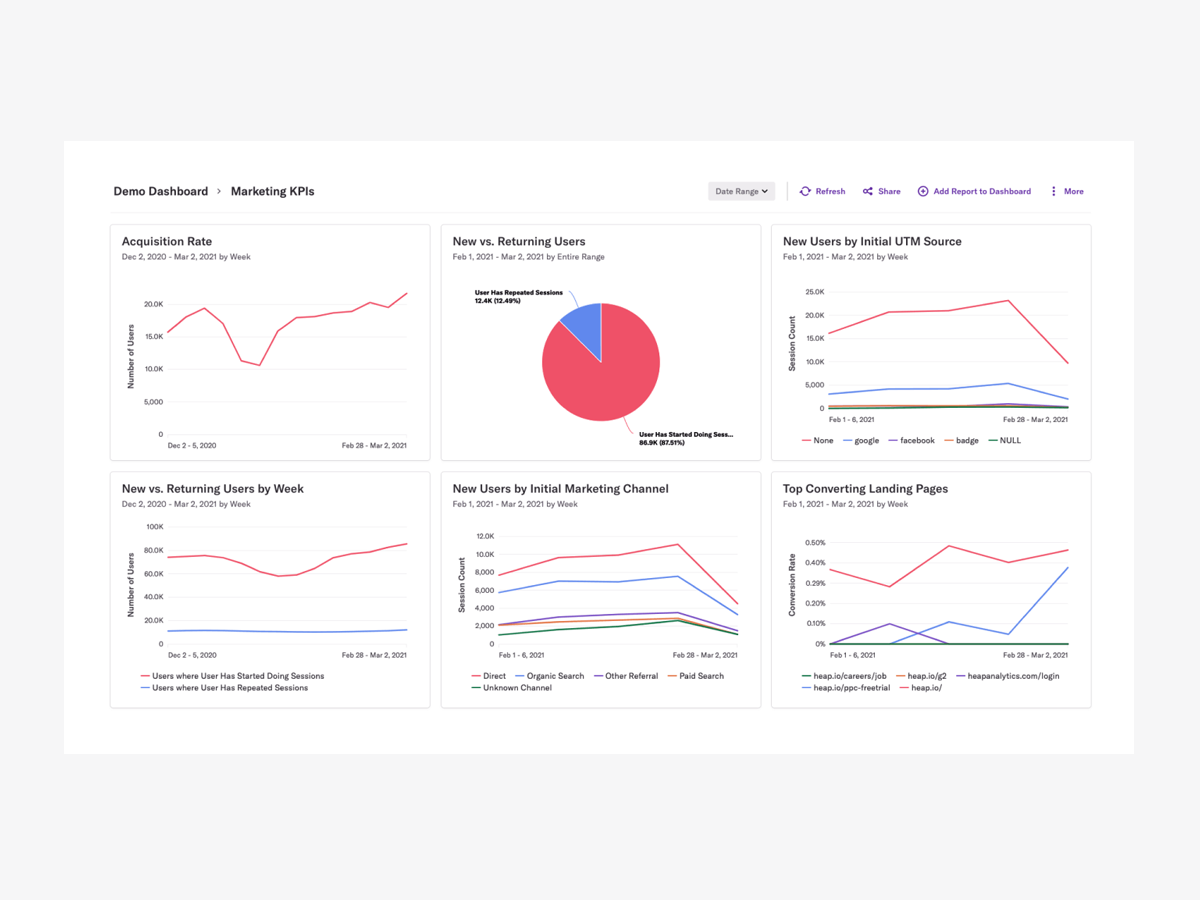
Dashboard in Heap (Use to get Product or User Behavior Insights)
Effort Analysis provides the first-ever quantitative measurement of user friction, capturing the difficulty users face when moving through every step of every user flow across the digital experience.
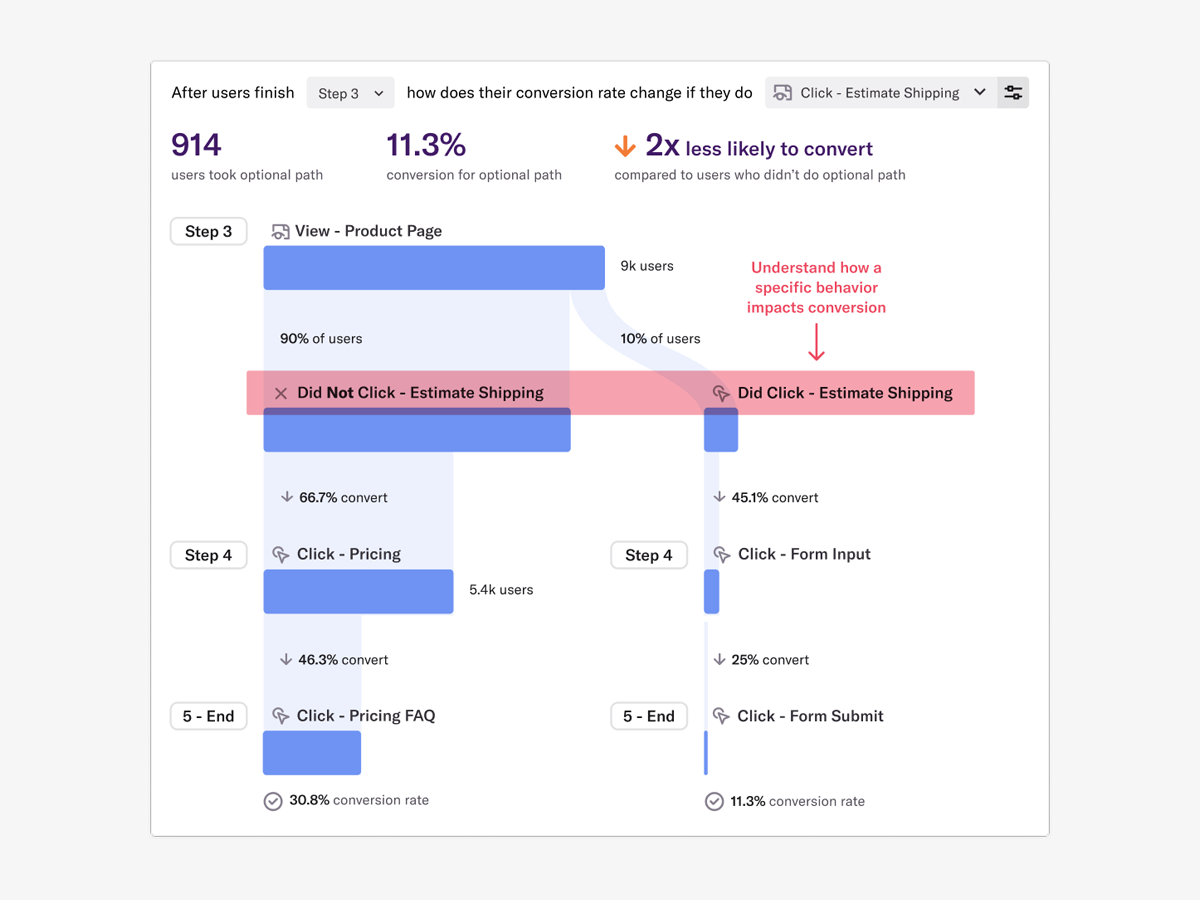
Heap Illuminate looks for the most common events between two steps in a funnel and generates a Top Events table that displays how well paths including different events convert to the next step so you can understand how that behavior is helping or hurting conversion.
From Top Events you can choose an event and use Path Comparison to fork your funnel and see how the selected behavior impacts conversion downstream.

1 / 4

Powerful Auto-Capture Tool for Data-Driven Product Teams

Use Cases and Deployment Scope

We are a SaaS based enterprise specifically focusing on e-commerce and digital services. While Heap is primarily used for Product Analytics and User Behavior Tracking within our organization. We do in depth analysis of how user interacts with our platform such as sign up flows, checkout pages or content engagement. Before Heap we seriously face challenges in identifying drop off points and user friction areas and substantially requites our back end team monitor every tracking change. On the other hand Heap solves this issue drastically by providing auto capturing of events which significantly reduces manual intervention. This all together saved a lot of time and improves agility. From a business point of view our Market and Product teams utilizes Heap to prepare data driven strategies. We can now quickly test UI changes, Monitor conversion funnels and identify touchpoints drive the most engagement and revenue. Heap is a powerful tool for an organization looking to prepare planning roadmap and to significantly improve customer experience.

Pros

  • One the most interesting feature Heap provides is Automatic Event Tracking. Unlike other traditional tools that requires manual intervention Heap does it automatically by capturing all user interactions by default.
  • For example when we launched a new pricing page we were able to instantly analyze user behavior. All this has made it easy which pricing plan clicked most and where users drop off. This helps us to identify that users were not engaging with specific part of enterprise plan section and leads us to reposition it for better visibility.
  • Heap excels in building funnels on the fly. With traditional tools we had to define conversions but with heap can retroactively creates funnel using existing event data. For example if we tracked how many users went from blog spot to product signup and then to activation this all can be done with great ease as Heap tracks and captures all the necessary events.
  • Heaps Visual interface is quite easy to use and is not overwhelming for beginners. Even non technical team members from marketing and customer services can pull the insights on there own.
  • User Segmentation Feature is quite powerful, We can break down user properties like devices, Type, Location, Traffic Source and compare behaviors helping us provide personalize UX improvements and increase conversions.

Cons

  • Users unfamiliar with product analytics can find it overwhelming. As well as terms like "session replay", "properties", "virtual events" can be bit confusing at first and learning resource should be more beginner friendly or interactive.
  • Sometimes there is a noticeable delay in data availability. Especially for large data sets or High traffic days. Heap must work on real time data analytics as these lags and delays one can not rely on it while product rollouts and campaign launches.
  • Heap works as a great web platform but its mobile analytics capabilities are still not mature.
  • For small enterprises Heaps pricing could be unpredictable as it doesn't offer clear public pricing. It would be really helpful for enterprises if they had a very clear pricing plan.
  • Heap leads in event based analysis but reporting customization is limited to other BI tools like Tableau or Looker.

Return on Investment

  • While using Heap my teams does not require to set up codes in most of the cases
  • Users can get seamlessly fast insights as well as drop off usage points
  • It can easily be integrated with other third party software like Salesforce, Slack, HubSpot and segment
  • It has a very user friendly UI
  • Pricing of Heap can be overwhelming for small enterprises
  • User must be technically sound to use certain features of advance analysis

Usability

Alternatives Considered

Google Analytics

Other Software Used

Mixpanel, Hotjar, Google Analytics, Notion

Great for Quick Data Analysis

Use Cases and Deployment Scope

We use Heap across the company to track experiments and core business metrics. It helps us in making product decisions and [tracking] marketplace health.

Pros

  • Identifying the results of new user interactions through the website
  • Measuring user dropoff during larger user journeys
  • Analyzing the results of A/B experiments

Cons

  • Easier onboarding experience for users with minimal data analytics experience
  • Ability to write direct SQL in the platform
  • Auto generate event names to save time

Return on Investment

  • We've driven reductions in drop-off for new user journeys
  • Helped us iterate on carousel tests to see which performed better
  • Driven additional opportunity areas to target better user upsells

Alternatives Considered

FullStory

Other Software Used

FullStory

The collection and processing of data is automated.

Use Cases and Deployment Scope

The use of Heap in the company is focused on the development of automated data collection and processing systems. [We use this] to obtain a complete analysis of different areas that require tools with robust analysis systems that can provide verifiable reports to know the possible changes that we must perform. [This allows our] clients [to] feel that we are continuously working to satisfy their needs and also to increase our vision of events and projects in relation to the data that we manage to process in Heap. Although Heap is not the only solution that we are implementing to perform data analysis of the behavior and interests of customers in the company, we can use this tool for more specific aspects that result in productivity growth in high percentages.

Pros

  • Robust automated analysis of customer behavior and interests helps make the necessary changes.
  • Heap has a fast and powerful data collection and processing system that takes into account every specific detail related to the web.
  • It also generates reports after data analysis that help my team to know the possible changes that we must make.

Cons

  • Heap is an intuitive tool that has good analytics and I don't really see anything negative about this product.
  • The usability is good, the technical support is attentive, it performs automated data analysis and also generates robust reports, these are the best features of this software and they are the ones that give me a satisfactory opinion.

Return on Investment

  • We have achieved a significant increase in our productivity in [the] analysis of behavior and customer interests since the implementation of Heap in the company, we have the data collected instantly and with easy to understand reports for all users, this is what Heap does a better job and the ROI has met our expectations.
  • The cost of this tool is the most appropriate for the company, the quality and price ratio is at its best levels and we have confidence that thanks to Heap and we can know what changes we must make and this translates into the growth of the productivity.

Heap - a great Digital Insight Platform

Use Cases and Deployment Scope

As an implementation partner, I was tasked with product comparison and choose between various marketing analytics platform. We did a comparitive analysis between Heap and Google analytics. The scope of my use case was

1. Reduce dependency on engineering team to generate perpetual dashboards.

2. Provide real time data insights for re-marketing and personalization.

3. Quick and continuous site(s) level implementation, based on data insights.

4. Side by side comparison of historical data

Pros

  • Realtime interactions which are captured automatically is a unique feature which no other product offers.
  • Low code implementation is a big plus for marketing teams, as there is less dependency on engineering
  • Detailed customer behaviours can be studied with captured replay sessions
  • Due to all the above points - it helped to improve customer experience

Cons

  • During our analysis, I could not find any such area of improvement as of now.

Return on Investment

  • Implementing Heap would surely help increase revenue as more insights can be tracked for customer journeys
  • Reduced engineering efforts significantly - so this is another area of cost savings.
  • Marketing team can be more customer focused through session replays and personalizing customer experience - leading to increase in customer base and retention of existing customers

Alternatives Considered

Google Analytics and Google Analytics 360

Other Software Used

Iterable, Smartling, Optimizely Web Experimentation

Heap: Identify your website logical path to improve sales.

Use Cases and Deployment Scope

The best tool to research user behavior in a storefront sales website. It gives information about the user's path from the website's landing from marketing campaigns or search engines. With this tool, you can track the reasons for a customer to shop and pay and what happens when your storefront does not succeed in a sale. You can research if a logically broken path is affecting your online sales.

Pros

  • The path from website landing until the sale success.
  • Identify the possible broken logical path that is avoiding the sale success.
  • Machine Learning to identify the customer navigation trends in your website.

Cons

  • Measuring of website performance to see if the server is deliving content fast.
  • Machine learning time series of customer visits.
  • Grouping statistics to identify geographically the website sales.

Return on Investment

  • Website design to create accurate logical paths for the customer.
  • Clear development methodology for website programmers and graphic designers.
  • Use of Machine Learning to identify the navigation trends of the customers.

Other Software Used

Dynatrace, Elasticsearch, Kibana