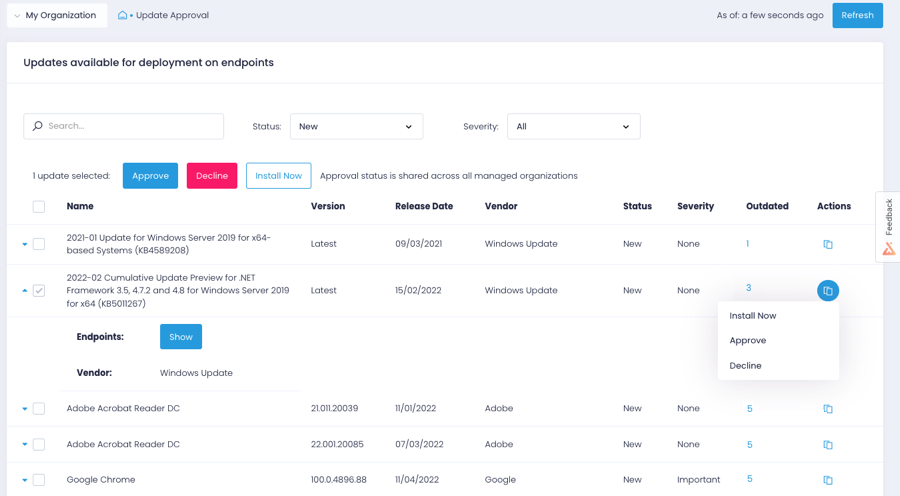
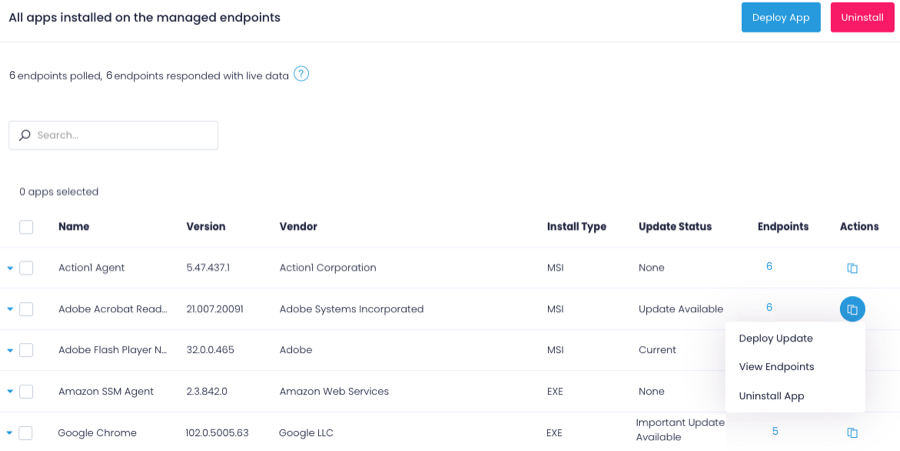
Action1 is an autonomous endpoint management platform that is cloud-native, scalable, and configurable in 5 minutes. It is free for the first 200 endpoints, with no functional limits. By pioneering autonomous OS and third-party patching - AEM’s foundational use case - through peer-to-peer patch distribution and real-time vulnerability assessment without needing a VPN, it eliminates costly, time-consuming routine labor, preempts ransomware and security risks, and protects the digital…
N/A
Automox
Score 8.7 out of 10
N/A
Automox is an endpoint management platform built for the era of autonomous operations. It provides a cloud-native foundation that unifies automation, speed, visibility, and trust.
N/A
Pricing
Action1
Automox
Editions & Modules
No answers on this topic
Offerings
Pricing Offerings
Action1
Automox
Free Trial
No
Yes
Free/Freemium Version
Yes
No
Premium Consulting/Integration Services
No
No
Entry-level Setup Fee
Optional
No setup fee
Additional Details
—
Automox can patch macOS, Windows, and Linux endpoints with PatchOS, an offering at $1 per endpoint/ month with an annual commitment.
The Automate Essentials or Automate Enterprise packages are for scaling IT automation, endpoint configuration, and software updates.
Modules are available with Automox Assist, a one-on-one remote endpoint control and assistance for helpdesk technicians.
While other RMMs may only be good at one thing, Action1 is really good at everything that their does. If they don't have it in the platform yet, that's because it's not good enough for their standards. From a pricing standpoint on Patch/Software management there is no match for …
Action1 has a sweet spot with the functionality it provides at a great price point. The product is not overwhelming yet continues to grow with functionality that customers request.
Freshdesk and Freshservice are great products with Freshservice being the better of the two. However, in comparison to Action1 with regards to our budget, it was an easy choice to select Action1. I selected Action1 not only because of the "free" price tag, but also because I …
Aforementioned regarding the high cost of Lansweeper. In my experience, it also has a greater effort to configure and isn't as easy to deploy and customize out of the box. In my opinion, their platform is built around the assumption everyone is a long-time customer and/or a big …
To be honest, I might have been lucky, but Action1 was the first I actually tested. I've heard from our mother company from Italy, that they have tested NinjaOne but it was not what they were expecting in terms of vulnerability and patch management. I've recently suggested them …
GFI Languard was pretty nice, but that was ages ago. I do pay for PDQ deploy and inventory though and am happy with that software...however, while its feature set does overlap with Action1, it is not just another flavor of the same thing, so I find that I use both of them.
Action1 excels with patch management and their ability to show if applications have been marked as vulnerable. It is also hard to beat their free model where the first 200 are free. When I first started with Action1 it was only 50 endpoints so seeing that expand so much is …
From a functionality point of view the platforms are very similar, when we worked with NinjaOne they tried the hard push for us to onboard our entire organization. We didn't want that and they refused to scale down to the requirements of our small satellite office (<10 …
For the amount of functionality you get with the cost, no other product compared to Action1 did. The free trial and free endpoints they offer help prove there is no time trial to rush and select a product. The support has been fantastic with the company as well as the Action1 …
Action1 is a similar but less feature-filled product than ConnectWise or Kaseya. However, Action1 can fulfill the main use-case scenarios of both products at a much lower cost per endpoint. Action1 is also constantly innovating and working with its users to improve upon the …
Price for one. The cost is extremely reasonable IMO. Action1 is easier to use for a non-technical person and there is zero maintenance since it is cloud hosted.
After looking at different solutions, Action1 [Cloud Remote Monitoring and Management Solution] was the perfect fit for us that delivered all of the features we wanted without being as costly as some of the others alternatives we've looked at. There was no minimum endpoint …
Action1 Cloud Remote Monitoring and Management Solution may not be as feature rich as SCCM and Intune, but it does its job without having to set up and support additional infrastructure on your network. It's more user friendly than ManageEngine's Desktop Central but does most …
It has a broader set of capabilities than Automox (which we underutilized). However, Automox's cloud-native architecture and simpler administration were better suited for supporting our remote employees.
Automox is definitely better than Intune as it is way more compatible with other operating systems, as well as allowing patching for third party apps. Intune does have other features but thats because it is basically something else entirely. Automox has 1 goal and it achieves …
Automox is a modern, simple-to-use, and powerful tool compared to the others we evaluated. The POC and deployment process were smooth, and pricing was competitive.
I have used Tenable Patch Management, but the reason I did not go with it is because it uses on prem servers that we have to host instead of using Agent and cloud platform like Automox.
I feel like that is dated as most solutions are now changing into the cloud solutions.
Specifically for patch management, Automox is one of the most user friendly options available. The ability to customize packages and target specific machines makes it a very useful tool. It's definitely a stand out software out of the options available.
worklegs are more advance on Automox, and the reports on Automox give you more detail information, the patching support is better on Automox, Atera can be simple but effective. However, Automox is a more efficient tool and like said before, better for large counts of devices. …
We felt that Automox provided us with the functionality our MSP offered, including OS and device patching, as well as remote control capabilities, but in a better and more manageable way. We also felt the usability of the tool gave us the ability to be effective in our way of …
Automox has a much better user interface. Much simpler to use and share tasks with other team members. They offer great additional training and certifications to help you become an expert.
We chose Automox for it's clean/easy to use UI, remote control capabilities, and automation/patching. The balance of effectiveness and cost made it the best choice for our org
While not a direct analog, we have noted that our A/V provider also handles patching. That being said, the solution is not as al la carte as Automox, and requires much more thought to implement. Automox is a favorite for its lightweight nature and it's time to implementation …
All of these other products are overly complicated with user interfaces that are not very friendly.. too technical, even for IT pros. They are also expensive for smaller companies or those with limited IT budgets. I've found that these other solutions are really geared for …
Automox has a could based console and platform which can cater the computers outside the network. It's not possible in Lan Guard. Also Automox support cross platform and have a very big 3rd party application support than intune. So better to go with Automox
Cloud-based solution with no need for on-prem infrastructure. Support Windows, macOS, Linux, and third-party applications. Cost-effective solution compared with other vendors.
Compared to these solutions, Automox outranks them as the Automox is highly personalized for different types of device types. It supports Windows, Linux, and macOS devices very effectively. Other products are also support other types of devices, but not this much of control can …
Automox is by far the easiest to use and does a better job patching. The built in AI tool is a real time saver making writing Powershell scripts quick and easy.
Any place that has multiple computers that need to be managed can benefit from using Action1. Currently that means Windows PC's and servers, Linux PC's and servers and devices running MacOS can be managed by Action1 and benefit from their patch management and software management tools. Mobile OS need not apply at this point.
Every organization would work better with Automox on board. It not only approaches patch management as a whole, but also ensures that our third-party applications are secure against all vulnerabilities. It ensures that we keep track of all software and hardware in our OS. As a health tech company, we cannot overemphasize the need for Cybersecurity compliance.
Automations. We utilize scheduled tasks that we define within Action1 to provide additional controls for reporting, alerting, and for endpoint management. It is a unique way to expand functionality by use of centrally managed scripting events.
Able to create and view reports showing detailed information of all types of endpoints within my enterprise. We can also create custom reports from a large set of available data points and can also create custom alerts based on these data points.
Vulnerability detection and resolution management. Able to detect vulnerabilities and apply controls or actions based on the vulnerabilities found. Along with the Security patching, this adds and extra layer of visibility and control to secure my environment.
Custom application deployments. Action1 provides a large set of third part applications you can deploy and patch updates for, but if you have custom applications built in-house or just an application that is not available in the software repository that Action1 has, you can build your own custom deployments easily.
The deployment screens for update deferrals can be hard to understand at first and easy to skip since it carries some default info when you create a new automation rather than a more conspicuous prompt to update.
There exists an issue where you register some Amazon AMIs, which in even samples of 4 or 5, sometimes contain a duplicate identifier. Automox has provided a fix document, but it requires manual intervention and digging to discover this. I think they should identify a better way to assign UUIDs to machines, as sometimes registering too many VMs makes others "fall off"
This is a software that just works. Once configured its a set and forget kind of tool that keeps things up to date and alerts me if something is wrong. I was able to work through an expansion project to deploy an additional 500 devices in almost no time and create a robust self-patching environment.
Easy to use. Straight Forward. No hidden settings or stuff that's buried several layers deep and you have to watch a video before you do it. Point. Click. It works and I can feel assured that my CVE issues are being handled.
It's great at what it does. We're able to veiw endpoints that are online in real time, and run scans on them to ensure they're still compliant. The software itself is very easy to use and set up on end points, with the main admin portal having a clean and very easy to understand set up
I did not need to reach out to support often but when I did the answers were relatively correct and they were answered quickly. The only thing I might "ding" their support on was their lack of understanding of OS's different from Windows and especially Linux. Other than that I was satisfied
Implementing Automox successfully starts with a clear strategy for organizing and grouping devices based on operating systems, environments, or business criticality. This ensures that patching and configuration policies can be applied with precision. A phased rollout approach is essential—beginning with a pilot group allows teams to test patching schedules, reboot behaviors, and custom Worklets before scaling across the organization. Leveraging Worklets from the start can significantly boost automation by enforcing security baselines and performing routine system tasks. Integration with existing SOC tools, such as SIEMs, enhances visibility and response time by correlating patch compliance with threat intelligence. Additionally, aligning patching schedules with operational downtimes minimizes disruptions, and consistent monitoring and reporting helps maintain compliance and prepare for audits. Overall, Automox offers a streamlined and effective solution, but its true value is unlocked through thoughtful planning, testing, and integration with existing IT and security workflows.
Freshdesk and Freshservice are great products with Freshservice being the better of the two. However, in comparison to Action1 with regards to our budget, it was an easy choice to select Action1. I selected Action1 not only because of the "free" price tag, but also because I didn't need a full fledged ITSM product. Action1 is cheaper, easier to setup and use, and is cloud based as well so you don't need to install it on a server to utilize.
I have used Tenable Patch Management, but the reason I did not go with it is because it uses on prem servers that we have to host instead of using Agent and cloud platform like Automox. I feel like that is dated as most solutions are now changing into the cloud solutions. Tenable system is also very hard to navigate and complex policy which makes it hard to get anything done.
It's pretty hard to negotiate investments / costs in IT when you have a small team in a mid size company. Everything is seen as useless cost and not investment. As of now, I'm pretty sure that if we ever cross the free-tier, I'll have no problems with investment approval since the tool is proven and useful on a daily basis. I believe this was the single most importat decision that Action1 took in their sales model.