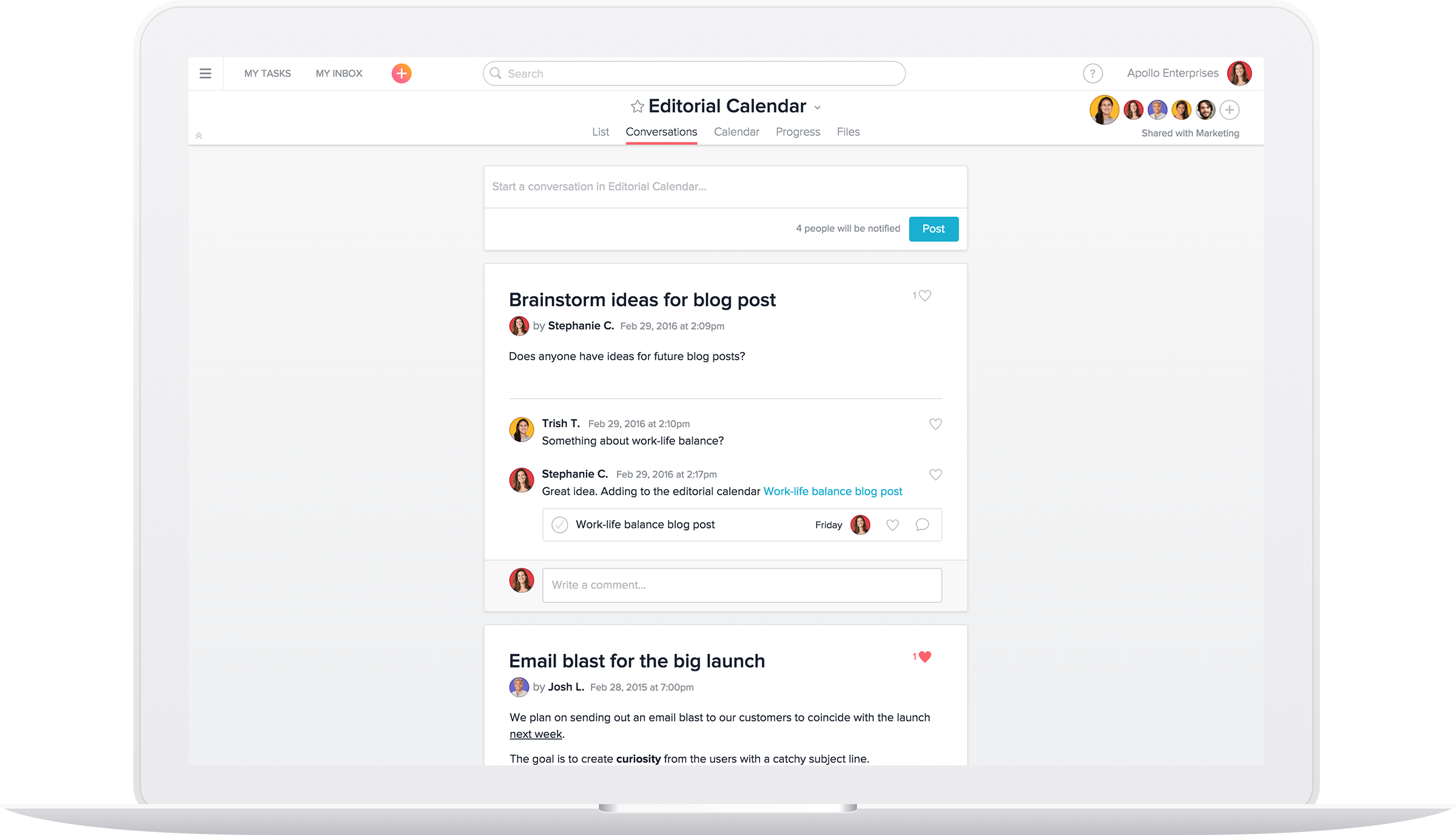
Asana is a web and mobile project management app. With tasks, projects, conversations, and dashboards, Asana lets an entire team know who's doing what by when, enabling workload balancing. Users can also add integrations for GANTT charts, time tracking and more.
$13.49
per month per user
Quickbase
Score 8.6 out of 10
N/A
Quickbase helps users tackle any project, no matter how complex. Quickbase helps customers see, connect and control complex projects. Whether it’s raising a skyscraper or coordinating vaccine rollouts, the no-code software platform allows business users to custom fit solutions to the way they work – using information from across the systems they already have.
$700
per month
Pricing
Asana
Quickbase
Editions & Modules
Starter
$13.49
per month per user
Advanced
$30.49
per month per user
Enterprise
Contact Sales
Personal
Free
Enterprise
Full Customizable
per month/billed annually
Business
Starting at $2,200
per month
Team
Started at $700
per month
Offerings
Pricing Offerings
Asana
Quickbase
Free Trial
Yes
Yes
Free/Freemium Version
Yes
No
Premium Consulting/Integration Services
No
No
Entry-level Setup Fee
Optional
Optional
Additional Details
A discount is offered for annual billing.
Quickbase offers three key plans, with feature distinction, simple and consistent entitlements, and a flexible licensing model, giving users the option of either user based or usage based licensing across all 3 plans.
Asana is a highly effective instrument for managing teams and projects. The paid edition provides a multitude of features that can be tailored and used in accordance with the organisation's specific requirements.
Email integration facilitates notifications that remind team …
Overall for the money Asana brings a lot of value for organizations who want to do more with less and need a task and project management solution as a small company is growing and scaling to get to the next level. In the space when we evaluated didn't find a lot of other …
Against Jira it offers a more modern experience with less complex user interfaces. The admin and setup experience is also way faster with less (or no) legacy complexity.
Against other modern players like Linear and Basecamp it offers way more integrations so we can pull in data …
Asana is a top-tier project management software that helps us organize and track projects from start to finish. It allows us to apply tasks/to-dos to multiple projects without duplication, divide complex projects into smaller tasks, and track project progress. It also helps us …
Asana provides a mix of features between notion and Jira. Unlike Notion, it helps ease up the collaboration on vast projects and between multiple teams. Jira proved to be a little expensive with similar set of features if not more and which is why we thought of going with Asana.
I believe that Asana is more professional than Trello. I used Trello a long time ago, but it looked more suitable for a student project rather than for a professional team or business environment. I believe it has great features to help companies in different stages and of …
Since I have tried the two applications and saw their advantages and disadvantages, I see that Asana is much better in terms of dealing with files, ease of use, and the many features and characteristics that it has. Also, I noticed that it does not consume much space on my …
Side by side with the other two Asana by far beats Monday.com and is comparable and slightly better than ClickUp. Monday is completely browser-based and is hard to navigate and figure out how to set up. Asana and ClickUp are the exact opposite. Both are easy to set up and …
I like how extensive the capabilities are for Asana. With other softwares it seems there are many things lacking. I feel like Asana is also a very user friendly platform and aesthetically pleasing which is important in a modern office. We have many young people entering our …
Asana compared to Jira is certainly better in terms of user experience, since most of the people can start using it basically without having any kind of training or previous explanation, which makes it really useful not only for people already used to project management but …
Asana is amazing for a remote team, that we are currently as its accessible seamlessly to all our team member no matter where they are in the world. Its very easy to onboard new members to this platform as its very intuitive and easy for new people to get a hang of it. It has …
Basecamp was a great tool, but it was paid and things like recurring tasks and opening new projects was a pain. Asana, as a free tool, has been better for our organization as it serves the basic functions very well and is not complicated otherwise. I really like the …
Quickbase is pretty easy to use, user friendly and simple dashboard. Anyone can easily use Quickbase without any prior knowledge. This is efficient and fast performer. You can prioritize task easily . You can manage lifecycle of prospects effectively . Good reporting features …
Microsoft tools are functional but they are not necessarily created for scalability. As our contract scaled, we needed something that had the capability to consolidate data as well as handle more and more amounts of data and analysis. Quickbsae has also helped us stop working …
I picked Quickbase before investigating the low-code no-code market because I was so impressed. I did a pricing exercise a couple years ago because Quickbase was drastically increasing the cost and decreasing our allotments/features. We could have saved a lot of money by going …
Some will tell me they don't use Quickbase because they already have Excel. I always take that opportunity to explain how they're missing out by not converting that Excel sheet (which takes less than 1 minute to convert) into a Quickbase tool. The functionality that Quickbase …
Compare to excel Quickbase is having so many advanced features which help users to solve different scenarios of real time problem. excel can only store and sort the data according to our request. Pipelines, notifications, reports, charts, formulas, forms these are the advanced …
Quickbase stacks up against them because it's speed of delivery is not only important for development but also for true change and lifetime, which are remarkable tools.
Out of the box softwares come with out of the box assumptions that are difficult to mold your workflow to so companies generally adapt part of their workflow to how the software works and then when that fails revert to doing it outside of any system. Quickbase does the opposite …
Quickbase is highly flexible for application development. Other vendors also provide customization options, but Quickbase is preferred because it is more flexible and provides more custom options. Also, Quickbase is preferred because it is easier for data handling. Other …
We've looked at Microsoft Power Applications and use them where appropriate but its limited and they are not as agile or as clean looking as Quickbase and requires more build time to deliver similar outcomes.
Well, there's a plethora of low-code tools out on the marketplace and, you know, there's a reason that we've decided to partner with QuickBase because it has all the right balance of the ability to integrate with the ability for a citizen developer to create apps successfully. …
QuickBase is really the first product like itself that I've used. I mean, granted I lived and breathed in Excel in my past career, and being able to see what you do in Excel and bring it to life in a totally different aspect to an application in QuickBase is just taking it to a …
The usability of Asana is broad since it's available in a variety of platforms that are widely used nowadays. I think that it would be great for people who are constantly on the move and switching devices, since it has allowed me to work from my phone, too. I also think that Asana has proven itself to handle a large quantity of work
Quickbase has proven that if it's in a spreadsheet, it really should be in Quickbase. One of my more recent achievements with the program was redesigning our current process for notifying management of something irregular. The old process had all the notification infrastructure built behind the scenes with only a handful of people knowing and understanding the process. The new process was able to clean up the behind-the-scenes and also provide an increased level of intuitiveness by allowing complete visibility and customization of notification recipients. This allows the initial notification to reach a select number of management individuals who can then decide whether or not it needs to be escalated, all while allowing the operations personnel to get back to work immediately. The biggest issue I've found with the program is the limitation of the user - I find that the biggest roadblock in my way is myself, as I am confident the program has the ability to accomplish what I need, but am I skilled enough to create it? This has helped me become very proficient in only one year of use and become more active in community engagement surrounding the program.
Pipelines - being able to share them or have permissions based viewing capabilities
Table size limits are small for really large apps. While I agree that there needs to be a cap on the size, it would be nice to adjust it up when needed.
I just can't see us getting it off of Asana any time soon, despite the many headaches it has caused us. We have too much data in there, too much time & training invested into it, too much at stake to move. If we were just starting out today, fresh, I don't know for certain that I would absolutely go the same direction, but I *think* I still would. I just haven't seen anything better yet. Maybe if Podio's support staff hadn't treated me like a worthless nuisance to them, I might feel differently, but the fact is that their task management is simply inferior to Asana's. That can't be denied, and in fact Podio said it themselves: "Tasks are a simple function. They cannot be customized. Tasks in Podio can be used for quick to-do's for you and your team members." In our operation, however, prompt task completion is a big deal; one task can't be completed until another one is done first, and closing the gaps between those tasks is critical in meeting deadlines and servicing our customers. Asana gets us there, the others don't.
We are growing our user base and getting more out of this system. Quick Base will continue to grow with our company as more of our users become super users and are capable of developing new features and solutions. We're getting more and more interested from departments that are hearing of our successes.
It is very user-friendly. Takes a new employee an hour to start figuring out how the system works. That's an important factor. You don't want to encounter the issue where employees need a week to understand how the system works. For example, JIRA, I tried using it for a week and I still don't understand the complicated layout. Asana has a simple interface. Once you see it, you get it type of program.
Quick Base has done everything we have asked it to do and then some. Our original goal was to have one system for CRM that encompassed both the sales process and the customer management. We have gone w-a-y beyond that with analytics, project management, system bug logging, and historical effort reporting.
I gave it a 10, but it should be a 9.99. They do a nice job of keeping the application running. The application can drag a bit when you have thousands of users accessing the application concurrently. We experienced this with large scale implementations.
Some of our tables that hold over a million records are starting to perform poorly, with some summaries taking over 20 seconds to load. This may be an indication that it is best to archive old data when reaching large volumes like this.
I haven't had to use their support so I can't rate it. The fact that I haven't needed them reflects the ease of use of the product. I would recommend that any new users schedule a complete demo of the product to ensure that they are using it to it's fullest (there's a lot of useful features).
If you utilize the community, the support is amazing. Unfortunately, I find their actual support system a bit underwhelming. They don't seem to have a great process for interacting directly with an issue and often sweep significant issues under the rug by categorizing them as "Enhancement" ideas or legacy items.
Quick Base already is having a separate portal of providing training to customers and it is very easy to use and updates as per the new features added in to the application
I was not directly involved with the initial account implementation, only a bystander. For the app I directly implemented for my department only, I wish I had know to create an app diagram first. I don't remember if that was suggested. I think that would be a great help tip tool when a new app is created, to have a page with a check list of what is needed or how to get started. If you are a regular app builder, then you can bypass it or have the ability to turn it off in the app settings.
Asana is a top-tier project management software that helps us organize and track projects from start to finish. It allows us to apply tasks/to-dos to multiple projects without duplication, divide complex projects into smaller tasks, and track project progress. It also helps us organize work on Kanban boards or linear lists. It stands out from the crowd in a big way compared to the competition.
I picked Quickbase before investigating the low-code no-code market because I was so impressed. I did a pricing exercise a couple years ago because Quickbase was drastically increasing the cost and decreasing our allotments/features. We could have saved a lot of money by going with another comparable solution. However, those companies didn't have the longevity and all of the features and functions that Quickbase had.
While the purpose of this product is to provide flexibility and scalability to and organization, it is not as easy to roll out on the enterprise level. The support from Quick Base is not on a level that it makes the process easy and fluid. Be prepared to spend more time on this product than you might want to.
Quickbase has saved us so much time by reducing the clicks you need to get from one place to another. It takes the average colleague 5 or 6 clicks to get to another tool they need to do their job whereas it takes me 1 or 2 clicks to get to that same tool by using a personal Quickbase dashboard that has all the tools I need all on one page. This is a huge timesaver, especially when desk sharing where you have to get quickly to the info you want to share.
Quickbase has helped us streamline workflows and close gaps by having to ask for info only 1 time. Since users can't save a form until they've provided all the info you need on your end to complete a task, it saves a tremendous amount of time for everyone. No more replying to emails 2 or 3 times until you get the info you need.