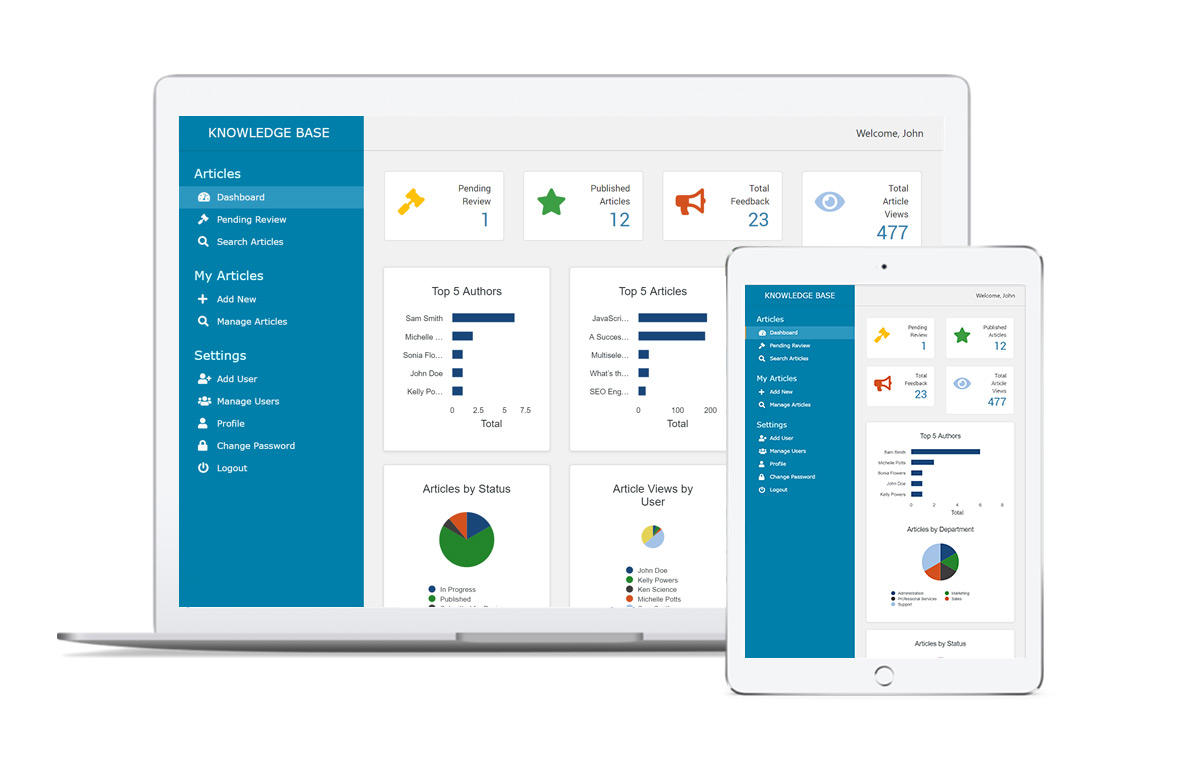
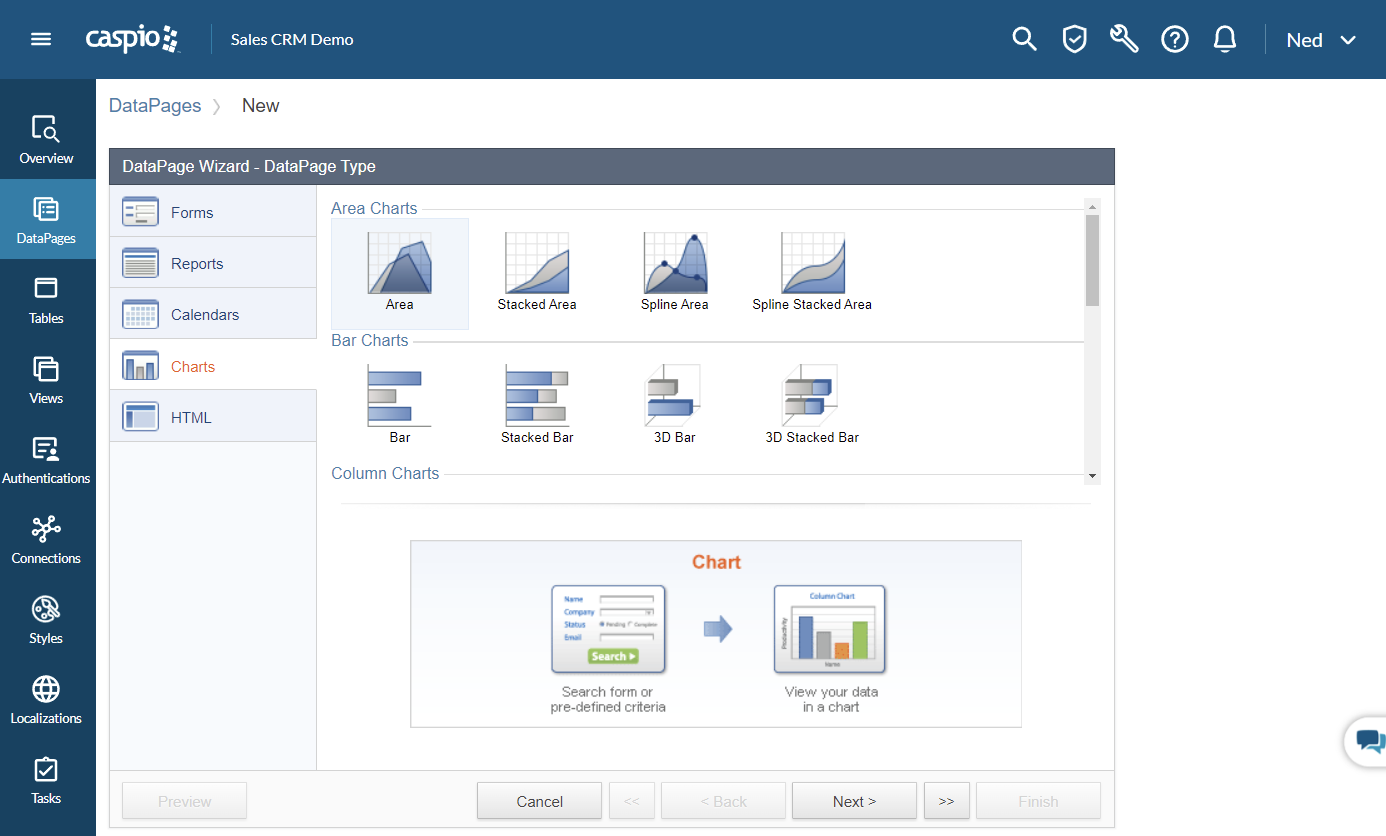
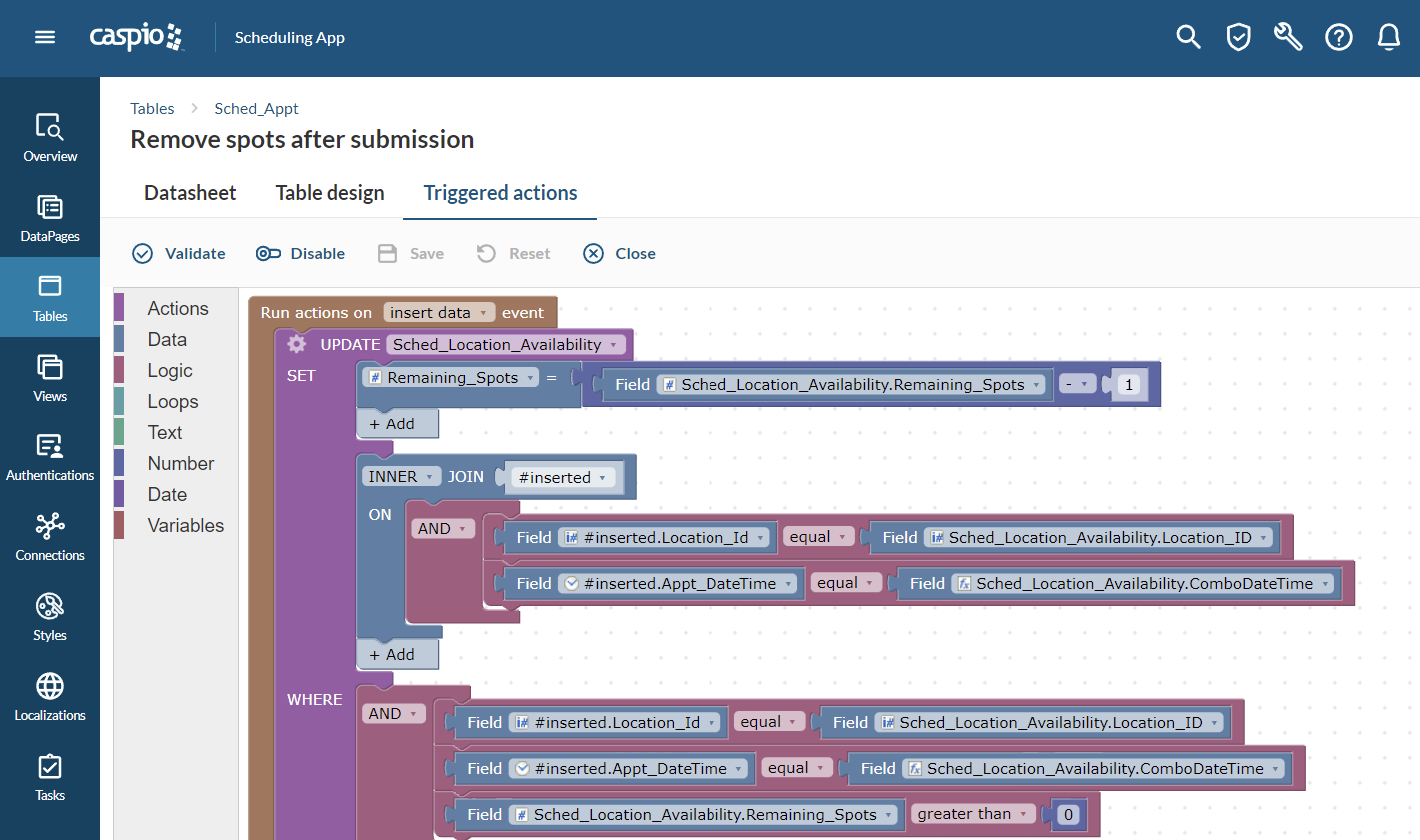
Caspio is a solution providing the infrastructure, tools and support that allows users to create customized online databases, applications, reports, forms, and charts/graphs. The point-and-click interface requires no coding experience and apps can be integrated into any website, blog, intranet or content management system.
$100
per month
Quickbase
Score 8.6 out of 10
N/A
Quickbase helps users tackle any project, no matter how complex. Quickbase helps customers see, connect and control complex projects. Whether it’s raising a skyscraper or coordinating vaccine rollouts, the no-code software platform allows business users to custom fit solutions to the way they work – using information from across the systems they already have.
$700
per month
SharePoint Designer (discontinued)
Score 3.0 out of 10
N/A
Microsoft's SharePoint Designer was a tool for developing SharePoint applications that has been discontinued.
N/A
Pricing
Caspio
Quickbase
SharePoint Designer (discontinued)
Editions & Modules
LITE
$100
per month
PLUS
$300
per month
BUSINESS
$600
per month
ENTERPRISE
Contact Us
per month
Enterprise
Full Customizable
per month/billed annually
Business
Starting at $2,200
per month
Team
Started at $700
per month
No answers on this topic
Offerings
Pricing Offerings
Caspio
Quickbase
SharePoint Designer (discontinued)
Free Trial
Yes
Yes
No
Free/Freemium Version
No
No
No
Premium Consulting/Integration Services
Yes
Yes
No
Entry-level Setup Fee
Optional
Optional
No setup fee
Additional Details
> All plans include unlimited users.
> Caspio offers a 10% discount to non-profits, NGOs, and customers in qualifying countries.
> Compliance plans support strict regulatory requirements: HIPAA; FERPA; PCI DSS Level 1; VPAT 2.0/Section 508; GDPR; EU-US Privacy Shield; SOC 2 Type II; ISO 9001, 27001; CSA Star Level 1, 2 & 3; 3D Secure 2.
> Project consultations for planning and customization, in-depth online help, how-to videos and instructor-led training.
> Pricing plans designed for teams of all sizes. Discount for annual pricing.
Quickbase offers three key plans, with feature distinction, simple and consistent entitlements, and a flexible licensing model, giving users the option of either user based or usage based licensing across all 3 plans.
After a 3 month evaluation period testing several other online solutions, QuickBase came out top.
In comparison:
Azure allows for massive flexibility, but also takes a considerable amount of effort. We use Azure successfully in our business for large scale highly customised …
Quickbase is easier to implement than a LAMP stack.
Knack's licensing is far superior to Quickbase. Quickbase and the crazy cost per user make it hard to develop an application that is shared by our customers. Knack gives us similar functionality at a fraction of the cost.
QuickBase does not require highly technical resources to get up and running with new business applications as some of the other larger and more sophisticated business systems. If you value the ability to create applications quickly without the need for specialized resources …
Contact forms are incredibly easy to build and customize, as are most other kinds of more involved forms. Forms allow html input and can be designed in a number of ways. It's helpful if you know some HTML. JavaScript knowledge can add advanced options, but is not necessary for the most common uses. The company used to call itself "No-Code," but has changed to say "Low Code," which is much more accurate.
I no longer think that Quickbase is the way of the future. They do not fix major bugs in a timely manner, and are releasing basic functionality behind a paywall. I believe that Enterprise Level Tier should be given certain things, like SLAs on Support and up-time. However, as a low-code no-code platform the majority of the accounts, "builders", and users are not going to be able to justify the cost of an Enterprise Tier Plan, and won't be able to use the features that Quickbase continues to advertise.
SharePoint does not provide, out of the box, a tool to create / update workflows from web. You have to use SharePoint Designer in order to create them. If you need to implement custom workflows for specific business processes, then SharePoint Designer is well suited. SharePoint Designer allows you to create workflows with task approval, email notifications, assign variables and update SharePoint Lists / Documents properties. In our company, we have created specific workflows for : - Purchase order - RH forms validation like annual employee review - Dematerialized existing forms and validation
Caspio is an online database platform. It allows one to create multiple tables and views to be stored via the web. Tables can be configured to not only hold data but also to hold files like Word docs and images.
Caspio is great at creating online forms and reports. It allows the user to create forms to capture, update data, whether it's password protected or just a simple form.
As a database platform, one can create online tables and forms linking multiple tables and views to each other. I would say it is the Microsoft Access of the online platforms.
The system is very easy. Wizards allow one to create forms, tables, and datapages. Since the platform is online, you may access your database anywhere.
2013 Workflows - Loops: You can build loops to work while a value (not) equals something, or N number of times. You can insert Parallel Blocks to do multiple things at once, or to watch for multiple things, and when 1 thing finishes, cancels the others and moves to the next step or stage.
2013 Workflows - Stages: Previously all we had were steps, which worked sequentially. With the Concept of Stages, we can create blocks of steps and based on the data collected during those functions, we can tell the workflow to go to a different Stage in the workflow based on a set of 1, or multiple, Conditionals in a transition area after each Stage. Giving you the power to develop multiple entire processes and skipping to the correct part of the workflow, rather than going through 20 conditionals to find out you needed to do action 31.
2013 Workflows - REST API: the "Call HTTP Web Service" is a very powerful tool, but hard to understand if you have never seen it done, or have a guideline. It works very similar to the requirements in PowerShell to connect and get and post data to SharePoint using the Rest API. You can also use this to manage permissions on List Items, Lists, Sites, and Site Collections. Best part is when developed correctly, it is SUPER FAST!
Intentionally Building Infinite Loops: I have built multiple review process from Managing Certifications to Updating Published Documentation, that monitors when an Item, based on provided approved metadata, when the "Author" needs to review the document within the given amount of time. They will get e-mails with links asking if changes are needed. If not, it is routed to the Approving Executive, and the Workflow Automatically updates the Metadata to push out the review dates to the next date, based on metadata provided on how how often the document should be reviews. By using conditionals in the transition of stages, it basically starts over, and goes into a parallel block to allow the monitoring of multiple values of metadata to move to the next stage. Very Powerful when you want to automate these types of process. It truly is a "Set It and Forget It" process.
I'd like to see a link on email notices that take you directly into said notice. On an app that only has 1 or 2 email notices firing, there's no issue. However, we have some tools that are so complex that they have about 20 email notices firing at any given time based on the action users take. In this case, if we have to go in to modify a notice, we have to guess or scroll down the long list of notices to see which one we need to customize. It would be great if Quickbase had the URL of said notice somewhere at the footer of that notice so when Administrators click on it, it takes them into the exact notice they need to update.
When filling out or reviewing a lengthy form, I'd like to see the Save & close button, as well as a Save & next option at the bottom of the form rather than having to scroll back up to the top of those forms just to click on those choices.
In the newest version of SharePoint Designer, they have gotten rid of the Design view which makes what used to be quick and easy changes much more code-intensive. This makes it harder for non-IT users and is more risker for all SharePoint Designer users.
SharePoint Designer workflows have a lot of functionality, but there are also some crucial limitations, such as not being able to put lookup fields in email subjects or using parenthesis to separate/group logical conditions.
Although this goes along with the Design view, there really isn't a good user interface anymore for adding conditional formatting and styles in views/pages.
We are committed to Caspio Bridge. We could migrate to another product, but we would not be able to do so quickly. I estimate that we would need about a year (maybe more) to convert all of our forms and processes if we were to switch to some other product
For our use-case of QuickBase, there really aren't any other products out there that can offer us the same out-of-the-box solutions they provide to us. We're also so integrated with it in our daily processes that to move away from it abruptly would cause mass chaos, so it's going to be renewed for at least the next several years.
Quick Base has done everything we have asked it to do and then some. Our original goal was to have one system for CRM that encompassed both the sales process and the customer management. We have gone w-a-y beyond that with analytics, project management, system bug logging, and historical effort reporting.
Once we did get Quick Base configured and customized it was reliably available when we needed it. We may have had one or two occasions when the product was inaccessible but those were few. The greatest challenge with its availability was its difficulty with integrating with our systems.
Some of our tables that hold over a million records are starting to perform poorly, with some summaries taking over 20 seconds to load. This may be an indication that it is best to archive old data when reaching large volumes like this.
I've had some instances where my team and I discovered a bug in Caspio. We alerted the company, and the bug was fixed in the next regular update of the software. The few times that I've had to contact support, it was a pretty good experience. They're not terribly quick to respond and take action, but they don't ignore you, either.
If you utilize the community, the support is amazing. Unfortunately, I find their actual support system a bit underwhelming. They don't seem to have a great process for interacting directly with an issue and often sweep significant issues under the rug by categorizing them as "Enhancement" ideas or legacy items.
Support is good from Microsoft. They are quite responsive when we raise a ticket but SP Designer support will be ended by Microsoft in the near future as they have got new techs like PowerApps and Flow to achieve the same functionality SP Designer does and even more than that.
Quick Base already is having a separate portal of providing training to customers and it is very easy to use and updates as per the new features added in to the application
I was not directly involved with the initial account implementation, only a bystander. For the app I directly implemented for my department only, I wish I had know to create an app diagram first. I don't remember if that was suggested. I think that would be a great help tip tool when a new app is created, to have a page with a check list of what is needed or how to get started. If you are a regular app builder, then you can bypass it or have the ability to turn it off in the app settings.
GroupHigh is so frustrating to use. It is constantly changing the way you can search for bloggers, and we can never find exactly what we are looking for
Well, there's a plethora of low-code tools out on the marketplace and, you know, there's a reason that we've decided to partner with QuickBase because it has all the right balance of the ability to integrate with the ability for a citizen developer to create apps successfully. So if you look at something like Zo Ho's low-code offering, for example, yes, there are some similarities there, but they're really dependent on all of their other licensed products to get you where you want to be, where with QuickBase you have the ability to truly create something custom.
I haven't used anything else like this. I use different products for workflows and forms, but they aren't listed in the listings for this page. Instead of using it for workflows or forms (deprecated 2 years ago), I use Nintex. For everything else, I have what I need in the Modern version of SharePoint online
It has evolved really well with our company, but there is a hard limit to the table size that has begun to affect us and not let us grow. The table size limit is set at 500 MB and we have had to jump through quite a few hoops to be able to get by.
ROI is HUGE. Our company saved over 3.5 million in one year alone based on developments that year in Quickbase that saved time for many teams
Less user error - implementing automations and standardized workflows has led to less user error as was previously seen by maintaining spreadsheets or Smartsheets
For my needs, I have not found SharePoint Designer useful for my day to day maintenance of SharePoint. It is useful for viewing all the objects that make up the SharePoint site.
It is not as intuitive in regard to setting up Workflows. I have yet to use it to set up workflows in SharePoint. Maybe if I needed more complex workflows, it would be beneficial.
I like to use SharePoint Designer for moving around files within SharePoint sites.