Citrix DaaS (formerly Citrix Virtual Apps and Desktops, or XenDesktop) is a virtual desktop infrastructure (VDI) and application virtualization solution from Citrix.
$375
Omnissa Horizon
Score 7.2 out of 10
N/A
A VDI solution used for the secure delivery of virtual desktops and apps from on-premises to the cloud. It is used to deploy, manage, monitor and scale desktops and apps across private, hybrid and multi-cloud infrastructure using a cloud-based console and SaaS management services.
$4.67
per month per user
Parallels RAS
Score 9.2 out of 10
N/A
Parallels Remote Application Server (Parallels RAS, formerly 2X RAS), is application virtualization technology, billed as a solution to extend the life of legacy OS (like Windows XP) with its virtual desktop for any device.
Maltese company 2X Software developed the technology, but was acquired by Parallels (in Seattle, WA) in February, 2015 to extend their cross-platform support solutions.
$120
per year per user
Pricing
Citrix DaaS
Omnissa Horizon
Parallels Remote Application Server (Parallels RAS)
Parallels Remote Application Server (Parallels RAS)
Considered Multiple Products
Citrix DaaS
Verified User
Professional
Chose Citrix DaaS
Citrix Virtual Apps & Desktops is platform agnostic (we can use any underlying hypervisor technology) and really flexible for any use case. Using a golden image and provisioning it (with Machine Creation Services or Provisioning Services) is powerful and really straightforward, …
Citrix Virtual Apps and Desktops was our pick because of the low infrastructure requirements. With Vmware, you need compatible hardware to run ESXi and then a machine to run the vCenter Server and free other machines to run horizon view, app, policies, etc which can get …
Citrix Virtual Apps and Desktops (CVAD) allows for the use of any hypervisor or cloud platform which ensures flexibility in decisions that are made across a IT organization while others are typically tied to a single or highly controlled cloud selection. Additionally the …
We needed our application vendor to support our solution and Citrix was their main choice. The other choice was Microsoft RDS/RDP but we wanted the higher management functionality that Citrix brought.
XenDesktop is the best because Citrix says so! But really it depends on a lot of factors that vary from one organization to the next that require detailed analysis with a trusted consulting partner or an in-house EUC architect.
We briefly looked at VMware Horizon View and its integration into our current VMware environment, but experience with XenDesktop and common usage overcame any potential savings with Horizon View.
XenDesktop includes features above and beyond the competition, and you really do get what you pay for. Provisioning Services makes single image management an absolute dream. Anyone who has ever had to recompose 100+ desktops in View knows the pain of waiting for composer to do …
At least in our company, Citrix only worked allied with a physical authentication token, which was a Smart Card written and provided by the company. The software randomly froze and came back as nothing ever happened and the Citrix support couldn't care less about this. We grew …
Citrix vid setup was very difficult and initially hard to set up. I believe this has changed somewhat now, but there are still multiple servers that need to be set up before it can be used. Vmware VDI was fairly easy to set up and was immediately working and up and running, …
Director of IT Infrastructure, Security & Compliance and Customer Service
Chose Omnissa Horizon
Some of the platforms are designed for smaller or standalone environments and do not allow for large-scale centrally controlled deployments. in the case of Citrix, there was better Chrome OS support but the lack of PCoIP UDP optimizations made is slower and less desirable by …
I suppose I'm prejudiced but I don't think either of those products is in the same league. I know XenDesktop has made some strides I just think VMware has the superior product.
When we were considering a VDI solution, I reviewed Citrix XenApp and XenDesktop as alternative solutions to Horizon View. It seemed like Horizon View was a more mature solution and had the best integration to our existing Vmware vSphere environment. The systems …
Citrix XenDesktop is another big player in the VDI market, but the product simply isn't as mature or powerful as Horizon. Xen still struggles with Windows 10, whereas Horizon has accomodated every OS we throw at it with ease. XenDesktop is a great product overall, performance …
Did not do a full evaluation on Citrix XenDesktop as VMware Horizon View integrates nicely with the VMware vSphere environment that we had currently set up.
We were using PanoLogic for about 6 months before we scrapped it and moved onto VMware Horizon View. Horizon View gave us …
We did not deploy in-house testing, though we did review another company's deployment. At the time we liked what we saw in Horizon, though I have no doubts that XenDesktop could deliver just as well and still does for the other company that presented it to us. What tipped the …
XenDesktop is a good product and has its advantages. It comes down to where you want the processing to take place (the server in the data center or the client endpoint). Regarding cost, the infrastructure needed to deploy the Citrix solution is more expensive than VMware's …
Chose Parallels Remote Application Server (Parallels RAS)
Citrix has more bells and whistles within their product line, but we've actually been pleasantly surprised with the performance of Parallels Remote Application Server (Parallels RAS) vs our Citrix implementation. Citrix Netscaler has way more functionality than the Parallels …
Chose Parallels Remote Application Server (Parallels RAS)
The cost of the two products is significantly different. Though Citrix has many advantages and features, the cost was a primary factor that helped us make that choice.
Chose Parallels Remote Application Server (Parallels RAS)
Citrix is a great products but very expensive. That's why we choose Parallels Remote Application Server (Parallels RAS). Citrix is a great products but very expensive. That's why we choose Parallels Remote Application Server (Parallels RAS). Citrix is a great products but very …
Chose Parallels Remote Application Server (Parallels RAS)
Parallels Remote Application Server (Parallels RAS) stacks up against VMware Horizon and Citrix Workspace because it was much more cost effective and easier to install, configure and implement. Our decision to use Parallels RAS was because of using all features with one license …
Chose Parallels Remote Application Server (Parallels RAS)
I have used but not admined similar products from VMware and seen demos from Cisco and I would not personally find any benefit in migrating away from our Parallels configuration to those platforms.
Chose Parallels Remote Application Server (Parallels RAS)
We evaluated Citrix as well as Parallels when we undertook this project, and our research concluded that not only was Parallels much easier to set up and use, but it was much more cost-effective.
Chose Parallels Remote Application Server (Parallels RAS)
I think it's a pretty easy comparison of the two. Citrix is more expensive and more complicated compared to Parallels Remote Application Server; however, Parallels Remote Application Server misses the nice audio plugins that Citrix has for teams, etc. Parallels Remote …
Chose Parallels Remote Application Server (Parallels RAS)
Parallels Remote Application Server has been easier and less expensive to implement for our clients than VMware Horizon and offers a better experience than Microsoft Remote Desktop Services. All three of these can accomplish similar end results, but when looking at the overall …
Chose Parallels Remote Application Server (Parallels RAS)
Parallels Remote Application Server is a cost-effective solution for Citrix and VMware products. It is also less complex to configure and manage. Offers similar connectivity options and integrates easily with 2FA authentication, for example from Google which is a free option.
Chose Parallels Remote Application Server (Parallels RAS)
The least prerequisites for RAS server compare to other solutions. Server configuration is totally based on user load. Licensing model is impressive. The most important factor for us was the support. Parallels Remote Application Server support is more than expected and all …
Chose Parallels Remote Application Server (Parallels RAS)
Parallel RAS is so much easier to install than Citrix. Doesn't require a NetScaler for external access. The customizing for the login page is so much simpler they anything we have used. The single console helps our helpdesk staff manage clients much easier.
Chose Parallels Remote Application Server (Parallels RAS)
Parallels Remote Application Server competes against Citrix on a one-for-one feature setlist. It provides many of the same services and capabilities. It is, overall, a simpler product to use and configure. It does not compete perfectly in the VDI space, as the Citrix offering …
Chose Parallels Remote Application Server (Parallels RAS)
Setting up and managing Parallels RAS is extremely quick and easy. Support in the form of manufacturer support is better. In general, support for resellers is better at Parallels and easier for resellers.
Parallels Remote Application Server (Parallels RAS)
Likelihood to Recommend
Citrix
DaaS is ideal in large-scale environments that require centralized, secure management. Remote workforces at large organizations. Highly regulated industries like finance. It allows for easy security and monitoring over one aspect instead of multiple remote machines. DaaS is not ideal for organizations with small budgets due to the pricing and organizations with lousy network connectivity. This would make the end-user experience terrible.
VMware is well suited to a business where there will be many remote users needing to connect to the companies desktop. The installation on a remote computer is simple and is easy to use remotely but can be complicated to set up on the back end on the office system. It may not be worth the effort for a company that has few people who need remote access.
Scenarios where time is a factor in having a solution in place and up and running safely and securely. Where there are older devices that ordinarily wouldn't be up to the task of running modern apps and services. Where users need to work away from the network, and security is a concern.
It provides a robust, secure, rich desktop environment that is able to access all internal network resources.
Addresses security and compliance concerns as all data resides within the internal network. All data accessed stays within the internal network and does not need to traverse a VPN to the local desktop where it may be cached, etc.
The connection is thin client that does not require large amount of bandwidth.
Client application is available for all common devices and O/S’s.
No need to install, configure and maintain applications on local desktop.
The printing driver is quite excellent, both in the Parallels Client and on the HTML5 client.
Setup is incredibly easy; the default setup is very functional, and adding features is a breeze.
Speed is very acceptable in general for end-users, the clients adapt quite well to the amount of bandwidth available, and features are available to adjust further.
Parallels Remote Application Server (Parallels RAS) continually improves the product but has broken some features recently. For example the web management portal lost the ability to manage user sessions after a major update. That issue was fixed in a later release
Multi-monitor support beyond 4 monitors (It does handle up to 4 -1080 monitors well)
More options around connection security and MFA. current options are sufficient but limited
We've noticed some performance issues with Windows Server 2019 and 2022. I'd like to see more robust support for remote applications running from those platforms.
We have been using Parallels since it was called 2X - it is a major part of how we do business. It is fairly simple to use and maintain - staff like it, we like it. It is a product that makes a promise - and it keeps it. As Parallels evolves, and clean bandwidth becomes more readily available everywhere - it just makes sense to continue to use Parallels in our environment
Getting the environment setup took me three months of off and on work, with 3 complete rebuilds of the environment. Utilizing the WebUI to access the environment had presented so many random issues that we had to require end users to use the Citrix Reciever App. As it was the only stable solution. Aside from that, it hasn't required much admin intervention since the stand-up was completed.
Because it delivers what it promises, I am giving this rating. While there is scope for improvement, it does the job and meets our requirements reasonab;y well. It helps our remote resources connect to our environment securely and improves their productivity. We also get to access our client environment from remote locations and complete the tasks assigned to us.
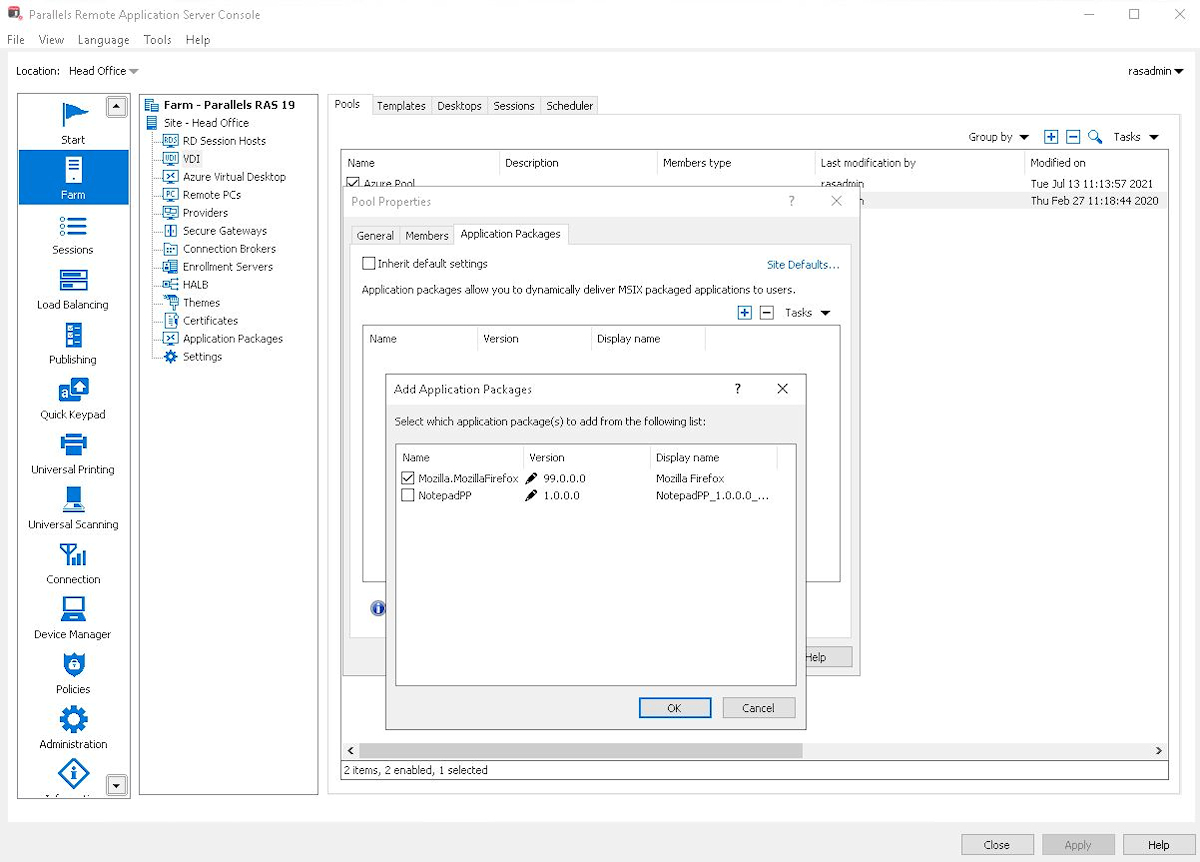
Parallels RAS was easy to setup, with great admin guides and resources. We especially liked the included Visio templates which made diagramming much easier. The reference deployment diagrams also simplified our deployment process. Our end users love Parallels RAS. Apps launch faster than Citrix, and the Parallels RAS client is far more reliable than Workspace.
If there are any issues with Parallels - they are usually more about the server operating systems than Parallels itself. It would be rare for us to have any reason to take Parallels offline - we schedule a reboot on the servers at 3am to keep the O/S itself fresh, but again - it is not a Parallels issue. If individual users have any issues we ask them to completely log out of parallels - which ends their session - and then back in - and that typically resolves the issue right away.
The performance of XenDesktop is the best in the industry because of the fine-tuned protocol and years of updating. Overall, I don't think there is a better performer on the market. The question is if the added complexity of running XenDesktop is really worth the performance gain. While the latest version of XenDesktop is the easiest to deploy so far, it is still more challenging than the competitors.
There are a lot of things that went into my rating from the ease of use compared to other systems to the limited amount of issues I have had with this one. Any issue with this system has been identified and resolved in a much quicker manner than I have seen with like systems.
I am giving Parallels 9/10 on this one because the only application that sometimes seems slow or has issues - is Microsoft Outlook. It is sometimes the result of a pop-up that may not show up in the published application (vs full desktop). Other than that - pages load very quickly - and it does not seem to slow down other applications that are running at the same time. Most of our users run Outlook, softphone and Teams locally - and published applications for everything else. When they do that - it is very solid.
The support is great when you get an engineer that knows what they are doing but getting that individual sometimes takes a while. Overall, they are professional and polite and competent in their knowledge. Sometimes the cases are open for an extended period of time which becomes very frustrating when dealing with critical issues.
It is surely way better than Citrix, but it could improve a bit. Usually, they send us the solution without saying what was the root cause so we can avoid breaking something in the future. Besides that, VMWare support answers in an OK time-frame and even speaks our language (Portuguese).
Good support in place if required, very helpful when it comes to upgrades or any issues faced. The support team is knowledgeable, friendly, and quick to respond to issues The company also provides a range of online resources, including a knowledge base, documentation, and forums, which can be helpful before raising a ticket
Take it slow and read the directions each step of the way. If you are not familiar with Citrix products, use a reseller or other experienced engineer to assist you in the setup of your environment
Overall, it was pretty simple compared to most other projects. Again, we had a strong familarity with the product so there was not much of a learning curve. Our 'biggest' issue is the end-user understanding of a 'local' application and a published application. For example - Online meetings need to run locally for camera/video to work smoothly so opening a link to a meeting from a published application continues to be an occasional issue.
Citrix Virtual Apps & Desktops is platform agnostic (we can use any underlying hypervisor technology) and really flexible for any use case. Using a golden image and provisioning it (with Machine Creation Services or Provisioning Services) is powerful and really straightforward, compared to the complexity in Microsoft RDS of maintaining a coherent farm, or the limitation of VMware Horizon to run on VMware Products.
Although I really prefer Microsoft Remote Desktop for accessing Windows servers (from Windows machines especially), and this can be done from off-site with a VPN, this entails much more effort, namely getting everyone's Active Directory in the correct group to have access. VMWare Horizon is a much simpler solution in terms of granting access. Chrome Remote Desktop and TeamViewer are really not viable solutions for remotely accessing servers in business settings, although they work alright for home servers and such, especially from off-site.
Parallels Remote Application Server (Parallels RAS) provides the finest end user experience while being cost-effective and reducing administrative and support man hours. Parallels Remote Application Server (Parallels RAS) is platform agnostic; it works with various kinds of devices (computers, phones, tablets) and several operating systems (Windows, Linux, Apple, etc.), allowing users to access it on gadgets of their choice.
We added our Integrated Services Staff to parallels, with filtered, published applications - in a single afternoon. We added licensing and installed the desktop client software on multiple platforms both in the office and at remote sites all on the same day - and got remote users that had never used the product up and running - very quickly.
XenApp has allowed us to continue support of legacy applications and all access of those applications to users across the globe with any device.
XenApp can also manage software licenses by restricting number of users, number of concurrent sessions, or combination of both to required specification.
While initial investment in XenApp can be costly, continuing support and upgrade are very cost effective and product stability is excellent.
While there are competing products from Microsoft and VMware, when it comes to remote application access, XenApp is the best of breed.
Our customers have had dramatic cost decreases due to no longer needing IT departments to work with our software.
We've been able to charge more for our hosting services due to our customers saving money in the long run. Parallels Remote Application Server has more than paid for itself, and the increased income has gone right back into the business.
Both our customers and our company have benefited from this transition.