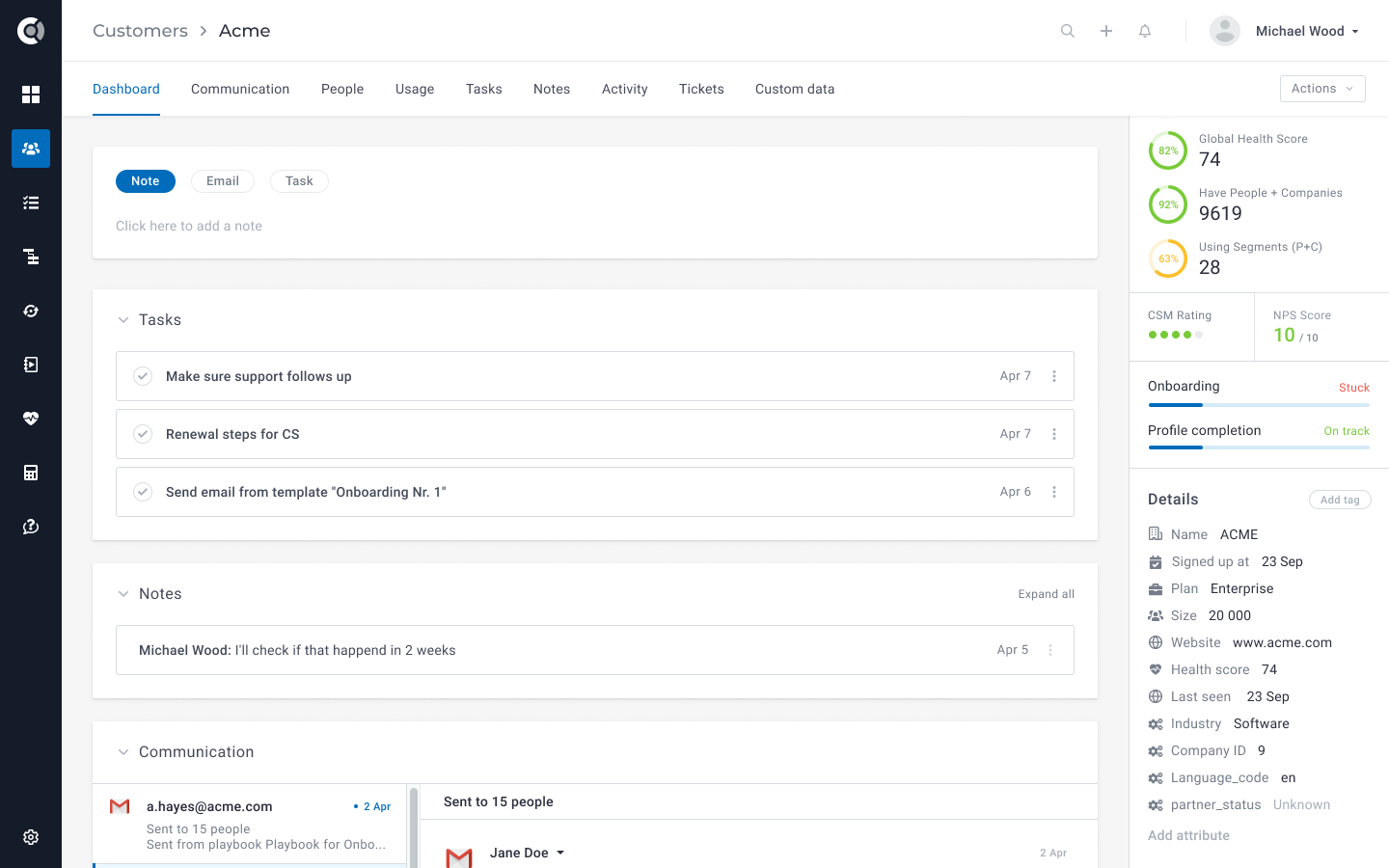
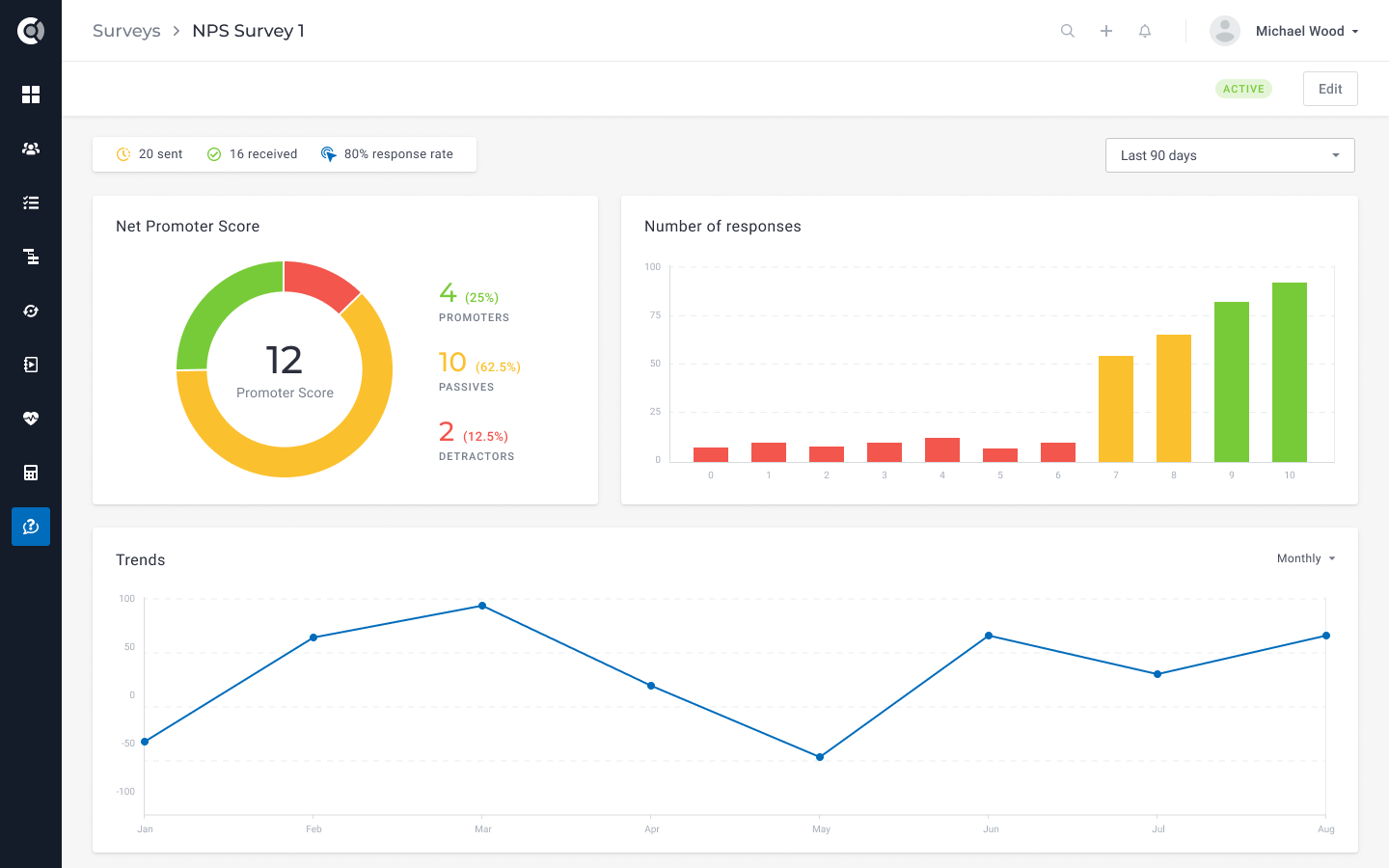
Custify is a customer success platform designed for B2B SaaS businesses. It helps users better meet customers' needs, reduce churn and increase lifetime value. The user can see in-product usage insights as well as data from CRM, support, billing, and other systems in one place. Relevant customer success KPIs and client interactions are displayed in its dashboard. Custify also identifies clients that get stuck during onboarding, those whose trial is about to expire, and those whose usage has…
N/A
Sitecore Digital Experience Platform
Score 8.9 out of 10
N/A
The Sitecore Experience Platform (Sitecore XP) is a digital experience platform used to build websites and create customer experiences online. The solution boasts fast content authoring, built-in personalization features, testing and other optimizations, as well as analytics and marketing features.
N/A
Zendesk Suite
Score 8.6 out of 10
N/A
Zendesk is a customer support solution with built-in ticketing, conversational messaging, and live chat, designed to help businesses of all sizes and industries deliver personalized service at scale. Zendesk's AI agents are trained in CX to help Service teams resolve customer issues faster and more accurately while still providing a human-centered experience. Zendesk ultimately aims to help businesses improve time to value, reduce effort per ticket, and keep costs low.
Hubspot is defintiely more robust in what you can do with it, but Custify is great for customer success specific activities. We do use hubspot in line with custify, but we wouldn't be able to use one without the other. Custify can measure some product engagement metrics that …
This software makes it easy to analyze your data and optimize your onboarding - maybe the easiest I've seen, but you've got to be willing to dig into its features and setting. And of course without their Concierge Onboarding this is not so easy.
Custify was simpler to integrate and easier to use. We got troubled by enterprise-grade software as it has a lot of requirements and were sometimes even shocked that the data is kept only for a short timeframe so no historical data digging was possible. Custify helped here a lot.
I'd get Custify if you have high-value accounts, but your team doesn't have enough time to give them personalized treatment. If you're facing this, I know how difficult it is to run a CS team and use "no time" as the reason a key account is at risk.
We tried other products before. They were good, but Custify is hands down our favorite. I recommend getting a demo from a few companies, maybe give a few a try, to see what works best for your needs.
We actually thought of using Trello first. But as great as Trello is for task management it just won't work for this. Most other Customer Service systems seem to be designed for enterprise-level or have a bad user experience.
Adobe Marketo Engage is a fantastic product for managing campaigns and audience segmentations syncing with Adobe Audience Manager. It also has OOTB connectivity to very popular CRM platforms. Adobe Analytics and Adobe Target are pretty similar to Sitecore CDP/Personalize. Any …
Other tools lack one or the other and fail to provide a comprehensive best experience for everyone - content authors, marketers and developers. Sitecore comes with out of the box authoring host, best content authoring and WYSIWYG editing experience and much more.
Really the only comparable product to Sitecore DXP is Adobe Experience Manager. Both are very well established and robust content management platforms. Products like Contentful and Contentstack are very lightweight and do not have as many built-in features like DXP, so it is …
For one our client, we utilized Sitecore XM Cloud with Sitecore Search to build their websites. Sitecore search help to provide more ai based search experience with suggestions, textual relevance, facets. XM Cloud with Next JS help us to deliver the website for more modern …
Its is simply by far the most advanced system. Using other CMS you will soon be blocked with advanced customizations specially to their back office but Sitecore enables you to do whatever you want and hook into the pipelines and embed your own code/business logic.
I haven't used other DXPs in that great detail to provide a holistic comparison between it and Sitecore. Overall, I feel every product has its pros and cons. With Sitecore, I feel they are always innovating and coming up with new solutions to help the partners deliver the best …
We experienced issues with this CMS and thus switched from Sitecore Experience Platform to AEM and both of them have their own pro and cons. While Sitecore Experience Platform provides flexibility to copy properties from one page to other, AEM doesnot allow that.. we need to …
The main reason to use Sitecore Experience Manager is if you want to develop something completely custom. Sitecore is best suited for very robust, multi-page websites. If you need to build out a website that supports multiple product lines, Sitecore could be a good option.
All of these platforms have their pros and cons. Selecting the best fit is a matter aligning corporate need vs features provided. Have a .NET shop with an advanced marketing team looking to push UX forward and willing to pay a premium, then Sitecore may be the right fit. …
After evaluating OpenText, we found that Sitecore has stronger capabilities to utilize the content for personalization and contextual marketing. We also favored Sitecore's user permissions, roles, and content creation processes out of the box.
Sitecore was evaluated by our practice next to two other Content management systems 4 years ago. Sitecore scored the highest following a series of questions related to product stability, scalability, ease of use, and a host of other categories.
WordPress and Wix are great solutions for a small business or a solopreneur who's just looking to get a simple website up and running. For larger businesses with more robust content, I think Sitecore offers a bit more flexibility. Wix and Wordpress are both really simple to get …
Sitecore provides and enterprise grade CMS over Wordpress and allow us to do the customization we need for our unique environment. Optimizely might be better for AB testing.
Sitefinity is improving but at the time of decision making it had nothing that could compare with the A/B testing and personalisation features that Sitecore offers. This was a key differentiator and ultimately ensured Sitecore was purchased. Wordpress isn't really comparable …
The decision to select Sitecore was not ultimately mine, but the fact that we were able to leverage in-house Microsoft .Net (C#) experience on a platform that had a library of extensions, but also allowed us to customize and keep private our confidential IP has been a big help. …
Of all the competitors listed above, Sitecore owned, by far, the best combination of power, easy-of-use, and extensibility. It easily outperformed the other paid-for CMS systems. Its power is especially noticeable in its ability to handle very complex workflows, security …
I have used an in-house CMS and the Amaxus CMS. Sitecore is a great balance of these two. The in-house CMS was VERY user friendly, for the least technical client. It showed the actual page you were editing and allowed you to basically edit the text on the page, no HTML …
Every product has a cost window it fits in. Umbraco is perfect for small to mid-enterprise implementations. However Sitecore is more stable from a developement standpoint.
Zendesk Suite is a better product all round for customer support - it is designed specifically as a level 1 helpdesk platform and compares favourably to JIRA. While JIRA has some extra features and can do things like change management and service management it does not do them …
Zendesk Suite blows what I have used before out the water. The base features alone are a level of advancement far above my previously used systems. Also, the ingenuity of the software to mold to my needs is priceless.
Zendesk Suite has been a much better fit for us than Salesforce Experience Cloud and Salesforce Knowledge. With Salesforce, many basic knowledge base needs require custom development or AppExchange add-ons, from UI tweaks to more advanced analytics. Authoring and formatting …
Even these two have a ticketing system but that I also used previously but Zendesk Suite has a very clear ticketing system - it does not take much time to understand and use it, the interface is easy and the automation system also works up to the expectation, it is not just …
Here are the explanations for my preference of analysis Zendesk Suite to this end:
Power + Usability: Zendesk Suite has abundant omnichannel coverage, acceptable automation, and decent reporting but does not go all in to full-custom dev mode, so hangs nicely in the space of …
We use JIRA for some IT Tickets but we ended up using JIRA as our second line of defense. If support couldn't resolve a Zendesk ticket, they create a JIRA ticket and someone else is pulled in to help troubleshoot something more complex. We haven't really had an issue having to …
We Initially started working the Zendesk Suite and it is more easier to understand all the functionalities and workflows. It is more secured and well managed platform
I haven't really used other services of this kind for some time now, but that is simply because Zendesk Suite has provided us with everything that we have needed, and have also continue improving a developing new features through time.
I like the Zendesk Suite because it can run on any of most browser that is compatible. The navigational experience is better than most CRM tools I have encountered with and far more advance with the embedded UI and plugins. Back then, the dialer for calls we has to use a …
Zendesk Suite seemed to have a lot more customization and flexibility. We have multiple "brands" that need to follow different flows and have different needs and Zendesk Suite allowed us to easily do that. We also had strong needs for a help center and liked how their worked …
Although Zendesk Suites has a higher value when it comes to it's pricing, Zendesk offers more features and functionality also Zendesk Suites has already established it's name and is trusted by many businesses and organizations. Other similar products maybe cheaper and simple …
Zendesk Suite is very similar to the companies we listed, but, in my opinion, there are a lot of things that these companies do right that Zendesk Suite fails at. Particularly reporting and phone systems. We have looked into Five9 in great detail to replace our current phone …
Zendesk Suite comes with a complete package. Right from receiving customer calls to responding emails. Managing tickets and following up with customers for required information. This tool feels like the place where you can Manage more of the things
Zendesk Suite ultimately is very capable and highly configurable. When you really get to know what options exist, there are a lot of workflows you can build for your support operation that can improve agent efficiency, and lead to higher CSAT.
Create mobile-friendly, personalized support request forms with Formstack’s easy-to-use builder ,Auto-add new support tickets to Zendesk CRM and alert your first available team member Build better customer relationships by storing everything in one, secure place and improving …
Zendesk Suite is way less complicated than Salesforce. The response from the team is prompt if the company is in need. It's all in one place. Commercial friendly as well. Cost effective to what we pay. Used by MNC's hence better clarity of the suite even brand wise. Zendesk …
Two big use cases where it's very well suited: onboarding of our clients and churn prevention. It just saves me so much time and helps me recommend more strategic suggestions. At the end of the day I can see my productivity being a lot higher than before having Custify.
Having worked with other DXP platforms, I find Sitecore to be the most suitable for enterprise-level clients. The platform is highly flexible - both customizable and extendable - making it adaptable to any customer needs or requirements. The platform focuses on the success of both marketing and technical teams, which I don't see on other platforms.
Benefits of Zendesk Suite: Support across channels In the case of a retail company with chat, email, WhatsApp and social DMs all piling up together, agents do not have to change tabs - everything comes into one screen in the Suite. An example could be a representative for this e-commerce company on a sale weekend when they have live chat up, and also must deal with emails and complaints on social. Zendesk Suite handled all of this interaction seamlessly. Knowledge base + self service: A SaaS platform receiving constant flow of "how do I reset my password" questions. You set up a help centre once, and are able to deflect hundreds of tickets for months and years. Even better when combining with Answer Bot, where the bot begins suggesting articles without even a human interacting with the tickets. Scaling customer service teams: A startup that has just expanded from 5 customer service representatives to 50 customer service representatives. Zendesk Suite automates routing, SLAs, macros, and analytics, when it could never work with Google Workspace + sticky notes. This is especially helpful when managers want to be able to report or analyze ticketing conversations to see trends in perhaps their backlog, or a customer service representative is running into consistent workflows. Globalization: A company with support teams that are spread across time zones and languages. Zendesk Suite enables for business hours, language packs, and localized help centers. It even comes with routing either by skill or region
360 degree view of anything that has to do with a single account, including health score history across many elements, all the lifecycles of that account, different usage and adoption trends on multiple users in the same account, and more.
Getting multiple health scores and trends on one screen.
Customer Profiles - the ability to identify key features on the site and flag those interactions to tie customer visits back to specific persona types.
Lead Scoring - the ability to establish a funnel for leads and use this funnel to assign a score or qualification within the sales funnel.
Personalization - the ability to tailor experiences to unique customer segments based on their needs, identifiying and optimizing the experience in real-time.
My biggest surprise was that we needed to dedicate more time than I thought at the beginning to learn the software more deeply. The interface is the easiest I've used, but there are just many possibilities this software opened up for us, and we wanted to make sure we're familiar with them.
Sitecore is complicated. Software developers need (costly) training to get the most value out of it and business users do not find it intuitive to use. Concepts like the content tree can be difficult for the business users to grasp.
Despite everything being possible in Sitecore, virtually nothing comes out of the box - you need to develop every component and do so within a defined process and framework, which can be a fairly big development overhead.
Sitecore has proven that it can deliver on its promise of a robust, reliable enterprise CMS solution with plenty of features. Also, they keep updating it with more and better features. Now that we are highly trained on it we have started on getting the most out of it and we plan to keep doing more of that in the future.
Zendesk is super easy to use and navigate. I really enjoy the sleek layout, the ability to tailor tickets, the macro option, and the quick key guide they have to make your use of time even more effective. My whole team loves working with Zendesk and rarely ever has problems.
Overall a great tool with very useful features. It's UI seems a bit clunky and there is no full dashboard. Without these it takes a bit of work to find what you need and get an overview of current activity. Also, implementing everything takes a bit of work. I would recommend it to any saas that is serious about scaling and has a customer success dept
Once you learn how to use the platform and can put a solid strategy in place to manage it long-term, it becomes a lot easier to use. The tricky part is working with resources who are familiar with the platform to navigate some of the common implementation and configuration pitfalls. Although Sitecore has worked very hard to overcome some of these from their earlier product versions by creating wizards and improving their support documentation, at the end of the day it is still a very complex and powerful system that needs to be implemented carefully in order to foster the best possible user experience for authors. So it could be rated very usable or not usable at all based on how much planning took place and the quality of the implementation.
I used to work without a ticketing service, and everything was handled on an email provider, this made it very difficult to track, no integrations to the software complicating the use of internal tools or other software like Guru, Zendesk Suite wasn't hard to learn, in fact it was very easy, very straightforward, and I was an admin learning to use several tools at the same time.
I personally have never used their support but i know our business has had multiple calls with them and they have always been helpful. I would imagine they are helpful as they have always had responses for our questions and have never left us hanging. Highly rate their support team
1. Customized software development & maintenance. 2. Technology Consulting - Consulting-based services for technology solutions data engineering or cloud solutions. 3. Used for tapping into multiple data sources such as CRM and marketing automation systems and, creating automated data extracts with a high-end visual representation of data. 4. Implemented for scheduling an existing report to automatically refresh and be delivered to specific users at a specific regular interval.
We rarely need to contact their support team, but when we do they are responsive. However there have been notable times when communication between myself and the support rep was challenging despite me providing clear explanation of the issue, screenshots, and a thorough explanation of the goal we hope to achieve. It took several back and forth attempt, on a few occasions, to get resolution on an otherwise simple request
Sitecore captures and remembers every single interaction your customers and prospects have in any part of the system, allowing you to build comprehensive, ever-learning profiles of each individual. From email marketing, to social media, to online shopping, Sitecore remembers where each interaction left off so you can automatically continue the conversation. Sitecore helps you manage your content for each and every experience your customers enjoy. Customize what content you want and the system will take care of how it's displayed.
Zendesk has tons of available material for training - videos, webinars, articles, etc. The only reason this is not a 10 is because it can be hard to figure out how to navigate to these things and find what you are looking for.
We implemented Sitecore on an Agile project team, which worked very well. We worked closely with the stakeholders for each feature and all features and user stories were prioritized outside of the development team. Anyone trying to implement a website of this magnitude should definitely attempt to do so in as much an Agile fashion as possible.
There is not a lot of implementation, it's all setup and you just start using it. We did do some email to ticket setup and that worked really well. The only thing that didn't work for us was the Salesforce integration, maybe your mileage will vary.
Hubspot is defintiely more robust in what you can do with it, but Custify is great for customer success specific activities. We do use hubspot in line with custify, but we wouldn't be able to use one without the other. Custify can measure some product engagement metrics that hubspot cannot
Adobe Marketo Engage is a fantastic product for managing campaigns and audience segmentations syncing with Adobe Audience Manager. It also has OOTB connectivity to very popular CRM platforms. Adobe Analytics and Adobe Target are pretty similar to Sitecore CDP/Personalize. Any custom/extension implementation required in the Adobe space has the same complexity as Sitecore.
Even these two have a ticketing system but that I also used previously but Zendesk Suite has a very clear ticketing system - it does not take much time to understand and use it, the interface is easy and the automation system also works up to the expectation, it is not just easy for the users but for us from the backed support as well, it is so user-friendly.
Connecting all these data points has been a game-changer. We're seeing higher conversions both from free trials and from starter plans to premium plans. We're now developing an upsell offering for our most premium plan and figuring out how to integrate it into Custify. We're ambitious and want to see what's possible to pull off.
Customer Success looks at ticket resolution surveys as part of their CSAT scores and either thanks their customer for a positive review or reaches out if it's a negative review.
Sales uses Zendesk to make sure their new prospects are getting POCs properly set up quickly and fix any issues while they do a trial of our tool.
Onboarding uses Zendesk to quickly make sure new customers implementations and user access are set up to help them start implementation faster.