
D'Ana Guiloff
Manager, Marketing Operations
Chose Slack

| Product | Rating | Most Used By | Product Summary | Starting Price |
|---|---|---|---|---|
 eXo Platform | N/A | eXo Platform is an open-source, social-collaboration software designed for enterprises. Some key features include: Enterprise Social Network, Enterprise Content Management and Social Collaboration. | $0 engaged user/month | |
 Slack | N/A | Slack is a group messaging or team collaboration app that aims to simplify communication for businesses. Features include open discussions, private groups, and direct messaging, as well as deep contextual search and message archiving, and file sharing. Slack integrates with a number of other tools, such as MailChimp, Dropbox, and Google Drive. Slack was acquired by Salesforce in December 2020. The product is free to use, and also has paid plans with more features and greater controls. The… | $8.75 per month per user | |
 Sococo | N/A | Sococo is a remote collaboration tool with integrations with third-party applications such as Google Docs, Atlassian JIRA, and Box. | $14.99 per month per seat |
| eXo Platform | Slack | Sococo | ||||||||||||||||||||||
|---|---|---|---|---|---|---|---|---|---|---|---|---|---|---|---|---|---|---|---|---|---|---|---|---|
| Editions & Modules |
|
|
| |||||||||||||||||||||
| Offerings |
| |||||||||||||||||||||||
| Entry-level Setup Fee | No setup fee | No setup fee | No setup fee | |||||||||||||||||||||
| Additional Details | — | *Per active user, per month, when paying once a year. Pro is $8.75 USD per active user when paying month to month. Business+ is $15.00 USD per active user when paying month to month. | Sococo pricing plan includes a 10 seat minimum and 500 minutes per seat per month. Additional minutes price at $5 per 1,000 minutes. Sococo unlimited include a 100 seat minimum with unlimited minutes per seat per user. | |||||||||||||||||||||
| More Pricing Information | ||||||||||||||||||||||||
| eXo Platform | Slack | Sococo | |
|---|---|---|---|
| Considered Multiple Products |  eXo Platform No answer on this topic | Slack D'Ana Guiloff Manager, Marketing Operations Chose Slack |  Sococo  John Ball Software Team Lead Chose Sococo Sococo lacks the power of Slack for storing and searching old messages but I think Dlack is overkill in most situations. When using instant messages ad an alternative to a quick phone call who needs a record?
Skype for Business is just awful for conference calls. You can't … |
| eXo Platform | Slack | Sococo | |||||||||||||||||||||||||||||||||||
|---|---|---|---|---|---|---|---|---|---|---|---|---|---|---|---|---|---|---|---|---|---|---|---|---|---|---|---|---|---|---|---|---|---|---|---|---|---|
| Project Management |
| ||||||||||||||||||||||||||||||||||||
| Communication |
| ||||||||||||||||||||||||||||||||||||
| File Sharing & Management |
|
| eXo Platform | Slack | Sococo | |
|---|---|---|---|
| Small Businesses |  Stackby Score 8.9 out of 10 | Stackby Score 8.9 out of 10 | Stackby Score 8.9 out of 10 |
| Medium-sized Companies |  Troop Messenger Score 9.8 out of 10 | Troop Messenger Score 9.8 out of 10 | Troop Messenger Score 9.8 out of 10 |
| Enterprises |  HCL Connections Score 9.0 out of 10 | HCL Connections Score 9.0 out of 10 | HCL Connections Score 9.0 out of 10 |
| All Alternatives | View all alternatives | View all alternatives | View all alternatives |
| eXo Platform | Slack | Sococo | |
|---|---|---|---|
| Likelihood to Recommend | 10.0 (16 ratings) | 9.1 (625 ratings) | 1.0 (5 ratings) |
| Likelihood to Renew | 8.2 (2 ratings) | 10.0 (25 ratings) | - (0 ratings) |
| Usability | 9.0 (1 ratings) | 9.0 (248 ratings) | 7.0 (1 ratings) |
| Availability | - (0 ratings) | 10.0 (2 ratings) | - (0 ratings) |
| Performance | - (0 ratings) | 10.0 (2 ratings) | - (0 ratings) |
| Support Rating | 8.1 (2 ratings) | 9.9 (68 ratings) | 6.0 (1 ratings) |
| Implementation Rating | - (0 ratings) | 8.7 (5 ratings) | - (0 ratings) |
| Configurability | - (0 ratings) | 10.0 (2 ratings) | - (0 ratings) |
| Contract Terms and Pricing Model | - (0 ratings) | 10.0 (1 ratings) | - (0 ratings) |
| Ease of integration | - (0 ratings) | 9.2 (2 ratings) | - (0 ratings) |
| Product Scalability | - (0 ratings) | 10.0 (1 ratings) | - (0 ratings) |
| Professional Services | - (0 ratings) | 10.0 (1 ratings) | - (0 ratings) |
| Vendor post-sale | - (0 ratings) | 10.0 (1 ratings) | - (0 ratings) |
| Vendor pre-sale | - (0 ratings) | 10.0 (1 ratings) | - (0 ratings) |
| eXo Platform | Slack | Sococo | |
|---|---|---|---|
| Likelihood to Recommend | eXo Platform
 Emely Foster Sales and Marketing Manager | Salesforce
 Jeremy Herman Security Engineer | Social Communications Company
 Tom Roller Production Director |
| Pros | eXo Platform
 Corinne Girr Library Assistant | Salesforce
 Donavan Dunga Training Manager | Social Communications Company
|
| Cons | eXo Platform
 Ayhan Şehrin Co-Founder & Shareholder, R&D Director | Salesforce
| Social Communications Company
John Ball Software Team Lead |
| Likelihood to Renew | eXo Platform
 Daniel Ferraz Developer | Salesforce
| Social Communications Company No answers on this topic |
| Usability | eXo Platform
Emely Foster Sales and Marketing Manager | Salesforce
| Social Communications Company
|
| Reliability and Availability | eXo Platform No answers on this topic | Salesforce
 Leonardo Oliveira Quality Analyst | Social Communications Company No answers on this topic |
| Performance | eXo Platform No answers on this topic | Salesforce
Leonardo Oliveira Quality Analyst | Social Communications Company No answers on this topic |
| Support Rating | eXo Platform
Emely Foster Sales and Marketing Manager | Salesforce
| Social Communications Company
|
| Implementation Rating | eXo Platform No answers on this topic | Salesforce
Leonardo Oliveira Quality Analyst | Social Communications Company No answers on this topic |
| Alternatives Considered | eXo Platform
 Luigi Trevisant Project Manager | Salesforce
| Social Communications Company
|
| Return on Investment | eXo Platform
Emely Foster Sales and Marketing Manager | Salesforce
 Michael Grey Director of Operations | Social Communications Company
|
| ScreenShots | eXo Platform Screenshots    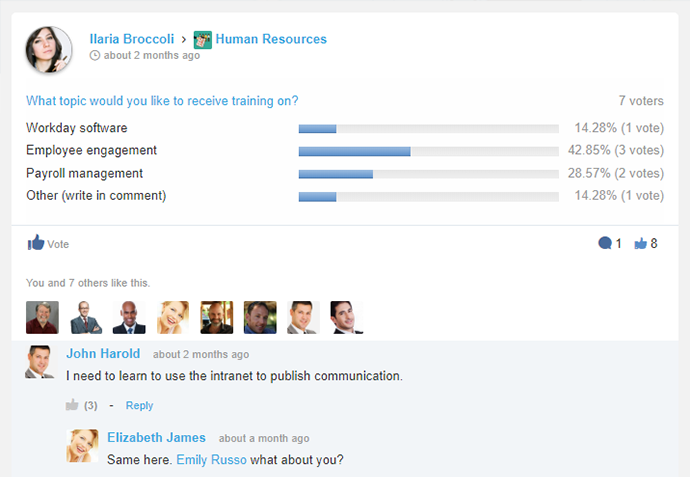  |
