Google Sheets is the spreadsheet app available on Google Workspace, or standalone, with a free plan for personal use and accessible via mobile apps for iOS and Android.
N/A
monday.com
Score8.2 out of 10
Mid-Size Companies (51-1,000 employees)
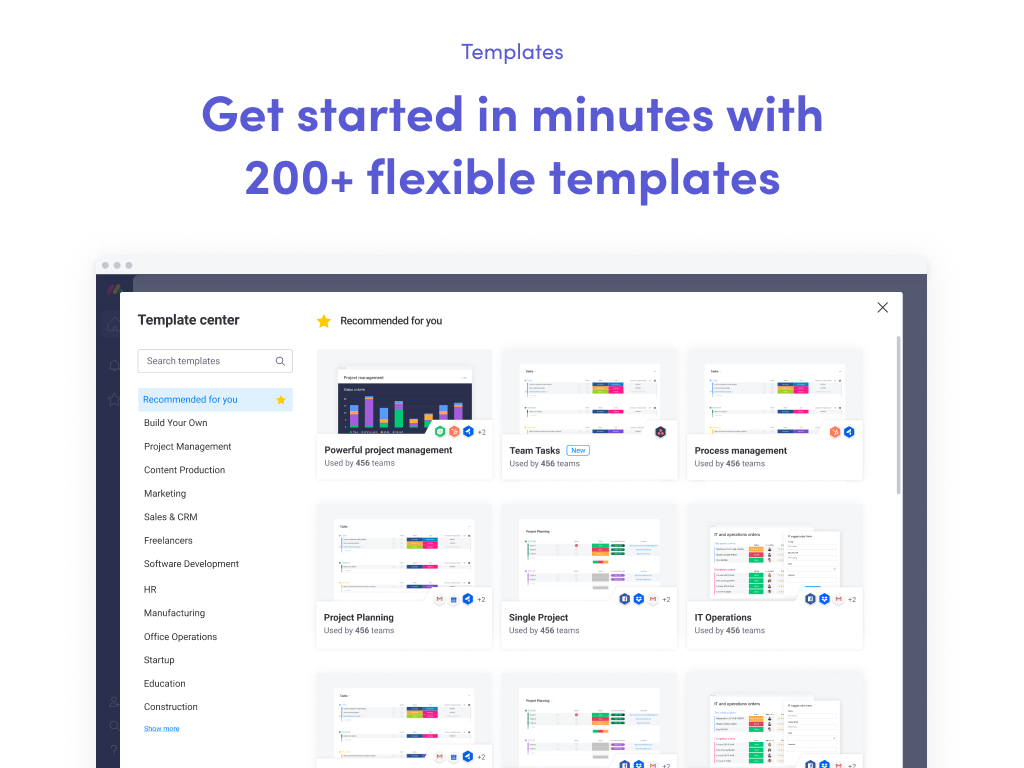
monday.com Work OS is an open platform designed so that anyone can create the tools they need to run all aspects of their work. It includes ready-made templates or the ability to customize any work solution ranging from sales pipelines to marketing campaigns, CRMs, and project tracking.
I have used monday.com and Trello for task and project tracking. Those tools are useful in the company-wide setting where multiple people need to have access, though the way I use Google Sheets is strictly for my own eyes. In that situation, I think Google Sheets is far more …
A de minimis incentive was given to thank the reviewer for their time. The incentive was not used to bias or drive a particular response, nor was the incentive contingent on a positive endorsement. More Info
Verified User
Chose Google Sheets
It's a necessary building block upon which so many other programs are created. Our most important information is best shared via sheets - information that then gets posted in all of our other platforms.
A de minimis incentive was given to thank the reviewer for their time. The incentive was not used to bias or drive a particular response, nor was the incentive contingent on a positive endorsement. More Info
Director of Customer Success Manager in Customer Service at RueBaRue (Computer Software, 1-10 employees)
Chose Google Sheets
I started using Google Sheets years ago and have never looked back! I made the switch because I was able to share my documents and make changes with anyone that had access to it.
A de minimis incentive was given to thank the reviewer for their time. The incentive was not used to bias or drive a particular response, nor was the incentive contingent on a positive endorsement. More Info
Client Success Manager in Marketing at Infinity Concepts (Marketing & Advertising, 11-50 employees)
Chose monday.com
monday.com provides a plethora of customization compared to Google Sheets and offers an automated workflow system that is easy to set up and implement. We have several newsletter emails for some of our brands and they are all built out in the dashboard to run weekly or monthly …
A de minimis incentive was given to thank the reviewer for their time. The incentive was not used to bias or drive a particular response, nor was the incentive contingent on a positive endorsement. TR verified that a representative sample of customers was invited. More Info
Verified User
Chose monday.com
We have not used anything like Monday.com before. We used to do all of what I described on Google Sheets and share them with the company. It was very time consuming and cumbersome to remake new sheets every year, Monday.com gives us the freedom to add on year by year and not …
A de minimis incentive was given to thank the reviewer for their time. The incentive was not used to bias or drive a particular response, nor was the incentive contingent on a positive endorsement. More Info
Verified User
Chose monday.com
I had originally selected monday.com because it was a bigger brand and it seemed to be more established. However, I was a little bit disappointed in the overall functionality beyond basic features. this is where I believe competitors have the edge and but ultimately led me to …
A de minimis incentive was given to thank the reviewer for their time. The incentive was not used to bias or drive a particular response, nor was the incentive contingent on a positive endorsement. TR verified that a representative sample of customers was invited. More Info
Design Manager in Marketing at The Atlanta Journal-Constitution (Publishing, 201-500 employees)
Chose monday.com
monday.com gives us the most flexibility when it comes to its features -- to create templates and quickly modify or customize. While limited in its overall functionality, it is secure and does what it is supposed to do well. An ability to interpret documents given to it -- not …
A de minimis incentive was given to thank the reviewer for their time. The incentive was not used to bias or drive a particular response, nor was the incentive contingent on a positive endorsement. TR verified that a representative sample of customers was invited. More Info
Customer Operations Enablement Manager in Customer Service at Telesign (Computer Software, 501-1000 employees)
Chose monday.com
When I arrived at my org, I was initially disappointed to hear that we used something other than Asana for project management. Fast forward just a few months, and I became a complete monday.com convert. While its organization is similar to Asana's, it's user interface, …
A de minimis incentive was given to thank the reviewer for their time. The incentive was not used to bias or drive a particular response, nor was the incentive contingent on a positive endorsement. TR verified that a representative sample of customers was invited. More Info
Verified User
Chose monday.com
monday.com is much easier to use and offers all the tools of google suite in one spot for task management. I use gsuite services still but in an entirely different way. If there is something that needs to be shared with the team or is important that I will need to refer back to …
A de minimis incentive was given to thank the reviewer for their time. The incentive was not used to bias or drive a particular response, nor was the incentive contingent on a positive endorsement. TR verified that a representative sample of customers was invited. More Info
Managing Director in Professional Services at Insodus Technologies OÜ (Information Technology & Services, 1-10 employees)
Chose monday.com
I'd put monday.com and Asana on par, then ClickUp and lastly Jira. Jira would be more appropriate for exclusively technology engineering teams. Jotform offers better choices for forms use cases especially ones with complexity. Zoho makes more sense when you have the full suite, …
A de minimis incentive was given to thank the reviewer for their time. The incentive was not used to bias or drive a particular response, nor was the incentive contingent on a positive endorsement. More Info
Employer Relations Specialist in Corporate at Network Kinection (Education Management, 1-10 employees)
Chose monday.com
monday.com molds to your business and tracks the information only you want to see. Other platforms I worked with they have a standard format and you cannot manipulate the data very easily. The other platforms aren't user friendly they are more for developers and not users. …
A de minimis incentive was given to thank the reviewer for their time. The incentive was not used to bias or drive a particular response, nor was the incentive contingent on a positive endorsement. More Info
Executive Pastor in Corporate at Bridge Church (Religious Institutions, 1-10 employees)
Chose monday.com
Although monday.com costs more than the other services, it can handle more as a platform. The functions, features, integrations, and automations allow you to do so much more than, than just keeping track of project & task deadlines.
A de minimis incentive was given to thank the reviewer for their time. The incentive was not used to bias or drive a particular response, nor was the incentive contingent on a positive endorsement. TR verified that a representative sample of customers was invited. More Info
Google Sheets is well suited in two main areas: is free to use and you don't need to buy a license to use it, comparing to the most direct competitors ; collaboration is in my opinion the best advantage, with multiple people working together and seeing others working in real time. It's less appropriate in low connectivity environments (offline capabilities)
Another feature I love in the free plan is the “Sort” feature, which enables me to sort all my clients by name alphabetically. Or sort by date, status, progress notes, etc. I make extensive use of the text column, where I can keep ongoing, detailed notes on the progress of a particular client's work and the information I am still waiting on. I have it open automatically every day, and my tasks are listed there for me to follow through on.
A de minimis incentive was given to thank the reviewer for their time. The incentive was not used to bias or drive a particular response, nor was the incentive contingent on a positive endorsement. TR verified that a representative sample of customers was invited. More Info
Collaborative planning : In the initial phase of project, Team leads and architects create a permission matrix along with the naming convention simultaneously, seeing who is editing / adding the details in real-time.
Cost tracking : We use this tool to track cloud resource usage monthly costs, so that we can analyse it and send out comms for high cost based resources. By storing cost data here, it's easy for use to store data of last couple of years.
Flexible documentation : For change logging of different scenarios we would need different / ad-hoc columns to be added on the fly, which makes using this tool much simpler then reputed third party tools.
A de minimis incentive was given to thank the reviewer for their time. The incentive was not used to bias or drive a particular response, nor was the incentive contingent on a positive endorsement. More Info
Intuitive board functionality with a variety of column types and customizations to address different use-cases, such as templates for user lifecycle management, checklists for onboarding.
Extensive automation capabilities to reduce tedium in more complex boards, such as our company's computer asset inventory board, to ensure devices are kept organized within the board for quicker reference.
The ability to connect boards and mirror info across them allowed us to build out a cross-functional, quasi-ticketing system enabling more efficient processing of requests that involved action items from different departments and/or teams.
We could use both the many board functions in tandem with the WorkForm feature to create an IT ticketing system that could be replicated and tailored for other teams needs.
A de minimis incentive was given to thank the reviewer for their time. The incentive was not used to bias or drive a particular response, nor was the incentive contingent on a positive endorsement. TR verified that a representative sample of customers was invited. More Info
A de minimis incentive was given to thank the reviewer for their time. The incentive was not used to bias or drive a particular response, nor was the incentive contingent on a positive endorsement. More Info
The management of holdable items, continuously drops in incorrect places or doesn't show the 'correct way' to handle in the wished place, it happens with the dragable items on dashboards
The 'favorites' menu on desktop is now with 'Use my IA feature' everywhere and has removed the Fav section of for the boards in the sidebar. It was so useful when there were hundreds of Tables and only work on or update 3 - 4 of them (it is still visible on the mobile version, by the way)
The errors after using for a while, like 90 minutes, I am writing something and unexpectedly the app says something is wrong and I need to reload the page, and the thing I was doing doesn't still local storage as in other use cases
A de minimis incentive was given to thank the reviewer for their time. The incentive was not used to bias or drive a particular response, nor was the incentive contingent on a positive endorsement. More Info
I am not involved in the purchase/selection process, but my organization is a Google shop, and Sheets meets most of our spreadsheet needs and works seamlessly with our other tools. I don't anticipate our switching anytime soon.
A de minimis incentive was given to thank the reviewer for their time. The incentive was not used to bias or drive a particular response, nor was the incentive contingent on a positive endorsement. More Info
Teams involved in content creation, such as marketing or editorial teams, could use monday.com to manage the entire content lifecycle. Boards might track content ideas, assignments, drafts, reviews, approvals, and publication schedules, helping teams collaborate and keep content production on track.
A de minimis incentive was given to thank the reviewer for their time. The incentive was not used to bias or drive a particular response, nor was the incentive contingent on a positive endorsement. More Info
It can easily handle most uses and functions. It is only for very large datasets or advanced analysis that it either lacks the proper functions or performance begins to slow. Most employees who continue to use competitors' products do so out of preference, familiarity with the user interface, or other surface-level reasons.
A de minimis incentive was given to thank the reviewer for their time. The incentive was not used to bias or drive a particular response, nor was the incentive contingent on a positive endorsement. More Info
monday.com was pretty easy to use from the get-go. Their automation templates are really easy to get things set up. A few of my monday.com boards are essentially upgraded spreadsheets that are much easier to digest and automatically send out reminder email to myself and my team.
A de minimis incentive was given to thank the reviewer for their time. The incentive was not used to bias or drive a particular response, nor was the incentive contingent on a positive endorsement. More Info
Like most Google products, Google Sheets rarely has outages or slowness, and when it does, connection is always momentarily restored. I can't recall a time when I've been unable to access Google Sheets but able to access other sites just fine. That said, errors aren't uncommon when handling large data volume. You know what they say about using spreadsheets as databases, but sometimes it's just the most convenient option, especially for smaller or one-off projects, and not being able to store large amounts of data hampers our ability to move quickly with scrappy prototypes or full solutions. It would be great if we could better integrate our data manipulation (Apps Script) with big data in the sheet.
A de minimis incentive was given to thank the reviewer for their time. The incentive was not used to bias or drive a particular response, nor was the incentive contingent on a positive endorsement. More Info
A de minimis incentive was given to thank the reviewer for their time. The incentive was not used to bias or drive a particular response, nor was the incentive contingent on a positive endorsement. More Info
Again, Google Sheets is no exception to Google's general high speed and reliability, but load times can be slow for larger amounts of data. I've used Sheets with Zapier and have used the Python API, and speed has never been an issue.
A de minimis incentive was given to thank the reviewer for their time. The incentive was not used to bias or drive a particular response, nor was the incentive contingent on a positive endorsement. More Info
Everything performs fairly well. Every now and then there are user errors where an employee will not click "ok" on a note they've created and simply exit out (I do wish that something was in place to prevent this, such as a pop "are you finished?")
A de minimis incentive was given to thank the reviewer for their time. The incentive was not used to bias or drive a particular response, nor was the incentive contingent on a positive endorsement. More Info
I have never contacted Google Sheets support, but Google Sheets makes it very easy to report an issue or suggest a feature from Sheets itself (Help > Help Sheets improve), and I've had mostly good experiences with support for other Google products.
A de minimis incentive was given to thank the reviewer for their time. The incentive was not used to bias or drive a particular response, nor was the incentive contingent on a positive endorsement. More Info
I personally haven't found their customer success managers to be proactive or useful as the primary user of our monday.com account. This is different from a few years ago, when I had a contact that I reached out to as-needed (we are an enterprise account). I don't get a lot of touchpoints with anyone from monday.com and rarely submit tickets.
A de minimis incentive was given to thank the reviewer for their time. The incentive was not used to bias or drive a particular response, nor was the incentive contingent on a positive endorsement. TR verified that a representative sample of customers was invited. More Info
To have someone walk you thru the features and capabilities of Monday.com is priceless. Someone also coming along later in the contract to see if you are maximizing the program to suit your company needs is beyond helpful. The staff that have provided this training are fun, creative and very patient.
A de minimis incentive was given to thank the reviewer for their time. The incentive was not used to bias or drive a particular response, nor was the incentive contingent on a positive endorsement. More Info
We signed up for the accounts. Created the accounts. Ran the trial version and tested it live while we were running multiple projects and found that it was fitting our needs perfectly. When the trial ended and we were asked to purchase the full version, we did. We have found other ways to use it and it's a breeze.
A de minimis incentive was given to thank the reviewer for their time. The incentive was not used to bias or drive a particular response, nor was the incentive contingent on a positive endorsement. More Info
I have found that I can do almost everything I could have done in Microsoft Excel faster and easier in Google Sheets. We recommend Google Sheets in 99.9% of our use cases and feel it meets the needs of our workers very well. I am sure there are other spreadsheet creation programs out there, but because we are already in the Google environment, adopting Google Sheets in very easy.
A de minimis incentive was given to thank the reviewer for their time. The incentive was not used to bias or drive a particular response, nor was the incentive contingent on a positive endorsement. More Info
monday.com gives us the most flexibility when it comes to its features -- to create templates and quickly modify or customize. While limited in its overall functionality, it is secure and does what it is supposed to do well. An ability to interpret documents given to it -- not just its own assets -- would take monday.com to the next level.
A de minimis incentive was given to thank the reviewer for their time. The incentive was not used to bias or drive a particular response, nor was the incentive contingent on a positive endorsement. TR verified that a representative sample of customers was invited. More Info
I'm not involved with the purchase, but I assume everything goes smoothly and that the pricing structure is predictable and reasonable. We do not get surprise fees.
A de minimis incentive was given to thank the reviewer for their time. The incentive was not used to bias or drive a particular response, nor was the incentive contingent on a positive endorsement. More Info
Google Sheets works very well with multiple users. It's convenient to see in real-time who is collaborating in a sheet, down to the specific cell that they're viewing/editing. Linking Sheets across departments is convenient with the IMPORTRANGE function.
A de minimis incentive was given to thank the reviewer for their time. The incentive was not used to bias or drive a particular response, nor was the incentive contingent on a positive endorsement. More Info
For it to work across multiple departments and sites, I would like to see improvements made with integrations and automation. For this question, I am acknowledging not only the addition of internal triggers/automation, but also an expansion on external ones.
A de minimis incentive was given to thank the reviewer for their time. The incentive was not used to bias or drive a particular response, nor was the incentive contingent on a positive endorsement. More Info
Don't need to pay for windows 365 license as it is free
Has a positive impact since I am not cursing excel for annoying problems(I don't want the new Pivot table format, I want to use Classic and I don't want to expand/collapse arrows. "x$#%")
[Haven't] looked at return on investment on work, but has "simplified" for basic and medium spreadsheets.
A de minimis incentive was given to thank the reviewer for their time. The incentive was not used to bias or drive a particular response, nor was the incentive contingent on a positive endorsement. More Info
A de minimis incentive was given to thank the reviewer for their time. The incentive was not used to bias or drive a particular response, nor was the incentive contingent on a positive endorsement. TR verified that a representative sample of customers was invited. More Info