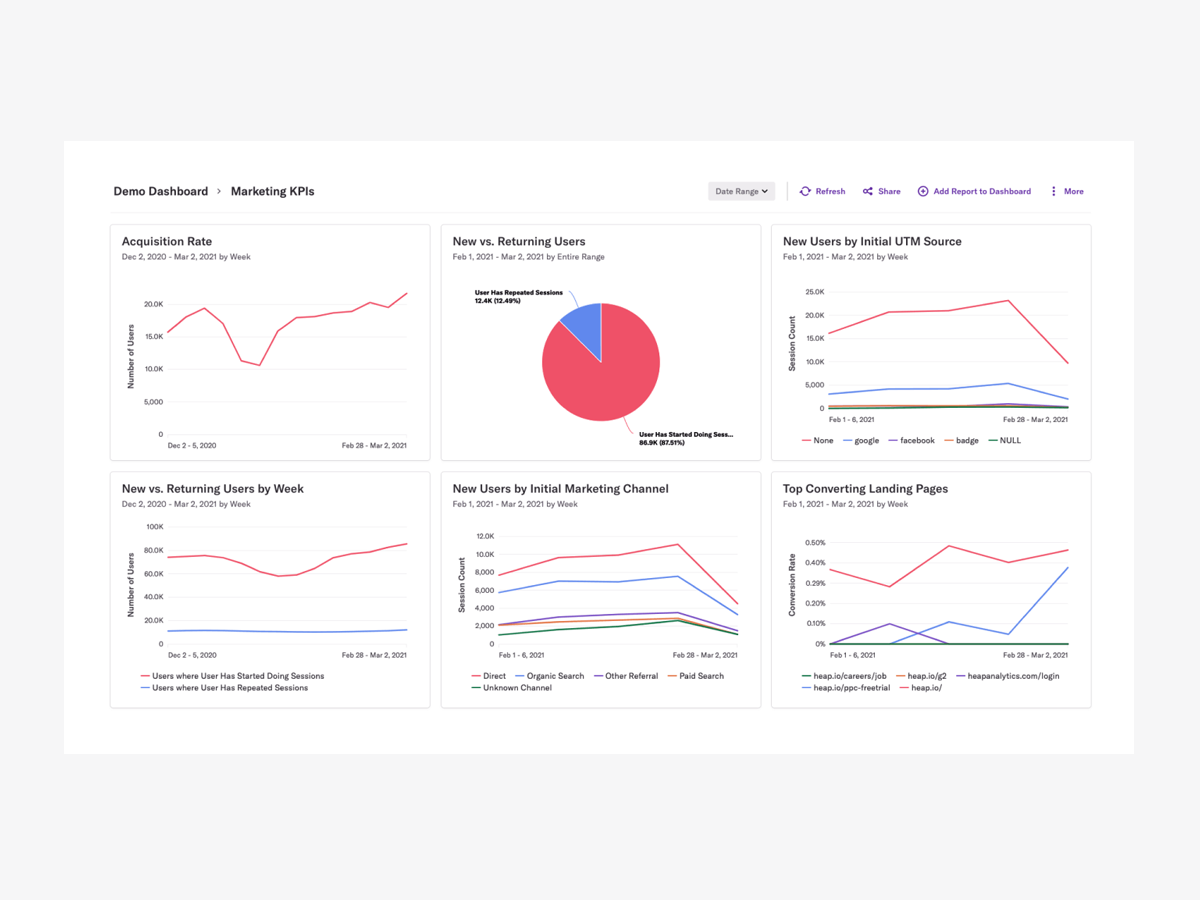
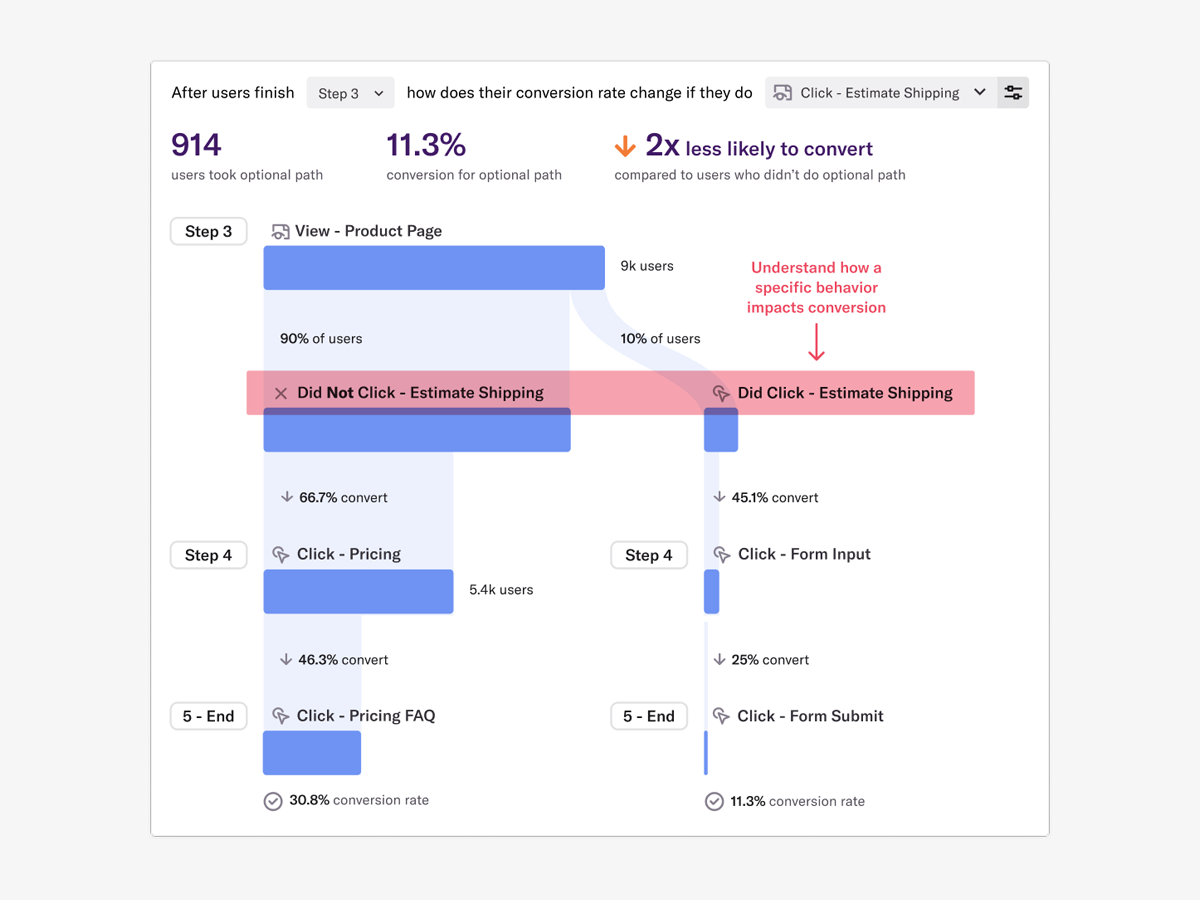
Heap is a web analytics platform captures every user interaction on web iOS with no extra code. The tool allows you to track events and set up funnels to understand user flow and dropoff. It also provides visualization tools to track trends over time.
$0
per month
Twilio Segment
Score8.4 out of 10
N/A
Segment is a customer data platform that helps engineering teams at companies like Tradesy, TIME, Inc., Gap, Lending Tree, PayPal, and Fender, etc., achieve time and cost savings on their data infrastructure, which was acquired by Twilio November 2020. The vendor says they also enable Product, BI, and Marketing teams to access 200+ tools (Mixpanel, Salesforce, Marketo, Redshift, etc.) to better understand and optimize customer preferences for growth— all integrations are pre-built and…
$120
per month
Pricing
Heap
Twilio Segment
Editions & Modules
Free
$0
Up to 10k sessions/month
Growth
Starting at $3,600 annually
Up to 300k sessions/year
Pro
Contact Heap Sales
Custom sessions per month and unlimited projects
Premier
Contact Heap Sales
Custom sessions per month
Free
$0.00
Includes 1,000 visitors/mo
Team
$120.00
Includes 10,000 visitors/mo
Business
Contact Sales
Custom Volume
Offerings
Pricing Offerings
Heap
Twilio Segment
Free Trial
Yes
Yes
Free/Freemium Version
Yes
Yes
Premium Consulting/Integration Services
Yes
No
Entry-level Setup Fee
Optional
No setup fee
Additional Details
Heap pricing is based on session volume. A session is a period of activity from a single user on your app or website. It can include many pageviews or events.
A de minimis incentive was given to thank the reviewer for their time. The incentive was not used to bias or drive a particular response, nor was the incentive contingent on a positive endorsement. More Info
A de minimis incentive was given to thank the reviewer for their time. The incentive was not used to bias or drive a particular response, nor was the incentive contingent on a positive endorsement. More Info
Verified User
Chose Heap
Heap is much easier to use versus Google Analytics. Previously, I was using Segment to get channel level data. However, Segment is not a customizable tool to understand top of funnel/web performance in the same way Heap does. Heap Connect is excellent when it comes to creating …
A de minimis incentive was given to thank the reviewer for their time. The incentive was not used to bias or drive a particular response, nor was the incentive contingent on a positive endorsement. More Info
Verified User
Chose Heap
We selected Heap due to its simplicity in creating events as well as creating reporting on those events.
No other tool comes close to the simplicity and ease of using Heap.
A de minimis incentive was given to thank the reviewer for their time. The incentive was not used to bias or drive a particular response, nor was the incentive contingent on a positive endorsement. More Info
Verified User
Chose Heap
More robust event capture that is easier to implement. Simplified capabilities that typically get the job done. However, customization was much more robust on Mixpanel.
A de minimis incentive was given to thank the reviewer for their time. The incentive was not used to bias or drive a particular response, nor was the incentive contingent on a positive endorsement. More Info
Verified User
Chose Heap
We didn't choose Heap over the others listed above. But we use Heap in conjunction with several other platforms in order to better understand our user base. Heap has been a great addition to our repertoire of usable tools and we love how it has integrated with other …
A de minimis incentive was given to thank the reviewer for their time. The incentive was not used to bias or drive a particular response, nor was the incentive contingent on a positive endorsement. TR verified that a representative sample of customers was invited. More Info
Verified User
Chose Heap
I'd say Heap is a simpler version of Amplitude. It does ~70% of what Amplitude does. If you're looking to go deeper with product analytics, it's hard to beat Amplitude.
A de minimis incentive was given to thank the reviewer for their time. The incentive was not used to bias or drive a particular response, nor was the incentive contingent on a positive endorsement. More Info
A de minimis incentive was given to thank the reviewer for their time. The incentive was not used to bias or drive a particular response, nor was the incentive contingent on a positive endorsement. More Info
Verified User
Chose Heap
We used Segment in the past. Heap is better in that it allows non-developers to define events. It also has a reporting layer.
A de minimis incentive was given to thank the reviewer for their time. The incentive was not used to bias or drive a particular response, nor was the incentive contingent on a positive endorsement. More Info
Systems Architect in Corporate at Vidyard (Computer Software, 51-200 employees)
Chose Heap
Heap is cheaper than segment and performs in a similar matter, the time to implement and destinations plus flexibility is considerably different so both options are valid depending on the priorities of the enterprise and set up.
A de minimis incentive was given to thank the reviewer for their time. The incentive was not used to bias or drive a particular response, nor was the incentive contingent on a positive endorsement. More Info
Data Architect in Information Technology at Precision Nutrition (Health, Wellness and Fitness, 51-200 employees)
Chose Heap
Heap's implicit tracking and visualizer make it much easier to add and analyze events. Historical events can also be analyzed, with wasn't possible with the other tools.
A de minimis incentive was given to thank the reviewer for their time. The incentive was not used to bias or drive a particular response, nor was the incentive contingent on a positive endorsement. More Info
Scenarios when Heap was well suited: It is when a user claims that he encountered a bug without giving us the details of the error message. Scenarios where it is less appropriate: Its when we try to capture user interaction in our mobile app
A de minimis incentive was given to thank the reviewer for their time. The incentive was not used to bias or drive a particular response, nor was the incentive contingent on a positive endorsement. More Info
Best suited: - Merging emails coming from: Facebook leads forms, Unbounce or landing pages forms, Google forms, any other kind of lead generation tool and bundling all that information together for a single user "profile". - Passing events generated in multiple applications by the same user (product selected in web, product discarded in cart, etc) and delivering those events into other applications (like a CRM) Less appropriate: - Reading/updating data directly from segment from a frontend application
A de minimis incentive was given to thank the reviewer for their time. The incentive was not used to bias or drive a particular response, nor was the incentive contingent on a positive endorsement. More Info
A de minimis incentive was given to thank the reviewer for their time. The incentive was not used to bias or drive a particular response, nor was the incentive contingent on a positive endorsement. More Info
Multi-platform. Segment has easy integrations in many different web, backend, and app platforms/frameworks. We use the Segment SDK in Android and iOS as well as our node.js backend.
Segment is fairly affordable for early-stage companies that are trying out different analytics software. The "developer" plan is free and is suitable for most companies with products that have a small user base.
The UI is great! It is extremely intuitive and easy-to-learn, and this made it take very little time to integrate this software into our analytics and marketing workflows.
A de minimis incentive was given to thank the reviewer for their time. The incentive was not used to bias or drive a particular response, nor was the incentive contingent on a positive endorsement. More Info
A de minimis incentive was given to thank the reviewer for their time. The incentive was not used to bias or drive a particular response, nor was the incentive contingent on a positive endorsement. More Info
More and richer sources. For example, MailChimp is a source but the data you get from MailChimp is quite limited. I ended up writing my own scripts to take better advantage of MailChimp's API because Segment's integration was lacking.
Better examples on how to set up event tracking. Pageview tracking is easy enough, but it would be nice if they had a sample app and corresponding code for it and showed you, via Git commits, how to add various kinds of events.
A de minimis incentive was given to thank the reviewer for their time. The incentive was not used to bias or drive a particular response, nor was the incentive contingent on a positive endorsement. More Info
It's a great platform. I'm glad that one of our product managers introduced it because it has allowed us to create all kinds of new functionality. We're not only able to create a better product experience from our communications because of Heap, but we're also able to generate all kinds of helpful analysis.
A de minimis incentive was given to thank the reviewer for their time. The incentive was not used to bias or drive a particular response, nor was the incentive contingent on a positive endorsement. TR verified that a representative sample of customers was invited. More Info
On a scale from 1-10, I find Heap to be incredibly user-friendly and easy to use. I enjoyed the training videos available and was quickly able to pick up how to create events and reports to track user interactions on our product. I would recommend Heap for its usability first and foremost.
A de minimis incentive was given to thank the reviewer for their time. The incentive was not used to bias or drive a particular response, nor was the incentive contingent on a positive endorsement. TR verified that a representative sample of customers was invited. More Info
I've never run into any issues with Heap's availability, Heap is always there when I need it. I haven't run into any issues like application errors or unplanned outages during my 2+ years of using Heap. Each and every time I log in to Heap I have a completely functional experience
A de minimis incentive was given to thank the reviewer for their time. The incentive was not used to bias or drive a particular response, nor was the incentive contingent on a positive endorsement. More Info
Heap doesn't affect page load times considerably nor has a large impact [on] our overall score, as far as page loading times inside of the tool its pretty reliable to retrieve data as much as "instant" that it can be the delay seems to be on data getting tracked into the servers to be read but it's not significant.
A de minimis incentive was given to thank the reviewer for their time. The incentive was not used to bias or drive a particular response, nor was the incentive contingent on a positive endorsement. More Info
Heap support has allowed us to troubleshoot and test a lot of different items. Their support team is always helpful and friendly, even when we come to them with the most complicated questions. I think this greatly improves the value proposition of the product because their support team is knowledgable and friendly.
A de minimis incentive was given to thank the reviewer for their time. The incentive was not used to bias or drive a particular response, nor was the incentive contingent on a positive endorsement. TR verified that a representative sample of customers was invited. More Info
Over the period it took us to set up, we kept going back to their enablement team to help us with the setup, and they were always ready and were very helpful in the entire process. Even with their documentation, they took the time out to help us work through the process. We've never had a message/email unanswered for more than an hour on working days.
A de minimis incentive was given to thank the reviewer for their time. The incentive was not used to bias or drive a particular response, nor was the incentive contingent on a positive endorsement. More Info
The implementation was smooth and easy. The Heap team helped us with implementation and it went great! Within a few weeks, we were fully up and running and utilizing the platform to its full capability. This is an additional thing that has made this platform so great and we couldn't recommend it enough.
A de minimis incentive was given to thank the reviewer for their time. The incentive was not used to bias or drive a particular response, nor was the incentive contingent on a positive endorsement. TR verified that a representative sample of customers was invited. More Info
Heap offers a ton of functionality on a single platform.It also has an smart data science layer to offers suggestions for next steps in the analysis, allowing us to explore alternative paths we may not think to take. The low-code option for updating data is appealing, and there is a lot of automation with minimal engineering effort.
A de minimis incentive was given to thank the reviewer for their time. The incentive was not used to bias or drive a particular response, nor was the incentive contingent on a positive endorsement. More Info
We chose Twilio Segment for the good API integration and node resources, I would use Ontraport again, particularly if I didn't have the requirements for API and development/platform integration. Certainly the set up and management is easy and seamless with both the API and the user interface to use depending on circumstances and requirements.
A de minimis incentive was given to thank the reviewer for their time. The incentive was not used to bias or drive a particular response, nor was the incentive contingent on a positive endorsement. More Info
The most challenging part of using Heap in a growing organization is the naming and structure in which reports and dashboards are organized. I work within the marketing department and our Heap leader internally works within the IT/Product department, which makes it challenging because we often don't speak the same language, so the learning curve has been steep without any specific use-case examples to leverage online.
A de minimis incentive was given to thank the reviewer for their time. The incentive was not used to bias or drive a particular response, nor was the incentive contingent on a positive endorsement. More Info
A de minimis incentive was given to thank the reviewer for their time. The incentive was not used to bias or drive a particular response, nor was the incentive contingent on a positive endorsement. More Info
Segment has enabled us to get a full view of our front end activity, join it to our back-end activity, and get full visibility into our funnels and user activity.
Segment lets us send events to ad tools with a full audit trail so all the numbers line up.
Segment also brings data from other sources into our data warehouse, saving our data engineering time from building commodity connectors.