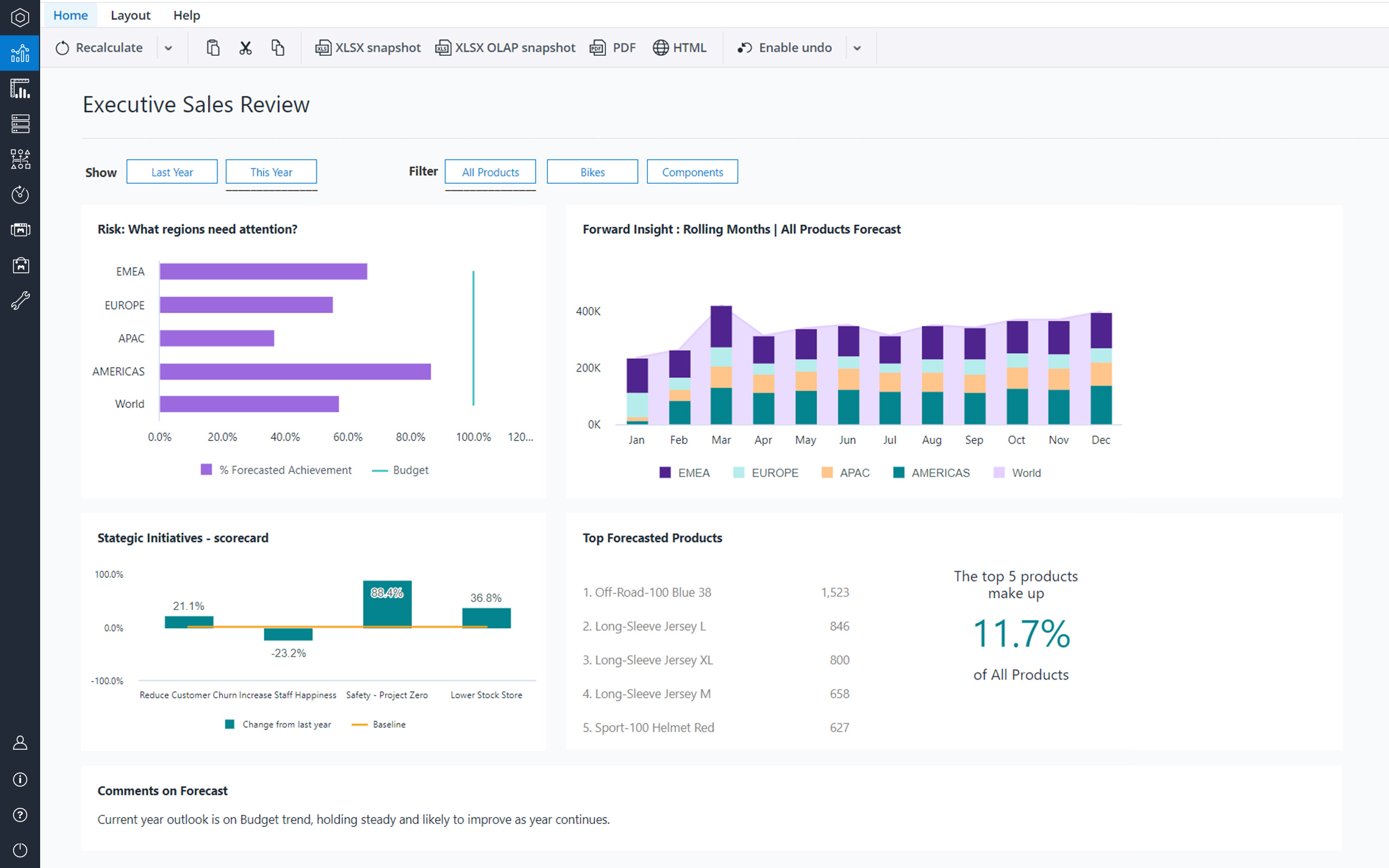
Jedox is a Business Intelligence and Corporate Performance Management solution. According to the vendor, their solution’s unified planning, analysis and reporting empowers decision makers from finance, sales, purchasing and marketing. Additionally, the vendor says this solution helps business users work smarter, streamline business collaboration, and make insight-based decisions with confidence. The vendor also says 1,900 organizations in 127 countries are using Jedox for real-time planning…
N/A
Microsoft Power BI
Score 8.4 out of 10
N/A
Microsoft Power BI is a visualization and data discovery tool from Microsoft. It allows users to convert data into visuals and graphics, visually explore and analyze data, collaborate on interactive dashboards and reports, and scale across their organization with built-in governance and security.
$10
per month per user
Sisense
Score 7.7 out of 10
N/A
Sisense is a BI software and analytics platform. With what the vendor calls their In-Chip™ and Single Stack™ technologies, users have access to a comprehensive tool to analyze and visualize large, disparate data sets without IT resources.
Power BI in some respects is easier to set up using tabular analysis, which makes creating new models relatively easy in comparison to Jedox, however, the DAX language is more complex to learn than the Groovy script used by Jedox. Jedox's power comes in its ability to write …
Setup and maintenance is much easier. Jedox is one product for all purposes: ETL, Excel-Integration, Web-Integration, Mobile. For TM1 you need the full IBM Cognos Suite to achieve the same. You have to install and configure more than 5 GB of software compared to 400 MB of the …
Microsoft Power BI
Verified User
Professional
Chose Microsoft Power BI
Cost-effective but has a lot of features to offer. The perfect tool to build reports and dashboards with a large amount of data and complex data modeling. End users do not require much knowledge to get used to the tool. Regular updates from Microsoft to add new features and has …
Microsoft BI tool does a better job than most of the other software. The reason is excellent visualizations and its capability to connect with various other software and data sources. Tableau does a better job when it comes to tutorials and being more user-friendly. Also …
Each tool has strengths, but Sisense stands out for its ease of use, scalability, and robust data integration. We chose Sisense for its balance of robust functionality and ease of use. We are happy that it can handle complex data integrations that aligned perfectly with our …
Sisense truly stacks up against Power BI, Domo or Tableau as one of the most accurate data analysis applications that offers an intuitive approach to data exploration. You can use its web-based interface to tap the expertise of your data analytics team. They can build and share …
Sisense does very well against most of the tools in the market. We chose this tool because of its great visualizations and easy to deploy procedures. The reports are very easy to generate and distribute them across departments and organization. It provides a great interface to …
Before purchasing Sisense and began recommending it as a solution to our clients, we tested four other BI visualization tools. All four of these ranked high on the Gartner Magic Quadrant. We researched Domo, Looker, MS Power BI and Tableau. Looker could be a better solution if …
Verified User
Analyst
Chose Sisense
I've used a few different analytical engines over the last few years and none have the efficient ability as both a data manager and a dashboarding tool - usually, other platforms excel in one area or another. To expand further, tools that succeed in data management and …
Sisense can't compare to any tool for the ease of user, intuitive interface and "time to data". I gave been working with both large enterprise and small SMB's using Sisense, and it is amazing to see how small companies quickly learn how to use it and how practical and efficient …
Features
Jedox
Microsoft Power BI
Sisense
BI Standard Reporting
Comparison of BI Standard Reporting features of Product A and Product B
Jedox
9.1
4 Ratings
18% above category average
Microsoft Power BI
8.3
196 Ratings
2% above category average
Sisense
9.7
47 Ratings
17% above category average
Pixel Perfect reports
9.14 Ratings
8.3167 Ratings
10.037 Ratings
Customizable dashboards
9.14 Ratings
8.7195 Ratings
10.047 Ratings
Report Formatting Templates
9.14 Ratings
8.0178 Ratings
9.033 Ratings
Ad-hoc Reporting
Comparison of Ad-hoc Reporting features of Product A and Product B
Jedox
8.3
3 Ratings
3% above category average
Microsoft Power BI
8.0
194 Ratings
0% below category average
Sisense
8.8
47 Ratings
9% above category average
Drill-down analysis
8.23 Ratings
8.3191 Ratings
10.047 Ratings
Formatting capabilities
8.23 Ratings
7.8191 Ratings
9.047 Ratings
Integration with R or other statistical packages
8.53 Ratings
7.4143 Ratings
9.027 Ratings
Report sharing and collaboration
8.53 Ratings
8.4189 Ratings
7.33 Ratings
Report Output and Scheduling
Comparison of Report Output and Scheduling features of Product A and Product B
Jedox
7.9
3 Ratings
3% below category average
Microsoft Power BI
8.0
187 Ratings
2% below category average
Sisense
10.0
46 Ratings
20% above category average
Publish to Web
8.53 Ratings
8.2177 Ratings
10.036 Ratings
Publish to PDF
7.93 Ratings
8.1172 Ratings
10.046 Ratings
Report Versioning
7.03 Ratings
7.7144 Ratings
10.024 Ratings
Report Delivery Scheduling
8.23 Ratings
8.2147 Ratings
10.039 Ratings
Delivery to Remote Servers
00 Ratings
7.9110 Ratings
00 Ratings
Data Discovery and Visualization
Comparison of Data Discovery and Visualization features of Product A and Product B
Best suited for financial consolidation and / or as a highly customized and compact EPM / BI solution (up to 100 CCU) with individual workflows, planning and reporting functionalities, with moderate number of users (no restrictions for any industry, all industries are covered well). It also has advanced reporting & data analysis requirements and provides an integration and reporting layer of imported data from different external systems (via ETL). It can help with migrating your legacy Excel-based business models to the Web. It is not well suited for Enterprise BI applications with expecting >500 CCU (users at the same time working with the system) - this may cause serious performance issues, as all data is kept in RAM. Jedox is also less suited for applications with heavy document management requirements (document management is not an out of the box functionality in Jedox and rather requires custom development through custom widgets etc.).
Has significantly improved collation of data and visualisation especially with business across Europe. Has given me the ability to see the Site availability at the click of a button to see which Site is in the "money" and seize opportunities based on Market data
I believe Sisense is perfectly suited for any organization of any size that have access to the proper resources, as the tool is very expensive. The data connectors come in all shapes and sizes out of the box, which allows a great deal of data control within the ElastiCubes. Additionally, while the platform only runs on Windows platforms, the web application can be accessed on any client: mobile, Apple, Windows, etc. This allows a much more flexible user experience, resulting in data and dashboards reaching further than any other tool.
Options for data source connections are immense. Not just which sources, but your options for *how* the data is brought in.
Constant updates (this is both good and bad at times).
User friendliness. I can get the data connections set up and draft some quick visuals, then release to the target audience and let them expand on it how they want to.
Diversity. Jedox can be applied to many different use cases from small to large deployments and from budgeting to enterprise class BI solutions. But rarely is one tool able to fulfill all of these requirements in one organisation. This value proposition can be complicated for prospective users.
Awareness. Jedox punches above its weight in capability and scalability, but not enough people have heard about it and therefore procurement processes can be drawn out as a result.
The usability of the application on mobile devices needs some improvement, especially navigation and filtering.
Dashboards that are created by multiple users can be a bit of a hassle to share by Admins.
If you need to embed dashboards into your website, you are require to buy a license separate from the user and platform license. This is a norm on most BI visualization tools, but Sisense can seem a bit on the high side, cost-wide.
Microsoft Power BI is an excellent and scalable tool. It has a learning curve, but once you get past that, the sky is the limit and you can build from the most simple to the most complex dashboards. I have built everything from simple reports with only a few data points to complex reports with many pages and advanced filtering.
I think the business and myself as a user has come to rely on SiSense as a dashboarding and quick ad-hoc reporting tool. I am hoping to integrate SiSense dashboards into more parts of the business in the future. We have reduced our report turn-around time for the most part from hours/days to minutes and in some cases almost the speed of thought. Reports are also easier on the eye and more easily distributed. I would also like to say that the support and professionalism from the SiSense team has been excellent.
To me Jedox deserves 10/10 because it is a consistent one-in-all platform with a modern look and feel. It is intuitive to use and allows you to make intuitive applications integrating traditional business intelligence with performance management functionality. It certainly has a short learning curve, especially for those that are familiar with MS Excel. An example: I've lost count but Jedox it is available in more than 25 languages. Another: Jedox does not require programming skills... it is developed to be used by the business.
Automating reporting has reduced manual data processing by 50-70%, freeing up analysts for higher-value tasks. A finance team that previously spent 20+ hours per week on Excel-based reports now does it in minutes with Microsoft Power BI's automated Real-time dashboards have shortened decision cycles by 30-40%, enabling leadership to react quickly to sales trends, operational bottlenecks, and customer behavior.
New V5 is ground floor of an exciting collection of possibilities. Weekly Sisense developers come up with new functionality that they share with us in their forums. The move to HTML5 has been pleasing in that widgets auto size themselves into appropriate forms in the board but everyone of them can be popped out to full page size to be looked at in more detail
Jedox has very few bugs. Reports are available through an Excel add-in, the web and/or mobile device (IOS/Android). In my opinion, availability also means high performance, not having to wait for the system to give you the required reports, analysis, dashboards instantly.
There are very few situations when there is unexpected downtime. Mostly during development, new dashboard implementation and during upgrades. other then that there were very few crashes.
SiSense is usually performing better then other solutions even if going for complex reports/dashboards(of course within reasonable frames). I haven't noticed any bad influence on other systems, usually if something happens it stays within SiSense.
Jedox support in general is a professional and fast responding team. An easy-to-use ticketing system is in place. Bug-related questions are solved fast (responses come usually in a few hours after the question), but some questions / tickets, that are not Jedox-related bugs (for example some advanced questions about Jedox functionality), may be forwarded to Application Management team for further processing and then it may take several days or even weeks to get a response here -> there is room for improvement here.
It is a fantastic tool, you can do almost everything related with data and reports, it is a perfect substitutive of Power Point and Excel with a high evolution and flexibility, and also it is very friendly and easy to share. I think all companies should have Power BI (or other BI tool) in their software package and if they are in the MS Suite, for sure Power BI should be the one due to all the benefits of the MS ecosystem.
SiSense's support ninjas are very knowledgeable and are exceptionally responsive. So far, all of the issues we ran into were resolved within minimum time. My sense of dealing with the support staff at SiSense is that they are very focused on not just answering your immediate question, but also to delve into the cause of the matter.
Easy and free training that allowed us quickly understand basics in SiSense and start using them. More advanced features requires some browsing through SiSense forums, but there is always support to help, and SiSense support is one of the best whith which I worked so far.
Many examples, videos and scenarios which you try on your own right away. This combined with in-person training gives you enough to utilize most of SiSense's power.
The implementation of SSO, SAML Authentication, HTTPS, Server splitting (Frontend / Backend servers) could be more standardized and made more user friendly to set up (e.g. via setup guide). Otherwise the implementation of Jedox is quick and simple when compared to other similar technologies.
Calumo is similar product to Jedox. I have used it extensively in my previous role. It was a major contender when we evaluated a BI platform for NIDA. Calumo is a great product as well and it was a very close call. Where we found Jedox to be a better fit for NIDA was the ability to prepare dynamic reports with ease without the need to learn MDX which was used extensively by Calumo to make dynamic reports which expand or shrink based on the underlying data. Another major benefit we saw in Jedox was the whole ETL process could be managed within Jedox instead of doing it in SQL server which negates having a dedicated SQL specialist role when the scale expands.
Microsoft Power BI is free. If I didn't want to create a custom platform (i.e. my organization insisted on an existing platform that I *had* to use), I'd use Microsoft Power BI. For any start-up or SMB, I'd just use Claude & Grok to build it quickly, also for free. Would not pay for Tableau or Sigma anymore. Not worth it at all.
1) Easy to use, really, there is nothing too much to say. The set up is easy and not confusing. You can use it internally or externally.
2) Customer Service, having spoken to various product reps from similar industry. Sisense rep provides you with the best support to get started, and it is really appreciated.
Scalability is often another word for speed. Given enough data, enough users or enough calculations, the tool becomes slower and slower. You will find that Jedox has a very high performance that can even be increased by the use of grafical cards. Other thaen that it does not only offer BI (looking back based on historical ERP data) but also allows you to look forward through integrated budgetting, planning, forecasting, workflow and collaboration. Not easy to find a tool that can support so much business functionality. So, also pretty scalable in that respect.
Financial budgeting and Forecasting are done in a centralized fashion in Jedox now instead of a decentralized excel based approach. A lot of cost savings and improved reliability
Easy to use self-help Dashboards and detailed reports