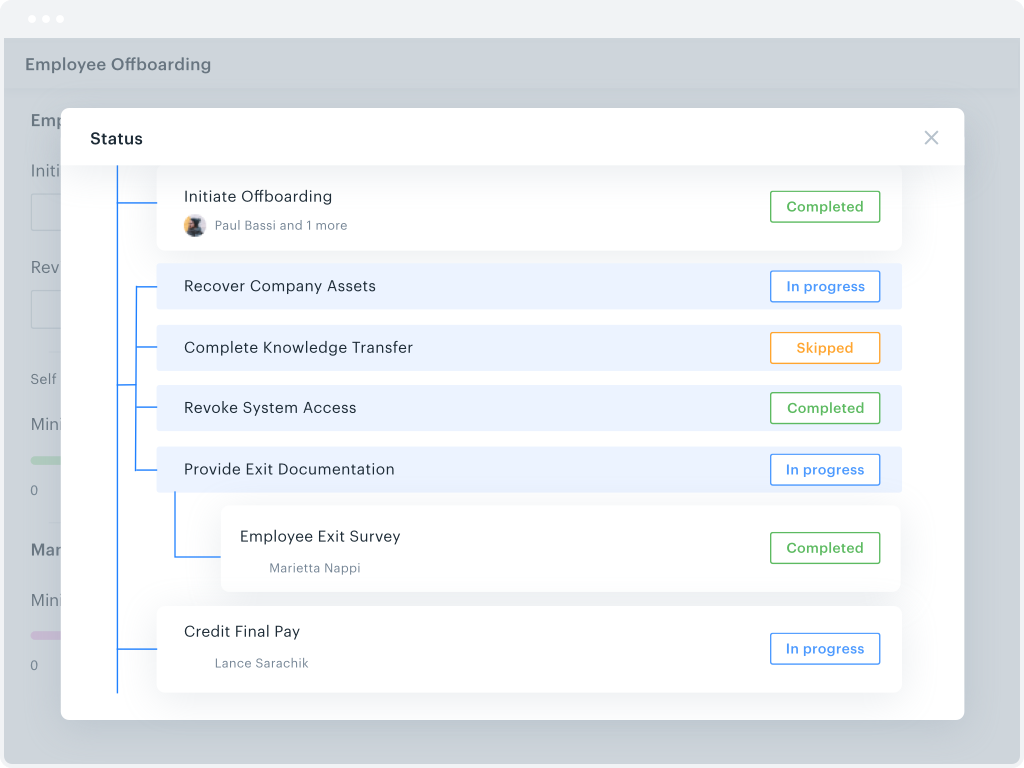
Kissflow is a low-code platform for custom application development tailored to business operations. Kissflow empowers process owners and IT developers to automate and build processes and applications for internal business operations.
$1,500
per month 50 Users
Mendix
Score 7.2 out of 10
Enterprise companies (1,001+ employees)
Mendix is a low code platform-as-a-service offering with mobile and social extensions. Mendix was acquired by Siemens August 2018.
$0
OutSystems
Score 6.4 out of 10
N/A
The OutSystems Platform is a Platform-as-a-Service solution for rapid delivery of responsive web and mobile applications. It includes functionalities required to develop, deploy, manage and change web and mobile applications. It is targeted at the delivery of enterprise applications that require integration with backend systems, complex business rules and logic, usable interfaces and flexibility to change. It can be deployed in the cloud, on-premises or in hybrid environments.
Cordys has cost us a lot of money. Mendix and OutSystems are similar products but we just liked Mendix better. The Mendix community is really helpful. You get answers in hours when you post a question on their forum. And the Mendix's help desk is also always there to help you …
The two were neck-and-neck on most measures. OutSystems, at the time, had more of a WYSIWYG UI development environment. We chose to work first with Mendix because we could implement the WebService interface to Exari DocGen with less Java/C++ code than was required for OutSyste…
Mendix is more flexible and custom making oriented than Appian. OutSystems is almost the same as Mendix but more directed to the traditional developer, whereas Mendix is trying to make it possible for everyone to be able to model.
Although I have never worked with OutSystems, Mendix is seen as a platform that can be used more easily by people that do not have an IT background. Mendix is indeed a platform that makes it possible for people with a business background (and are IT minded) to create beautiful …
Verified User
Team Lead
Chose Mendix
they are good but Mendix is more of enterprise grade. Mendix has many modules available and ready plug ins
Because most of our apps work closely with our main system (ERP) and other tools, we went with Mendix. It's good at easily connecting with lots of different systems, which is exactly what we need. Another thing we like about it is that it can handle growth well, and its pricing …
We did not deep dive into the competitors that far, primarily because of the support of the Mendix team. We felt that from a technology standpoint they were all likely close enough. What separated Mendix was the willingness of the people to make sure we succeeded. I believe the …
We selected Mendix over the competition simply because it seems like Mendix is growing faster than the competitors. The functionality is largely the same, but the price and resources favors Mendix at least at the time I reviewed the industry landscape in 2015.
I evaluated Mendix. OutSystems has many features baked in where they are third party add-ons on Mendix. For example the Process Modeling is baked into OutSystems. That is great. I also get a sense of better community support with OutSystems than with Mendix.
Mendix was similar to OutSystems, but OutSystems seemed more polished in comparison. Note we reviewed Mendix over two years ago and I have not seen the product since to update the comparison.
Verified User
Manager
Chose OutSystems
Mendix is a great platform, but [when considering] the platform capabilities when compared to Outsystems (and when you add to the people aspect of Outsystems), Outsystems comes out a distinct winner.
Mendix is getting close to OutSystems but has too many vendor locks. Apart from that Mendix is no way near the current status of OS. Betty Blocks is more suitable to service SME companies, since the costs are lower but the featureset is way smaller.
The two platforms are similar in a lot of respects but Mendix has a strong project management side where OutSystems put a focus on the devops. We had an existing project management solution so the increased focus on devops was a better fit. We are also a .NET shop and …
We did two analyses of a POC of a week, comparing OutSystems and Mendix. From our point of view, OutSystems was a better fit for bigger enterprises, and IT can still keep an eye on a possible wide growth of new applications and solutions. After this POC, we also had a look at Be…
We had a very comprehensive comparison between Mendix and OutSystems. We had multiple demonstrations of the platform and we had them both build a mockup or dummy application within a day at our office. After those meetings it was a pretty easy pick between the both of them. It …
Where Mendix looks nice, but mobile application have runtime interpreters, it makes maintaining multiple application and managing them very hard. Thinkwise is a nice ERP platform, but cannot be compared to OutSystems because they are miles apart. The developer experience is a …
Verified User
Engineer
Chose OutSystems
OutSystems is a tool that we developers use to develop an application that is a service studio. We don't need to download any other tool to create our application. Service studio provides all the functionalities related to front end things just like React Native provide, and …
Although I haven't tried much of other low-code platforms, what I know, what I read, what they share with me ... there is currently no better platform than OutSystems in the low code market. And the tendency is for OutSystems to be increasingly disruptive.
Verified User
Project Manager
Chose OutSystems
OutSystems had many more possibilities and a good user community. The stability, reliability, and performance of the tool were much higher compared to any other RAD platforms.
The vision and strategy of OutSystems (developer oriented) fits our company. Also the technology stack and scalabilty options outperform the competition. We have now also learned that the platform keeps developing, releasing new relevant features frequently. Another advantage …
The biggest benefit is that it helps avert vendor lock-in (you can take the code and leave if you need to/want to)! Also, OutSystems supports multi-tenancy and directly incorporates containers and DevOps concepts/tools. OutSystems is on top of analyst charts for two …
Verified User
C-Level Executive
Chose OutSystems
Most complete solution. Beyond the super fast ability to create high-quality web and native mobile apps, the built-in analytics have proven to almost eliminate the need for added overhead of analytics tags.
I've been following OutSystems for 3 years and the pace of innovation …
OutSystems has a better product for all deployment models, overall the product is much more matured; deployment and post-production analytics are better. UI components are richer. Using the overall ecosystem of tools provided, development teams can confidently deliver …
We've used Kissflow [School Cloud] in order to track parent requests for transportation in the SpEd department. It has been user friendly for parents to input a request and staff to review, double check school sites and locations, and set up specific routes to meet the needs of students and communicate the info back to parents.
Mendix excels in scenarios involving Business Process Automation, making it a strong choice for applications requiring workflow automation, including processes like request approvals, document management, and other business workflows.Conversely, Mendix may be less suitable for projects that demand highly customized solutions with extensive custom coding. Its primary focus on low-code development may not align well with the requirements of projects that heavily rely on intricate and specialized coding.
Well suited for internal exposure of business processes (invoicing, API layer to other systems, customer maintenance etc), whether a UI is required or not. Not so well suited for full fledged web design. An OutSystems application must serve one particular business need, if gets too much functionalities and responsibilities it tends to get chaotic and complex.
They know what they are. You aren't going to get a Workflow program that also wants to be a CRM. You will get the equivalent of an electronic assistant going from station to station, taking care of business and giving you the end result.
Paper. It reduces the amount of paper needed for menial tasks tremendously. You can automate an entire process. As an educational institution, you may still need paper copies, but you aren't waiting for John Doe to sign Line 3, then Jane Doe to initial, and so on and so on with a paper form.
Tracking. If you need to know where things are in the process, the fact that this program is dedicated to workflow makes it incredibly easy to identify where people are in the sales flow.
Customer appreciation. When your workflow is stronger, faster, and better, the customers feel it. They feel like you are right there with them and getting things moving.
We're able to really easily develop different views that are very specific to a customer's needs or customer's different types of user needs. So for example, the production managers can have a certain view that's relevant to them and then certain line managers can have views that are specific to them that allow them to run different scenarios which they define. So it allows us to easily build customized apps for each different type of user.
Workflow Design: There isn't a copy/paste function when creating the workflow, and you can't move a workflow task between parallel branches. This becomes a pain point when an item has 98% of what you need, but you can't copy it and place it in another branch to make the last tweaks. Instead, it needs to be completely recreated
Interface: While I like the current design features, which make it easy for an end-user to find their tasks and items, it would be nice to also have some flexibility within the platform. Things like being able to groups apps under a category or tailoring the look and feel of the page a little more would be a welcome addition.
Price – The licensing model of OutSystems is very expensive and not suitable for small scale developments. This is offset by the time to develop and stability for larger scale developments
Flexibility on PaaS version – The PaaS hosted version of OutSystems limits your flexibility to access the front end and backend database systems which can significantly restrict your options on high data volume developments or where anything requiring slightly out of the ordinary access is required
Same price for PaaS and self-hosted system. Licensing model dictates that you pay the same price even when you host the system on your own hardware which effectively means you pay more to manage the infrastructure yourself
We are very happy with OutSystems and our developers deliver good work. OutSystems lets us build new software on a regulare (2 weekly) basis, which is highly flexible and adjustable. Even without very much experience, our developers manage to build usefull software, which is working a lot better than our previous (legacy) software.
The system has room to grow as it's limited by not being able to edit POs after they've been approved. The system is great for registrations and syncing to other systems while including the attachments. The reporting from Kissflow is also easy to setup to link to other platforms such as Looker
A 10 would say I have nothing to wish for. A 9 means I haven't seen anything better.This tool really helps you in the whole creation and maintenace cycle, so from requirements to building/modeling to testing to deploying to capturing feedback.
OutSystems has a feature in which we can develop a functionality in a application and can use that functionality in another application without developing it again. That is main plus point for the development team so they can work with different functionalities rather focusing on the same thing again and again. if we want to make any change on the user side then we can make it live with just the deployment using the service center.
I haven't encountered a need for support with KiSSFLOW. It's not a perfect platform, but it's functional, dependable, and reasonably intuitive. I can't fault a support team just because their product works!
Response times are quick and you will get updates regularly about the status of your request. Even with very technical questions they have specialists that can help you with your problems it will give you an answer or help you with a work around.
The tech support is very reachable. Usually by [email] from but also by phone if needed. We had some difficulties at the start with understanding "what our machine was doing" under high performance load. After some good sessions understanding our needs they delivered good solutions for our problems we had in the beginning.
The online training material is well designed and explanations are step by step, helping trainees to understand and follow each exercise and new concept.
In a large company, patiently and consistently work the behind the scenes politics with business and IT partners across the firm. This is transformational - you will need a solid set of key business partners to lock arms together to move forward.
KiSSFLOW is much easier to set up, less coding and easier to explain to those that are being trained. The company already had SharePoint, but it is a very difficult system to set up. A class had to be taken, along with getting books in order to understand the process of the workflow. With KiSSFLOW, it is simple to understand, the helpdesk is quick with their response, help topics are laid out simply and you can even talk with someone on that side to ask your questions. Overall, KiSSFLOW is a much easier workflow and system to use.
Mendix would be my preferred system all the way. The system is designed for these kinds of works. I've worked with WP and DNN but they should be used just for websites. To create an app for a business value, I would suggest Mendix. Also, the offline capabilities of Mendix have greatly improved since the deployment of Mendix 7.13.
I tried to use WordPress with some success. Also looked at Joomla. But when I saw OutSystems I knew I had been wasting my time there. It takes you longer to get going with OutSystems - but even I as a novice realized immediately that Outsystems is simply in another league. Outsystems is powerful. (Can you compare WordPress and Joomla to Outsystems - I don't think so).
The only real hard number savings that we have had with KiSSFLOW is the money we have saved in forms being printed, especially multi-part forms. So for a small college like us that it probably in the $5000 to $10000 per year range. We have certainly saved money in increased efficiencies of the processes that we have moved to KiSSFLOW. But that is harder to calculate.
It helps to speed up application development because of its low code by the fact that it's low code. It allows professional developers to focus more on specialized application development rather than the more routine application development that business IT and super users can do for themselves with some coaching from the IT department. So it's just allowing the more specialist professional developers.net, for example, Java in our organization to focus on more complex engineering application developments.
The ease of use of the OutSystems development process has been the biggest ROI for us. We have developed our Framework product and maintained/enhanced it with only 4 workers.
OutSystems has enhanced their product very significantly over the last 4 years. They have gone from a simple to use tool to a very simple to use sophisticated tool that covers the standard mainframe-based computing apps and the apps used on handheld mobile devices all using the same basic set of development tools.