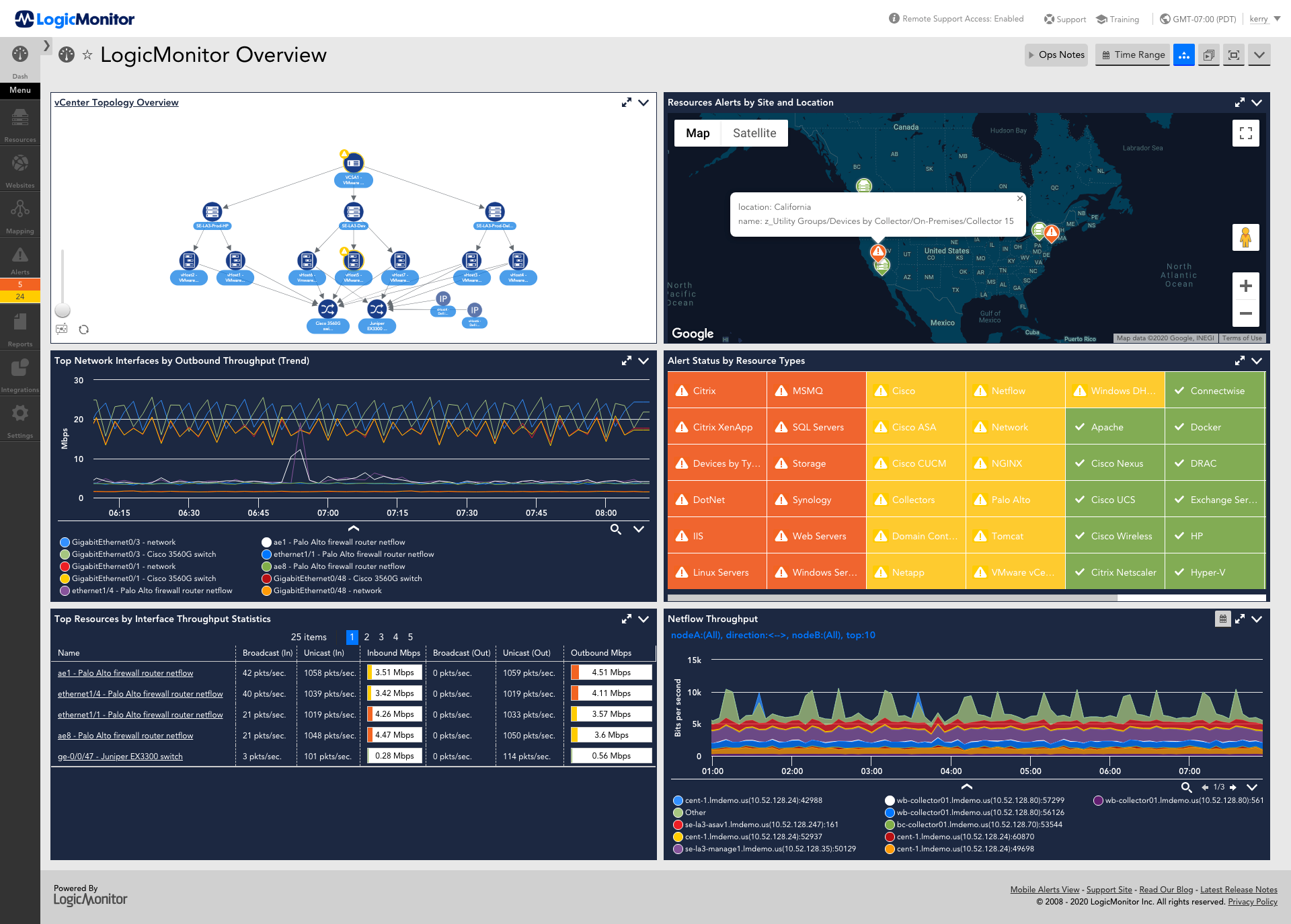
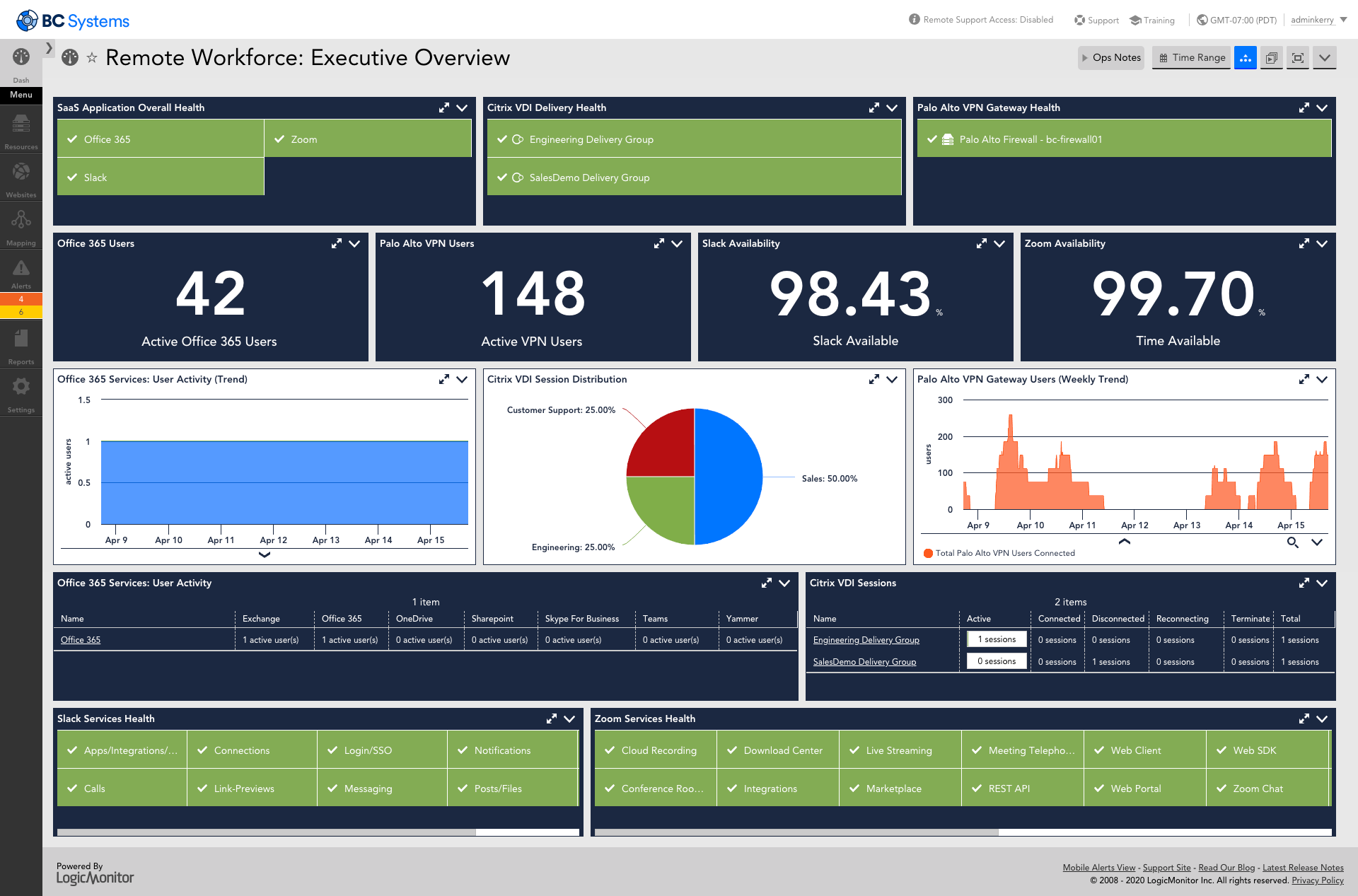
LogicMonitor’s SaaS-based platform, LM Envision, enables observability across on-prem and multi-cloud environments. It provides IT and business teams operational visibility and predictability across their technologies and applications.
N/A
SolarWinds Network Configuration Manager (NCM)
Score 8.4 out of 10
N/A
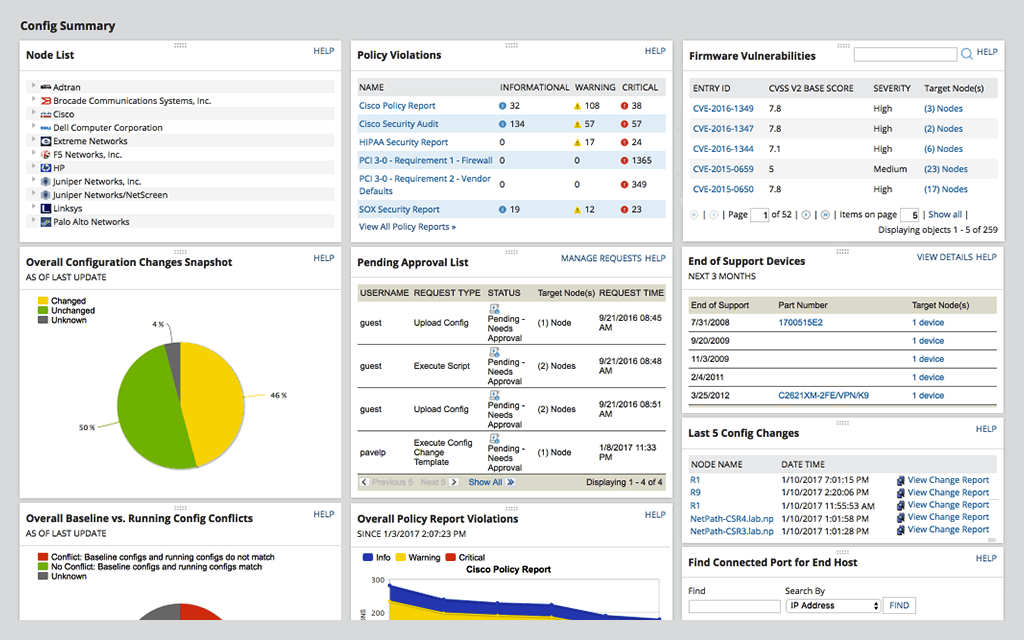
SolarWinds Network Configuration Manager is network diagnostics and troubleshooting technology, from Austin-based SolarWinds.
N/A
Sumo Logic
Score 8.8 out of 10
N/A
Sumo Logic is a log management offering from the San Francisco based company of the same name.
$3
Per GB Logs
Pricing
LogicMonitor
SolarWinds Network Configuration Manager (NCM)
Sumo Logic
Editions & Modules
Enterprise
Contact sales team
Website Monitoring
Contact sales team
No answers on this topic
Essentials
$3.00
Per GB Logs
Enterprise
$4.00
Per GB Logs
Enterprise Security
$4.25
Per GB Logs
Enterprise Suite
$4.75
Per GB Logs
Offerings
Pricing Offerings
LogicMonitor
SolarWinds Network Configuration Manager (NCM)
Sumo Logic
Free Trial
Yes
Yes
No
Free/Freemium Version
No
No
No
Premium Consulting/Integration Services
No
No
No
Entry-level Setup Fee
No setup fee
Optional
No setup fee
Additional Details
Our platform is broken down into Pro and Enterprise Pricing. Pro includes monitoring for all of your cloud, hybrid, and on-premises infrastructure. Our Enterprise package includes all of this, plus our AIOps and Machine Learning functionality that provides dynamic thresholds, root cause analysis, anomaly detection and more!
LogicMonitor only charges by the device. What is considered a device? A device is anything with an IP address that you want to monitor, including a physical device or a cloud resource. This means multiple data sources under the same IP address can be monitored for the same price. Unlike some monitoring platforms. we don’t charge per node, interface, or metric.
I was one of the members who were looking for a better application for our system security, and we tried Datadog and New Relic. Those software were very good for normal usage. New Relic was working fine until we started facing problems if any sudden system increase as it was …
I did use Dynatrace for my freelance work, as I was doing some projects on weekends for some extra income. We used to protect all of the financial information. However, LogicMonitor is used by our organization. I must say I really like LogicMonitor, as it is the best solution …
It was a fantastic product, but I used it in my previous company. After I changed jobs, I became familiar with LogicMonitor because my current employer was considering it. I must say I have not faced any issue within my career since the time I started using it, and we are happy …
We did not use software like LogicMonitor for the same work before, but I must say that my experience with LogicMonitor has been outstanding so far. It helps me to be free of tension. I can now concentrate on the actual work I was hired to do for my company.
Some teams in our company are also using New Relic, and they are pretty satisfied with it. However, I also used it for some time, and I did not find it as flexible as LogicMonitor for our needs. So, yes, I suggested that management remove New Relic, as we have a superior tool …
Our business used the trial period they provided on one of our systems and conducted sessions with all of this software. Our team tested all of these software options before deciding on LogicMonitor, as our business is expanding daily and we needed a system that could …
Basically, we did not have any idea about it and how to choose, but we asked one of our former bosses, as they were very experienced with it, so they helped us by clarifying a few things between New Relic and LogicMonitor, as they told us that if you are looking for an …
We evaluated Datadog, but it was primarily focused on data-related issues. So we decided to use LogicMonitor because it is excellent and offers so many more things than just data protection. It also keeps our systems safe with an advanced alert system, which is more critical …
SaaS monitoring makes so much sense. Why run your monitoring inside the same environment you're trying to monitor, and how do you monitor your on prem monitoring if there's an outage affecting your own infrastructure? Whilst LogicMonitor isn't a specific point solution so …
SolarWinds Access Rights Manager (ARM), SolarWinds NetFlow Traffic Analyzer (NTA), SolarWinds Network Automation Manager (NAM) and Microsoft System Center Operations Manager (SCOM)
When looking for a monitoring tool, LogicMonitor was similar or better than all of them. We moved away from SolarWinds because of its inability to monitor other network environments and lack of a collector or probe type device that could collect remote data. PRTG was very …
LogicMonitor was the most versatile and easy to deploy solution. The data from LogicMonitor could be integrated with our other platforms, so it became the source of truth.
We replaced N-Central with LogicMonitor, and had an extended bakeoff with Datadog. There were many things we liked (and still like) about Datadog, but its deployment model and less agnostic focus were disqualifying for our specific use case.
Our initial business requirements in 2016 were to monitor Vblock and FlexPod deployments. We had specific gaps with particular storage appliances the monitoring tool we used at that time could not monitor effectively. When evaluating the mentioned solutions, LogicMonitor was …
After switching from Solarwinds to LogicMonitor we would never go back. The higher price for LogicMonitor is well worth all the areas that this platform excels when compared to Solarwinds. The support is great, they are available directly through the web portal in a chat and I …
During the evaluation process we looked a number of other solutions, a detailed technically analysis was carried out to map functionlity, deployment and scalabilty across the solutions.
The primary areas that LogicMonitor succeeded are around the simplicity of deployment, …
Domotz didnt cover all devices, for example MacOS devices. Which we dont have a lot of but are still critical to monitor on our network. Solarwinds Network Device monitoring was free and great, however the display was a bit much. Also had a lot of stuff we didnt really need to …
Auvik did not provide historical data and could not monitor as many device types as LM. We found the Auvik collector to be more "buggy" and have had less issues with LM. We do feel that Auvik had a better network topology map and would clearly show device relationship. That is …
LogicMonitor has a ton more ways to customize and monitor specific processes or items that other products simply cannot do. We started monitoring applications and actually logging into them to verify everything from start to finish is fully monitored and is working properly. I …
SolarWinds had the big breach just as we left it. We loved how powerful it was, and how customizable - however, it is an ON-Prem tool, and as a growing MSP, that dynamic didn't and couldn't scale. We then moved to Auvik, which had the cleanest GUI and some neat features. That …
LogicMonitor is much easier to configure, deploy, and manage than Zabbix. Alert tuning and client configuration is clear and intuitive in LogicMonitor. Zabbix is agent based, very convoluted configuration, and is difficult to adjust tuning to minimize false positives and alert …
Auvik has some similar features but it is very expensive. SolarWinds Network Configuration Manager (NCM) has gone up in price but it is much more affordable than Auvik. Auvik has no way of sending a script to more than one device at a time so that is a downside of Auvik versus …
We evaluated PRTG Network Monitor which was similar to SolarWinds but was very resource-intensive and the server kept crashing when we got close to 100 devices
whereas on SolarWinds we were able to add several thousand devices. We
also evaluated Nagios Core as a free …
Solarwinds Network Configuration Manager is extremely powerful in allowing our organization to automate specific tasks. It is extremely simple to use and offers a Graphical User Interface for performing tasks. I am a very curious person, which has led me to use Ansible simply …
All of the SolarWinds solutions stack up against their competition. The customer support is excellent, KB articles are details, and the community (Thwack) is the best when it comes to working through complex configurations/monitors. These are the things that make them the right …
At the time SolarWinds was the biggest player in the space and their whole portfolio was very comprehensive. As time progressed and newer technologies came about (i.e. SDWAN) their products couldn't keep up with the consumer demands and changing market. Security became such a …
The product is easy to use, has great support, and is more cost-effective than the other products on the market. I would recommend this to anyone who asked for my opinion.
Red Hat Ansible Automation Platform is a great tool and matches much of the functionality of SolarWinds Network Configuration Manager. Nothing about Ansible will likely be overwhelming to an engineer with a little time to spare, but that spare time combined with SolarWinds …
I actually prefer the ManageEngine Network Configuration Management engine product but switched to SolarWinds Network Configuration Manager to standardize to our Orion deployment.
We had previously used cattools and rancid for configuration management. Cattools is another Solarwinds product but one that we outgrew and doesn't integrate with the Orion platform like SolarWinds Network Configuration Manager (NCM) does. Rancid it seems a lot of engineers are …
The SolarWinds NCM product stacks up well compared to just about any other product on the market. The NCM tool is super easy to use and will complement every Cisco or Aruba product that you may have.
If it has been used and it has been functional since it reduces the work time by more than half, making the process faster, safer, and more precise, carrying out not so complex and functional processes referring to configurations of multiple devices at the same time in an agile …
SolarWinds NCM solution is more flexible and GUI is from my point of view more intuitive, from the other hand Manage Engine solution is [a] cheaper solution which has almost [the] same functionality but suffers of luck of deeper integration with other Manage Engine modules.
LogicMonitor is very basic when it comes to config management, with support for a limited number of devices (though sufficient for us) and minimal frills/features. While we could have used it for the BC/DR portion of our solution, we wanted the better config diffs, compliance …
I have not had the opportunity to evaluate any of them, NCM has been the only software that has been used in recent years, and due to its good design, I have not had the need to look for additional software it meets my expectations and those of the manager.
SolarWinds Network Configuration Manager (NCM) was by far the easiest to implement and it just started working right out of the box. Within a few hours were we populating our config backup repository and soon after that, we were writing scripts to audit our configurations. …
We are looking at puppet just to keep our options open. This is more my area because I don't have to rely on windows. Sure there's some learning you need to do, but it runs on a solid system. Not much else we are looking at for comparison. Now if NCM moves to another OS, well …
We did not evaluate any other similar products. When the need for a config manager arose, we already had a heavy investment in SolarWinds, so using another SolarWinds module made the most sense for us.
Sumo Logic works very well out of the gate. For a small business it has given us what we need. I worked at a larger company previously, and we produced so many logs we had to create a custom logging service to handle them all. Cost and availability are big issues when …
It's cheaper, by an ungodly number of dollars. Splunk is insanely expensive. But Splunk is also incredibly fast and efficient. Splunk also holds information indefinitely (forever) so if I wanted to see if a specific end-user clicked a very specific button in 2012, I can search …
We felt the features were comparable and Sumo Logic offered a better price. This was our first log aggregation tool so we don't have a lot of insight for competing products. I speak with many others specifically regarding splunk and it seems to be comparable in many ways except …
Provides the same basic solution as Splunk as it is a central log aggregator. The main difference for us is hosted or cloud vs. on-premise. The other large difference for us was the central management of the collectors. Sumo provides a single view of all the collectors, …
For use this was a better overall solution for our needs. Between reporting, access and the ability to support an external two-factor solution for controlled access.
Comparing them to Logstash and other open source tools, Sumo Logic is a clean, already well built tool that is ready to ingest and analyze data instantly. Other open source tools take a lot of time to build and manage; and their graphs/dashboards are almost always lacking. Sumo …
We had used Splunk previously. Sumo Logic defeats them when it comes to cost, including the costs that would normally come with supporting/managing/patching/upgrading your own infrastructure and storage. Those were wins, but especially the real-time CDN integrations due to Sumo …
We have several government departments and universities as our clients, and we conduct online examinations for them. Therefore, our servers require additional security to prevent unauthorized access to our systems remotely without our permission. We were performing an examination for one of our clients when someone from outside attempted to access our systems by creating a backdoor to our servers. Our team was busy handling the examination process and ensuring its smoothness. However, thanks to LogicMonitor, we were alerted at the right time, and we were able to save our data and clients' information with its help.
If your IT team isn't proficient in automation and scripting, Solarwinds NCM can fill that gap (assuming your company's security team signs off on approving SW in your environment given the hack.) Basic device configuration, pushing mass changes reliably and backups are NCM's strong suites. If you have a complex scenario where if/then cases are needed, NCM is a bit lack luster. Auto discovery isn't as easy either as certain parameters need to be met for that feature to work 100% of the time
SumoLogic is a fantastic log aggregator and analysis tool, a fine alternative to Splunk. Searching is powerful and mostly intuitive and results come fast. If you have application logs in clusters or Kubernetes pods that lose their logs every time they're restarted, Sumo is the solution for you
LogicMonitor is very customizable. We can build whatever modules we need, because it uses standard protocols like HTTPS, SNMP and WMI to gather data and metrics.
We like that LogicMonitor is an agentless solution for our use case. Not all customers will allow an agent-based approach to 3rd party tools.
LogicMonitor has thousands of out of the box modules, which work on their own and also act as good baselines for the ones that we will end up customizing more. We are rarely starting at zero when we decide to do something new with LogicMonitor.
LogicMonitor has great documentation, and support has been helpful in the instances where we've needed them.
Log Aggregation and uploading. The architecture for Sumo Logic makes a great deal of sense and works very well.
Automated analysis. It still impresses me how well a newly uploaded log can be broken into intelligent parts, then searched and sorted using their tools.
Dashboards. It might not be what YOU will need as an IT admin, but you can give access to these dashboards easily to business users who love that kind of stuff. Most other types of (monitoring / alerting) tools, for no apparent reason, lack this feature.
Reporting, monitoring, and graphing. Given, you need to have useful log generation for an application or service as a prerequisite for sumo logic to be able to gain use, once it has it is an amazingly powerful tool.
For our use case, it does everything great and some of the features we underutilize but I would like to be able to set a configuration baseline when initially adding a node instead of after the configuration is pulled but it's not a particularly big deal to let it pull the configuration then set it as the baseline.
This product has met virtually all of our needs. It was easy to implement and has been simple to support. Customization has been intuitive with many options available. They keep adding features and expanding available options. The future of LogicMonitor looks even better than it is today which is very promising. The management and support teams at LogicMonitor are always helpful
Medium complexity to set up in the beginning if using any non-standard devices or configurations, else fairly easy (e.g. Cisco Nexus or IOS-based devices). Reports are fairly straightforward to set up. Updates to the platform are fairly straightforward and don't take a major effort. Easy to add or remove devices.
Set up is super easy. Just stand up a small Linux or Windows server to act as a collector. There are no agents to install on monitored devices and all you need is SNMP or WMI access. When creating dashboards, all you have to do is find the widget on the device you want to show up and choose the menu option to add it.
The user interface is lacking. It is difficult to navigate at times and things can be done multiple ways. Quite often I am confused by how their notification structure works. It is not very intuitive. They do offer a free Academy. They also offer a community of other technical folks. I have enjoyed both.
Sumo Logic is very powerful but definitely requires some configuration work to get the most out of it. You can get a certification related to this, but it is definitely not something you can just throw together.
The sales team support we received was top notch. They worked hand in hand to make sure the product met all expectations. So far we have not really had to work with support that much; we have worked with setup team after purchase to deploy product fully. No issues so far and we are four weeks in.
To be fair, I have not had to involve Support in a number of years, but when I did, I was greeted with enthusiastic engineers who wanted to understand and solve the issue. It was a fairly complex scenario and I have discovered in my most recent implementation that engineering included that option as a standard now.
I would give this rating because I attended a free Sumo Logic training at a WeWork in Chicago. I found the training very useful, and I learned a lot of features that I was not aware of before I went to the training. I like the idea that SumoLogic provides free training seminars. I am certified in level1, and I plan on certifying to level2.
Solarwinds has actually produced new training since I last used it that is available on their site at any time. Their previous training was more than enough to get us started but now there is significantly more content. Since I'm comfortable with the Orion platform and the products we use I haven't checked the new training out yet but we have new staff go through portions of that training and they always come away with an understanding of the platform and ready to use it
I did not truly dedicate myself to implementing LogicMonitor. However, I overheard the IT team members explain that "LogicMonitor is perfect for us as it has made most of the work automated, and implementation and training sessions were perfect for us." Thus, I can state that everything went smoothly with our implementation.
I was satisfied with the implementation, as at the time, it was the best way to implement the product with the available feature sets in Sumo Logic. User creation and management became more of an issue during continued use, instead of it being an issue related to deploying the product in our environment.
We did not use software like LogicMonitor for the same work before, but I must say that my experience with LogicMonitor has been outstanding so far. It helps me to be free of tension. I can now concentrate on the actual work I was hired to do for my company.
Auvik has some similar features but it is very expensive. SolarWinds Network Configuration Manager (NCM) has gone up in price but it is much more affordable than Auvik. Auvik has no way of sending a script to more than one device at a time so that is a downside of Auvik versus SolarWinds Network Configuration Manager (NCM).
We had used Splunk previously. Sumo Logic defeats them when it comes to cost, including the costs that would normally come with supporting/managing/patching/upgrading your own infrastructure and storage. Those were wins, but especially the real-time CDN integrations due to Sumo Logic's collaborations with other vendors. We had spoken to Logentries and discovered that many of the cons we found with Sumo Logic seemed to have been resolved in their product. Their pitfall was that, at the time, Logentries did not have the ability to get real-time log ingestion from our CDN. They said they had a solution, which was scripted, but we had not evaluated/tested. Logentries also did not have a User / RBAC REST API, and are nowhere near the level of compliance that Sumo Logic had (https://www.sumologic.com/press/2015-02-19/sumo-logic-successfully-completes-pci-data-security-stand...). In the end, I believe Logentries and Sumo Logic would be two good vendors to get involved in a bake-off
We have been able to eliminate multiple tools through LogicMonitor's ability to use collectors to run scripts and collect any numerical data from any reachable endpoint along with the customization and widgets available for dashboards. This has allowed for reduced costs and consolidation to a single point of view.
The ability to grant our clients access to see their data in real time has improved both our client satisfaction surveys and attributed to a few point gain in our NPS score. The ease of getting to the data has also reduced the quoting time for our sales teams during renewals to quantify what a client is consuming.
The amount of data that LogicMonitor collects affords our technicians a wide area of review when trying to isolate an issue and find a root cause. With the standard out of box data that is collected we have often been able to set a new threshold on something not previously thought of to proactively alert us in the future after identifying those root causes. This has reduced our Major Issues from 3-5 per month to usually 1-2 or less per quarter.
Saves 100s of hours a year in man hours over manual configuration.
Saved easily 50k in lost revenue when a switch rebooted with months old unsaved configuration. NCM let us quickly restore a snapshot of the running config from the previous day.
Saves us several man hours per week of config auditing by reducing all changes to a summary email.