Microsoft Dynamics 365 is a CRM providing sales, marketing, and service functionality. It is offered as SaaS and on-premise. Dynamics 365 is part of the larger Dynamics suite of business intelligence and ERP products.
$44
per month
Shopify
Score 8.7 out of 10
N/A
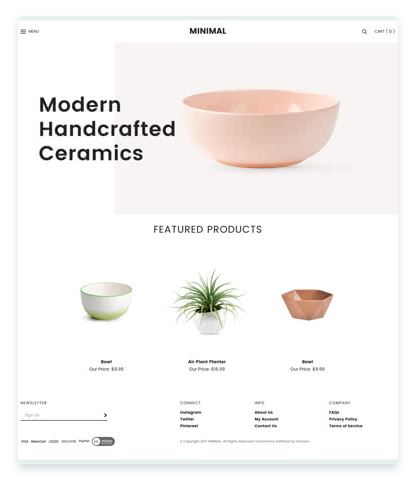
Shopify is a commerce platform designed for both online stores and retail locations. Shopify offers a professional online storefront, a payment solution to accept credit cards, and the Shopify POS application to power retail sales.
$39
per month
Volusion
Score 4.8 out of 10
N/A
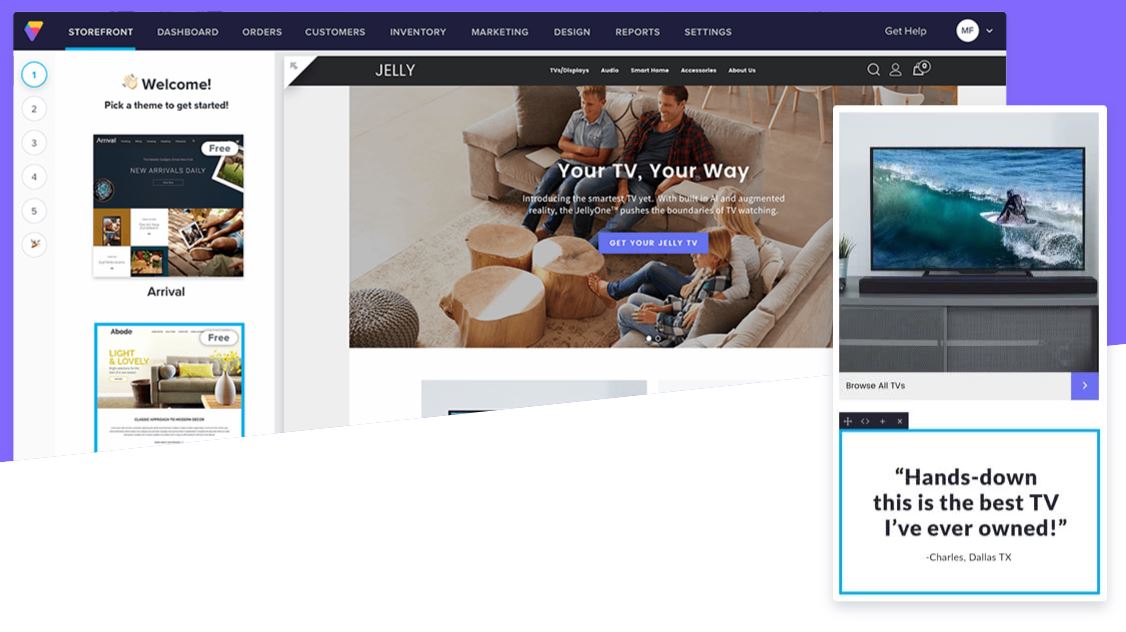
Volusion is a cloud-based ecommerce solution from the company of the same name in Austin, TX. It features an intuitive dashboard, built-in marketing and promos, SEO, templates, and tools to customize look and appearance.
For my review of BigCommerce please check out: https://www.trustradius.com/reviews/BigCommerce-2014-03-21-11-44-15
BigCommerce and Volusion are both hosted solutions just as Shopify is.
Shopify seemed to be more intuitive and more customizable. It seemed to fit a little more in what the company sought, and ended up being our choice, even despite a higher price. The company ended up opting for Shopify by putting everything in the balance and deciding that its …
We used Volusion for a while, but switched over because Shopify was a lot easier to use. It has an easier check-out process, better templates, easier management of products, and is user-friendly. Squarespace on the other hand, we still use because we think it's better when we …
My #1 issue with small business and ecommerce is that there's this belief that you can plug a few pictures into any old website, and the orders will start pouring in. This is simply not true, and if you try and build your online business that way you'll save yourself some time …
I have tried (and currently use and love) BigCommerce. GoDaddy was also decent and very easy to use. Volusion, Ecwid, Weebly, Wix, SquareSpace - all were colossal wastes of time.
Again, we work with all of these platforms, not just Volusion. However, we do make recommendations for Volusion based on the size of client and the need for additional customization and tuning. For clients who lack major development resources in house to maintain a platform …
Volusion provided the best overall list of features, performance history, and bang for the buck. By not being the new kid on the block, they have worked out a lot the bugs and kinks that plague many ecommerce platforms. They've also refined a system that is very user-friendly …
I would say overall Volusion offers very similar solutions to these other platforms. One of the main reasons I went with it over others was my experience working on Volusion stores for years before we opened our own stores and took on new clients. I'm comfortable with the …
We use Shopify and while the monthly fee is slightly higher than Volusion, working within Shopify and the visual results you get...it's not even close. Volusion seems very outdated and overcomplicated, but looking for positives with Volusion, again, I'm paying an additional $40 …
Volusion makes the creation of a store a simple process even for a beginner. More importantly, for advanced users it allows to work fast, efficiently, and with efficacy due to its bulk import/export functionality. Shopify is aesthetically pleasing and Magento is an open source …
Features
Microsoft Dynamics 365
Shopify
Volusion
Sales Force Automation
Comparison of Sales Force Automation features of Product A and Product B
Microsoft Dynamics 365
7.7
84 Ratings
2% below category average
Shopify
-
Ratings
Volusion
-
Ratings
Customer data management / contact management
7.981 Ratings
00 Ratings
00 Ratings
Workflow management
7.980 Ratings
00 Ratings
00 Ratings
Territory management
7.160 Ratings
00 Ratings
00 Ratings
Opportunity management
7.572 Ratings
00 Ratings
00 Ratings
Integration with email client (e.g., Outlook or Gmail)
7.979 Ratings
00 Ratings
00 Ratings
Contract management
7.961 Ratings
00 Ratings
00 Ratings
Quote & order management
7.458 Ratings
00 Ratings
00 Ratings
Interaction tracking
8.171 Ratings
00 Ratings
00 Ratings
Channel / partner relationship management
7.362 Ratings
00 Ratings
00 Ratings
Customer Service & Support
Comparison of Customer Service & Support features of Product A and Product B
Microsoft Dynamics 365
8.0
68 Ratings
4% above category average
Shopify
-
Ratings
Volusion
-
Ratings
Case management
7.863 Ratings
00 Ratings
00 Ratings
Call center management
7.850 Ratings
00 Ratings
00 Ratings
Help desk management
8.557 Ratings
00 Ratings
00 Ratings
Marketing Automation
Comparison of Marketing Automation features of Product A and Product B
Microsoft Dynamics 365
7.8
78 Ratings
1% above category average
Shopify
-
Ratings
Volusion
-
Ratings
Lead management
7.672 Ratings
00 Ratings
00 Ratings
Email marketing
8.171 Ratings
00 Ratings
00 Ratings
CRM Project Management
Comparison of CRM Project Management features of Product A and Product B
Microsoft Dynamics 365
8.0
76 Ratings
4% above category average
Shopify
-
Ratings
Volusion
-
Ratings
Task management
8.171 Ratings
00 Ratings
00 Ratings
Billing and invoicing management
8.054 Ratings
00 Ratings
00 Ratings
Reporting
8.065 Ratings
00 Ratings
00 Ratings
CRM Reporting & Analytics
Comparison of CRM Reporting & Analytics features of Product A and Product B
Microsoft Dynamics 365
7.6
77 Ratings
1% below category average
Shopify
-
Ratings
Volusion
-
Ratings
Forecasting
7.667 Ratings
00 Ratings
00 Ratings
Pipeline visualization
7.773 Ratings
00 Ratings
00 Ratings
Customizable reports
7.476 Ratings
00 Ratings
00 Ratings
Customization
Comparison of Customization features of Product A and Product B
Microsoft Dynamics 365
7.7
80 Ratings
0% above category average
Shopify
-
Ratings
Volusion
-
Ratings
Custom fields
7.678 Ratings
00 Ratings
00 Ratings
Custom objects
7.572 Ratings
00 Ratings
00 Ratings
Scripting environment
7.956 Ratings
00 Ratings
00 Ratings
API for custom integration
7.861 Ratings
00 Ratings
00 Ratings
Security
Comparison of Security features of Product A and Product B
Microsoft Dynamics 365
8.8
75 Ratings
5% above category average
Shopify
-
Ratings
Volusion
-
Ratings
Single sign-on capability
8.869 Ratings
00 Ratings
00 Ratings
Role-based user permissions
8.770 Ratings
00 Ratings
00 Ratings
Social CRM
Comparison of Social CRM features of Product A and Product B
Microsoft Dynamics 365
7.7
44 Ratings
3% above category average
Shopify
-
Ratings
Volusion
-
Ratings
Social data
7.843 Ratings
00 Ratings
00 Ratings
Social engagement
7.643 Ratings
00 Ratings
00 Ratings
Integrations with 3rd-party Software
Comparison of Integrations with 3rd-party Software features of Product A and Product B
Microsoft Dynamics 365
7.2
65 Ratings
4% below category average
Shopify
-
Ratings
Volusion
-
Ratings
Marketing automation
7.665 Ratings
00 Ratings
00 Ratings
Compensation management
6.834 Ratings
00 Ratings
00 Ratings
Platform
Comparison of Platform features of Product A and Product B
Microsoft Dynamics 365
6.8
56 Ratings
11% below category average
Shopify
-
Ratings
Volusion
-
Ratings
Mobile access
6.856 Ratings
00 Ratings
00 Ratings
Online Storefront
Comparison of Online Storefront features of Product A and Product B
Microsoft Dynamics 365
-
Ratings
Shopify
8.4
149 Ratings
8% above category average
Volusion
3.6
9 Ratings
73% below category average
Product catalog & listings
00 Ratings
8.8149 Ratings
4.39 Ratings
Product management
00 Ratings
8.2147 Ratings
4.39 Ratings
Bulk product upload
00 Ratings
8.3125 Ratings
4.28 Ratings
Branding
00 Ratings
8.5146 Ratings
3.69 Ratings
Mobile storefront
00 Ratings
9.1142 Ratings
1.28 Ratings
Product variations
00 Ratings
8.0139 Ratings
4.78 Ratings
Website integration
00 Ratings
8.8140 Ratings
3.38 Ratings
Visual customization
00 Ratings
8.6146 Ratings
5.19 Ratings
CMS
00 Ratings
7.6118 Ratings
2.27 Ratings
Online Shopping Cart
Comparison of Online Shopping Cart features of Product A and Product B
Microsoft Dynamics 365
-
Ratings
Shopify
8.5
141 Ratings
11% above category average
Volusion
3.6
9 Ratings
72% below category average
Abandoned cart recovery
00 Ratings
8.2131 Ratings
3.67 Ratings
Checkout user experience
00 Ratings
8.8139 Ratings
3.79 Ratings
Online Payment System
Comparison of Online Payment System features of Product A and Product B
Microsoft Dynamics 365
-
Ratings
Shopify
9.4
143 Ratings
12% above category average
Volusion
4.1
8 Ratings
68% below category average
eCommerce security
00 Ratings
9.4143 Ratings
4.18 Ratings
eCommerce Marketing
Comparison of eCommerce Marketing features of Product A and Product B
Microsoft Dynamics 365
-
Ratings
Shopify
8.3
146 Ratings
8% above category average
Volusion
2.6
9 Ratings
99% below category average
Promotions & discounts
00 Ratings
8.5140 Ratings
4.89 Ratings
Personalized recommendations
00 Ratings
8.432 Ratings
1.88 Ratings
SEO
00 Ratings
8.0135 Ratings
1.28 Ratings
eCommerce Business Management
Comparison of eCommerce Business Management features of Product A and Product B
Provides our company access to manage and customize the folds tailored to our needs. We needed to have certain paragraphs on certain paperwork per customer. MD 365 has those options to customize where needed and remove when not. The system is easy to navigate, and training can be done in a matter of days, even without prior knowledge of the system or similar systems.
Shopify allowed us to handle matrix items and combined listings. Both of which we could not do on our previous platform. There was some customization involved but overall, it did what we needed it to. The one downside was that if we want to change anything we would have to reload the entire set of matrix items manually.
Volusion is a good company if you're starting out. The problem is that, if you want more complexity out of the program, you're kind of stuck. Also the regular time out errors and slow downs can be very frustrating. Packages that miss overnight deadlines because your system stops working can cost you customers. In today's highly competitive market, that's just something that's hard to put up with. If you have a lower volume of business you might be able to work around these issues.
Best to use for AP - like in our organization, there are plenty of AP bills, so with Dynamics, we can quickly enter the same into the Excel utility, which means CSV-based upload, and then we can easily upload the same to the software. It's a time saver.
Best for Bank reconciliation - MS Dynamics makes Bank reconciliation easy. Banks can easily sync with software and easily get reconciled.
Generating invoices to customers and directly sending them to their inbox is easy with this software.
It's base security and integration with trusted security partners (such as NoFraud) is a game-changer when it comes to reliability and a "hands off approach" for our IT department. The up-time is also very good.
It offers a wide range of verified plugins that are (for the most part) easy to install and use for any specific scenario you're looking for.
It's Analytics area in the admin is actually nice and offers a wide variety of reports that you can run.
Templates are pre-built for a good end user experience. I've gone through the process of building custom sites as well as tweaking both free and paid templates that Volusion's design team provides.
Their support team didn't use to be as helpful, but in recent years have answered nearly all questions I've had. Their support section within the database provides detailed walkthrus as well.
Order processing is easy once you've been trained on the system. We got to a point where nearly the entire process was automated from initial purchase through shipping.
Small learning curve, obviously. You won't figure this out in a day, a week, or even a month. But given time, you can learn to be an expert. Or you can always get a consultant or hire in somebody. But learning the tool isn't out of the questions by any means.
Licensing can be confusing at times and isn't cheap, but it is cheaper than Salesforce. Plus no additional fees for data calls to better integrate your D365 CE data with other systems.
The Classic user interface left a bit to be desired, but now with the much-improved Unified Interface, the web client and the mobile client look the same, much more modern, and have more flexibility and power behind them for customizers as well.
I would love it if Shopify built an in house app which helped us post UGCs and social proof from platforms such as Instagram, Youtube etc. more seamlessly on our website. Right now, we are able to do it through third party apps but the look and feel is just okay.
API calls use the previous call as a reference, even if you weren't the one we made the previous call. Can lead to data gaps, so you often have to set a manual date range to look back to make sure you aren't missing any data.
CRM has allowed us to keep all of our data in one place that is easy for all users within the company to view. I came into the company after they had been using CRM for about 4 years. They have all said that since we have used this it has helped us control work processes better, it has allowed us to be able to track things so much better, and has been something that has helped unite many processes that used to be all over the place. We are currently using CRM 4.0 and are planning on upgrading in the next 18 months to the 2011 version. Support for 4.0 is almost all but dried up. Understandably so. Some of the customization we have done, and a plugins we use, are now contained within the 2011 version so we are looking forward to that upgrade. We use an email marketing company as well, and they primarily support the 2011 version, but their product connects and is integrated within CRM. This is a great benefit as well so that all of our marketing information can be contained in one location.
Nothing we have used in the past or have seen thus far even comes close to offering what we get with Shopify Plus, especially for the price. You cannot even come close to getting what we are getting at the price we pay. We are beyond thrilled and Shopify Plus meets and exceeds all of our needs and expectations. We love it!
When you spend so much time with a product like this and not only have you witnessed its growth, but you almost feel like you are next those that make the decisions of building features a certain way, you can't help but want to stay and be a part of their continued growth. It's simply a great product. Can it improve? By all means! But it will only improve because of users and avid resellers like me.
The usability is easily adopted for users familiar with other Microsoft products. Dynamics 365 has several interfaces that cross over browsers and tablets. These multiple interfaces will be phased out and updated to a single unified interface eventually to provide the same usability across all devices. The backend configurations is slowly improving with the introduction of PowerApps compared to pre-D365 Online versions
It is fairly easy to use Shopify regardless of what task you are attempting to perform. Most things are customizable to a degree without requiring coding ability. I have very limited coding experience and have still been able to navigate my way around changing features of the website that require edits to the code with the use of AI and trial-and-error. This previously wasn't possible with the WooCommerce platform.
Our partner, Ledgeview Partners has been FANTASTIC to work with. They are always timely in their response and have taken time to understand our business and our specific needs. We've made a lot of advanced customizations and they have been a great help in making those updates.
In terms of support I give Shopify a 9 out of 10 because they're always very friendly and thorough, and they personally can't solve my problem for me they always point me in the proper direction with the proper information I need to move forward
You have to wait on hold for at least 45 minutes every call—the tech support person never knows the answer right away so they put you on 10 minute holds only to come back and say they're still looking for answers. The chat function could take days to get a response. Our "Dedicated Account Manager" never checks in or answers, nor are they ever in the office when we call. It's like they try to be as unavailable as possible until you forget why you even called in the first place. Insane.
Shopify offered us several trainings to setup a Shopify store, how to build a brand, SEO, product photography etc. All this content have been super helpful in our journey.
We used a data warehouse to house our data, and our IT team and implementation vendor worked diligently ahead of time to construct idea implementation plans. Out of millions of records- we had less than a dozen errors, which is remarkable. My major insight is simply having a group of completely devoted individuals working towards your goal who fully understand the desired outcome. Focused resources for implementation season are critical to success.
It is best to use the built-in features and recommended services for the most turn-key experience (ie. Skipjack for payment processing so that it can all be done from the Volusion backend).
Microsoft Dynamics was part of a system overhaul for a local school, and we looked at many products. If we had used it for a company with low turnover, then it might have been more feasible. They needed something a new person could learn quickly, someone who might also be learning marketing terms at the same time - especially if there is nobody to train the individual now expected to know the system. Similar issues occurred with all of these programs (we called it being too big for their britches), and one of the bigger things we liked was that it is more compatible with MS Office products in both technical and visual appeal. If you have a steady employees who use a CRM consistently, low turnover, and those who are very familiar with Office products, Dynamics would be the smartest option for you. Unfortunately, this was just not true for the school environment
Big Commerce and SAP Hybris are two other platforms we've investigated and Shopify is by far easiest to use and customize. While it doesn't do everything out of the box, the apps do fill in many gaps. The cost however, is probably the biggest selling point against these other two options.
While k-eCommerce was very glamorous to us because it integrates with our main workflow, it just didn't have some of the marketing features that are so integral to the way we do business online. The set-up costs were also way too high. Volusion is so affordable and feature heavy, it makes it very difficult for any shopping cart provider to compete. You can find others who are competitively priced and have similar features, but they simply aren't as robust (at least for the way we use it)
On our purchase, I'd been interrogated about our usage. Our needs are met by Microsoft Dynamics 365, which is simple to use. With so much data and information available, we must ensure that it is presented correctly to managers. Due to a lack of use, we don't have to spend as much money on Salesforce.
My company's preferred program right now is Microsoft Dynamics 365. We use it to keep track of customers and important sales metrics in a streamlined manner. Anyone familiar with CRMs will find the tool extremely useful. Considering that we have a good turnover, this product will be used for its basic segments. As a result, there are few chances of error with Microsoft dynamics because it is so easy to use. Many options for recording data on these leads are available. It meets our needs and pays off.
For those without a centralized, all in one solution for major HR, Finance and other departments, Microsoft Dynamics 365 has vastly improved employee time utilization and profit.
Migrating clients from on-premise to the cloud has reaped benefits including better security, no unscheduled downtime and frequent updates to functionality.
Those transferring from cheaper solutions have lost money in the aim to be better integrated with other Microsoft products and AI they don't really utilize.
It got the store up quickly so the client could start selling. She was previously selling products on Etsy and Facebook and wanted to consolidate everything onto one website, so the main thing Shopify solved was to reduce the store owner's time in managing all her products on multiple sites. Also, we had previously built a website on Wix with all the custom functionality and branding she needed - a truly great, high-end website - but it performed so slowly that it was unusable. So the speed at which Shopify can be set up and then works on the page is appreciable.
The website was manageable by the client - she could figure the system out herself after a while so she saved money on costs for hiring developers. She did have to hire developers to customize some of the plug-ins but costs are all relative; it wasn't a high investment compared to building a full e-commerce website. With the complexity and size of her product base and the functionality and branding she wanted to have in a website, and the potential of her business, she would have needed to invest well over $10,000 to get to where she really needs to be. In the end she kept the budget under $5000.00.
Costs kept climbing with plug-ins having to be added with everything. My client became more involved in building the website and began to try multiple plugins, and she did not have the skill base to evaluate the plugins functionalities so she chose plugins that did not do everything she needed, and then ended up paying the plugin developers to customize the plugins. So on one hand, it's pretty amazing to be able to bring up an e-commerce website as quickly as a week or so, but on the other hand if you need anything customized or deeper functionality in regards to product searching and filtering on the web page, and management on the backend, it quickly goes beyond the skills of the average person to manage, and above their expected budget as well. In the end my client really did not get anything close to the functionality for the website we had originally envisioned.
Shopify was the easiest way we could find to bring the client's products to a global market. We evaluated several other platforms and the functionality simple did not seem to be adequate, so Shopify seemed like the only solution that could do enough of what we needed and still stay within this client's budget. Really the problem in this project was not platform per se but that the budget wasn't large enough. Shopify managed to provide a solution for an ecommerce store with thousands of products on a tiny budget, so in the sense of pure functionality it provided the best value of all the platforms we evaluated. The solution still isn't big enough for this client's business though so, without having insights into this client's post-build sales results, my guess is that because her new website did not make her products easier to sort through, and she likely didn't have much more budget left to invest in SEO and other marketing of the website, her sales probably didn't increase substantially as a result of having built the website. So I think this project all in all did not likely have a high ROI.
Honestly, when you're in the dashboard, the UX is simply horrendous. I mean, everything that should be 1-2 clicks away is 4-6 clicks away, and each pages takes at least four seconds to load. You just find yourself wasting a lot of time waiting for things to load. This should be more simple.