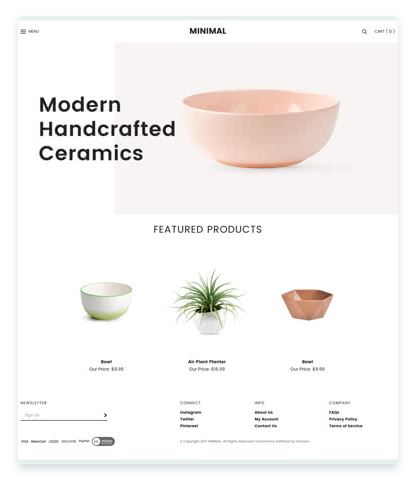
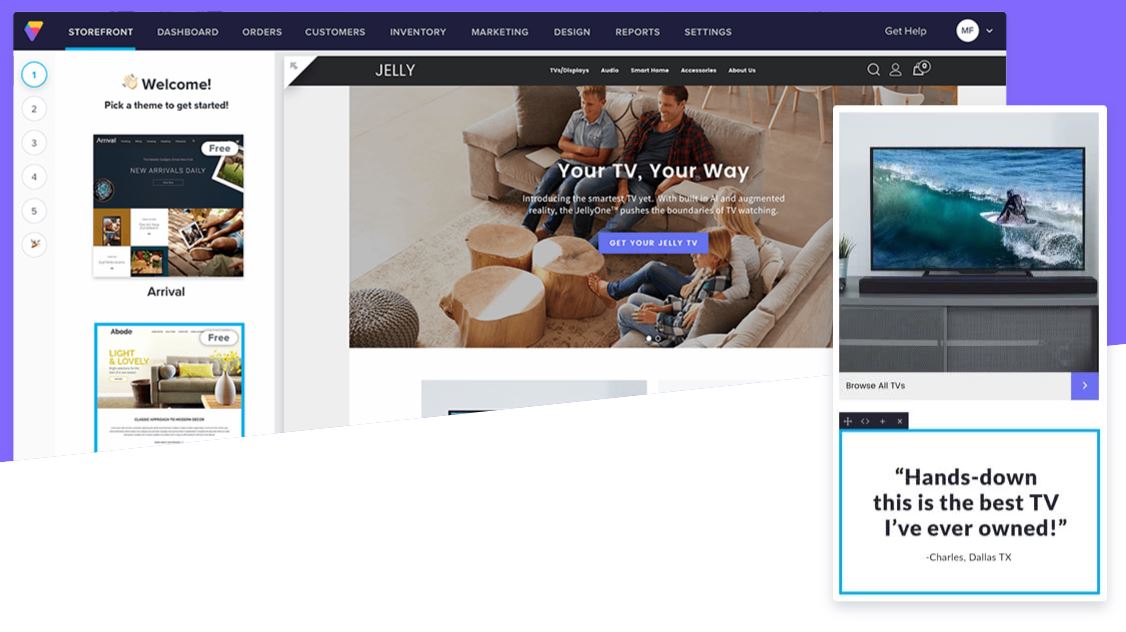
Miva Merchant is a point-and-click, online store development and management system that allows merchants to build their online store through a web browser, and lets developers provide aftermarket enhancements for the online store.
N/A
Volusion
Score 4.8 out of 10
N/A
Volusion is a cloud-based ecommerce solution from the company of the same name in Austin, TX. It features an intuitive dashboard, built-in marketing and promos, SEO, templates, and tools to customize look and appearance.
$29
per month
WooCommerce
Score 8.3 out of 10
N/A
WooCommerce is an eCommerce plugin for WordPress, developed by WooThemes (recently acquired by Automattic). Like WordPress, it is designed to be an extendable, adaptable, open-sourced platform. WooCommerce allows merchants to sell physical products, downloadables, or services.
$0
Pricing
Miva
Volusion
WooCommerce
Editions & Modules
No answers on this topic
Personal
$29
per month
Pro
$79
per month
Startup
$179
per month
Business
$299
per month
Woo Enterprise
Contact Sales
Offerings
Pricing Offerings
Miva
Volusion
WooCommerce
Free Trial
No
Yes
Yes
Free/Freemium Version
No
No
Yes
Premium Consulting/Integration Services
Yes
Yes
Yes
Entry-level Setup Fee
No setup fee
No setup fee
No setup fee
Additional Details
Miva employs a revenue-based pricing model. The Miva platform is best suited to growing mid-size and enterprise merchants that have complex business needs and are making (or planning to make) $1 million or more in annual online revenue.
—
WooCommerce is a free and open-source plugin for WordPress. Merchants can host their WooCommerce store on any private hosting service, or with Automattic directly via WordPress.com. Some added features or services from the WooCommerce Official Marketplace may have one time or subscription pricing.
Miva is so much more customer oriented and willing to work with and for you. There are many modules you can install to get specific functionality to work, but if there's none available, they are more than willing to work with you to accomplish your needs. Miva actually listens …
Each player has positive features and value to add to a business. BigCommerce and Shopify have brand recognition that has lead to them being the more common choice in eCommerce. Overall, they have their place for simple B2C sites, and less complex B2B sites. Miva was the …
Verified User
Employee
Chose Miva
Miva Merchant has it's own language which had a high learning curve for me to understand. Customize the template to match a html/css static site was difficult because you needed those Miva Merchant code pieces to be in the correct places. Now that I'm older and wiser, I no …
Verified User
Manager
Chose Miva
Many years ago, Miva was a good eCommerce platform compared to others, typically offered by a hosting company for free or a small charge. However, it's fallen way behind the pack now and the declining interest in their system and ever increasing fees make it exceptionally …
All of these products are nice in their own way. MIVA's big advantage is their selection of modules, although I have to say WooCommerce is starting to catch up in that area. While MIVA has begun to show its age, it's still a solid way to manage a store that contains a lot of …
Miva Merchant for me as a Module Developer I believe scales better than the above. Has better customer support, and as a developer has the most open API.
I have used others, but don't recall all the names. In the end though - we always go back to Merchant. Its just easier, and we have full access to our data.
When we started using Miva, (in 2003) the other alternatives simply weren't available. Miva was the eCommerce solution our hosting provider offered.
Over the years, we considered migrating to several other services, including Volusion, Amazon Storefront, and Zen Cart. Zen Cart …
Volusion
Verified User
Director
Chose Volusion
Volusion blew Miva out of the water. Magento allows for more customization without having to use 'partners' which helps keeps the cost down but requires a great deal more technical knowledge to create and maintain.
Again, we work with all of these platforms, not just Volusion. However, we do make recommendations for Volusion based on the size of client and the need for additional customization and tuning. For clients who lack major development resources in house to maintain a platform …
Volusion provided the best overall list of features, performance history, and bang for the buck. By not being the new kid on the block, they have worked out a lot the bugs and kinks that plague many ecommerce platforms. They've also refined a system that is very user-friendly …
I would say overall Volusion offers very similar solutions to these other platforms. One of the main reasons I went with it over others was my experience working on Volusion stores for years before we opened our own stores and took on new clients. I'm comfortable with the …
WooCommerce sits in a nice sweet spot between hosted e-commerce solutions where you have to give up some control in exchange for easy-of-use (like Shopify, Squarespace) and larger more enterprise solutions that are endlessly customizable but too complex for most merchatns needs …
Miva is a SaaS closed platform. Page builder has bugs and errors, it's not as easy to work with as they say. To work with Miva, you need to work with their professional services or an agency, it's not a cheap platform to make changes to. Has anyone read the latest terms of service update from Miva sent out yesterday 5/21? It's extremely concerning. Miva could shut you off the day after a payment for your subscription fails. Why would they do this to their customers?
Under section C. (ii) Payment Terms: d (ii) Customer shall be in default of this Agreement. If Customer’s Account is not paid in full on the invoice date, Miva reserves the right to interrupt or terminate Customer’s access to and use of the Services and to any other Miva Products and/or Services on the following day. Miva is not responsible for any losses or damages resulting from any interruption or termination of the Services due to outdated or incorrect payment information.
Miva is based in San Diego, CA. Under California law (e.g., California Business and Professions Code § 17200 for unfair business practices), a 24-hour notice period for service suspension could be deemed unreasonable, especially for a critical business service like an ecommerce platform. Courts often expect “reasonable notice” (typically 5-30 days) to allow the customer to cure the default.
This change isn't lawful and it's extremely concerning to anyone who hosts a website on their platform. No opportunity to cure? They used to have a 15 day grace period to cure. One would wonder why they would be unreasonable in taking this away when it's best practice throughout the e-commerce industry.
Volusion is a good company if you're starting out. The problem is that, if you want more complexity out of the program, you're kind of stuck. Also the regular time out errors and slow downs can be very frustrating. Packages that miss overnight deadlines because your system stops working can cost you customers. In today's highly competitive market, that's just something that's hard to put up with. If you have a lower volume of business you might be able to work around these issues.
WooCommerce is best suited to customers whose website is built on the WordPress platform, and whose development team has a good understanding of plug-in implementation. If your website is not built on WordPress, but on Laravel or React (or any other non WordPress technology), then WooCommerce is not for you. WooCommerce is also great for customers who just need a simple online shopping experience. If your needs involve more complex or immersive features such as timed discounts, pick up locations, delivery reminders, or post shopping feedback surveys, know that you will need to purchase additional add-ons to make to get these features using WooCommerce set up on WordPress.
The ability to quickly change the look and feel of any given page in the store. The storefront, category, product description, and all checkout pages are easily customize-able using simple HTML language.
With minimal effort, more sophisticated changes and behaviors of the store can be modified using MivaScript, the language Miva Merchant is built upon.
New features are very easy to add using a huge selection of 3rd party feature modules that typically sell for less that $100. Miva has so many features already built in, but if there is a major common feature not already in the code, it's almost a sure bet that there is a affordable and easy to install module that will meet your e-commerce business requirements.
Miva corporation provides a high level of free support 7 days a week and 24 hours a day.
Templates are pre-built for a good end user experience. I've gone through the process of building custom sites as well as tweaking both free and paid templates that Volusion's design team provides.
Their support team didn't use to be as helpful, but in recent years have answered nearly all questions I've had. Their support section within the database provides detailed walkthrus as well.
Order processing is easy once you've been trained on the system. We got to a point where nearly the entire process was automated from initial purchase through shipping.
The Miva admin area hasn't been the most user-friendly in the past. However, the admin in the the upcoming new Miva Merchant 9 Release has been completely revamped, is VERY user-friendly, and is formatted for desktop as well as mobile devices.
Some fairly standard ecommerce functionality like Gift Certificates, Coupons, Sale Prices, etc have previously required third-party modules or template customization. However, many of these features are being built into Miva Merchant upcoming releases.
API calls use the previous call as a reference, even if you weren't the one we made the previous call. Can lead to data gaps, so you often have to set a manual date range to look back to make sure you aren't missing any data.
For most clients, the MIVA Merchant platform, in combination with 3rd party plugins from ADS, Emporium Plus, eMediaSales and Sebenza, has all of the bells and whistles they need. While MIVA is lacking in a mobile friendly option and the ability to easily sell soft goods like mp3's or eBooks, these additions are coming to MIVA soon. The lack of connectivity to popular POS systems is also a negative for us. We will certainly continue to offer MIVA Merchant to clients.
When you spend so much time with a product like this and not only have you witnessed its growth, but you almost feel like you are next those that make the decisions of building features a certain way, you can't help but want to stay and be a part of their continued growth. It's simply a great product. Can it improve? By all means! But it will only improve because of users and avid resellers like me.
Despite very rare glitches, more connected to an excessive number of plugins, that affect the speed of the site, we are extremely satisfied with the platform, the ability to import and export products, even though we just export them, as we have our proprietary system for updating inventories. We love the ease of upgrading, enhancing, innovating, and the freedom we have to do whatever we want, which is a plus, when you consider Shopify can take down your whole store as they please, if they think you aren't abiding to their TOS or their ever changing set of rules.
I won't say usability is all bad with Miva; basic product configuration isn't complicated and assigning products to categories works well. However, when you go beyond the most elementary tasks, things almost always become needlessly cumbersome and the information stored by the platform is inherently poorly organized. They've really hyped that Miva 9 released last year features a re-worked admin interface, but from our perspective they've simply given it a fresh coat of paint, made the layout passably mobile friendly, but yet still have not in a substantive way addressed the glaring deficiencies at the core of the platform itself. Adding custom admin area bookmarks is a band aid, not a proper fix.
It is built on the Wordpress platform, so there are some quirks compared to a dedicated e-commerce product, but it is very intuitive and easy to use, especially for anyone with Wordpress experience. There are numerous great support articles and learning resources available. Significant customization can be achieved with plugins vs other eCommerce platforms, which may require more custom code and have fewer plugin options.
I work with multiple Miva sites daily, and uptime is fantastic. Outages are rare from my experience, and any issues have generally been short and handled quickly.
I would give 10, but there were a couple of times when I was misinformed and I had to do some unnecessary work. When you have to work on every product individually and then you discover you could have done it in bulk it kind of makes you roll your eyes back. I also have an issue still with some shipping settings that no one seems to understand. But the support team is super friendly, they are trying
You have to wait on hold for at least 45 minutes every call—the tech support person never knows the answer right away so they put you on 10 minute holds only to come back and say they're still looking for answers. The chat function could take days to get a response. Our "Dedicated Account Manager" never checks in or answers, nor are they ever in the office when we call. It's like they try to be as unavailable as possible until you forget why you even called in the first place. Insane.
Creating the Miva store originally took a reasonable amount of time, 2-3 months, but we were unable to migrate our orders and customer accounts from the old platform. Additional refinements were required over the following 6 months to refine the functionality and features so that they worked properly for our store and fulfillment process.
It is best to use the built-in features and recommended services for the most turn-key experience (ie. Skipjack for payment processing so that it can all be done from the Volusion backend).
Each player has positive features and value to add to a business. BigCommerce and Shopify have brand recognition that has lead to them being the more common choice in eCommerce. Overall, they have their place for simple B2C sites, and less complex B2B sites. Miva was the only one where we had access to not only the core of the platform, but every part of our page templates. Most platforms will give you a box to stay in, but Miva lets you define the box, and when it doesn't fit your needs, you can adjust it to bring it where it will benefit your company most. Some of the major benefits that we couldn't find on other platforms: Ability to incorporate APIs at any stage of customer journey Unlimited Custom / Complex Product Configurators and Builders Easy to understand the structure and hierarchy of pages and templates.
While k-eCommerce was very glamorous to us because it integrates with our main workflow, it just didn't have some of the marketing features that are so integral to the way we do business online. The set-up costs were also way too high. Volusion is so affordable and feature heavy, it makes it very difficult for any shopping cart provider to compete. You can find others who are competitively priced and have similar features, but they simply aren't as robust (at least for the way we use it)
We were pretty sure we wanted a WordPress site so that we had more control over the site itself, having been burned by third-party vendor sites before. The fact that WooCommerce integrates so well with WordPress was a big selling point for us. Magento would have been too heavy of a lift for our small dev team and we didn't want to rely on Shopify or BigCommerce (though all of those products could have their merits for other projects or clients).
Miva has proven to be a great solution for smaller mom-and-pop stores through large enterprise-class businesses with tens of thousands of products. Performance is just as strong on enterprise-class stores as on considerably smaller stores, and an increasing number of marketing/sales tools are continually being added to the core Miva functionality to keep up with current marketplace demands.
Running a business in general (and this applies to e-commerce of course) involves not enough time to do too many things. Any place one can automate/streamline/ simplify some of these myriad things, you gain more time to focus on high value activities. We have found that the more we have been able to leverage Miva's capabilities (often with our own tools), the more time we can spend on marketing, sales and product development.
Honestly, when you're in the dashboard, the UX is simply horrendous. I mean, everything that should be 1-2 clicks away is 4-6 clicks away, and each pages takes at least four seconds to load. You just find yourself wasting a lot of time waiting for things to load. This should be more simple.