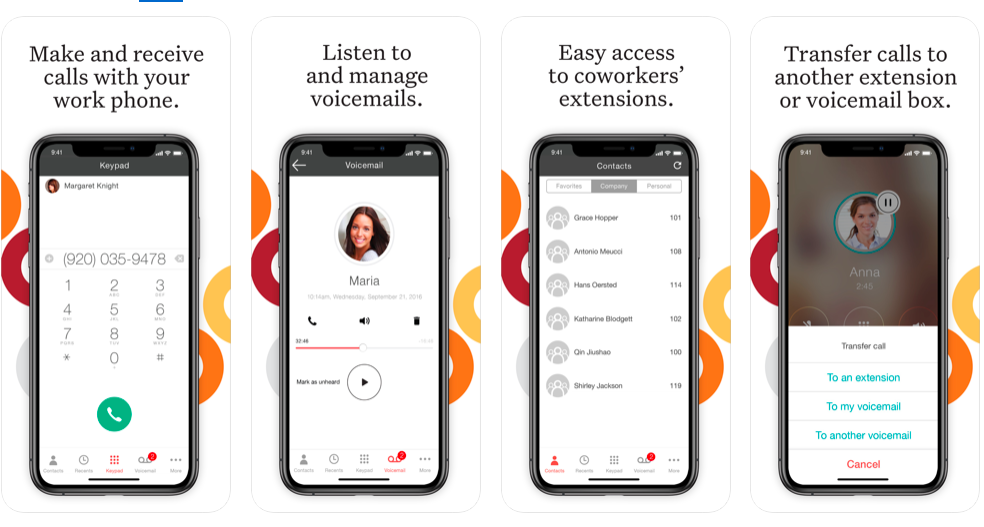
For businesses of all sizes, Ooma provides advanced voice and collaboration features which they describe as flexible and scalable. With plans starting at $19.95 per user per month, Ooma Office is available without contracts or long-term commitments so as to make it easy for a small business to scale its office phone system with Ooma as its business grows. Ooma Office features include: Unlimited Calling in U.S., Canada, Mexico and Puerto Rico Free Local…
$9.95
per month
Webex Calling
Score8.8 out of 10
N/A
Webex Calling is Cisco’s flagship cloud calling solution with over 12 million users worldwide. It delivers an enterprise-grade calling experience that enables customers to replace PBX hardware with a cloud calling solution. Webex Calling's connectivity and collaboration experience includes calling, meetings, messaging, contact center, and integrated devices.
$17
per month per user
Pricing
Ooma Office
Webex Calling
Editions & Modules
Local Phone Number
$9.95
per month
Toll Free Number
$9.95
per month
Toll Free Calling Plan
$15.00
per month
Base Price
$19.95
per month
User Extension
$19.95
per month
Pro
$24.95
per month
Ooma Linx
$49.99
per month
Ooma Wireless Adapter
$49.99
per month
Ooma DP1 Desk Phone
$89.99
per month
Expansion Base Station
$99.99
per month
Yealink IP Phones
$99.99
per month
Cisco IP Phones
$109.99
per month
Yealink Conference IP Phones
$399.99
per month
Conference Bridge
Free
Ring Groups
Free
Virtual Receptionist
Free
Number Porting
Free
Webex Call
$17
per month per user
Webex Suite: Meet + Call
$25
per month per user
Webex Enterprise
Contact Sales
Cisco Unified Communications Manager
Contact Sales
Offerings
Pricing Offerings
Ooma Office
Webex Calling
Free Trial
No
Yes
Free/Freemium Version
No
No
Premium Consulting/Integration Services
No
Yes
Entry-level Setup Fee
$19.95 per user/month
Optional
Additional Details
Ooma Office offers plans starting at $19.95 per user/month with no contracts, ever.
Discount available for annual pricing.
More Pricing Information
Community Pulse
Ooma Office
Webex Calling
Considered Both Products
Ooma, Inc.
No answer on this topic
Cisco
Verified User
Chose Webex Calling
Webex Calling provides additional features and a greater ease of access compared to Microsoft Teams. Though teams is free, the capacity to host larger meetings with professional noise/background cancellation was not present. Webex Calling has a sense of notoriety as well, …
A de minimis incentive was given to thank the reviewer for their time. The incentive was not used to bias or drive a particular response, nor was the incentive contingent on a positive endorsement. More Info
Verified User
Chose Webex Calling
I had used Ooma for business in the past and the functionality did not stack up to the features available in Webex Calling. It also lacked available add-ons like meetings and customer care. Mobile apps were in need of a major upgrade as well as better user interface, ease of …
A de minimis incentive was given to thank the reviewer for their time. The incentive was not used to bias or drive a particular response, nor was the incentive contingent on a positive endorsement. More Info
We use Ooma Office for everyone in the company including mobile users. It has allowed us to eliminate the spam callers as well give our mobile and remote users the ability to make business calls - from any device, from anywhere, at any time - without having to worry about any long distance charges, or without giving up their personal telephone numbers (at home or cellular).
A de minimis incentive was given to thank the reviewer for their time. The incentive was not used to bias or drive a particular response, nor was the incentive contingent on a positive endorsement. More Info
easy to set up, fewer failure points, and it is all in the same location as the rest of the tenant configurations. Lots of PSTN providers are available and options to choose from. easier to create routing, but at the same time, simplified all the rules needed in CUCM. Great way to see all users, devices, and licenses. Call analytics needs improvement, but otherwise it's a great product.
A de minimis incentive was given to thank the reviewer for their time. The incentive was not used to bias or drive a particular response, nor was the incentive contingent on a positive endorsement. TR verified that a representative sample of customers was invited. More Info
A de minimis incentive was given to thank the reviewer for their time. The incentive was not used to bias or drive a particular response, nor was the incentive contingent on a positive endorsement. TR verified that a representative sample of customers was invited. More Info
A de minimis incentive was given to thank the reviewer for their time. The incentive was not used to bias or drive a particular response, nor was the incentive contingent on a positive endorsement. More Info
Webex Calling supports limited codecs that are generally accepted all over the world but it would be good to see if they add transcoding support.
The local gateway option is designed more for on premise PBX communication. It would be good to see if it is developed more as a local PSTN breakout where local SIP trunk or local PRI is terminated.
We would like to see more of the dial plan features like CLI manipulation, translation, etc.
A de minimis incentive was given to thank the reviewer for their time. The incentive was not used to bias or drive a particular response, nor was the incentive contingent on a positive endorsement. More Info
We have found it very easy to configure, manage, and expand our phone operations with Ooma Office. We needed a reliable phone network as this is the first means of communication for our customers - Ooma has made it a lot easier for us to manage. Their support is also available 24x7 so that's a huge plus.
The service can be intermittent and the call forwarding feature will not always work perfectly. There will be periods of time where the calling feature will not work at all and people on the other end can hear me but I am unable to hear them. It also requires a fairly strong signal which can be an issue if you work somewhere remote or a building without much service.
A de minimis incentive was given to thank the reviewer for their time. The incentive was not used to bias or drive a particular response, nor was the incentive contingent on a positive endorsement. More Info
Ooma has helped us make better use of our phones and given us many more capabilities than our previous service. The mobile app has provided an excellent connection and quality. Its integration with the cellular phone app and contacts makes it a breeze to use. Emailed recordings of voicemails are very helpful for both receiving messages and allowing us to archive them. It has also saved us a significant amount of money and provided us with a more capable and reliable system all at once.
A de minimis incentive was given to thank the reviewer for their time. The incentive was not used to bias or drive a particular response, nor was the incentive contingent on a positive endorsement. More Info
Cisco Webex Calling is an outstanding cloud collaboration that includes enterprise-grade cloud phone system designed for the modern hybrid workplace. Webex Calling integrates calling, messaging, and meetings into a single, intuitive platform, empowering your teams with unparalleled flexibility and productivity. Benefit from advanced features like HD audio and video, voicemail to email, call forwarding, and intelligent call routing, ensuring crystal-clear communication and efficient workflows from any device, anywhere. Webex Calling prioritizes security and reliability, offering redundant data centers and end-to-end encryption to safeguard your conversations. Its scalable architecture effortlessly adapts to your envolving business needs, providing a future-proof communication foundation. Enhance collaboration and streamline operations with a solution that's not just a phone system, but a comprehensive communication hub.
A de minimis incentive was given to thank the reviewer for their time. The incentive was not used to bias or drive a particular response, nor was the incentive contingent on a positive endorsement. TR verified that a representative sample of customers was invited. More Info
I've not actually had it ever be unavailable when I needed to use it. As mentioned before, a network outage would take it down, but we have redundant systems for our network connections with automatic failover.
A de minimis incentive was given to thank the reviewer for their time. The incentive was not used to bias or drive a particular response, nor was the incentive contingent on a positive endorsement. TR verified that a representative sample of customers was invited. More Info
I don't really see this impacting any other system performance at all. The client is very light use on resources, even on my iPhone. I don't know what else it connects to behind the scenes other then the campus directory, but I haven't seen or heard of any impacts. It seems fairly self contained except for wherever it interfaces with the general telephone system connectivity outside the campus.
A de minimis incentive was given to thank the reviewer for their time. The incentive was not used to bias or drive a particular response, nor was the incentive contingent on a positive endorsement. TR verified that a representative sample of customers was invited. More Info
Ooma Office support is always available. I've never been on the phone with them for longer than 5 minutes. They are knowledgable, have great active listening skills, are able to make recommendations on how to make Ooma Office work even better for you, and wait times to speak with an agent are reasonable and typically less than 1 minute.
A de minimis incentive was given to thank the reviewer for their time. The incentive was not used to bias or drive a particular response, nor was the incentive contingent on a positive endorsement. More Info
I have been working for a long time with Cisco as a provider and also Cisco TAC and Cisco Support Engineers. The support starts right beforehand in the documentation of the product you are interested in. From the start you have a good, complete, and detailed and easy to read datasheet and there's always someone available to answer any questions.
A de minimis incentive was given to thank the reviewer for their time. The incentive was not used to bias or drive a particular response, nor was the incentive contingent on a positive endorsement. More Info
Have a plan in place before you start the implementation, open communication with the staff on the changes being made, prepare a reference guide on the system and how to navigate the new setup. Budget and allocate time for helping staff learn the new system. Consolidate and coordinate all the questions internally before reaching out to support.
We went over to Ooma [Office] after having had Intermedia for several years. Intermedia was good, but they were due for an update on many of their systems, which they did after we left. With Ooma [Office], we have our hold music and other basic, easy to use options that fit well for our small business.
A de minimis incentive was given to thank the reviewer for their time. The incentive was not used to bias or drive a particular response, nor was the incentive contingent on a positive endorsement. More Info
The company uses Microsoft Teams. They do use Microsoft Teams right now and for a long time a lot of the different practices have been using on-premise, contact Call Manager and Unified Communications Express. But Cisco WebEx, the cloud-based product is one of the new ones. And some of our other site practices are also using RingCentral. So cloud calling is not new to the company. For those of us who are familiar with Cisco products, the transition to WebEx calling is not as difficult as it might be for some other products. Going from on-prem to RingCentral, there is more of a learning curve with.
A de minimis incentive was given to thank the reviewer for their time. The incentive was not used to bias or drive a particular response, nor was the incentive contingent on a positive endorsement. TR verified that a representative sample of customers was invited. More Info
So far it has been very reliable, with very little down time that was associated with the product itself. We have had network outages due to external factors such as construction cutting a fiber link, but other than that kind of thing not much for failures.
A de minimis incentive was given to thank the reviewer for their time. The incentive was not used to bias or drive a particular response, nor was the incentive contingent on a positive endorsement. TR verified that a representative sample of customers was invited. More Info
System made it one-stop shopping for fax lines and phones numbers and equipment which was convenient.
It was a shock to see that $39.98 of service manages to result in about $18 of additional “fees” every month. Makes the service significantly less of a bargain than is advertised.
Certainly when it comes to my client base, they certainly understand the benefits of the full end-to-end, Cisco stack. And when I talk about a calling platform in regards to it simply being a call from one end to another or a message from one end to another, Cisco provides so much more because it enables all that AI and I guess analytical data of which the endpoints cover. So when it comes to integrating with a meeting room experience and you're in a meeting room that can cater for up to 20 people, but say for example, only two or three people on average utilize that room, that type of safe spacing information gets transmitted into other business decisions that can benefit the business from an ROI perspective such as rearranging the interior design to create better outcomes for worker experiences. So much more than just a calling platform.
A de minimis incentive was given to thank the reviewer for their time. The incentive was not used to bias or drive a particular response, nor was the incentive contingent on a positive endorsement. More Info