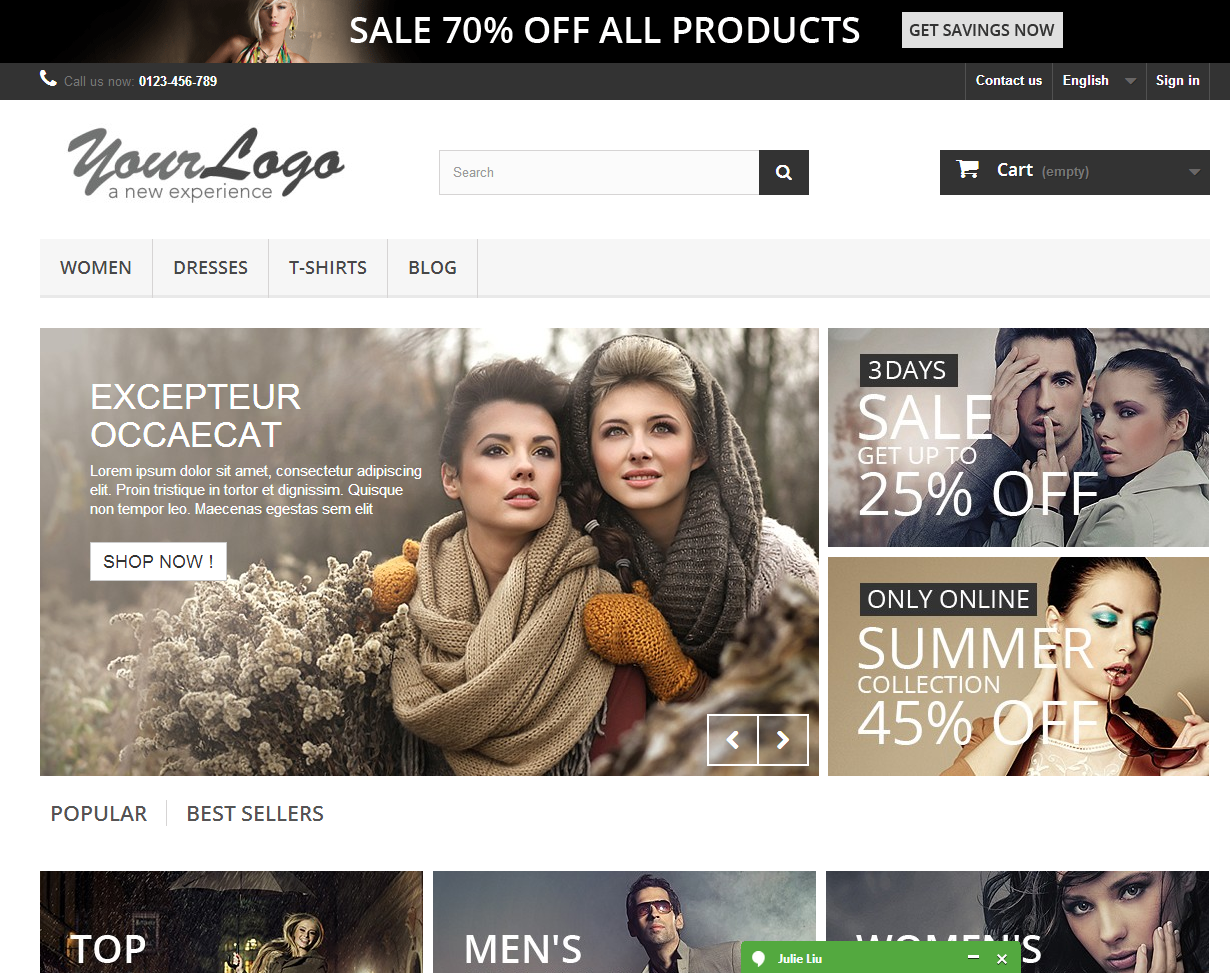
PrestaShop is a free, open source e-commerce solution available under the Open Software License and officially launched in August 2007. The software is written in PHP and based on the Smarty template engine and is currently used by 165,000 shops worldwide. The PrestaShop group was founded in Paris, with a second Headquarters opened in Miami in 2011. PrestaShop is translated into 63 languages, with English, French, Portuguese, German, Spanish, Italian, Dutch, Polish and Russian having full…
$24
per month
Spryker Cloud Commerce OS
Score 6.4 out of 10
N/A
Spryker Cloud Commerce OS is a modular Commerce System that enables B2B, B2C, and Marketplace business models through any customer interface, touchpoint, and device. Boasting extensibility, best-in-class performance, and fast time-to-market, the vendor states Spryker is trusted by brands such as TOYOTA, HILTI, and TomTailor. The Spryker Cloud Commerce OS NOW version has been specifically developed for manufacturers and brands who want to reach customers directly online.
$900,000
12 month contract
WooCommerce
Score 8.3 out of 10
N/A
WooCommerce is an eCommerce plugin for WordPress, developed by WooThemes (recently acquired by Automattic). Like WordPress, it is designed to be an extendable, adaptable, open-sourced platform. WooCommerce allows merchants to sell physical products, downloadables, or services.
Pricing is based on the duration and terms of your contract with the vendor. This entitles you to a specified quantity of use for the contract duration. If you choose not to renew or replace your contract before it ends, access to these entitlements will expire.
WooCommerce is a free and open-source plugin for WordPress. Merchants can host their WooCommerce store on any private hosting service, or with Automattic directly via WordPress.com. Some added features or services from the WooCommerce Official Marketplace may have one time or subscription pricing.
As compared to other open-source systems, PrestaShop has the most elegant backend interface. Most of your standard eCommerce features come default: 1. Invoice and Delivery documents in PDF, 2. Promotion and discount mechanism, 3. SEO functionalities, 4. Quick access, 5. …
I've tried other open-source software like PrestaShop, but the others were either more complex, didn't have the right plugins for me to use in my country, or didn't have my preferred look in terms of how I wanted my business to be represented as an e-commerce site. PrestaShop …
I often built websites for businesses and friends and I am experienced with different platforms out there. Some of my customers sometimes prefer one e-commerce solution over the other because it have some functionalities that they may be interested in, like shipping or payment …
Spryker is more advanced and allow more customization. The storefront is already fast in Spryker default implementation without any special settings. Spryker Commerce OS also fit better with complex business requirements and have a clearer approach to connect with third-party …
PrestaShop: It's Woocommerce poorer brother, without the CMS, the community, the devs and designers. It's the worst of both worlds. Shopify: For us, it wasn't possible to use because of our scale. It depends on how many products you will be managing and how much you want to …
WooCommerce stands out from its competitors for being very simple. I have used PrestaShop and I can say that WooCommerce is easier to use and install, the themes that can be installed are much more professional and compatible with all mobile devices. It has really been very …
When creating an e-commerce site, it is important that its management interface is simple even for those who are not very familiar with the web. WooCommerce, in this case, is the master.
This is a great system for small and medium businesses dealing from 1 product to 100,000 products. It is elegant to use and very stable. The system may not be great for converting into a marketplace and the handling of > 1million products. The system is also not suitable for services selling like events, registrations, subscriptions and ticket bookings etc.
Spryker is very well suited (B2C and/or B2B) for big companies with complex and individual business models or also if your company needs a certain level of customization. Very good fit, if you need a scalable system. It is rather not the perfect fit for small companies or companies with very basic E-Commerce needs.
WooCommerce is best suited to customers whose website is built on the WordPress platform, and whose development team has a good understanding of plug-in implementation. If your website is not built on WordPress, but on Laravel or React (or any other non WordPress technology), then WooCommerce is not for you. WooCommerce is also great for customers who just need a simple online shopping experience. If your needs involve more complex or immersive features such as timed discounts, pick up locations, delivery reminders, or post shopping feedback surveys, know that you will need to purchase additional add-ons to make to get these features using WooCommerce set up on WordPress.
The PayPal button modality was integrated with the PrestaShop system, which helped our clients to complete payments digitally in just a few seconds, this integrated button allowed to streamline many transactions.
Performing inventory reviews and modifying the PrestaShop catalog was one of the things that I liked the most, I could make changes to the catalog, make changes to the conditions of the products in the catalog and all those changes were reflected on my website in a instant, no need to wait some time.
The PrestaShop system created a digital invoice for each client who made the advance payment of a property, which made it even easier to complete the property negotiation. Customers came to our company with the digital invoice for the advance payment and it was easy to identify the property that was paid, thanks to the digital invoice.
Content - content administration is not a strong part of Spryker, although it improved over the years. I still see room for improvement in the world of bigger CMS systems being able to also do "commerce".
Backoffice-usability - for non-technical users the first few days, weeks and month[s] can be full of surprises. An extended documentation, or more intuitive handling on the backoffice could serve every party on Spryker.
Off-the-shelf internationalization - Spryker right now comes with an initial data set in English and German, which is for a German based company already a pretty stable starting point. Extension on the base data for Europe-wide used countries would be very helpful - French, Italian, Polish, Russian, etc.
Despite very rare glitches, more connected to an excessive number of plugins, that affect the speed of the site, we are extremely satisfied with the platform, the ability to import and export products, even though we just export them, as we have our proprietary system for updating inventories. We love the ease of upgrading, enhancing, innovating, and the freedom we have to do whatever we want, which is a plus, when you consider Shopify can take down your whole store as they please, if they think you aren't abiding to their TOS or their ever changing set of rules.
Spryker's usability depends a lot on custom development. Therefore, I would like not to consider usability as something that comes with Spryker Cloud Commerce OS. Spryker Cloud Commerce OS; however, brings all the tools needed to design a solution with great usability.
It is built on the Wordpress platform, so there are some quirks compared to a dedicated e-commerce product, but it is very intuitive and easy to use, especially for anyone with Wordpress experience. There are numerous great support articles and learning resources available. Significant customization can be achieved with plugins vs other eCommerce platforms, which may require more custom code and have fewer plugin options.
Since we use PrestaShop OpenSource there is only community support. What we found is that many other users fight with the same problems and there seems no solution or input from the PrestaShop developers' side.
Support suffered from Spryker Cloud Commerce OS's rapid growth. Contacts, department heads, and support systems changed frequently. Support processes as well as documentation are rather poor. One notices that they are putting more effort into the customers recently, but in the course of growth, there is still a lack of focus here. As a customer, I would like to see growth at a slower pace and a phase of stabilization.
It's a no-brainer for e-commerce stores. BigCommerce and Magento both far out-distanced PrestaShop in every major category. If you're just getting into e-commerce, I would highly recommend either BigCommerce or Magento. Their online documentation and support far outweigh any advantages you'd have over going with an open source software like PrestaShop.
If you compare Spryker with commerce solutions on the market, you will notice that the focus is not on the front end. Spryker assumes that the store is only one of many possible channels through which customers order today and in the future. To understand the differences, one must therefore take a look at Spryker's architecture. This is divided into the Spryker [Cloud] Commerce OS (the backend with all process-related components), the front-end modules for B2C and B2B, as well as the integration modules (middleware) and interfaces (Glue API).
We were pretty sure we wanted a WordPress site so that we had more control over the site itself, having been burned by third-party vendor sites before. The fact that WooCommerce integrates so well with WordPress was a big selling point for us. Magento would have been too heavy of a lift for our small dev team and we didn't want to rely on Shopify or BigCommerce (though all of those products could have their merits for other projects or clients).
It slowed down our Hosting service. Our website took a long time to fully load on our clients' devices due to the high consumption of the integration with the PrestaShop service.
It provided us with a fast billing service, where our clients obtained invoices in PDF mode for the electronic payments they made for the properties. These digital invoices helped us to recognize the property they wanted faster and streamlined the negotiation process.
The templates that had an optimized design, were too expensive, this caused that our catalog design was very simple and did not capture the interest of customers.
Extending the reach and visibility of the brand through content and commerce.
Increased customer satisfaction through better accessibility (self-service) and easy access to important product information (CAD data, technical documentation, etc.).
Rapid deployment thanks to packaged business capabilities and clear development leads to fast ROI and low TCO.