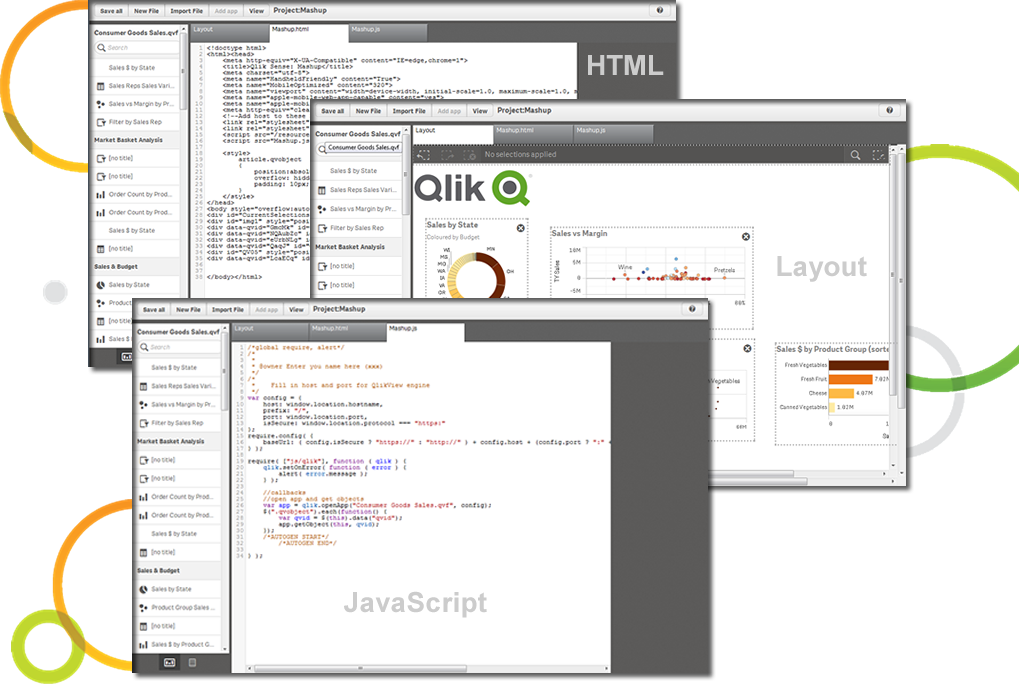
Qlik Sense® is a self-service BI platform for data discovery and visualization. It supports a full range of analytics use cases—data governance, pixel-perfect reporting, and collaboration. Its Associative Engine indexes and connects relationships between data points for creating actionable insights.
$200
per month
SAP Analytics Cloud
Score 8.1 out of 10
N/A
The SAP Analytics Cloud solution brings together analytics and planning with integration to SAP applications and access to heterogenous data sources. As the analytics and planning solution within SAP Business Technology Platform, SAP Analytics Cloud supports trusted insights and integrated planning processes enterprise-wide to help make decisions without doubt.
$36
per month per user
Sisense
Score 7.3 out of 10
N/A
Sisense is a BI software and analytics platform. With what the vendor calls their In-Chip™ and Single Stack™ technologies, users have access to a comprehensive tool to analyze and visualize large, disparate data sets without IT resources.
N/A
Pricing
Qlik Cloud Analytics (Qlik Sense)
SAP Analytics Cloud
Sisense
Editions & Modules
Starter
$200
per month
Standard
$825
per month
Premium
$2750
per month
Qlik Sense (On-Premise)
Contact Sales
SAP Analytics Cloud for Business Intelligence
$36.00
per month per user
SAP Analytics Cloud for Planning
Price upon request
per month per user
No answers on this topic
Offerings
Pricing Offerings
Qlik Cloud Analytics (Qlik Sense)
SAP Analytics Cloud
Sisense
Free Trial
No
Yes
Yes
Free/Freemium Version
No
No
No
Premium Consulting/Integration Services
Yes
No
Yes
Entry-level Setup Fee
No setup fee
No setup fee
No setup fee
Additional Details
—
A 30-day trial with SAP Analytics Cloud is available, supporting analytics enterprise-wide. A trial can be extended up to 90 days on request.
Other vendors products evaluated (in some cases used by other divisions within our corporation): ** SAP Analytics Cloud - stacks up quite well against Qlik Sense but the differences are subtle but important. Sometimes SAC has it over Qlik and sometimes Qlik has it over SAC so …
Qlik Sense can easily integrate multiple data models to
visualize customer data. Tableau is easy to use—perhaps more manageable than Qlik—but
expensive. Microsoft BI was chosen because it was similar to previously used
We evaluated over a dozen vendors when we selected Qlik; among them I felt it had the best internal data model philosophy leading to much more powerful self-service analytics and apps which are easily extensible to include other visualizations. I think it was a reasonable …
Qlik Sense was more fully-featured and scaled better on price. The ability to customize and extend functionality is helpful to tweak the product for our specific needs. It has truly helped scale our user community and their maturity/ability to do more with data without also …
Compared to the other three products, the data prep and mobile BI are two areas that we see Qlik stands out and that is why we designated the Qlik use cases.
Compared to Qlik Sense, I enjoy the functionality and feel of SAP Analytics cloud much better. The addition of the smart insights within SAP Analytics Cloud helps to identify root cause issues much quicker than the Qlik product. Additionally, with end-user deployment, SAP …
Qlik Sense is too expensive, much more complicated to use for users (especially new variables or other complex calculations) and requires you to buy too many extra functionalities to have the same options as SAP Analytics Cloud can offer.
SAP Analytics Cloud runs jobs and provides reports quickly. Other competitors take more time to generate [the] same reports with similar logic. The visualization features in SAP Analytics Cloud are superior when compared to Qlik Sense. In areas like DevOps, this gives a …
True SaaS solution built from ground level up. Ability to combine planning, BI and predictive functions in one tool. Digital boardroom add-on that truly impresses the business leaders and users.
Integration with SAP is the key feature to go for SAC with perks of SAP IQ etc offered from SAP. Usability is quite eased in SAC - makes it easy for users to use and develop their own dashboarding. Cloud is one more feature which enables to the cloud world from SAP and probable …
The two products, SAP Analytics Cloud and Microsoft PowerBI, are very similar data presentation tools. The strength of SAC SAP Analytics Cloud is in direct connections when the sources are SAP. On the other hand, Microsoft PowerBI, in its version, has strong integration with …
SAC is a full-featured analytics platform, it offers AP, CPM and PA unlike Tableau which doesn’t encompass corporate performance management tools.
Verified User
Analyst
Chose SAP Analytics Cloud
Power BI has some unique selling features like bookmarks and DAX functionality. However, a lot of emphasis has to be given to data security and authorization. One has to manually enable row-based authorization or model-based authorization to share a lot of confidential data, …
Adopted SAP Analytics Cloud with simple and rapid implementation in two months, three times faster than other competitive solutions. The business intelligence software had the ability to rapidly collect, better organize and manage great quantities of data in real-time, and …
This platform is powered by artificial intelligence and helps businesses of all types explore what-if possibilities based on historical data so that they make decisions with confidence.
For its current market maturity, SAC stacks up well against its competitors. There may be specific use cases for certain planning/analytic scenarios where it still lacks the functionality but generally speaking it is already a good reporting tool. SAC can still improve when it …
The solution very powerful, very interactive, designer is very good. Features like linked analysis, hierarchies are vey useful while analysing the data. The data wrangling options available in SAP Analytics cloud are also very powerful and they have very rich set of functions …
This tool does not match up to its competitors like microstrategy and Tableau when it comes to data visualization. It takes more time and effort creating dashboards and building schema objects in this tool. It is not as easy to learn as other competitive tools. Implementation …
In this particular case, the choice did not depend on my opinion as I was collaborating throughout the process. Their choice was primarily guided by the fact that the company we were advising was already on the SAP platform so Analytics Cloud was directly linked, thanks to the …
Each tool has strengths, but Sisense stands out for its ease of use, scalability, and robust data integration. We chose Sisense for its balance of robust functionality and ease of use. We are happy that it can handle complex data integrations that aligned perfectly with our …
Sisense worked out of the box, there was a lot of setup with the other 3. Out of the 3 others Board's was the only one that connected to Salesforce without a problem like Sisense. Sisense pricing destroyed the other 3 as well.
Sisense does very well against most of the tools in the market. We chose this tool because of its great visualizations and easy to deploy procedures. The reports are very easy to generate and distribute them across departments and organization. It provides a great interface to …
Sisense can crunch loads more data and has consistently better performance than other modern BI tools; It successfully retains the best of the Cube world and also provides the power of modern in-chip visualization engine.
Senior Manager Business Intelligence Data Architect
Chose Sisense
Sisense allows you to export individual widgets as iframes. It provides cube and row level security and can manage lots of data without interfering with the data sources. Tableau data sources were harder to manage and version. The customer support team with Sisense was head and …
Features
Qlik Cloud Analytics (Qlik Sense)
SAP Analytics Cloud
Sisense
BI Standard Reporting
Comparison of BI Standard Reporting features of Product A and Product B
Qlik Cloud Analytics (Qlik Sense)
7.9
315 Ratings
4% below category average
SAP Analytics Cloud
7.7
342 Ratings
6% below category average
Sisense
9.7
47 Ratings
17% above category average
Pixel Perfect reports
8.3216 Ratings
7.5289 Ratings
10.037 Ratings
Customizable dashboards
8.0313 Ratings
8.1331 Ratings
10.047 Ratings
Report Formatting Templates
7.4228 Ratings
7.5306 Ratings
9.033 Ratings
Ad-hoc Reporting
Comparison of Ad-hoc Reporting features of Product A and Product B
Qlik Cloud Analytics (Qlik Sense)
7.0
326 Ratings
14% below category average
SAP Analytics Cloud
7.7
344 Ratings
4% below category average
Sisense
8.8
47 Ratings
9% above category average
Drill-down analysis
8.0322 Ratings
8.1334 Ratings
10.047 Ratings
Formatting capabilities
6.1315 Ratings
7.5331 Ratings
9.047 Ratings
Integration with R or other statistical packages
6.1154 Ratings
6.9248 Ratings
9.027 Ratings
Report sharing and collaboration
7.9299 Ratings
8.3320 Ratings
7.33 Ratings
Report Output and Scheduling
Comparison of Report Output and Scheduling features of Product A and Product B
Qlik Cloud Analytics (Qlik Sense)
7.7
278 Ratings
6% below category average
SAP Analytics Cloud
7.6
325 Ratings
8% below category average
Sisense
10.0
46 Ratings
20% above category average
Publish to Web
6.2210 Ratings
7.9278 Ratings
10.036 Ratings
Publish to PDF
7.2257 Ratings
8.0309 Ratings
10.046 Ratings
Report Versioning
7.9176 Ratings
7.7269 Ratings
10.024 Ratings
Report Delivery Scheduling
8.9183 Ratings
7.6264 Ratings
10.039 Ratings
Delivery to Remote Servers
8.4108 Ratings
6.952 Ratings
00 Ratings
Data Discovery and Visualization
Comparison of Data Discovery and Visualization features of Product A and Product B
Qlik Sense is a program whose purpose is to greatly improve all your operations and use of all data in an organic way. The mission will always be to increase the economic and commercial processes of the company in a short time. I recommended it for its high technology, which was Created for this area, the results are successful. We have noticed how it has increased relationships with our clients thanks to the credibility and security that we provide.
>> Using SAC predictive analytics capabilities for inventory management in a Production line setup has helped generate Purchase Requisitions and Purchase Orders for raw or semi-finished goods without much head-banging into Demand management rules. It does it beautifully with seamless integration with HANA core MM and PP modules, along with BI integration. It has resulted in 30% greater warehouse storage capacity, thereby saving revenue from piled-up inventory and associated manpower costs. >> SAC sometimes shows latency in working out a large data set, thus giving a poor user experience compared to its competition. Also, it may occasionally show misinterpretations when embedding data from 3rd-party systems into the HANA core dataset.
I believe Sisense is perfectly suited for any organization of any size that have access to the proper resources, as the tool is very expensive. The data connectors come in all shapes and sizes out of the box, which allows a great deal of data control within the ElastiCubes. Additionally, while the platform only runs on Windows platforms, the web application can be accessed on any client: mobile, Apple, Windows, etc. This allows a much more flexible user experience, resulting in data and dashboards reaching further than any other tool.
It makes it easier yo analyse order and related records easily.
We can easily maintain and track the performance of employees in organisation.
Can easily track various aspects for the growth of an organisation thus allowing real time analysis and tracking of organisation's growth and performance.
SAC supports various data sources, but improvements in the ease of connecting to and integrating with certain data repositories, especially non-SAP databases, would enhance the platform's versatility and integration capabilities.
An offline mode for SAC could be valuable for users who need to access and analyze data without an internet connection. Additionally, optimizing performance for large datasets and complex visualizations would contribute to a smoother user experience.
The usability of the application on mobile devices needs some improvement, especially navigation and filtering.
Dashboards that are created by multiple users can be a bit of a hassle to share by Admins.
If you need to embed dashboards into your website, you are require to buy a license separate from the user and platform license. This is a norm on most BI visualization tools, but Sisense can seem a bit on the high side, cost-wide.
Qlik Sense is a constantly improving it's software and working with its' users to make it better. They are great at keeping their users informed of progress and care about delivering a quality product
We are planning to review the licensing as we have issues with SAC dealing with huge datasets. Analytics area is good for import models but when we have live connections in place that's when we have issue with SAC dealing with huge datasets in live be it BW or be it HANA models in the backend.
I think the business and myself as a user has come to rely on SiSense as a dashboarding and quick ad-hoc reporting tool. I am hoping to integrate SiSense dashboards into more parts of the business in the future. We have reduced our report turn-around time for the most part from hours/days to minutes and in some cases almost the speed of thought. Reports are also easier on the eye and more easily distributed. I would also like to say that the support and professionalism from the SiSense team has been excellent.
Qlik Sense has a better and easy to learn user interface compared with other analytics tool which always help us to create regular and adhoc reports within the stipulated time frame and can be easily refreshed at a scheduled time and sent to multiple stakeholders for timely update regarding the Key metrics indicator.
I landed on a 7 out of 10 for a few key reasons. The tool is flexible in the sense that we are using very very very (very) little off the shelf solutions and customizing to our needs. Users enjoy having the customized data actions, key variance calculations, and easy to use headcount/salary planning in the same tool. One downside is that users are hard to please when they are used to excel. SAP Analytics Cloud simply is not excel, and the flexibility of excel in a crunch is not there.
New V5 is ground floor of an exciting collection of possibilities. Weekly Sisense developers come up with new functionality that they share with us in their forums. The move to HTML5 has been pleasing in that widgets auto size themselves into appropriate forms in the board but everyone of them can be popped out to full page size to be looked at in more detail
I would rate SAP Analytics Cloud an 8 out of 10 for scalability. It offers a flexible, cloud-based architecture that supports expansion across departments and geographies. The platform adapts well to growing data volumes and user needs, making it a strong choice for organizations looking to scale analytics capabilities efficiently.
There are very few situations when there is unexpected downtime. Mostly during development, new dashboard implementation and during upgrades. other then that there were very few crashes.
I would rate SAP Analytics Cloud’s performance an 8 out of 10. Pages generally load quickly, and reports run within a reasonable time frame, even with complex datasets. Integration with other systems is smooth and doesn’t noticeably affect performance. Overall, it’s a responsive and efficient tool for business analytics. But
SiSense is usually performing better then other solutions even if going for complex reports/dashboards(of course within reasonable frames). I haven't noticed any bad influence on other systems, usually if something happens it stays within SiSense.
Qlik is great for companies with lots of business domains and departments because it scales well, especially if data that is reported is saved in SQL and similar structures. Its ease of use and good UI enables business units to create and manage their own reports. That removes a great burden of creating and managing/modifying these pages from the IT team. Overall, it's a win-win for both IT and business units.
Since the implementation stage, the support team has been very helpful and assisting. Even in the later stages, the tech team had quite a rapid response. In general, SAP has provided us with great customer support, let it be for a specific product of SAP or for integration of different modules.
SiSense's support ninjas are very knowledgeable and are exceptionally responsive. So far, all of the issues we ran into were resolved within minimum time. My sense of dealing with the support staff at SiSense is that they are very focused on not just answering your immediate question, but also to delve into the cause of the matter.
Easy and free training that allowed us quickly understand basics in SiSense and start using them. More advanced features requires some browsing through SiSense forums, but there is always support to help, and SiSense support is one of the best whith which I worked so far.
In hindsight, it would have been easier to have someone there in person. Questions were answered, but with 11 participants, it got a bit chaotic online
Many examples, videos and scenarios which you try on your own right away. This combined with in-person training gives you enough to utilize most of SiSense's power.
SAC is a simple solution ad it works fine when connecting it to other SAP tools. On the other hand, connecting it to third party solutions brings difficulties when there's no previous design and the objetives are not clear. It is really important to integrate Business users from the start to provide with valuable business insights
The customization of the platform opens up plenty of other options depending on the use cases. The API layer is incredibly rich and makes integration of Qlik based visualization into web pages a simple and effective pattern. It's been very easy to use with a great community made up of professionals. Qlik Sense has introduces artificial Intelligence into my data visualization and reporting activity.
SAP Analytics Cloud and Power BI are both tools that help businesses understand their data, but they have some differences. SAC, made by SAP, works well if your company already uses other SAP products. It's in the cloud, easy to use, and has features for analyzing data, getting insights, and planning for the future. Power BI, made by Microsoft, can be used in the cloud or on your own computers. It fits well with Microsoft tools, is easy to use, and can do advanced data analysis. SAC has built-in planning tools, while Power BI needs extra tools for detailed planning
1) Easy to use, really, there is nothing too much to say. The set up is easy and not confusing. You can use it internally or externally.
2) Customer Service, having spoken to various product reps from similar industry. Sisense rep provides you with the best support to get started, and it is really appreciated.
Is good for use across multiple locations. It allows users to access data and reports from anywhere, regardless of their location. Can consolidate data from various sources, including different SAP systems and external sources, which facilitates cross-location analysis. SAC enables access to data and models from SAP Datasphere to create new stories. Detailed permissions can be defined for cross-departmental use.
Many manual data manipulations and exports in Excel have been replaced by the tool, providing management with improved insight into the amount of time spent at each stage of an invoice's lifetime, allowing bottlenecks to be discovered.
We now have more insight into the data, and people with little technical experience can easily build stories.