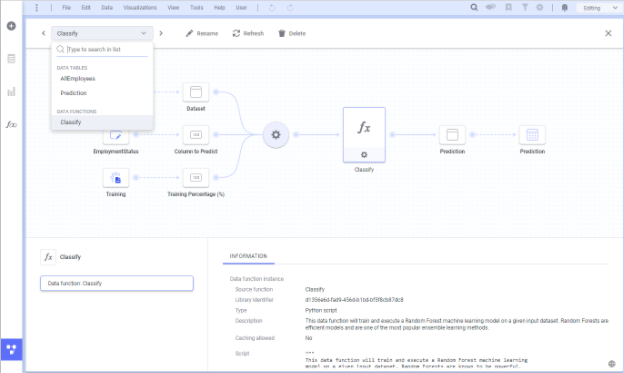
Spotfire, formerly known as TIBCO Spotfire, is a visual data science platform that combines visual analytics, data science, and data wrangling, so users can analyze data at-rest and at-scale to solve complex industry-specific problems.
N/A
Tableau Cloud
Score 8.0 out of 10
N/A
Tableau Cloud (formerly Tableau Online) is a self-service analytics platform that is fully hosted in the cloud. Tableau Cloud enables users to publish dashboards and invite colleagues to explore hidden opportunities with interactive visualizations and accurate data, from any browser or mobile device.
$15
per month per user
Tableau Server
Score 7.7 out of 10
N/A
Tableau Server allows Tableau Desktop users to publish dashboards to a central server to be shared across their organizations. The product is designed to facilitate collaboration across the organization. It can be deployed on a server in the data center, or it can be deployed on a public cloud.
$12
Per User Per Month
Pricing
Spotfire
Tableau Cloud
Tableau Server
Editions & Modules
No answers on this topic
Tableau Viewer
$15
per month billed annually per user
Enterprise Viewer
$35
per month billed annually per user
Tableau Explorer
$42
per month billed annually per user
Enterprise Explorer
$70
per month billed annually per user
Tableau Creator
$75
per month billed annually per user
Enterprise Creator
$115
per month billed annually per user
Tableau+
Contact Sales
Viewer
$12.00
Per User Per Month
Explorer
$35.00
Per User Per Month
Creator
$70.00
Per User Per Month
Offerings
Pricing Offerings
Spotfire
Tableau Cloud
Tableau Server
Free Trial
Yes
No
Yes
Free/Freemium Version
No
No
No
Premium Consulting/Integration Services
Yes
No
Yes
Entry-level Setup Fee
No setup fee
No setup fee
No setup fee
Additional Details
For Enterprise engagements, contact Spotfire directly for a custom price quote.
Although Spotfire has a longer learning curve, it has proven to be more practical and impactful than Tableau. We had only evaluated other tools at a high level initially, and were surprised to hear the success stories of companies moving from Tableau to Spotfire. We have found …
They are similar but don't offer some of the specific client login portal capabilities. We needed a centralized platform that allows customization and sign-ins from multiple clients. Additionally, they did not quite have the diverse data source support capabilities that we get …
Well, Spotfire was the only tool which could handle our data, we had over 100 Mio rows of data and with Spotfire you could navigate through the dashboard very fast. This was our killer feature. It also makes very nice and modern charts.
Within our use cases Spotfire is preferred due to the ability to manage live data as well as big data in an appropriate time. It is also much better in statistics and advanced analytics.
Spotfire is a hardcode data science tool which caters to true data statistical analysis very well. It suits science-based industries and offers powerful functionality. Tableau is the number one data visualization tool and Spotfire is not as robust in this area.
We also use Tableau in our organization. The advantage we see in Spotfire is that customizations are better. Both the tools are suitable for business users. Devart Excel Add-ins also don't have the level of customizations and visuals compared to Spotfire. Spotfire has better …
One of the best features in Spotfire is the capability to export the analysis to make it run in a web browser without losing the core interactive and filtering functionality making it available to anyone without having to install any software. This characteristic can represent …
Tableau rich in visuals and customization but easily breaks with large volume and complex drill downs. Spotfire being an enterprise level tool, handles it better. QlikView is great at handling large volumes of data but the visuals are not intuitive enough. Comparatively, …
Spotfire is a leader among visually driven BI software tools. It is easy to learn, creating dashboards is intuitive, and has very powerful elements. It can do the job if you commit the time and resources upfront to make sure implementation and adoption is effective.
The API, support for JavaScript, HTML, and control of Web Player. All of these are essential to provide visuals to clients. Other software requires special treatments that Spotfire can achieve right out of the box.
Spotfire is good for Engineering apps, but not a good tool when doing financial data. Spotfire was selected because my company uses more engineering tools for reporting.
We evaluated on Mobility, Dashboarding, Web Based User Interface and Analytical capability. At the forefront was the user experience which accounted for just over half of our evaluation criteria. No platform was a 10/10 in all four categories - SAS Visual Analytics excelled in …
Tableau is pretty but very shallow. Alteryx is very nice, but doesn't have the proximity to the data through visual exploration. Alteryx is more like a drag'n'drop analogy to programming, where you are placing icons in a workflow instead of writing code lines in a program. So …
Tableau Desktop is great because it has much more extensive capabilities. Tableau Prep is great for ETL. It makes it easy to aggregate multiple data sources, union, clean, etc. It is easy to QA within Prep, and takes a lot of the guesswork out of troubleshooting issues with …
Tableau Online is much better at presenting and visualizing and manipulating your data. While Host Analytics is second to none in data consolidation, Tableau has much greater flexibility in exploring that data.
Spotfire can do similar things, but Tableau's plots are prettier in my opinion. However, if one needs to perform complex calculations on the data first, Spotfire can do it better than Tableau. So, it depends on the task at hand.
Tableau does a great job compared to all of these mentioned tools. Other tools also have a great shape-up of dashboards but obviously all have their advantages and disadvantages. The reason Tableau has an edge over all the other tools is because of its excellent visual design …
Both Tableau Online and BI solutions provide visualizations. In Power BI we choose the visualization first, then drag the data into it. In Tableau, we select the data and switch between visualizations on the fly. It’s easier to jump between visualizations in Tableau. Power BI …
Verified User
Analyst
Chose Tableau Cloud
From an analyst point of view, Tableau is the most intuitive tool and it's really easy to use. It's simply the most convenient product and gives the biggest possibilities. Of course, it's more expensive and not all features are necessary for some users. I have chosen Tableau …
Tableau Online is much simpler than other Business Intelligence tools such as SAS and SAP Lumira. While SAS allows you to create algorithms to display a set, Tableau Online provides a more friendly user interface for ease of access. Although it does not stack up too well with …
The choice to use Tableau Server is really made for you if you already have adopted Tableau Desktop. If you're focused on an on-premise solution, Tableau is probably the way that you'll have to go. Looker and Mode are cloud-based (so is Tableau Online) and offer a true …
QlikView, Tibco Spotfire, SAS, and SAP. At the time, all cost more than Tableau for our (small) needs, SAS and SAP were in some ways overqualified in terms of breadth, and none of them had the ease of use of Tableau.
Features
Spotfire
Tableau Cloud
Tableau Server
Platform Connectivity
Comparison of Platform Connectivity features of Product A and Product B
Spotfire
7.2
8 Ratings
15% below category average
Tableau Cloud
-
Ratings
Tableau Server
-
Ratings
Connect to Multiple Data Sources
7.88 Ratings
00 Ratings
00 Ratings
Extend Existing Data Sources
7.48 Ratings
00 Ratings
00 Ratings
Automatic Data Format Detection
7.88 Ratings
00 Ratings
00 Ratings
MDM Integration
6.05 Ratings
00 Ratings
00 Ratings
Data Exploration
Comparison of Data Exploration features of Product A and Product B
Spotfire
9.1
8 Ratings
7% above category average
Tableau Cloud
-
Ratings
Tableau Server
-
Ratings
Visualization
9.08 Ratings
00 Ratings
00 Ratings
Interactive Data Analysis
9.28 Ratings
00 Ratings
00 Ratings
Data Preparation
Comparison of Data Preparation features of Product A and Product B
Spotfire
7.4
8 Ratings
10% below category average
Tableau Cloud
-
Ratings
Tableau Server
-
Ratings
Interactive Data Cleaning and Enrichment
7.28 Ratings
00 Ratings
00 Ratings
Data Transformations
8.08 Ratings
00 Ratings
00 Ratings
Data Encryption
7.05 Ratings
00 Ratings
00 Ratings
Built-in Processors
7.55 Ratings
00 Ratings
00 Ratings
Platform Data Modeling
Comparison of Platform Data Modeling features of Product A and Product B
Spotfire
7.6
8 Ratings
10% below category average
Tableau Cloud
-
Ratings
Tableau Server
-
Ratings
Multiple Model Development Languages and Tools
7.57 Ratings
00 Ratings
00 Ratings
Automated Machine Learning
8.55 Ratings
00 Ratings
00 Ratings
Single platform for multiple model development
7.68 Ratings
00 Ratings
00 Ratings
Self-Service Model Delivery
6.76 Ratings
00 Ratings
00 Ratings
Model Deployment
Comparison of Model Deployment features of Product A and Product B
Spotfire
7.4
7 Ratings
14% below category average
Tableau Cloud
-
Ratings
Tableau Server
-
Ratings
Flexible Model Publishing Options
7.87 Ratings
00 Ratings
00 Ratings
Security, Governance, and Cost Controls
7.07 Ratings
00 Ratings
00 Ratings
BI Standard Reporting
Comparison of BI Standard Reporting features of Product A and Product B
Spotfire
-
Ratings
Tableau Cloud
7.6
74 Ratings
7% below category average
Tableau Server
8.4
95 Ratings
3% above category average
Pixel Perfect reports
00 Ratings
7.756 Ratings
9.129 Ratings
Customizable dashboards
00 Ratings
8.774 Ratings
7.094 Ratings
Report Formatting Templates
00 Ratings
6.563 Ratings
9.081 Ratings
Ad-hoc Reporting
Comparison of Ad-hoc Reporting features of Product A and Product B
Spotfire
-
Ratings
Tableau Cloud
7.6
74 Ratings
6% below category average
Tableau Server
7.8
95 Ratings
3% below category average
Drill-down analysis
00 Ratings
8.674 Ratings
8.095 Ratings
Formatting capabilities
00 Ratings
7.271 Ratings
8.093 Ratings
Integration with R or other statistical packages
00 Ratings
6.247 Ratings
8.059 Ratings
Report sharing and collaboration
00 Ratings
8.672 Ratings
7.089 Ratings
Report Output and Scheduling
Comparison of Report Output and Scheduling features of Product A and Product B
Spotfire
-
Ratings
Tableau Cloud
7.8
72 Ratings
5% below category average
Tableau Server
7.2
91 Ratings
13% below category average
Publish to Web
00 Ratings
8.568 Ratings
8.085 Ratings
Publish to PDF
00 Ratings
7.567 Ratings
7.084 Ratings
Report Versioning
00 Ratings
7.655 Ratings
8.070 Ratings
Report Delivery Scheduling
00 Ratings
8.559 Ratings
8.077 Ratings
Delivery to Remote Servers
00 Ratings
6.538 Ratings
5.19 Ratings
Data Discovery and Visualization
Comparison of Data Discovery and Visualization features of Product A and Product B
A high level of data integration is available here it supports various data sources and so on. Collaborating features allow users to give access to the dashboard and merge data analytics with other team members. It can meet the demands of both small and large size business enterprises. A customized dashboard and reports are provided to meet the specific needs and get support of extensibility through APIs and customized scripts.
If you're using Tableau as the primary BI tool, then Tableau Cloud is well suited to publish and share the results with a wide(r) audience. It is well suited for various degrees of self-service proficiency, from pure consumers of analytical work to more advanced users who can use web editing for smaller or larger adjustments, and even for desktop power users who will publish their work to Tableau Cloud. It has many good ways to organize the content and make it easily accessible via search, favorites, folders, collections ("playlists for your data"), or history ("recents"). It might not be ideally suited if there are many on-prem sources to be used (even though there are options to connect them) or if you have very special requirements regarding custom server setup, which is limited in a shared cloud environment like Tableau Cloud.
Whole funnel and specific channel performance from upper to lower funnel metrics. The ability to view full channel performance for some time, such as weekly, monthly, or quarterly, has truly been monumental in how my team optimizes specific channels and campaigns. Daily performance tracking is a bit overwhelming, with load times and having to refresh specific live views over time. It can be challenging to do so at times, as extensive dashboards take much longer to load.
Tableau Online is completely cloud based and that's why the reports and dashboards are accessible even on the go. One doesn't always need to access the office laptop to access the reports.
The visualizations are interactive and one can quickly change the level at which they want to view the information. For example, one person might be more interested in looking at the country level performances rather than client level. This is intuitive and one doesn't need to create multiple reports for the same.
The feature to ask questions in plain vanilla English language is great and helpful. For quick adhoc fact checks one can simply type what they are looking for and the Natural Language Programming algorithms under the hood parse the query, interpret it and then fetch the results accordingly in a visual form.
It's good at doing what it is designed for: accessing visualizations without having to download and open a workbook in Tableau Desktop. The latter would be a very inefficient method for sharing our metrics, so I am glad that we have Tableau Server to serve this function.
Publishing to Tableau Server is quick and easy. Just a few clicks from Tableau Desktop and a few seconds of publishing through an average speed network, and the new visualizations are live!
Seeing details on who has viewed the visualization and when. This is something particularly useful to me for trying to drive adoption of some new pages, so I really appreciate the granularity provided in Tableau Server
The donut chart is I guess a powerful illustrations but I hope it should be done quite simple in Spotfire. But in Spotfire there are lots of steps involve just to build a simple donut chart.
Table calculation (like Row or Column Differences) should be made simple or there should be drag and drop function for Table Calculation. No need for scripting.
Information Link should be changed. If new columns are added to the table just refreshing the data should be able to capture the new column. No need extra step to add column
Tableau Server has had some issue handling some of our larger data sets. Our extract refreshes fail intermittently with no obvious error that we can fix
Tableau Server has been hard to work with before they launched their new Rest API, which is also a little tricky to work with
-Easy to distribute information throughout the enterprise using the webplayer. -Ad hoc analysis is possible throughout the enterprise using business author in the webplayer or the thick client. -Low level of support needed by IT team. Access interfaces with LDAP and numerous other authentication methods. -Possible to continually extend the platform with JavaScript, R scripts, HTML, and custom extensions. -Ability to standardize data logic through pre-built queries in the Information Designer. Everyone in the enterprise is using the same logic -Tagging and bookmarking data allows for quick sharing of insights. -Integration with numerous data sources... flat files, data bases, big data, images, etc. -Much improved mapping capability. Also includes the ability to apply data points over any image.
It simply is used all the time by more and more people. Migrating to something else would involve lots of work and lots of training. The renewal fee being fair, it simply isn't worth migrating to a different tool for now.
Basic tasks like generating meaningful information from large sets of raw data are very easy. The next step of linking to multiple live data sources and linking those tables and performing on the fly analysis of the imported data is understandably more difficult.
Based on comments from our clients, I awarded it this grade. Non-technical customers frequently compliment us on the ease with which they can utilize Tableau Online. Usability is rarely a source of contention amongst our customers. Few complaints have come from me as a user of our internal products.
Tableau Server takes training and experience in order to unlock the application's full potential. This is best handled by a qualified data scientist or data analytics manager. Tableau user interface layout, nomenclature, and command structure take time and training to become proficient with. Integration and connectivity require proper IT developer support.
Even though, it's a rather stable and predictable tool that's also fast, it does have some bugs and inconsistencies that shut down the system. Depending on the details, it could happen as often as 2-3 times a week, especially during the development period.
Our instance of Tableau Server was hosted on premises (I believe all instances are) so if there were any outages it was normally due to scheduled maintenance on our end. If the Tableau server ever went down, a quick restart solved most issues
Generally, the Spotfire client runs with very good performance. There are factors that could affect performance, but normally has to do with loading large analysis files from the library if the database is located some distance away and your global network is not optimal. Once you have your data table(s) loaded in the client application, usually the application is quite good performance-wise.
While there are definitely cases where a user can do things that will make a particular worksheet or dashboard run slowly, overall the performance is extremely fast. The user experience of exploratory analysis particularly shines, there's nothing out there with the polish of Tableau.
Support has been helpful with issues. Support seems to know their product and its capabilities. It would also seem that they have a good sense of the context of the problem; where we are going with this issue and what we want the end outcome to be.
I have not had any issues that require customer support from Tableau at this time, which speaks well to Tableau. I have taken an online course with Tableau and it was very professional and well done, so based on that I would assume a similar level of quality for their customer service.
We have consistently had highly satisfactory results every time we've reached out for help. Our contractor, used for Tableau server maintenance and dashboard development is very technically skilled. When he hits a roadblock on how to do something with Tableau, the support staff have provided timely and useful guidance. He frequently compares it to Cognos and says that while Cognos has capabilities Tableau doesn't, the bottom line value for us is a no-brainer
The instructor was very in depth and provided relevant training to business users on how to create visualizations. They showed us how to alter settings and filter views, and provided resources for future questions. However, the instructor failed to cover data sources, connecting to data, etc. While it was helpful to see how users can use the data to create reports, they failed to properly instruct us on how to get the dataset in to begin with. We are still trying to figure out connections to certain databases (we have multiple different types).
In our case, they hired a private third party consultant to train our dept. It was extremely boring and felt like it dragged on. Everything I learned was self taught so I was not really paying attention. But I do think that you can easily spend a week on the tool and go over every nook and cranny. We only had the consultant in for a day or two.
The online training is good, provides a good base of knowledge. The video demonstrations were well-done and easy to follow along. Provided exercises are good as well, but I think there could be more challenging exercises. The training has also gone up in price significantly in the last 3 years (in USD, which hurts us even more in Canada), and I'm not sure it is worth the money it now costs (it is worth how much it cost 3 years ago, but not double that.)
The Tableau website is full of videos that you can follow at your own pace. As a very small company with a Tableau install, access to these free resources was incredibly useful to allowing me to implement Tableau to its potential in a reasonable and proportionate manner.
The original architecture I created for our implementation had only a particular set of internal business units in mind. Over the years, Spotfire gained in popularity in our company and was being utilized across many more business units. Soon, its usage went beyond what the original architectural implementation could provide. We've since learned about how the product is used by the different teams and are currently in the middle of rolling out a new architecture. I suggest:
Have clearly defined service level agreements with all the teams that will use Spotfire. Your business intelligence group might only need availability during normal working hours, but your production support group might need 24/7 availability. If these groups share one Spotfire server, maintenance of that server might be a problem.
Know the different types of data you will be working with. One group might be working with "public" data while another group might work with sensitive data. Design your Library accordingly and with the proper permissions.
Know the roles of the users of Spotfire. Will there only be a small set of report writers or does everyone have write access to the Library?
ALWAYS add a timestamp prompt to your reports. You don't want multiple users opening a report that will try and pull down millions of rows of data to their local workstations. Another option, of course, is to just hard code a time range in the backing database view (i.e. where activity_date >= sysdate - 90, etc.), but I'd rather educate/train the user base if possible.
This probably goes without saying, but if possible, point to a separate reporting database or a logical standby database. You don't want the company pounding on your primaries and take down your order system.
Implementation was over the phone with the vendor, and did not go particularly well. Again, think this was our fault as our integration and IT oversight was poor, and we made errors. Would they have happened had a vendor been onsite? Not sure, probably not, but we probably wouldn't have paid for that either
Spotfire is significantly ahead of both products from an ETL and data ingestion capability. Spotfire also has substantially better visualizations than Power BI, and although the native visualizations aren't as flexible in Tableau, Spotfire enables users to create completely custom javascript visaualizations, which neither Tableau or Power BI has. Tableau and Power BI are likely only superior to Spotfire with respect to embedded analysis on a website.
In determining whether to go with Tableau Online versus Alteryx, two important factors stood out in determining our go-to solution. First, while Alteryx is an impressive tool for data cleansing, it did not stack up in terms of data visualization capabilities. Tableau, on the other hand, provided us everything we needed in terms of visualizing our data and analytics. The second factor is cost. Well neither solution would be considered cheap, Tableau was the more cost effective solution for our needs.
Today, if my shop is largely Microsoft-centric, I would be hard pressed to choose a product other than Power BI. Tableau was the visualization leader for years, but Microsoft has caught up with them in many areas, and surpassed them in some. Its ability to source, transform, and model data is superior to Tableau. Tableau still has the lead in some visualizations, but Power BI's rise is evidenced by its ever-increasing position in the leadership section of the Gartner Magic Quadrant.
In an enterprise architecture, if Spotfire Advanced Data services(Composite Studio),data marts can be managed optimally and scalability in a data perspective is great. As the web player/consumer is directly proportional to RAM, if the enterprise can handle RAM requirement accomodating fail over mechanisms appropraitely, it is definitely scalable,
Tableau does take dedicated FTE to create and analyze the data. It's too complex (and powerful) a product not to have someone dedicated to developing with it.
There are some significant setup for the server product.
Once sever setup is complete, it's largely "fire and forget" until an update is necessary. The server update process is cumbersome.