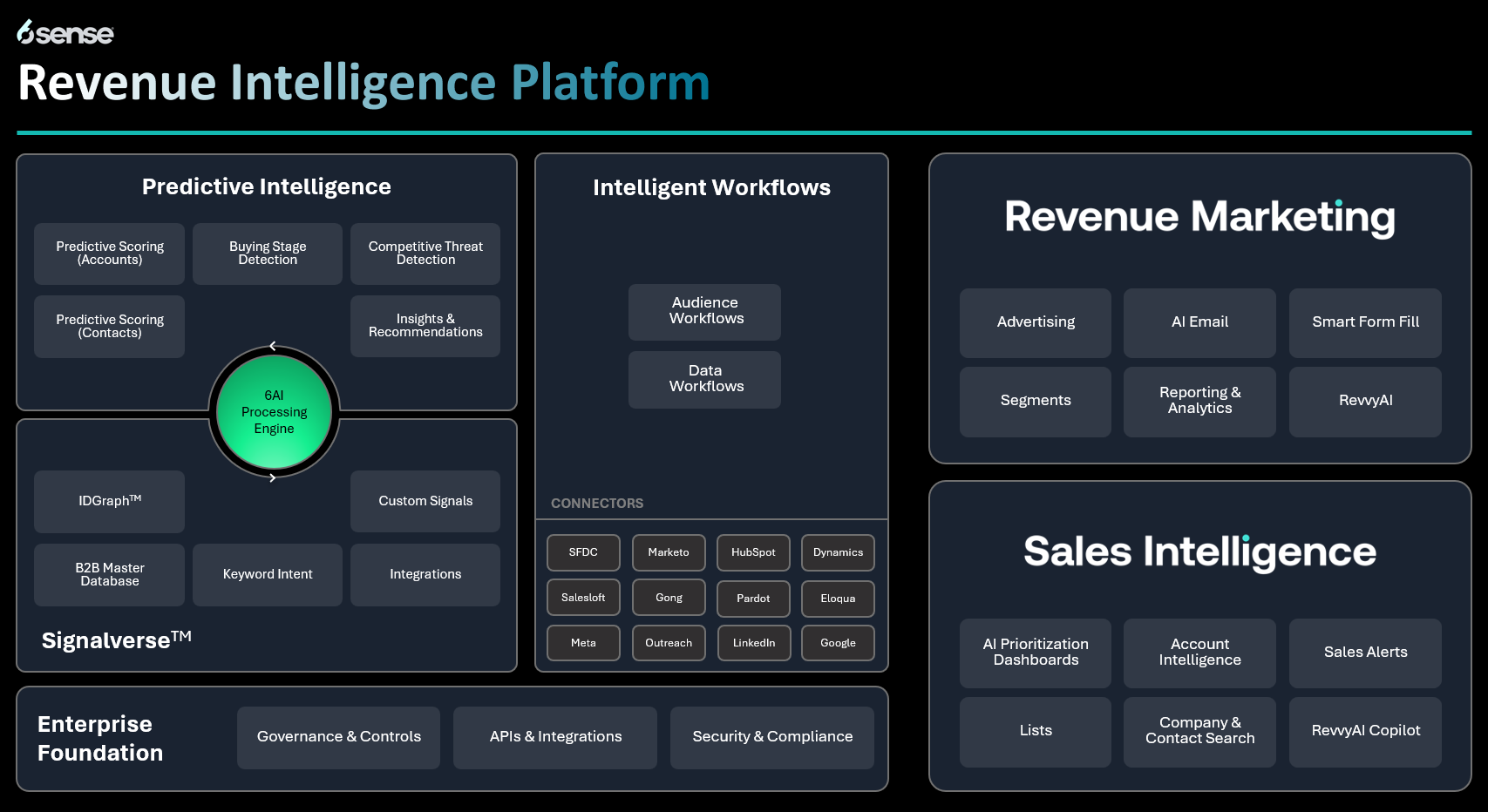
6sense’s ABM platform captures buying signals, transforms data into insights, and makes those insights actionable through automations and alerts that puts marketing's message in front of the right buyers.
N/A
Dealfront
Score 9.8 out of 10
Mid-Size Companies (51-1,000 employees)
Formed from the merger of Leadfeeder and Echobot, Dealfront is a Go-to-Market Platform for Europe used by businesses to find leads and close deals.
I feel like ZoomInfo was a data-first company. Now they're trying to get into the ABM space, whereas 6sense came in as an ABM tool and has just continued improving and adding data capabilities.
Their approach has made a lot more sense. The approach that ZoomInfo has taken—what …
When I was at a company that used Demandbase, a few people used it a little bit. At my company that uses 6Sense, 100+ people know how to use it and they use it daily.
I use both 6Sense and ZoomInfo. Both have their strengths. ZoomInfo is good with list building and contact data. It does not break like 6Sense when the results go beyond a few pages. 6Sense's UI is better, but it lacks the actual list of accounts one would like when building …
We compared other tools, but 6sense worked best for us because it puts intent, buying stage, and account insights in one place. It is easy for Sales and Marketing to use, and it helps us focus on the right accounts. We chose 6sense because it helps us take action faster and …
Both platforms offer very similar products. 6sense seems to be easier to get started, provides strong intent, and has a wider breadth of marketing capabilities. Demand Base appears to be a slightly cheaper option, but it requires a bit more effort to get started. It does have a …
Demandbase had a lot more flexibility in the platform and additional features like people lists, ability to export raw activity data, create custom reports. 6sense has better predictive scoring and more rich insights, however the platform is pretty rigid and requires a lot of …
While HubSpot CRM has it's own visitor tracking on an individual level, it is very much determined by if the visitor has submitted their details via a form before you can get this information. With Dealfront we can get this analytics before any action is taken to better improve …
Leadfeeder is very easy to set up, use, and maximize functionality. It is also easy to train. Other tools have a higher cost of acquisition and ownership. Plus, the customer support and training are helpful and very accessible! It's great for small to mid-market businesses.
Among all the competitors, Leadfeeder gives us the most visibility in terms of website traffic and lead score. The most important part of this is the contact identification that is recorded with a connection to the CRM. The account mapping and website traffic connection is the …
Leadberry was not an option offered above but that is the other option similar to this that I have taken a look at. I thought Leadfeeder had a better interface and served better & more results, enough to justify their higher price point compared to Leadberry. I have also looked …
Price was a big factor. This software was roughly a quarter of the cost. Plus Lead Forensics charges to access the emails of people at the company where as LeadFeeder does not.
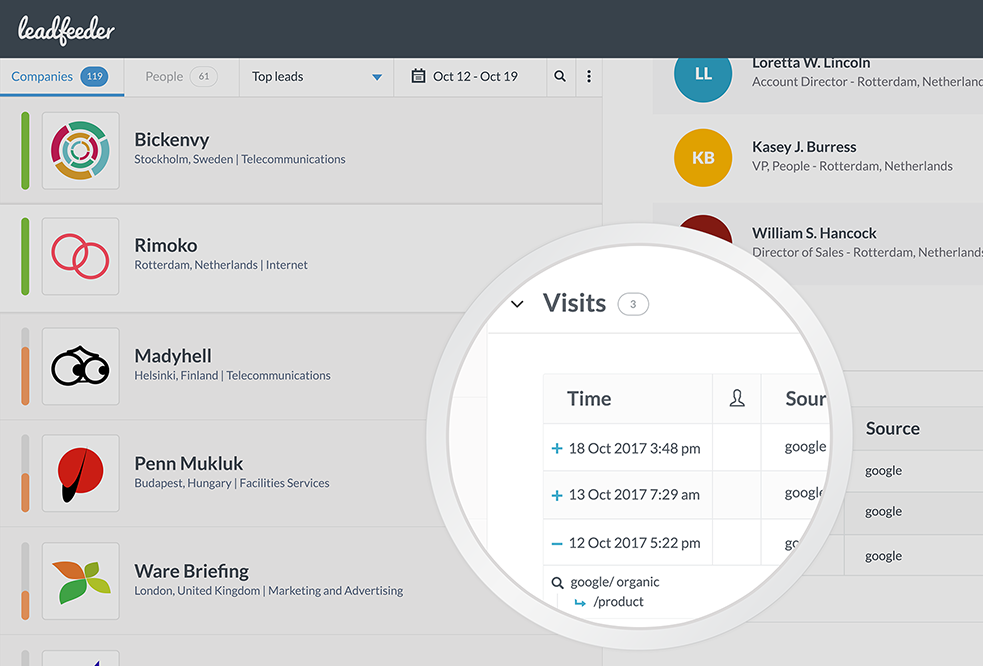
I used Sharpspring's reverse IP looking up for a while. Leadfeeder is far superior. It tracks and shows site visits by multiple people within an organization and rarely shows service provider names. We usually get the real companies.
Lead Forensics is a more costly option. Their fee is several hundreds of dollars a month. They give you the same information as LeadFeeder but different dashboard visuals. You will also have to pay extra if you need email addresses. Leadfeeder gives you a more cost-effective …
Leadfeeder seems to be more accurate than SharpSpring's visitor tracking, specifically with the ability to blacklist ISPs and internal users based on IP ranges. Leadfeeder's connection to Salesforce and the ability to assign prospects/visitors to our internal users makes it a …
6sense is best when we sell to a clear list of target accounts, and we want Sales and Marketing to focus on the right companies first. It works well for SDR daily prioritization, re-engaging accounts when they start researching again, and running ABM ads only to the accounts that matter and show intent. It is less appropriate when the business is mostly high-volume inbound leads, speed to contact matters more than account intent, the target market is very small, we already know every account, or we need perfect contact-level accuracy.
If you're looking to find new sales/customer contacts and are not a fan of complete "cold calling", Leadfeeder is a great source for finding those contacts or companies which may benefit you as they're clearly already looking at you. It weeds out half of the footwork for you.
I think one of my favorite features are the Bombora Surge topics, I'm able to take a topic that a segment is really highly active in and create an outbound sequence based on that, just targeting certain personas. Like on the buying committee, identifying activity. I can create an end-to-end campaign just with 6sense data.
Research Quality versus invested Time is absolutely efficient and motivating. Quick Research or Standard Alerts, both are done easily with instant results.
Usability of the User Interface in any of the modules is very supportive. New Team members are trained in short time. Very much self-explaining.
The connectivity between the modules is great and saves time. Each module has its key topic, but in Connection with the other modules this practical tool turns out to be even smarter more and powerful.
I would love to see more academy and certifications, availability, I think some easier, faster, easy, digestible courses to jump in. Certifications are great but they're very much focused on just those two certifications, so maybe more of a specialization focus on that side as well as some ways to kind of do a quick easy onboarding for first time users or those who have 6sense within their organization but don't know how to jump in and use it right away.
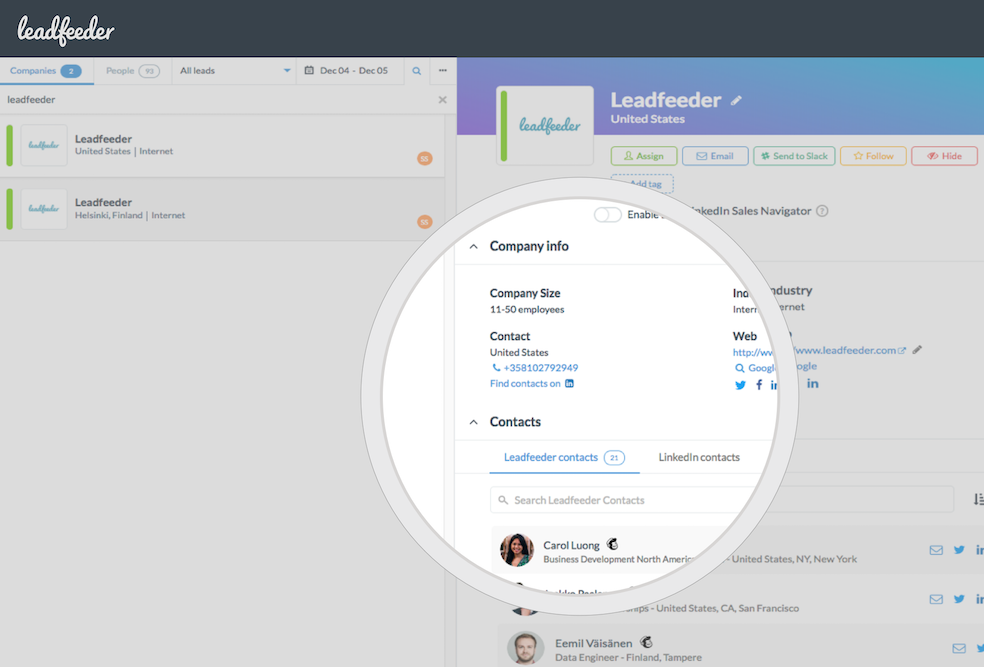
Leadfeeder has basic lead Tagging capabilities and some native integrations. It would be great to see more lead Activity Tracking and integration capabilities that sync with sales tools so a team could hypothetically keep their eyes on Leadfeeder-only while updating the CRM/sales tool.
6Sense is a powerful tool, and I’m hopeful that, despite some limitations tied to our sales process, we can make it work effectively for our organization. The customer support is great, and they have listened to my feedback and provided recommendations to improve. The insight we can see is still unmatched and it is easy to digest
Leadfeeder is the best anonymous visitor tracking software platform that I've ever used. Sitting as a layer on top of Google Analytics, the tool consistently provides us with accurate intelligence of what our hottest prospects are looking at while visiting our site. The Leadfeeder customer support is top notch and the company is always coming out with new updates that further improve the technology. On top of all of this, Leadfeeder integrates with Slack and our CRM, allowing me to continue to do my job without having to switch between various platforms throughout the day.
The platform is pretty straightforward as far as creating new segments and what's available to do so. The launch of digital advertising has greatly improved in recent months which has been great for our digital team. Adding or removing users and updating integration points is pretty easy as well. Reporting has also been recently updated which makes reporting on usage and ROI much easier too.
Always found the system super intuitive to use. I've never been stuck finding what I'm looking for and the team has some very clear and easy to understand documentation online.
We hardly needed any support but in the initial days we got some had to contact support for the product understanding, the suppor t was prompt and they were very quick to resolve any issues. The support team is very helpful and gives a lot of importance to unresolved issues.
It was too fast, too complex, no one could follow along. If you miss a step, you're lost for the rest of the time and there is SO MUCH to learn and keep up with.
I feel like ZoomInfo was a data-first company. Now they're trying to get into the ABM space, whereas 6sense came in as an ABM tool and has just continued improving and adding data capabilities. Their approach has made a lot more sense. The approach that ZoomInfo has taken—what they've built as their ABM tool—kind of just seems sloppy and not well thought out. The user experience doesn't seem as great, so it's not as appealing to a marketer trying to utilize ZoomInfo's ABM features. It's just clunky
While HubSpot CRM has it's own visitor tracking on an individual level, it is very much determined by if the visitor has submitted their details via a form before you can get this information. With Dealfront we can get this analytics before any action is taken to better improve our marketing and sales approach rather than needing to wait for a conversion to happen.
It has helped support us to understand our market and if our website is properly communicating to and providing value to that market
We currently do not have the sales staff to go after potentially qualified organizations that visit the site but don't convert but it is a strategy we will employ at some point.