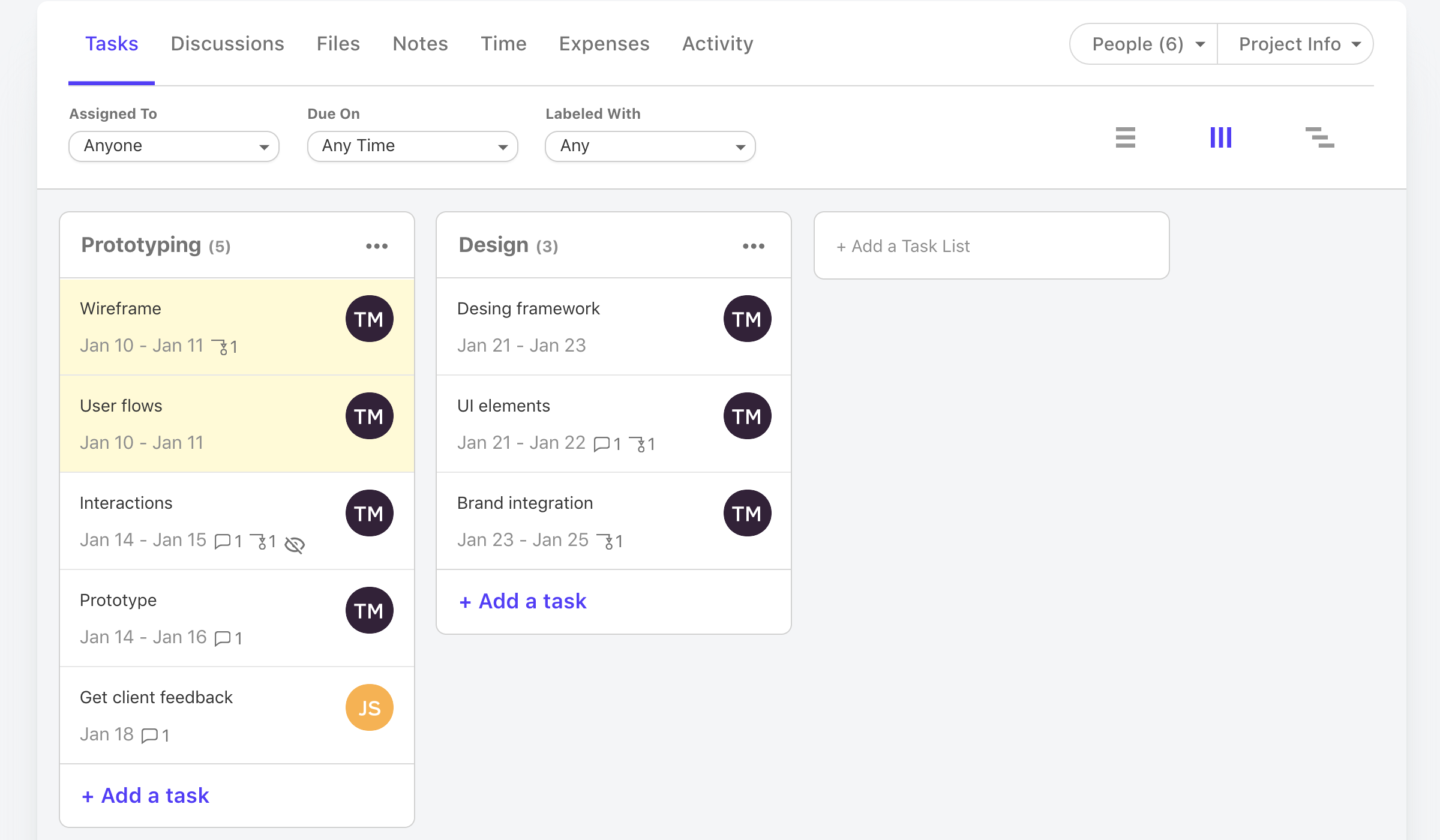
Active Collab is a project management solution built around features such as task management, collaboration, time tracking, and invoicing.
$8
per member/per month
OmniFocus
Score 8.0 out of 10
N/A
OmniFocus is a project management platform for iOS: Mac, iPad, and iPhone. It has features such as task management, Siri capture, and workflow automation.
$4.99
per month
Wrike
Score 8.6 out of 10
Mid-Size Companies (51-1,000 employees)
Wrike is a project management and collaboration software. This solution connects tasks, discussions, and emails to the user’s project plan. Wrike is optimized for agile workflows and aims to help resolve data silos, poor visibility into work status, and missed deadlines and project failures.
$240
per year 2 users (minimum)
Pricing
ActiveCollab
OmniFocus
Wrike
Editions & Modules
ActiveCollab Project Management
$8
per member/per month
Self-Hosted Plan
$999.00
license
Web Add-On Subscription
$4.99
per month
Cross-Platform Subscription
$9.99
per month
OmniFocus 3 Standalone (Mac only)
$49.99
per month
OmniFocus 3 Standalone (iPhone only)
$49.99
per month
Wrike Free
$0
per month per user
Wrike Team
$10
per month (billed annually) per user (2-15 users)
Wrike Business
$25
per month (billed annually) per user (5-200 users)
Apex
Request a quote
per month per user
Pinnacle
Request a quote
per month per user
Offerings
Pricing Offerings
ActiveCollab
OmniFocus
Wrike
Free Trial
Yes
No
Yes
Free/Freemium Version
Yes
No
Yes
Premium Consulting/Integration Services
Yes
No
Yes
Entry-level Setup Fee
$6.25 per member, per month, annual billing
No setup fee
No setup fee
Additional Details
—
—
Every premium plan begins with a 14-day trial period.
ActiveCollab is 100% better than any of the other tools we have used. We had previously spent thousands of dollars trying out different software that was comparable, but this has been one of the best decisions we have made as a company. It's also the cheapest ongoing option, …
ActiveCollab - the version from around 2013 was great. My current employer tested a newer version of ActiveCollab but it didn't give us the functions the old AC had. In the end we opted for Wrike.
Teams Planner (Microsoft) - we started to use this 6 months ago to get an overview …
monday.com is popular and it's easy to understand why. If you're looking for a low-commitment personal task manager, it might be for you. I found it was complicated in the wrong ways and too simple where I needed it to be complicated. I also found it distracting to use. …
Scenarios where ActiveCollab works well 1) ActiveCollab works well for small teams specifically T&M teams.Its invoicing feature is unique & can make your life easy. 2) It is very easy to use & posses good range of filters like on the task list, we can drag/drop tasks, Filter by assignee's, tasks lists, due dates, or completed tasks. 3) It has some simple but awesome features like when you're in the middle of writing something i.e a comment on story and get interrupted, it retains what you wrote. 4) It allows you to tag team members in threads of comments to grab their attention, its really needed when teams are distributed. Thus helping team members to collaborate easily & stay on same page. 5) It integrates pretty well with other web apps like quickbooks , Slack, Trello, HubSpot, Zapier etc Scenarios where ActiveCollab did not work well 1) Tasks can not have multiple assignee's here so if two members are working on same task it did not allow you to reflect that. 2) Sorting capability is not their under invoicing 3) It did not work well for larger teams 4) Search option is not very detailed & you may end up wasting lot of time searching one particular bug or issue.
1) Great for managing your work and personal activities. 2) One of the best implementations of the Getting Things Done method. 3) Not really suited for collaborative work management; OmniFocus is managed on a per-user basis so you can't share/assign tasks.
I believe it's well suited if you have multiple jobs/projects that you need to keep organized. We work with multiple job types from print/creative to web, copy and digital ads so it helps us stay organized. I don't think it would be suitable for a company that doesn't have a lot of jobs to manage. We average over 1,200 requests a year.
Ease of viewing what tasks need to be done at the present moment and the sorting of those tasks by availability, due date, start date, needed resources, and project.
The visual interface is really nice to work with, the UX/UI is intelligent and intuitive.
It's the most extensible software I've used. There is a community of people that publish compatible scripts for Omnifocus at no charge.
The code is robust and I've almost never had a bug or a glitch that resulted in issues.
The software syncs in the cloud between MacOS and iOS seamlessly and faster than other To-Do software. The sync aspect is available free of charge.
The development team at Omnifocus is on top of bugs and they have been adding releases regularly to increase functionality and performance.
While OmniFocus adheres to the GTD (Getting things done) principles, it can be used in almost any manner and you aren't stuck with just that methodology.
It isn't possible to set members of staff as part time, so if someone is unavailable on certain days you must manually enter them as OOO every single day that they are not in, that other teammates work. Hours also can't be edited individually - everyone is treated as working the same hours in a day, rendering capacity planner useless for flexi working teams
Subtasks cannot be assigned their own hours and deadlines, meaning the To Do list view can't be seen in actual date order and capacity planner does not reflect all time allocated to an individual's schedule unless every task is set up as a separate task rather than subtask
There is no way to see all tasks of a certain type across multiple campaigns (e.g all copywriting tasks vs all technical tasks) - support team suggested exporting data and making spreadsheets
Kanban view isn't available for people's own task lists ('board' view here shows a list)
Not possible to have one task be assigned to more than one person
Notifications are not sent when tasks are updated, so you have to leave comments and tag people each time
I would really like to see graphic presentations of how I allocate my time, what categories of tasks don't get accomplished, etc.
I would like to see OmniFocus include Gantt chart functionality, such as allowing me to see how long it took me to accomplish a task from start to finish. Allowing me to actually input time spent, and seeing it on a Gantt chart, would be icing on the cake.
I wish that Wrike had more drag and drop functionality that would be connected to assignee and also I wish that the finish date of a task would update to the date where you checked completed. It does not do that. Also finishing a task doesn't move the start date of the next task it "protects your time in that way", but our management team wants us to quickly see what we have down the pipeline rather than having to scroll down the list of upcoming tasks.
It does take some time and work to really understand and use it properly, but I think the accessibility to help and documentation make that completely feasible. Once you know how to use it, I find it to be very user-friendly, and have very few complaints.
Over two years of (almost) daily usage without outages. Don't remember any errors. I give it 9 only because some Wrike plugins (for online document edit) are based on NPAPI architecture. These types of plugins are being phased out in new browsers, and NPAPI plugins are disabled by default in recent versions of Chrome so you have to do some browser adjustments when you switch browsers or move to another computer.
Wrike tasks loads fine, but I hate clicking files and wait for a bit of time since it is powerpoint or word, Wrike assumes I want to open those on Wrike. My suggestion is to link it to office 365 so we do not need Wrike based decoder for PPTX and DOCX
We have not required support for ActiveCollab as it works pretty seamlessly. We didn't have any issues with using the platform or with any billing issues. The self-service aspect of the platform is robust and easy to navigate so we have not encountered any errors that required assistance from the support team.
OmniFocus has excellent user forums. They're active as well as mature, since the product has been around for years. I've never needed to actually contact customer support because OmniFocus is popular enough that I've always been able to find an answer in the forums, or in an article, or in a YouTube video.
During my learning phase with Wrike, I initially struggled with setting up automation rules and request forms. However, Wrike support was always my go-to, resolving issues within seconds or minutes. Their assistance made the learning process much easier. My best experience was receiving step-by-step screenshots to follow, with the support team on standby until I was completely satisfied.
I love the Wrike training options. Wrike Discover has tons of courses, learning plans, certifications, etc. This is an area where Wrike definitely shines! I wish these resources were more in your face for new people, because it seems like a lot of coworkers didn't know all of this training was available to them.
There are a lot of bells and whistles in Wrike, and not all of it is easy or intuitive to understand once it's plopped in your lap. It's easier when there are a few choice people who understand Wrike as a platform and articulate it in such a way where it makes it easy to pass it along to others in the group
ActiveCollab is easier to use and simpler in its setup. It has the right mix of features and simplicity. It's also project-oriented which is important for our workflow. Other tools are often too task-oriented, making it hard to track projects. Overall, ActiveCollab has a great mix of simplicity with good features.
OmniFocus is built for the user with a lot going on - consequently, it does a great job at organizing lots of things in a manageable workload. It's perfect for taking a project and breaking it down into small tasks for yourself or teams. Once you get past the learning curve, it's quick at adding new tasks. Overall, it's an excellent product.
Jira did not at all help us get our work done as content creators. I think that was because Jira wasn't quite right for our uses. Wrike fits our needs so much better. I can't tell you enough the relief I felt when we adopted Wrike and I never had to use Jira again.
The sky is the limit for what can be done in Wrike. We started with 1 use case and within 5 months we migrated several key business practices over to Wrike because they were easier to manage. Use cases so far: process improvement, management review, corrective actions, maintenance requests, month-end financial closing, and document management. As we grow, it's easy to imagine putting even more into Wrike where it becomes a cornerstone for how we do business
OmniFocus keeps our tasks moving forward. Using a free script you can search all your current projects for projects that have no next step assigned to it to ensure nothing falls through the cracks.
When we serve our clients, the attention to detail we are able to give them comes from accurate tracking of what we need to deliver.
We complete projects 25% faster than before and we can see where the bottlenecks are immediate. We have also been forced to document tasks in a more concrete manner which allows for better execution.
Different teams (e.g., contracting, compliance, provider relations) can view updates in real time, comment directly on tasks, and escalate items when needed.
Wrike allows us to template the contracting process (from intake to signature) to ensure consistency across payers and reduce administrative overhead.
Leadership can see the status of negotiations at a glance, identify bottlenecks, and prioritize resources accordingly.