Adobe acquired Omniture in 2009 and re-branded the platform as SiteCatalyst. It is now part of Adobe Marketing Cloud along with other products such as social marketing, test and targeting, and tag management.
SiteCatalyst is one of the leading vendors in the web analytics category and is particularly strong in combining web analytics with other digital marketing capabilities like audience management and data management.
Adobe Analytics also includes predictive marketing capabilities that help…
N/A
Fidelis Deception
Score 0.0 out of 10
N/A
Fidelis Deception is a proactive cybersecurity solution designed to enhance organizational defenses against cyber threats by leveraging sophisticated active deception techniques. It empowers cyber defenders by transforming the attack surface through the strategic use of decoys and lures that trap adversaries in a controlled environment. The platform continuously maps the cyber terrain, identifying high-risk assets and potential attack vectors, while employing machine learning to adaptively…
N/A
Heap
Score 8.2 out of 10
Mid-Size Companies (51-1,000 employees)
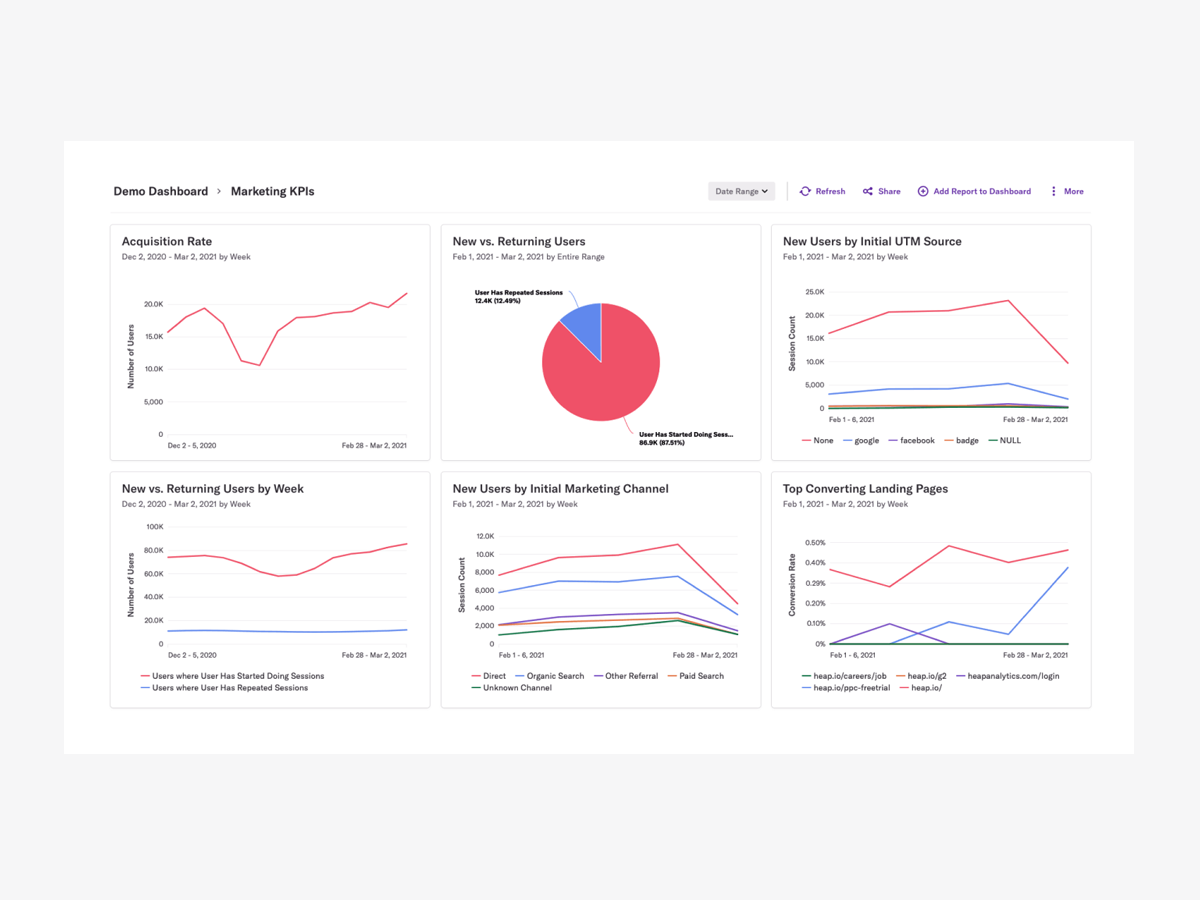
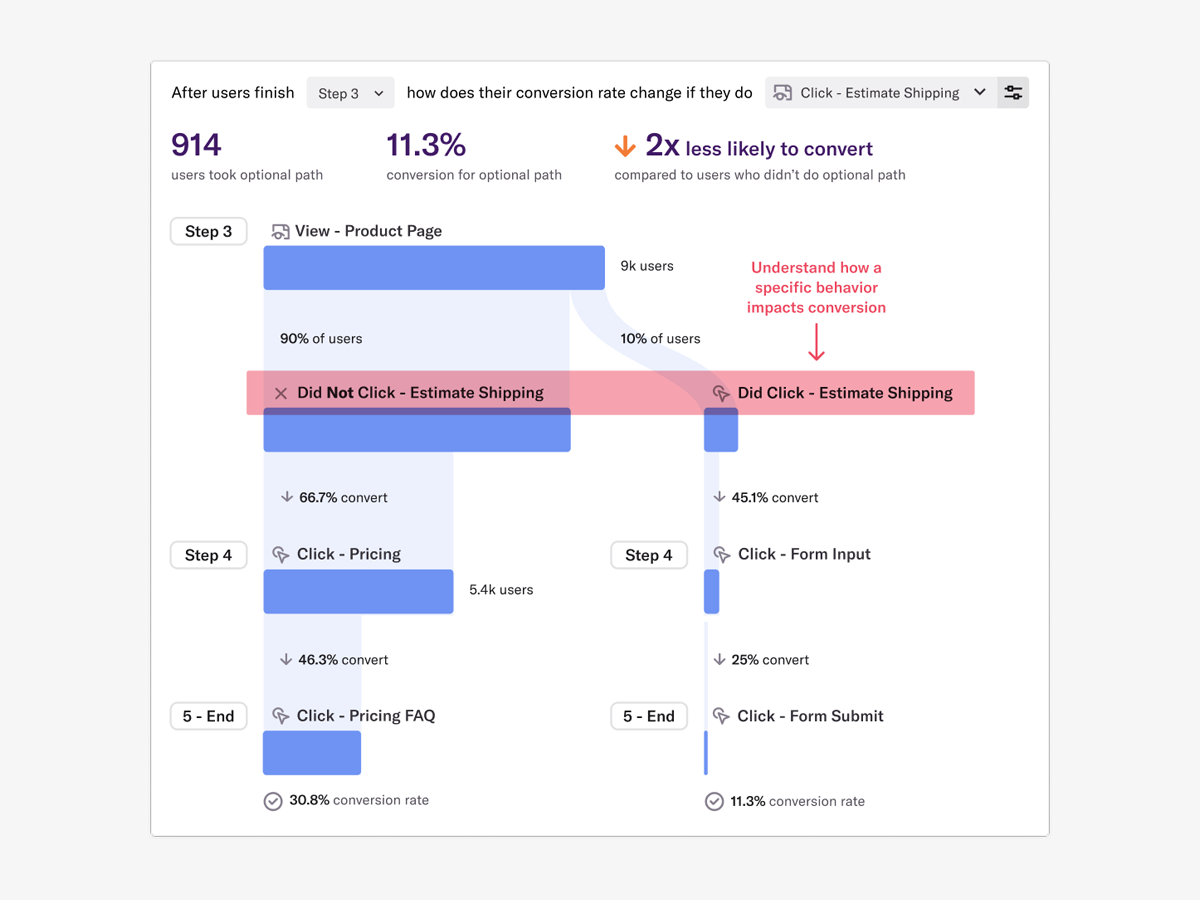
Heap is a web analytics platform captures every user interaction on web iOS with no extra code. The tool allows you to track events and set up funnels to understand user flow and dropoff. It also provides visualization tools to track trends over time.
$0
Up to 10k sessions/month
Pricing
Adobe Analytics
Fidelis Deception
Heap
Editions & Modules
No answers on this topic
No answers on this topic
Free
$0
Up to 10k sessions/month
Growth
Starting at $3,600 annually
Up to 300k sessions/year
Pro
Contact Heap Sales
Custom sessions per month and unlimited projects
Premier
Contact Heap Sales
Custom sessions per month
Offerings
Pricing Offerings
Adobe Analytics
Fidelis Deception
Heap
Free Trial
No
No
Yes
Free/Freemium Version
No
No
Yes
Premium Consulting/Integration Services
No
No
No
Entry-level Setup Fee
Optional
No setup fee
Optional
Additional Details
—
—
Heap pricing is based on session volume. A session is a period of activity from a single user on your app or website. It can include many pageviews or events.
I've used Google Analytics, which is probably the most direct competitor to Adobe Analytics, as well as Pendo Analytics, which is a little bit more of an adjacent product. It's more focused on product analytics rather than web analytics. I've also used Localytics, which is a …
Adobe in my mind, like I I've had clients that have used it, it feels like more of an enterprise, large size company type of solution. so yeah, it's been one of the, the two, you know, as I've been in advertising for 15 years, like IT and Google Analytics are the two big …
We evaluated and we currently use Mixpanel and we have Google Analytics on a couple of our properties. And honestly, once you get the hang of the Adobe Analytics workspace, the other products really don't stack up against it because the segmentation and the ability to create …
Compared to Google Analytics, Adobe Analytics is more powerful for deep segmentation and global analysis. It’s a bit less intuitive, but we chose it for flexibility, better cross-channel attribution, and the ability to handle complex user journeys at scale, which mattered more …
As I mentioned before, we identify a need to scale up our web performance in different languages and countries. Adobe Analytics allow us to use filters, segments, metrics inside an "all-in-one" report. No new web browser tabs to be loaded every time we need to change a date or …
I cant see direct compition with other products apart from one product which is Adobe Customer Journey Analytics. I'm generally suggesting to use Adobe Analytics with eCommerce platforms like Adobe Commerce as well as Adobe Experience Manager. It works best and easy to …
Google Analytics had issues with Geo locations, and our Markets were tracking less and less users. Also the GA is based on sampled data and it was not flexible enough for us to create different segments and classifications.
We felt Adobe Analytics was a much more robust platform and stacked that gave us much more depth into user behavior across our different channels. We needed a platform that had no sampling involved with a longer time. Period for analysis to ensure we were always able to pull …
Adobe Analytics is a more advanced tool which is used for complex business needs and it does require a lot of setup from the backend. However, when compared to tools like Google Analytics, it is significantly better with customization, personalization and attribution. It is …
Clients usually select Adobe Analytics because it suits them better than the alternatives and they want more customisation than GA4 offers. Also because they might be with Adobe Experience Cloud for a few other things like tag management, A/B testing, audience manager, campaign …
Google Analytics stacks up for high level traffic and marketing data but not ideal for enterprises looking user level product interactions in detail. On the other hand Heap stood out for its automatic data capturing, faster onboarding, easy to use dashboards, Highly integrable …
For me, Heap is much simpler to utilize. I've previously used Google and Adobe Analytics but switched to Heap because it provide better features and is easy to integrate. Without a specialist's assistance, I am able to construct dashboards and am convinced that they are useable …
Heap is better because its easy to use, easy to install. With Heap you just add a snippet of tracking code to your header, instead of having to instrument each event like you do with other tools.
all of them may have their own strong suits but Heap is backed by best in class ML and AI algorithms. not only that all this powerful and robust backends are well handles also from the frontend. no matter how good your software is, if it is somewhat hard to navigate or to get …
Heap is better then Pendo and Amplitude. Compared to Amplitude, Heap is cheaper and easier to analyze and use. Configurations might be cumbersome but in the long run, users find it very seamless and easy. Compared to Pendo, Heap offers much superior analytics, event …
The ability to view events in real time as they occur, restrict them to just show mine, and then create dashboards using those events is the finest feature for me. It eliminates the requirement for constant 100% accuracy in documentation maintenance and guessing. I can monitor …
Heap had an edge over Google analytics in many ways. Few points to consider Heap over GA. 1. Low code implementation and less involvement of engineering team. 2. Great reporting dashboard with additional feature of of showing user journey, that helps understand user behaviour
Other applications help to achive the requirements using the current data, but Heap has two driven model one is dependent on past data which is also known as predictive framework and also one dependent upon fly which is adaptive framework. And integration is other tools is …
Heap offers a ton of functionality on a single platform.It also has an smart data science layer to offers suggestions for next steps in the analysis, allowing us to explore alternative paths we may not think to take. The low-code option for updating data is appealing, and there …
Heap blows away the competition in this space in my opinion. Amplitude was the closest competitor but did not have the ease of instrumentation that Heap offers out of the box. Google Analytics has gotten worse year after year and was borderline worthless for our business, as …
Tableau offers more advanced features, but at a much higher cost across all dimensions: price, difficulty of implementation and integration, onboarding effort, prior knowledge required, etc.
Compared to GA, Heap provides a much better UI, and its a much better product analytics tool (considering GA's main functionality is not for Product analytics) Overall, of you, are searching for Product analytics I would choose Heap instead of GA.
Heap is much easier to use versus Google Analytics. Previously, I was using Segment to get channel level data. However, Segment is not a customizable tool to understand top of funnel/web performance in the same way Heap does. Heap Connect is excellent when it comes to creating …
Heap is much easier for me to use. With Adobe Analytics, I needed to work exclusively with a product analyst whose whole job is working in Adobe Analytics. I can create dashboards without help from a specialist and feel confident that they are functional, actionable, and usable …
I didn't select heap. Someone else did. I wasn't consulted during the process either, it was there before I arrived and we recently renewed, but I wasn't part of that process. Hotjar was alright, the heapmap is a neat way to quickly show non-experts where we might have an …
It is well suited for everything. I do because my advertising platforms will show me where I'm spending money and where I'm getting clicks, but you don't know anything beyond that. I always have to go into Adobe Analytics to see what those clicks are getting me. Are they actually visiting the website and doing anything we want them to do? And advertising, you can't just spend money without the results. So it allows me to close that loop and show the actions, in some cases, revenue, and the ROI for spending money. What's the return in revenue that we're getting? So I use it for everything. I can't look at the data that's in it. Adobe Analytics, when you live in the world of advertising, the contrary, you said, when would I not use it? So there are some instances where I'll go to a different sales-focused reporting platform or Salesforce reporting. Adobe Analytics is currently in our world at ESRI, but we don't have all that Salesforce data in Adobe Analytics. So that means I don't always go there for that sales-related data. I go into other reporting platforms to see that.
Heap is well suited for 1. Capture customer journey with session replay 2. Identify customer behaviour and improve overall customer experience 3. Frequent and quick implementations and modifications 4. Comparative analysis for historical marketing insights Heap is not so well suited, if the aim is to capture only analytics data without any goals to improve upon customer experience / targeting appropriate users based on data tracking.
It summarizes large complex data better than any other analytics solution I've dealt with without the need for sampling, gives the right level of detail, does the right level of breakdowns, aggregation. I consistently not only use Adobe Analytics, but I use other data sets and compare against Adobe Analytics. And as I go into Adobe Analytics and compare, as long as I've done the query right and the other systems, they're very, very close. And if anything, with a lot of Adobe's newer products, they've gotten more accurate over time. So that's basically, you asked me what I liked about it. I like that it's accurate. I like that I don't have to do a lot of explaining. There's enough explaining in the world of web analytics to have to go back and explain why data's problematic. And so like I said, provided that the implementation is correct, it's a very easy conversation. Even if people may not like the answer.
The Auto Capture function does indeed save quite a bit of time, and being able to build new reports off historical data is really valuable.
Interface is really intuitive and user-friendly. Much easier to pick up and use than GA.
Building reports out on the fly is really quick and easy, allowing you to give right into all kinds of analyses.
The Event Definition screen is really useful, giving a quick glance at the most used events, which you then decide to turn into conversions or goals if you want.
Support. I mentioned this earlier and we don't know what we don't know. Researching the massive amounts of documentation isn't realistic with bandwidth constraints, and our rep getting frustrated with us when we go through what we are seeing is disappointing.
Education. More please, and designed more towards the "business side". I get with the many many many different implementations (every company is different!), that it's tough, but even a basic of the basics would be nice for situations that everyone is looking at, like the engagement with the merchandising on the home page (or any certain page).
We need it to discover threats long before they become a loophole in the security ecosystem. Also, it is very much compliant with customer standards and expectations. It provides marketing intelligence through in-depth analysis. Overall, a very good product to gain customer attention and thereby improve market
Heap helps me understand key data points without fussing with the formatting of a dashboard. It gives me the benefit of data analyzation without the fuss of the formatting - as well as the ease of sharing data collected with my colleagues
It is necessary to have a minimum knowledge on tracking tools so you can use the tool on full performance. It is not an introduction tool, so please bear that in mind. Once you got the knowledge you just need a small training on how to create your custom reports, where to find the components you need and how to add them to your dashboard. Then you share your report or create a rule for periodic sharing and it's done. Finally, if you have a lot of data stored the tool might be a little slower but that's ok.
Sometimes, Heap has issues reconciling similar selectors, and I have not found the manual tagging system to be the most intuitive, especially when best practices are not used when designing the front-end infrastructure. Even so, it helps that the data is unmodified, and all analytics are done through an interfaced layer, so damage and confusion [are] not permanent.
I do not ever recall a time when Adobe Analytics was unavailable to me to use in the 8 or so years I have been an end user of the product. My most-used day-to-day analytics tool Parse.ly however, generally has a multiple hours planned offline maintenance every two to four weeks, and sometimes has issues collecting realtime analytics that last anywhere between 15 minutes to an hour, and happen anywhere between 1 to 5 times a month.
I've never run into any issues with Heap's availability, Heap is always there when I need it. I haven't run into any issues like application errors or unplanned outages during my 2+ years of using Heap. Each and every time I log in to Heap I have a completely functional experience
Overall, Adobe's servers seem responsive. Like any large-scale SAS provider, they can have occasional slowdowns where, I presume, a node is not available and other servers get bogged down with the user load. I have noticed this with both large and small data sets and reports.
On that note, Adobe Analytics can take a long time to run reports and pull various data points, depending on the period of time, number of metrics and segments applied. As you create reports, particularly in Workspace, the data are pulled in real-time while you're creating the report. This can often cause issues while trying to drag more metrics into the interface when certain elements of a table are grayed out because data is being pulled in.The more data points and segments involved, the longer it takes to update. When you look at larger windows of time, it takes even longer. If one were to compare to Google Analytics or one of the open source products like Piwik or Motomo, Adobe seems much slower. However, Adobe also supports far more variables than other web analytics products.
On a scale from 1-10, Heap loads pages fairly quickly. The only time I experience delays is when I am loading a graph with perhaps too many events or filters on the page. But in terms of creating or searching for events or viewing reports, I don't ever experience a lag.
Support for Adobe Analytics is ok, it used to be worse years ago. Now, the technology team at Adobe is way more knowledgeable on the product itself as well as the implementation. They also study your custom implementation and have good knowledge of where your company stands. Dedicated support is something worth considering.
Heap support has allowed us to troubleshoot and test a lot of different items. Their support team is always helpful and friendly, even when we come to them with the most complicated questions. I think this greatly improves the value proposition of the product because their support team is knowledgable and friendly.
It was a one-day training several years ago that cost the organization several thousand dollars. There were only about 10 people in the training class. Adobe tried to cram so much information into that one-day class that none of our users felt like they really learned anything helpful from the experience. Follow-up training is too expensive
The online training for Adobe SiteCatalyst consists of short product videos. These are ok, but only go so far. For a while Adobe charged a fee for this, but recently made these available for free. There are many great blog posts that help users learn how to apply the product as well.
It is a large effort to implement. Throwing a developer with zero experience with Adobe Analytics with no support is a REALLY BAD IDEA!!! Having experienced developers working as a team is crucial to a strong implementation. I say this because I have experienced both scenarios. I was the only developer on an implementation project and I had no experience with Adobe Analytics. As a result I made many architecturally bad decisions which lead to a rigid fragile implementation that eventually was scraped. It took some hard lessons to learn that Adobe Analytics was not as simple as their sales reps make it sound. Using the Adobe Dynamic Tag Manager made sequential implementations incredibly STRONG. Having a DTM to manage the code was a miracle and a life saver!!! If you plan on doing a big enterprise level implementation, please seriously consider using the Adobe Dynamic Tag Manager!!! it made code maintenance super slick and easy which is super important for a developer!!!
The implementation was smooth and easy. The Heap team helped us with implementation and it went great! Within a few weeks, we were fully up and running and utilizing the platform to its full capability. This is an additional thing that has made this platform so great and we couldn't recommend it enough.
I've used Google Analytics, which is probably the most direct competitor to Adobe Analytics, as well as Pendo Analytics, which is a little bit more of an adjacent product. It's more focused on product analytics rather than web analytics. I've also used Localytics, which is a mobile app analytics platform, which is there. In my experience, Adobe Analytics is far more full-featured and rich compared to Google Analytics and Pendo Analytics. Pendo has some interesting features that it offers that Adobe Analytics doesn't, but at an enterprise level, at least, or at a large organization scale, they're not critical features that are necessary. Adobe Analytics's flexibility in ingesting and exporting data makes it well-suited to environments like ours, where we need to merge web analytics data with other datasets we might have. And so that's been very effective for us. Localytics is strictly a mobile analytics platform, so it has some point level advantages, but the fact that Adobe Analytics is able to marry and kind of merge web analytics data with mobile analytics data into one kind of view of the data is a really nice feature that, in my mind, makes it superior to Localytics in general. And its Localytics reporting capabilities are far limited, I would say, from a reporting standpoint. All of the other competitors I've looked at, they're, the reporting capabilities are just not nearly as sophisticated as Adobe Analytics.
Heap is better because its easy to use, easy to install. With Heap you just add a snippet of tracking code to your header, instead of having to instrument each event like you do with other tools.
My organization uses Adobe Analytics across a multitude of brand portfolios. Each brand has multiple websites, mobile apps and some even have connected TV apps/channels on Roku and similar devices. Adobe can handle the multitude of properties that have simple, small(ish) websites and the larger brand properties that include web, mobile and connected TVs/OTT devices.
Each of those larger brands has multiple categories and channels to keep track of. We can see the data by channel/device or aggregate all the data together. This gives our executive teams the full picture and the departmental teams the view they need to see their own performance.
The most challenging part of using Heap in a growing organization is the naming and structure in which reports and dashboards are organized. I work within the marketing department and our Heap leader internally works within the IT/Product department, which makes it challenging because we often don't speak the same language, so the learning curve has been steep without any specific use-case examples to leverage online.
I think we're able to quantitatively analyze and report back on activities on our websites, where in the financial services sector, we really haven't been able to report that in the past. And so, as a company that has clutched onto paper as long as it possibly can, it's refreshing to our leadership to be able to report back and say these are exact things that are being done on our website that can lead to increased sales, increased signups, ease of use for our end users, et cetera.