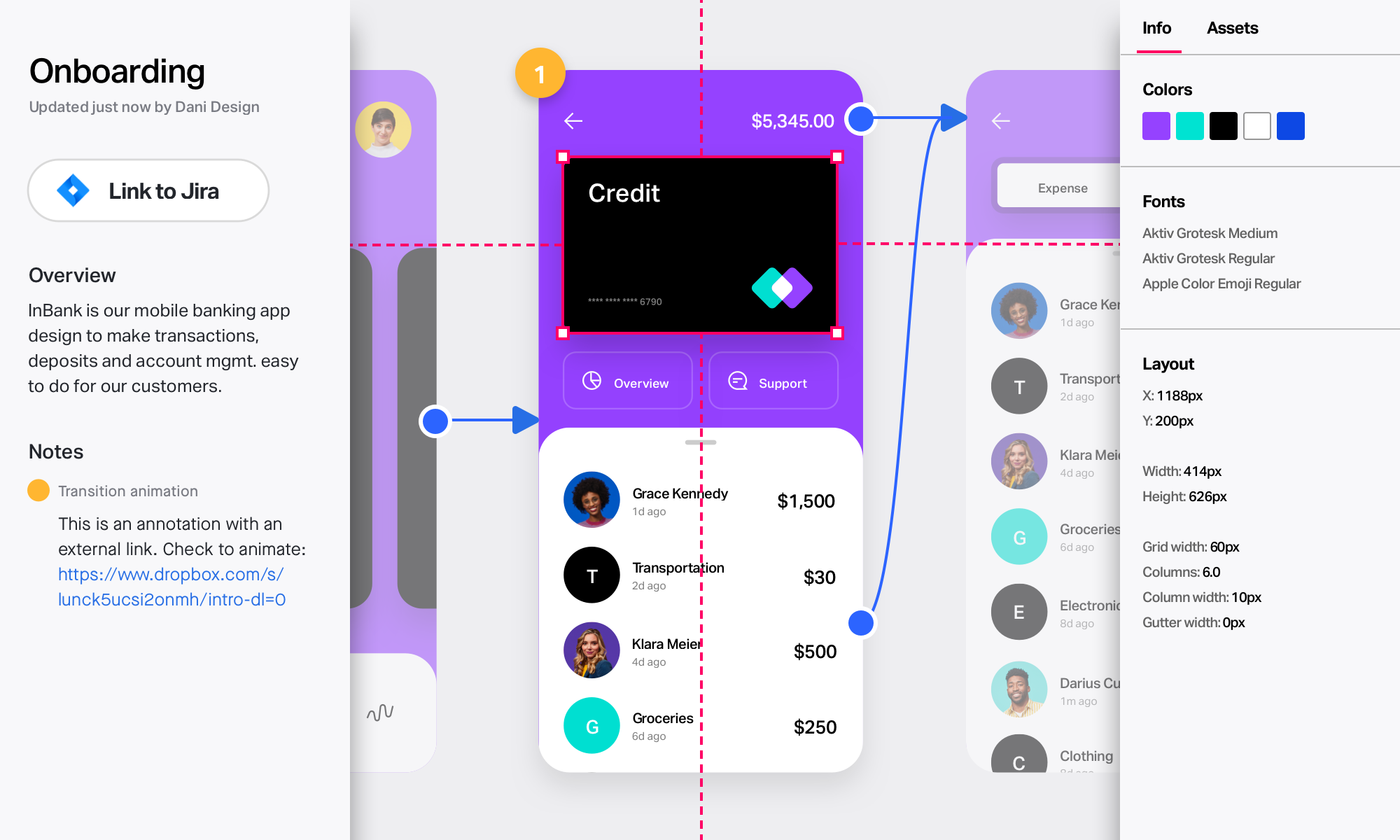
Adobe XD is a prototyping and UX/UI option for website and mobile application design, featuring a range of UI tools and and templates, a versatile artboard and contextual layer panels, and deep integration with Adobe's creative suite of products for fast import of objects from these applications.
$33.99
per month per license
Figma
Score 8.9 out of 10
N/A
Figma, headquartered in San Francisco, offers their collaborative design and prototyping application to support digital product and UI development.
$15
per month per editor
InVision
Score 7.8 out of 10
N/A
InVision is a collaborative design and prototyping platform with features such as freehand drafting mode and interactive mockups, collaboration, idea management, user testing, and integration with Slack and other collaboration tools. According to the vendor, 1 million designers are using the free version.
$0
Pricing
Adobe XD
Figma
InVision
Editions & Modules
Individual
$9.99 ($119.88)
per month (annual, prepaid)
Students & Teachers - All Apps
$19.99 ($239.88)
per month, annual plan (for the year)
Business - Single App
$33.99
per month per license
Business - All Apps
$79.99
per month per license
Schools & Universities - Institution Wide
Contact Sales
Professional
$144
per year
Organization
$540
per year
Starter
Free
Free
$0
Pro
$7.75
per user/per month
Enterprise
Contact Sales
Offerings
Pricing Offerings
Adobe XD
Figma
InVision
Free Trial
No
No
No
Free/Freemium Version
No
Yes
No
Premium Consulting/Integration Services
No
No
No
Entry-level Setup Fee
No setup fee
No setup fee
No setup fee
Additional Details
—
—
—
More Pricing Information
Community Pulse
Adobe XD
Figma
InVision
Considered Multiple Products
Adobe XD
Verified User
Project Manager
Chose Adobe XD
XD can do everything we need and more. It's already part of our Creative Cloud subscription and integrates with our current tools. It was really easy to get to work and establish a workflow for almost all projects where we are designing, prototyping, and iterating. Feedback and …
Adobe XD is a very useful tool for building wireframes, but I've now turned to Figma for my go-to wireframing and prototyping software. The thing that both Adobe and Figma have going for them is that they're available on Windows, as well as Mac. A lot of tools are Mac-only. Figm…
We actually use Figma, Sketch, and InVision along with XD in our design practice. We mainly use XD on quick prototypes or experimentation for mobile projects. We always end up falling back to Sketch+InVision for our Design System Implementations and developer collaboration …
It's a lot easier to prototype ideas and make mock-ups faster in Adobe XD than it is to in say Photoshop. Figma is fairly similar but XD works with the Adobe ecosystem and I feel is easier to learn and use and the way you can share XD links is what I really like.
While I have used Zeplin, InVision, and Adobe XD on various projects, partly dependent on in-house client teams preferences, Adobe XD is the most familiar to me based on 20+ years [of] working within Adobe applications. They all can do most of what I am looking to do within …
Compared to Sketch, Adobe XD is perfectly capable for most prototyping needs that we have. And it's free! I am less familiar with Figma, but can only say that it was a cost-prohibitive choice at the time we were evaluating. I do believe that Figma has become more sophisticated …
Before XD came to the company, screens were designed in Illustrator or Photoshop and a PDF presentation was generated, which was extremely time-consuming. XD saved us a lot of time (and money) by generating interactive prototypes, which are much more tangible for the client …
Figma is also a very good product, but the reason we are still using Adobe XD is because we can grab this software and have multiple projects that are going on at the same time, so it's very hard for to move on to other software. ** The Repeat Grid Feature is super good and, in …
More and more competitors, agencies, start-ups, tech companies are using Figma instead of Adobe XD or Sketch so our company is trying to get licenses of Figma in addition to Adobe XD. At a large company like us, we already have an Adobe Creative Cloud license so it makes sense …
Adobe XD used to be able to stack great, but I would select Figma over Adobe XD any day. Much better features, better quality of life features and includes darkmode. Another great part of Figma is the fact you can strickly use it in a browser without having to install any apps, …
If we compare with Sketch, I would still prefer Adobe XD. Sketch is a pioneer as a UI design tool, but the features and integration (without plugins) that Adobe XD provides are number 1, especially on the prototyping side.
The biggest benefit of Adobe XD for us is how easily we can use it based on our familiarity with Adobe products and because of the product’s integration with other Adobe products. There can be extra tasks when working, say, with Adobe Photoshop and Sketch. With XD, working …
I've tried all those softwares and the one that I found better was Proto.io. But, it has a high cost, and as we already had access to Adobe XD by our Adobe Creative Cloud membership, we chose to go with it. Some of those software have more features and functionalities than …
More people use Figma than Adobe XD at the moment. It feels like Adobe is no longer supporting XD so people are moving to Figma. Before XD there was Sketch but this isn't used as much. Figma are the market leader. If you are learning design in 2024 I recommend learning how to …
Axure is known for its powerful prototyping capabilities, including complex interactions, conditional logic, and dynamic content but it has a steeper learning curve due to its advanced features and complexity. Plus its expensive. Adobe XD integrates seamlessly with other Adobe …
Figma is often considered superior to Sketch and Adobe XD due to its web-based nature, enabling seamless cross-platform compatibility and real-time collaboration. While Sketch is limited to macOS and Adobe XD offers robust features, Figma's ability to work directly in the …
In comparison to Figma, other tools which can accomplish similar tasks (Adobe XD, Sketch, and Adobe PhotoShop) feel outdated, clunky, and lacking in functionality.
When switching over to Figma, the experience feels much more elegant, convenient, and cutting-edge in a number of …
Figma compared to other tools has user friendly UI which is very easy for all levels of designers. Compared to Adobe XD and Sketch Figma is stable, while in other tools I have faced software crashing in the middle of the work which resulted in loss of data/design. Compared to …
I prefer to use it comparing to Adobe XD. It surely is more intuitive and still develops itself providing new features (e.g. variables; however, I had to get used to the new interface). Now, if I had to compare it to Axure it'd depend on the project I'm working on. In case of …
Compared to Adobe XD, the Figma tool is much easier to use, offers more features, and has a much lower cost. Its features are less complex, making it very easy to teach beginners how to use it. The navigable prototype is also easier and more efficient to share in Figma compared …
Adobe XD is an absurd copycat that never got to have even 10% of Figma's features. It's hyper fast because it's native, but that's the only good thing it has.
Axure RP is an excellent prototyping software, with Local Variables and complex interactions. But it's also extremely …
Figma was a huge turning point compared to its competitors, especially Adobe XD, a tool designed for the same purpose as Figma. I would say that it and all the other tools I mentioned, including those that do not have the same focus on UX design (Photoshop and Illustrator), …
Figma easily wins against Adobe XD. Asset sharing on XD was a pain. Figma makes it really easy by allowing you to export any layer as an asset. XD had no comments making it incredibly hard to communicate with the designer in remote settings. XD's prototyping system was not good …
Figma is web based, it makes it easy to access across all platforms. It is always updated and has a massive community which leads to some of the most useful plugins and the most useful community support compared to other UI design tools. They are always trying to improve the …
It has all the necessary tools for the job while allowing a much greater collaborative workspace. I have a very limited time and can't lose it asking to designers to show me what they are doing and setting up meetings to comment / design with them. All other tools do not have …
Better auto layouts, components and prototyping capabilities. Variables in Figma are also a fantastic addition to create a robust, and scalable design system. I use these features all the time. Love them!
Figma is the only tool that was build from the ground up for enterprise level distributed teams. If I were a one man shop or even a small team, I would consider Sketch or other cheaper alternatives. For a large enterprise team, the only winner is Figma.
Figma is the go-to design tool that can be pushed to production very easily with developer tools. In my opinion it's the most complete design tool that considers the entire design process including the creation of solid design systems, high-fidelity prototyping, user testing, …
Figma is the best for collaborative work. Very easy to learn, so easy that most people dont use it properly (which is good and bad at the same time). Prototyping is where I'd wish it will improve. Axure was awesome.
Figma covers all our use cases. It helps with our design systems, pattern libraries, and prototyping; it's helpful to be cloud-based and sharable. Its plugins and usability for all team members make it very useful. Autolayout functionality is head and shoulders above the rest …
Figma blows these out the park. Adobe's system is very different, and I think this shows in their attempted acquisition of Figma. I've not used Sketch or Invision, but their lack of market presence says a lot—designers like using the best tools. Axure is definitely more …
I believe when it comes to prototyping and visualisation I would say Figma is way better than above mentioned tools. However, when it comes to workshops, brainstroming exercises and running sessions, I feel Miro might be better as compared to figjam and Mural. Figma is quite …
We migrated from Sketch to Figma and appreciated the design system when selecting Figma. We also liked the increased collaboration it would enable. We've found both to be incredibly helpful in practice and are very happy with our decision. Figma is intuitive and committed to …
InVision is a great tool to use and well worth the price. However, if you're looking for some variety, UXPin and Figma are worth looking into too. While UXPin may be a tad simplistic in the design ability, Figma is a great competitor to InVision. Both tools are worth looking …
We only tested out using Adobe XD for similar uses and found it to be more challenging to fit within our processes. It didn't have as robust a set of capabilities as InVision and wasn't as easy to use enterprise wide. I recall also having issues with working with Sketch.
InVision is a bit limited overall compared to other programs like Figma, Photoshop, Illustrator and XD. At the time we selected InVision they were one of the leaders and introduced a lot of new features that were beneficial. However now we've moved back to many of the Adobe …
Main difference is InVision's easy to use prototyping capability. When it is compared to Marvel and Axure RP, while it has less capabilities on tools it is more robust than both. I believe Figma is just a new and upgraded version of InVision where you could do everything online …
InVision can be a powerful tool when paired with Sketch and other platforms like Freehand. However, Figma is currently the industry leader in terms of functionality and usability for collaborative UI design and prototyping. Invision's sharing and prototyping features are its …
We went with InVision because we were already bought into that ecosystem. We have since decided to move to Figma, as we were not receiving the features we needed from InVision and the associated tools (Whimsical, Sketch, Abstract, and Zeplin). The ROI of Figma allows us to free …
InVision's design is much more polished and seamless due to its apps on mobile and web. They are very easy to learn and gather feedback compared to Sketch or Principle. Although these features are quickly coming to the other apps, InVision has an upper hand at the moment with …
Other design tools have been creating their own prototyping functionality, which has made InVision less valuable over time. It is much more convenient to use the same tool for both design and prototyping, because it removes the unnecessary steps of exporting, importing, and …
As the industry leader, XD and Figma have had some catching up to do. I think now InVision will have to innovate to hold these products off. Several are doing what made InVision famous, and in some instances do it even better. There is an insane amount of competition and …
If its already part of your organization, and they have a license for Creative Cloud, its worth learning. It doesnt take long to get started, but compared to other software in the same field, its lacking in many ways, from quality of life features to just simply not having the option for Darkmode. Even for website design, UX/UI, and mocking up proof-of-concepts, there are much better tools like Figma.
I would recommend if you need to start from scratch a product UI or any customer journey that you need to implement that requires designing and visualizing different steps to complete a process. I would recommend that any design/UI/UX team brainstorm and make proposals that they can compare and discuss in a visual way.
InVision is well suited for design reviews and immersing yourself in the experience of an app-to-be. As a Product Manager, it's difficult to take abstract concepts, user pain points, and business needs, and produce a vision for an app without a visual aid to communicate a vision. InVIsion offers PMs, designers, and developers the opportunity to sketch a vision, communicate about it with inline commenting, and shareable with other stakeholders.
Figma allows us to create universal content. This means that if multiple designers want to re-use a piece of content, and if everyone's content should be dynamically updated from time to time, we can easily accomplish this by turning design elements into a universal instance. Then, if an update is needed, we can push the change out to all assets at once. It's very efficient and ensures we're all updating content accordingly.
Figma also allows us to set parameters for the company's brand guide and share them across various designers. This way, we can easily pull from approved brand fonts, colors, and more, which allows our assets to remain unified across multiple touchpoints.
Figma also allowed us to create and install our own plugin, which we use to export every slide we have in a frame at one time, versus the default export feature, which limits you to one slice at a time. This is particularly useful for us when we're working on email templates, since we tend to have a ton of slices in any given series.
It will be great if Figma will consider having the Pages where interactions can be stitched together among the Pages and not just one page with so many Frames to create the stand-alone clickable prototype that can be used to simulate the intended UX
Bring back the Inspect Mode tab right on the right-side panel of the main workspace instead of hiding behind the Dev Mode.
Figma Slides feature could be improved quite a bit more in order to be easier to assemble slides into a presentation deck and having pre-built templates for slides can be useful too.
We utilize many of the applications in the Adobe CC suite and our usage of this application came about simply because it was the one that was already paid for. Bearing that in mind we will definitely be renewing the software upon the expiration of the licensing. I am not sure if this is the solution we would go with were it not already included, we would have to evaluate all other options
Figma is a pretty cool tool in many areas. My team almost uses it on daily basis, such as, brainstorming on product/design topics, discussing prototypes created by designers. We even use it for retrospectives, which is super convenient and naturally keeps records of what the team discusses every month. Furthermore, I do see the potential of the product - currently we mainly use it for design topics, but it seems it is also a good fit for tech diagrams, which we probably will explore further in the future.
Adobe XD is basically on life-support now, there are much better software out there that do everything XD can do, and a few that you don't even have to pay a monthly subscription fee on. While Adobe XD is great as shortcuts that are used in other CC software works, and its integration with CC is great. But it still lacks compared to its closest competitor.
There's a bit of a learning curve, but generally I think it's both more powerful and intuitive that other UX design tools. Most of what I need to do as a designer can be done in this platform, from basic wireframes to creating a design system, to creating pixel perfect designs, to prototyping to dev handoff.
Easy for prototyping, sharing for comments and review changes with version. lags a bit when the design is heavy and large design models learning curve is shorter so saves time with new stakeholders responsiveness could be better and auto modeling can be introduced Not much advance features that can be used
I have not had a need to connect with the Adobe XD support team as of yet, but from past experience when dealing with the other products, the support has been very very good, and I would have no reason to think that this product would be any different. There are a good number of training videos on the Adobe site for this product as well as on other social media sites so a quick search should let you find the answers in several different ways.
I haven't used their support lately but in the past, they had a chat that I used often. They often responded in a few hours and were able to give a satisfactory solution. I would imagine it's less personal now but the community has expanded drastically so there are more resources out there to self serve with a bit of Google magic.
I didn't need to contact InVision support, as I've never needed it. They have an intuitive UI, and most of the questions are answered in their help portal or in tutorials online. Since many people use it, there a great resources available on for example YouTube. No problems so far with InVision.
In-person training has its own benefits - 1. It helps in resolving queries then and there during the training. 2. I find classroom or in-person training more interactive. 3. Classroom or in-person training could be more practical in nature where participants can have an hands on experience with tools and clarify their doubts with the trainer.
Online training has its own merits and demerits - 1. Sometimes we may face issues with connectivity or the training content 2. The way training is being delivered becomes very important because not everyone is comfortable taking online training and learning by themselves. 3. With the advancement of technology online training has become popular but there is a segment of people who still prefer class-room training over online one.
Before XD came to the company, screens were designed in Illustrator or Photoshop and a PDF presentation was generated, which was extremely time-consuming. XD saved us a lot of time (and money) by generating interactive prototypes, which are much more tangible for the client than a PDF. The "fight" with Figma is frequent. Both have features in which they are better than their competition. And, while I still choose Adobe XD, don't rule out moving to Figma with its multiple updates.
Miro is more user-friendly than Figma, but is less robust in terms of web prototyping and graphic design. While Figma isn't made to be used as a design tool, our team has taken to using it as such because it's richer in functions and personalizations compared to Miro and Figma.
We only tested out using Adobe XD for similar uses and found it to be more challenging to fit within our processes. It didn't have as robust a set of capabilities as InVision and wasn't as easy to use enterprise wide. I recall also having issues with working with Sketch.
Ease of use means we are up and running in no time.
Integrates and is a part of the Adobe CC platform (which we already subscribe to) so there was no additional cost.
Online proofing and developer handoff links are the icing on the cake. Keeps everything in one place.
Handles all our assets (mostly created in Illustrator) like a dream. Even imports native Photoshop docs, too, so that saves us so much time round tripping.
InVision helps our team better and more professionally portray the value and the work we do as designers, leading to more company buy-in in supporting and funding our work. In the past, we would create PowerPoints with screenshots to portray a user workflow that we would share out to stakeholders. Once we began to use this app, where stakeholders could click through and comment as though they were “real” users, stakeholders began to better understand our work, designs, and workflows. This has led to more productive conversations that, in turn, lead to more effective end products that have more consistently served our business goals in tangible ways.
InVision helps us save production time, effort, and cost, as we are able to solve design issues early in the process by having clickable prototypes to show to internal stakeholders and external users. It’s, understandably, difficult for people to provide effective feedback on screenshots. Using the clickable prototypes we created in InVision, we are able to get more effective feedback to solve user workflow issues before we spend time and money developing problematic designs (and later having to redesign them).
It’s easier to market designs to potential buyers with clickable prototypes than with screenshots. With these prototypes, we’ve been able to sell more digital products before product release dates, which has helped to secure many contracts and new business relationships that continue to this day.