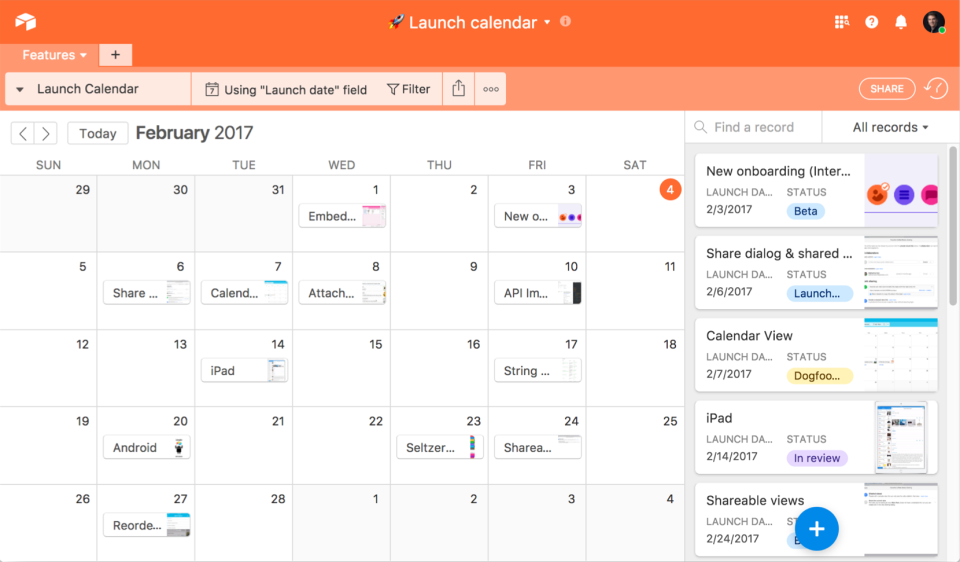
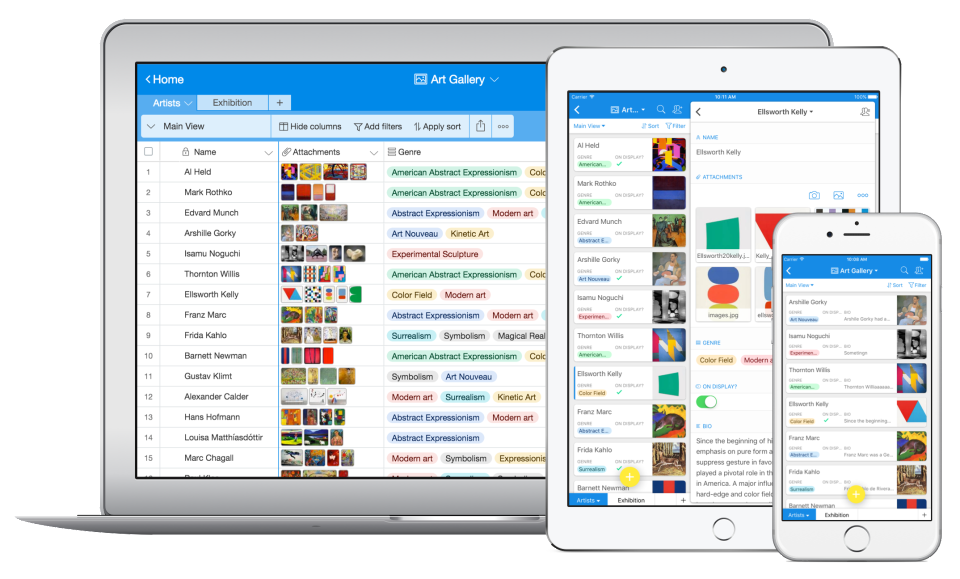
Airtable is a project management and collaboration platform designed to enable content pipelines, product management, events planning, user research, and more. It combines spreadsheet,database, calendar, and kanban functionality within one platform.
$24
per month per seat
Google Sheets
Score 8.9 out of 10
N/A
Google Sheets is the spreadsheet app available on Google Workspace, or standalone, with a free plan for personal use and accessible via mobile apps for iOS and Android.
N/A
Microsoft Office 2016 (discontinued)
Score 8.5 out of 10
N/A
Microsoft Office 2016 is the familiar suite of Office products including applications such as Word, Excel, and PowerPoint for use on a single PC or Mac. The 2016 is no longer available for sale from Microsoft, and support is at an end since 2020.
N/A
Pricing
Airtable
Google Sheets
Microsoft Office 2016 (discontinued)
Editions & Modules
Team
$24
per month per user
Business
$54
per month per user
Enterprise
Custom Pricing
No answers on this topic
No answers on this topic
Offerings
Pricing Offerings
Airtable
Google Sheets
Microsoft Office 2016 (discontinued)
Free Trial
Yes
No
No
Free/Freemium Version
Yes
No
No
Premium Consulting/Integration Services
No
No
No
Entry-level Setup Fee
No setup fee
No setup fee
No setup fee
Additional Details
—
—
—
More Pricing Information
Community Pulse
Airtable
Google Sheets
Microsoft Office 2016 (discontinued)
Considered Multiple Products
Airtable
Verified User
Professional
Chose Airtable
I have tried Trello, monday.com, Meister Task, and even Google Sheets. They are all great and solid applications. Some even have really nice user interfaces. However, none of them have met my primary need of being able to view my current projects and associated deadlines at a …
There's a saying that spreadsheets were never meant to be databases, and Airtable provides the missing piece for nontechnical users who need to hear that saying. It's more performant and provides more custom view options, for example, than Excel or Google Sheets.
AirTable does a great job at Project Management. You can easily create tasks and set up reminders, including automated reminder emails, when deadlines draw near. You can group the tasks and can also group tasks in a variety of ways (not started, pending, completed or …
Airtable is the best for structuring, automating and interacting with data, but only for internal use. For public-facing needs, other apps are required for their support of custom domains and styling.
Airtable is far more sophisticated than Sheets or Excel in terms of its functions. The interface is also much easier on the eyes. People are less familiar with it and there is a bit of a learning curve, but overall, Airtable empowers us to do more and to better understand our …
Microsoft Excel, Google Sheets, and Microsoft Access offer some of the same functionality but Airtable affords more team collaboration tools and organization functions that the other databases lack. We use Access for one of our programs, but it is very complicated and not …
While almost all the alternatives of Airtable also collect, store and analyze data (spreadsheets), none are true databases. While Airtable, when deployed, can act from a process start to its end, automating the whole process. Airtable is more efficient than its alternatives to …
Verified User
Manager
Chose Airtable
The Airtable interface is easier to use and more intuitive with less cumbersome development.
In a shared environment, I would definitely rank Airtable ahead of both Google Docs as well as MS Office both in terms of the learning curve and the ability to design and implement real-world solutions without having to resort to hiring (or being) a programmer. If you tend to …
I have mostly set up and helped architect custom database solutions in a proprietary software, as compares directly to Airtable. I have set up and used JIRA Software extensively, and several Marketing Automation systems, and set up Oncontact CRM, and used DAM systems, and Baseca…
Airtable is a modern data management tool. It doesn't bring in baggage from when technology was restricted to your local hard drive like other spreadsheet and database software. I don't have to deal with version control or 100 different files...and then figure out how to share …
I don't know of any other product that does what Airtable does, making previously static collections of data fields into a relational database without requiring any database training or significant conversion. It's kinda magic!
Airtable provides many tutorials to help me learn about the features. I have never been able to figure out how to use Excel to its fullest. With Airtable, I don’t need to figure it out. I just input my data, play around with the different views, and move on to my actual …
I find Google Sheets very similar to Excel in functionality and performance. The advantage is that it’s a cloud-based program rather than a local download. Airtable is more advanced but harder to use and not universally accepted like Google sheets, making Google sheets the more …
In some ways, SeaTable and Airtable provide a little more functionality beyond what Google Sheets provides. It is a little easier to set up different views of different types, not just table formats. They also make it easier to make groups and subgroups with the data set …
Verified User
General Manager
Chose Google Sheets
Google Sheets is the easiest to access to use, and is arguably the most powerful with its third-party integrations. Additionally, Google Apps Script enhances the ability of Google Sheets to process data in custom ways. For instance, integrating zap year to connect via Web hook …
My organization uses Google Sheets instead of Microsoft Excel because we are a Google shop. Sheets permissions are especially easy via existing Google Workspace groups. We're a very collaborative company that values easy browser-based simultaneous document editing and …
On Microsoft, we can't edit the documents at the same time with our friends and co-workers, we need to save everything on the computer memory. I find Google Sheets to be a lot superior, by allowing us to save everything up in the cloud, to read, share and edit whatever document …
Airtable is an ideal platform for small and growing businesses to keep track of just about EVERYTHING they need to keep things running smoothly. It's a great way to keep tasks organized, and keep everyone on the same page with progress on all things. Our company finds the kanban particularly useful, as products go through a lifecycle from ideation to retirement, it's good to keep a database of what is in production, what's working, and what we've tried before. I can see the platform being challenging with much larger businesses, but for the small to medium businesses I've used the platform with, it is ideal.
Google Sheets is well suited in two main areas: is free to use and you don't need to buy a license to use it, comparing to the most direct competitors ; collaboration is in my opinion the best advantage, with multiple people working together and seeing others working in real time. It's less appropriate in low connectivity environments (offline capabilities)
I'd recommend [Microsoft] Office2016 for any business that has more than a couple of users, as the software is very scalable from just a small business to a large enterprise corporation. I don't know of any case where it might not be appropriate, as even home users and students use the software suite as well.
Airtable has capabilities commonly found in spreadsheet applications, but also has some of the features found in databases.
The ability to filter fields. I set up a filter on the status field, so when a project is marked, complete, on hold, or canceled, that record is hidden from my current projects table view. If it is marked complete, the record is moved to the completed projects table view. In this way I can easily access a record of past projects
Being able to duplicate tables and create alternate views
Collapse and expand records. When I collapse the rows, I can easily scan current projects, next steps, project status, and due dates. When I expand the row, or field, I can see more detailed information about that field or record very easily. I can also expand or open the entire record. This is is helpful, when I am entering a lot of information to multiple fields in that record.
Collaborative planning : In the initial phase of project, Team leads and architects create a permission matrix along with the naming convention simultaneously, seeing who is editing / adding the details in real-time.
Cost tracking : We use this tool to track cloud resource usage monthly costs, so that we can analyse it and send out comms for high cost based resources. By storing cost data here, it's easy for use to store data of last couple of years.
Flexible documentation : For change logging of different scenarios we would need different / ad-hoc columns to be added on the fly, which makes using this tool much simpler then reputed third party tools.
Data manipulation. Excel takes the raw data we receive and allows us to digest it in ways that are useful to our business processes.
Communication. Outlook serves as our primary means of communication and setting up appointments.
Documentation. Word is the default standard when it comes to using a word processor and we are no different in this regard. Nearly every user has to use the application on a regular basis in order to accomplish their work.
We will 10/10 renew the use of Airtable because it has brought great value to our team. Not only is Airtable affordable, but it's also user-friendly and helps our team be efficient. We no longer need to rely on Excel spreadsheets being passed from person to person via email. Furthermore, we aren't dealing with corrupt Excel spreadsheets and the need to salvage data when a file is accidentally altered.
I am not involved in the purchase/selection process, but my organization is a Google shop, and Sheets meets most of our spreadsheet needs and works seamlessly with our other tools. I don't anticipate our switching anytime soon.
We believe that office 2016 offers the best value when it comes to features included out of the box. The software is used in its entirety by our organization and is easily supported by our staff of IT technicians. Users find this software to be easy to learn and easy to use with minimal learning curve.
IMO the usability of this product is its greatest asset. The UI is clean and the menus are intuitive to the point where I'd feel confident having a non-spreadsheety colleague take on building an Airtable for the first time with next to no training. I can't say that about every table-like software product that I've used such as Notion.
It can easily handle most uses and functions. It is only for very large datasets or advanced analysis that it either lacks the proper functions or performance begins to slow. Most employees who continue to use competitors' products do so out of preference, familiarity with the user interface, or other surface-level reasons.
It's fairly easy to use, but the automatic formatting or capturing of formatting when pasting is wonky - especially when there are outlines or other bullets/numbered lists. Fixing and sizing up tables can be annoying, and there are sometimes formatting issues that we just absolutely cannot fix for some reason
I have rarely experience downtime, compared to other tools, and given how much time we spend on the tool. Even if there were to be, their updates on it are very timely, and our support team are able to provide any questions regarding
Like most Google products, Google Sheets rarely has outages or slowness, and when it does, connection is always momentarily restored. I can't recall a time when I've been unable to access Google Sheets but able to access other sites just fine. That said, errors aren't uncommon when handling large data volume. You know what they say about using spreadsheets as databases, but sometimes it's just the most convenient option, especially for smaller or one-off projects, and not being able to store large amounts of data hampers our ability to move quickly with scrappy prototypes or full solutions. It would be great if we could better integrate our data manipulation (Apps Script) with big data in the sheet.
I never had any issues with load time, even with the integrations that we use today (google sheets) However, I'm curious if adding additional layers of integrations would slow down performance. We do carry quite a bit of data in Airtable, but, again, no impact on overall performance
Again, Google Sheets is no exception to Google's general high speed and reliability, but load times can be slow for larger amounts of data. I've used Sheets with Zapier and have used the Python API, and speed has never been an issue.
Airtable has great support. They have a variety of support features to answer any questions. They have great self teaching instructions for templates and product tours. They also have support for teams and project management. They also have a fantastic customer help line. They are able and willing to answer customer questions and never have customers waiting long
I have never contacted Google Sheets support, but Google Sheets makes it very easy to report an issue or suggest a feature from Sheets itself (Help > Help Sheets improve), and I've had mostly good experiences with support for other Google products.
I am an MS feedback hub participant and they certainly don't pay enough attention to several bugs several people raise it in the portal. For the enterprise, it seems to me based on my prior experience that yes, they have a dedicated team to support operations. For mid to small companies or single users, it has been a struggle. So, you are pretty much with MS Blogs and others.
Recorded trainings were provided by the Airtable team. Great as an evergreen resources to new team members and for anyone that wants to refresh their Airtable knowledge
Training all users was an important part of the implementation, which did take considerable time and effort. At first glance without training, the content calendar can be overwhelming because of the amount of data. The features within Airtable seem to be endless but our team was able to identify the most important to be successful.
Airtable was a really good fit for this specific use case as it provided a huge number of collaboration features in an intuitive and pleasant-to-use interface. The free tier worked initially with our work, and the upgrade pathway was fair and made sense for us.
I have found that I can do almost everything I could have done in Microsoft Excel faster and easier in Google Sheets. We recommend Google Sheets in 99.9% of our use cases and feel it meets the needs of our workers very well. I am sure there are other spreadsheet creation programs out there, but because we are already in the Google environment, adopting Google Sheets in very easy.
We use Microsoft Office 2016 because at the time it was the best tool for us, but now with full attention to cloud products, we may be thinking of migrating our solution to a cloud service.
I'm not involved with the purchase, but I assume everything goes smoothly and that the pricing structure is predictable and reasonable. We do not get surprise fees.
There are TONS of opportunity to scale, but I think it's a matter if you have the time and resources to do so because the initial setup can be fairly time consuming and prioritized dedication
Google Sheets works very well with multiple users. It's convenient to see in real-time who is collaborating in a sheet, down to the specific cell that they're viewing/editing. Linking Sheets across departments is convenient with the IMPORTRANGE function.
Through this platform, I always have the idea bout which of my team member is working on which particular part of the project, I can easily track their progress, and also I can easily correct them where it is required by adding sticky notes, by sending the attachments and URLs.
Don't need to pay for windows 365 license as it is free
Has a positive impact since I am not cursing excel for annoying problems(I don't want the new Pivot table format, I want to use Classic and I don't want to expand/collapse arrows. "x$#%")
[Haven't] looked at return on investment on work, but has "simplified" for basic and medium spreadsheets.
Microsoft Office 2016 saves me a lot of time daily. I have functions and macros set up that calculate and show me a lot of things just from a couple of my inputs. This would take full days sometimes if not for that.
Apart from time, it saves me money, I manage data in Excel, I don't have to buy software specifically for that.
Sooner or later my company will have to switch to new edition, which will hurt revenues because of a subscription model.