Amazon Web Services (AWS) is a subsidiary of Amazon that provides on-demand cloud computing services. With over 165 services offered, AWS services can provide users with a comprehensive suite of infrastructure and computing building blocks and tools.
$100
per month
GoDaddy
Score 7.4 out of 10
N/A
GoDaddy Web Hosting provides users with storage, email addresses, and unlimited bandwith.
$9.99
per month
Volusion
Score 4.8 out of 10
N/A
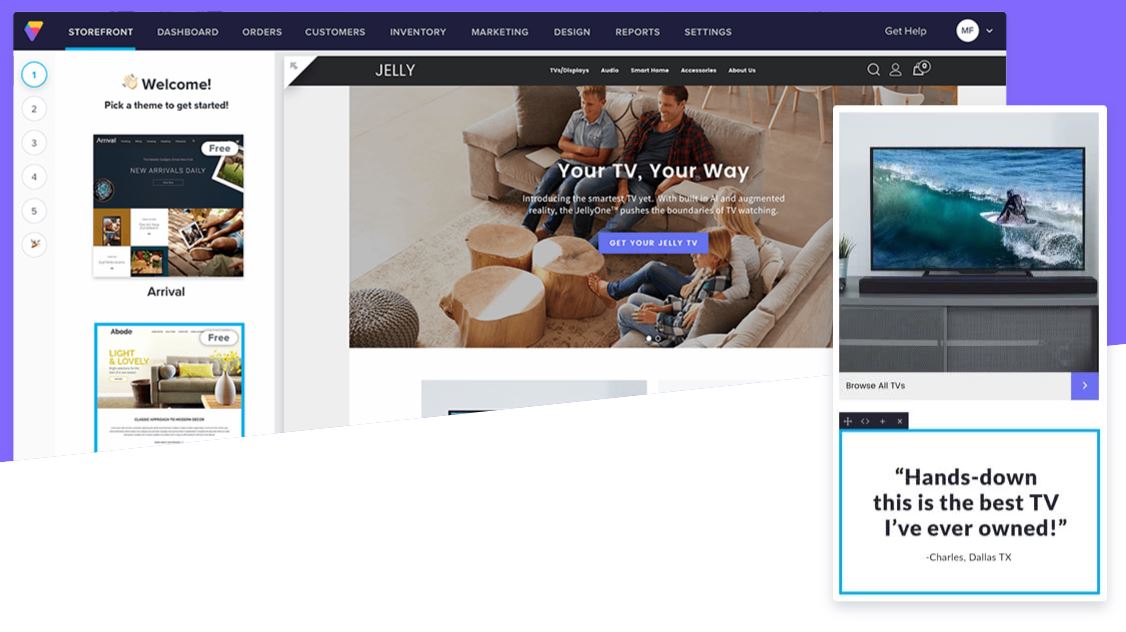
Volusion is a cloud-based ecommerce solution from the company of the same name in Austin, TX. It features an intuitive dashboard, built-in marketing and promos, SEO, templates, and tools to customize look and appearance.
$29
per month
Pricing
Amazon Web Services
GoDaddy
Volusion
Editions & Modules
Free Tier
$0
per month
Basic Environment
$100 - $200
per month
Intermediate Environment
$250 - $600
per month
Advanced Environment
$600-$2500
per month
Basic
as low as $6.99
per month with an annual term
Basic
as low as $10.49
per month with an annual term
Premium
as low as $13.49
per month with an annual term
Commerce
as low as $14.99
per month with an annual term
Personal
$29
per month
Pro
$79
per month
Startup
$179
per month
Business
$299
per month
Offerings
Pricing Offerings
Amazon Web Services
GoDaddy
Volusion
Free Trial
Yes
Yes
Yes
Free/Freemium Version
Yes
No
No
Premium Consulting/Integration Services
No
No
Yes
Entry-level Setup Fee
No setup fee
Optional
No setup fee
Additional Details
AWS allows a “save when you commit” option that offers lower prices when you sign up for a 1- or 3- year term that includes an AWS service or category of services.
Initially, we were with GoDaddy hosting but made a switch to a dedicated server with Bluehost. Our reasoning was that we would get more value from a dedicated server, however, as our SAAS grew we realized cloud computing was the way to go. We ended up choosing AWS over Digital …
For my own business website I did switch to BigCommerce because they offered features that weren't available at the time with Go Daddy, such as sales tax rates for every city/state, and products were limited to I think 10 or 20 options at the time and I needed 100+ options for …
This is something that is actually common across most cloud providers. A comprehensive understanding of one's use cases, constraints and future directions is key to determining if you even need a cloud solution. If you are a 2-person startup developing something with a best-scenario audience of 1k DAU in a year, you would very likely best served by a dirt-cheap dedicated Linux server somewhere (and your options to graduate to a cloud solution will still be open). If, however, you are a bigger fish, and/or you are actively considering build-vs-buy decisions for complicated, highly-loaded, six-figure requests per minute systems, global loadbalancing, extreme growth projections - then MAYBE you solve all or part of it with a cloud provider. And depending on your taste for risk, reliability, flexibility, track record - it might be AWS.
Good for transferring over an existing site. Truth be told, I haven't used it for building a brand new site-- I know that this is a fairly common thing but I just never needed it. For what I've used it for, it has worked well. For a small business with anyone with a little bit of technical skill, it's surprisingly good.
Volusion is a good company if you're starting out. The problem is that, if you want more complexity out of the program, you're kind of stuck. Also the regular time out errors and slow downs can be very frustrating. Packages that miss overnight deadlines because your system stops working can cost you customers. In today's highly competitive market, that's just something that's hard to put up with. If you have a lower volume of business you might be able to work around these issues.
Templates are pre-built for a good end user experience. I've gone through the process of building custom sites as well as tweaking both free and paid templates that Volusion's design team provides.
Their support team didn't use to be as helpful, but in recent years have answered nearly all questions I've had. Their support section within the database provides detailed walkthrus as well.
Order processing is easy once you've been trained on the system. We got to a point where nearly the entire process was automated from initial purchase through shipping.
API calls use the previous call as a reference, even if you weren't the one we made the previous call. Can lead to data gaps, so you often have to set a manual date range to look back to make sure you aren't missing any data.
We are almost entirely satisfied with the service. In order to move off it, we'd have to build for ourselves many of the services that AWS provides and the cost would be prohibitive. Although there are cost savings and security benefits to returning to the colo facility, we could never afford to do it, and we'd hate to give up the innovation and constant cycle of new features that AWS gives us.
We can't really choose anyone else and the cost/effort of moving all of the hosted data would be extremely large, and we just have to stick to them, and hope they improve service
When you spend so much time with a product like this and not only have you witnessed its growth, but you almost feel like you are next those that make the decisions of building features a certain way, you can't help but want to stay and be a part of their continued growth. It's simply a great product. Can it improve? By all means! But it will only improve because of users and avid resellers like me.
AWS offers a wide range of powerful services that cater to various business needs which is significant strength. The ability to scale resources on-demand is a major advantage making it suitable for businesses of all sizes. The sheer volume of options and configurations can be overwhelming for new users leading to a steep learning curve. While functional the AWS management console can feel cluttered and less intuitive compared to some competitors which can hinder navigation. Although some documentation lacks clarity and practical examples which can frustrate users trying to implement specific solutions.
AWS does not provide the raw performance that you can get by building your own custom infrastructure. However, it is often the case that the benefits of specialized, high-performance hardware do not necessarily outweigh the significant extra cost and risk. Performance as perceived by the user is very different from raw throughput.
The customer support of Amazon Web Services are quick in their responses. I appreciate its entire team, which works amazingly, and provides professional support. AWS is a great tool, indeed, to provide customers a suitable way to immediately search for their compatible software's and also to guide them in a good direction. Moreover, this product is a good suggestion for every type of company because of its affordability and ease of use.
You have to wait on hold for at least 45 minutes every call—the tech support person never knows the answer right away so they put you on 10 minute holds only to come back and say they're still looking for answers. The chat function could take days to get a response. Our "Dedicated Account Manager" never checks in or answers, nor are they ever in the office when we call. It's like they try to be as unavailable as possible until you forget why you even called in the first place. Insane.
It is best to use the built-in features and recommended services for the most turn-key experience (ie. Skipjack for payment processing so that it can all be done from the Volusion backend).
Amazon Web Services fits best for all levels of organisations like startup, mid level or enterprise. The services are easy to use and doesn't require a high level of understanding as you can learn via blogs or youtube videos. AWS is Reasonable in cost as the plan is pay as you use.
We use Wix currently for our online store. It is nice and easy to use, but they don't offer the email domains as well (the last time we checked). They have pretty decent customization of the web page, but still limited. We're going to try it with GoDaddy, since we have other services from them already. It just doesn't make sense to pay two different companies for something we can do with one.
While k-eCommerce was very glamorous to us because it integrates with our main workflow, it just didn't have some of the marketing features that are so integral to the way we do business online. The set-up costs were also way too high. Volusion is so affordable and feature heavy, it makes it very difficult for any shopping cart provider to compete. You can find others who are competitively priced and have similar features, but they simply aren't as robust (at least for the way we use it)
Using Amazon Web Services has allowed us to develop and deploy new SAAS solutions quicker than we did when we used traditional web hosting. This has allowed us to grow our service offerings to clients and also add more value to our existing services.
Having AWS deployed has also allowed our development team to focus on delivering high-quality software without worrying about whether our servers will be able to handle the demand. Since AWS allows you to adjust your server needs based on demand, we can easily assign a faster server instance to ease and improve service without the client even knowing what we did.
GoDaddy reduces our ROI by costing me in non-billable hours. I don't charge clients for sitting on the phone with tech support to power cycle the server or fix the php.ini file, so my $/hr takes a hit.
Their nickel&dime strategy requires I have an additional conversation with clients about their max recurring fees. Small as they are, I need approval for upping their bill. GoDaddy is only the cheap option if you don't value security, stability, or performance.
Honestly, when you're in the dashboard, the UX is simply horrendous. I mean, everything that should be 1-2 clicks away is 4-6 clicks away, and each pages takes at least four seconds to load. You just find yourself wasting a lot of time waiting for things to load. This should be more simple.