Anaplan is a scenario planning and analysis platform designed to optimize decision-making in complex business environments so that enterprises can outpace their competition and the market. By building connections and collaboration across organizational silos, the Anaplan platform surfaces key insights.
N/A
Board
Score 9.0 out of 10
Enterprise companies (1,001+ employees)
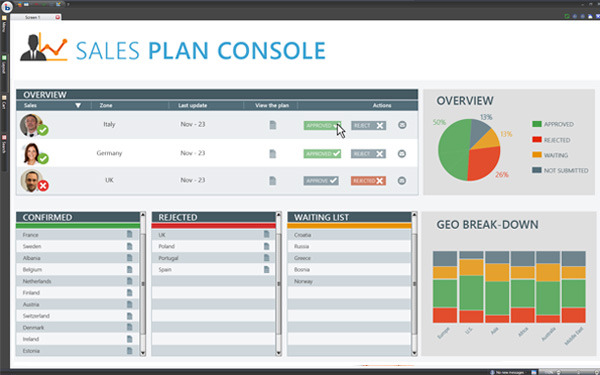
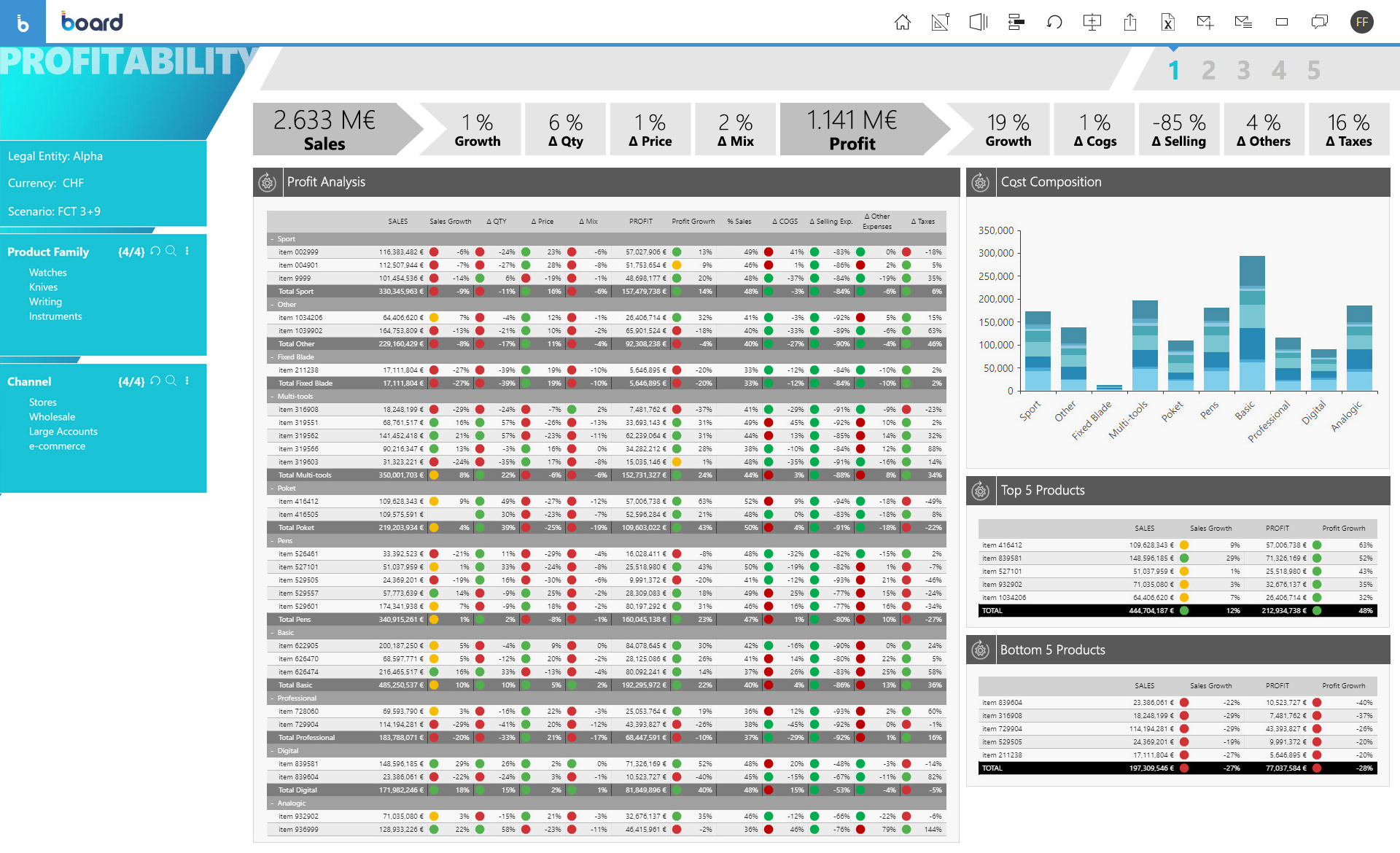
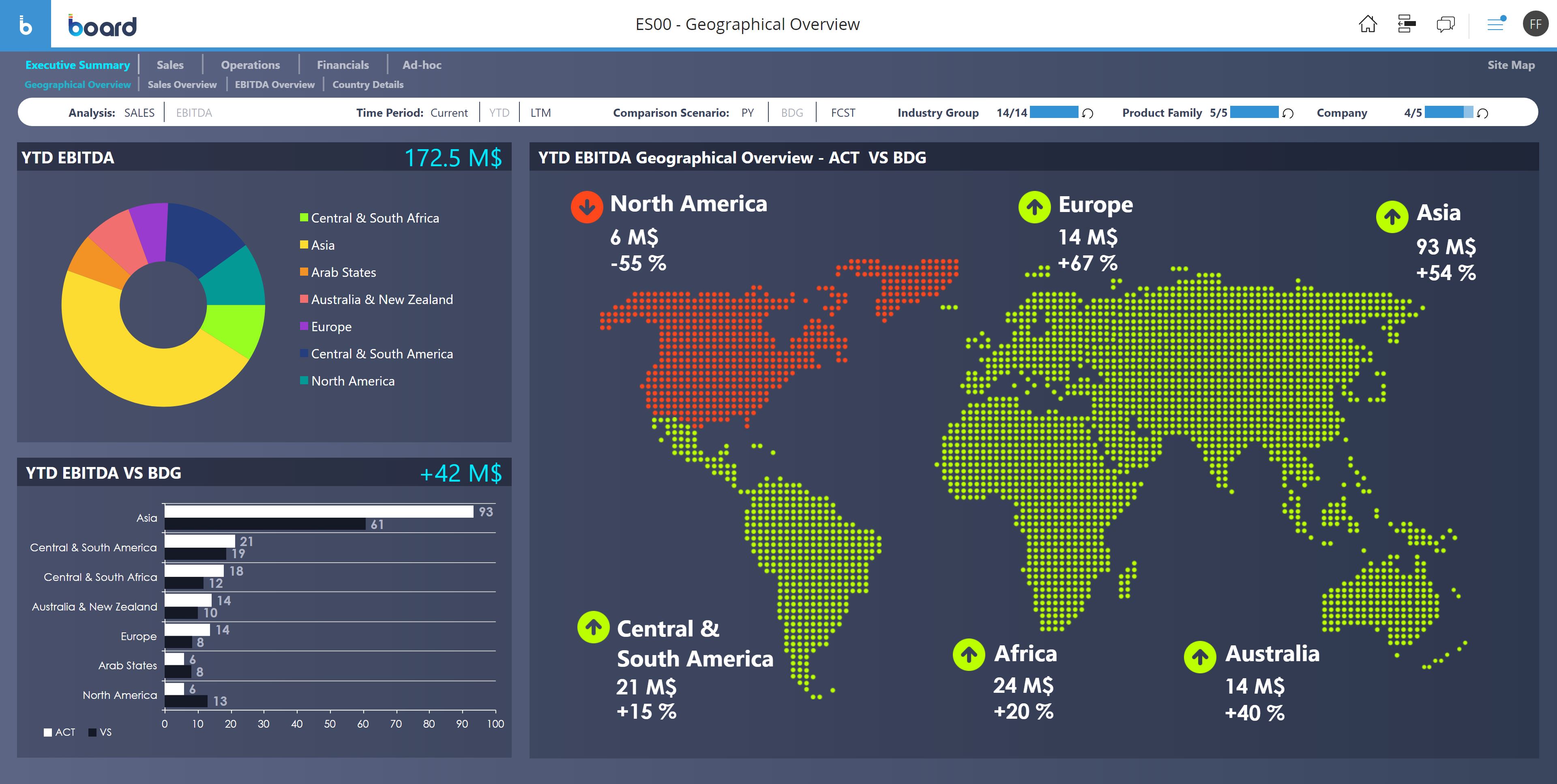
Board is presented as an enterprise planning platform, offered as a solution to accelerate business performance and enable continuous planning with greater forecast accuracy to drive confident, aligned decisions.
N/A
IBM Cognos Analytics
Score 7.5 out of 10
N/A
IBM Cognos is a full-featured business intelligence suite by IBM, designed for larger deployments. It comprises Query Studio, Reporting Studio, Analysis Studio and Event Studio, and Cognos Administration along with tools for Microsoft Office integration, full-text search, and dashboards.
Cognos TM1 is an On-Prim tool, compared to Anaplan, the implementation time is more. Also, visualization is more powerful in Anaplan than Cognos TM1.
Verified User
Manager
Chose Anaplan
Definitely a leader in the space. Far ahead in terms of capabilities. On the high end in terms of end user experience.
Verified User
Manager
Chose Anaplan
I feel that Anaplan really has no competition when it comes to implementing connected planning. The biggest reason being that with other solutions, you need consultants to develop. If you know how to develop in Excel and understand the concept of dimensions, then you can …
Verified User
Director
Chose Anaplan
The only platform with the flexibility that matches Anaplan is Excel. However, excel is not scalable. There are also many great point solutions out there that can do one thing well, but I have not seen anything else that can do as much as Anaplan can, and do it well.
Verified User
Manager
Chose Anaplan
Anaplan has the advantage of multidimensionality and fast calculation engine which is lacking in most of the above. Scenario planning is easier using Anaplan. Anaplan is not an off the shelf tool like most softwares that have been prebuilt to address specific problems/ issues. …
Verified User
Professional
Chose Anaplan
I used other competitors, and I think, overall, Anaplan is a much better solution. It's younger and not a result of older generation solutions that have been adapted over the years and that are much more difficult to learn and customise.
Anaplan logic and formula is easier to understand by end users so they can be more independent when they started to use the tool. Also the self training courses are detailed and practical enough to give end users a better understanding of the functions and what they can achieve …
Verified User
Executive
Chose Anaplan
Anaplan is one of the better cloud-based EPM solutions out there. While it doesn't come with a lot of features/modules out of the box, once you get it up and running it's really powerful. There is a steeper learning curve than some other EPM tools out there which are …
Honestly, having implemented Anaplan at another company, I knew it would suit our needs here and convinced management to get the tool on that basis. We already use a mix of Cognos BI, Tableau, and Excel ... but our need was something apart from what those can provide.
Anaplan handles use cases that involves hierarchy in a much more efficient manner compared to any platform. It is also simple to use and doesn't involve much to do with coding or configuration. From a scalability standpoint, Anaplan exceeds expectations in many ways compared to …
QlikView, I do admit, put complete power into the builder's hands. However it was really complex and script heavy. We just didn't have the expertise to deploy properly and it didn't seem as Finance friendly as it still relied heavily on servers sitting behind IT barriers. Qli…
We believed that Anaplan gave us much greater flexibility while still providing a source of data that we can trust. We were looking for not only a data warehouse with retrieve functionality, but a tool to help us calculate and report. We needed something more robust, so these …
We had been Cognos 10 and Powerplay users with similar multidimensional modeling capabilities. However, it required remote users to have VPN to access which was not always an optimal situation. Being cloud based, Anaplan allows all users to access it through their web browsers …
Anaplan is a quick study and people can build and develop models very rapidly where IBM Cognos TM1 can take much longer. Anaplan cannot handle larger dimensions and sparsely populated cubes and is not as customizable as TM1.
Board has been more complete when compared to Anaplan. Although I didn't participate in the buying decision of any of those products I have used both and by far Board just has more features. It's more than a CPM, it's BI and CPM put together. If I had to make a choice now it …
The features and the haslle free UI where any first time user can understand the esay navigation and achieving their business goal. To be brief, the features are very unique and most promising compared to the other application. Providing custom & tailored solutions of business …
Verified User
General Manager
Chose Board
The integration plan for Board was far easier and more comprehensive from a data security and data management perspective. The integration team had the help and support of the Board team as well as a third party team to enable smooth integration. Also, cost was a key issue and …
We selected Board over similar alternatives for its integrated business intelligence and corporate management capabilities. Furthermore, the ability to generate customized real-time reports, benchmark data, and trends were the primary reasons for implementing Board in our …
Verified User
General Manager
Chose Board
We can not say that IBM system is not good, it is at par with Board. Selection is based on [the] best bid only. While we have used IBM also in [another] place.
Board integration and deployment process is simple, with strict security strategies. Also, Board brings almost all the executives on the table, where they have similar data access, and real-time analysis, supporting decisions that are procedural. For smooth integrations and …
Board was generally more visually appealing when compared to many alternatives, some of which would retain the appearance of a spreadsheet and would have limited formatting or visualization capabilities. In addition, some tools were specifically a financial reporting and/or …
Board had a very robust solution at a reasonable price when we were looking at moving away from a sunsetted version of our previous tool. It gave us the ability to quickly implement with our ledger system and the flexibility to develop additional solutions after the …
We used Talentia for 2 years for yearly budget and forecast but is not possible to make drillable reports, it is not possible to plan in split & splat mode, it is not possible to retrieve data in a fast way as BOARD assure, it is not possible to modelize by scenarios and, above …
We chose BOARD over other options because it was something we could configure and extend internally. Other tools were too complicated and expensive to maintain, or not flexible enough for us to change on our own. From a visual perspective, BOARD was very appealing too. It …
IBM Cognos Analytics
No answer on this topic
Features
Anaplan
Board
IBM Cognos Analytics
BI Standard Reporting
Comparison of BI Standard Reporting features of Product A and Product B
Anaplan
7.3
235 Ratings
3% below category average
Board
6.8
91 Ratings
10% below category average
IBM Cognos Analytics
7.6
131 Ratings
7% below category average
Pixel Perfect reports
6.47 Ratings
6.778 Ratings
7.5121 Ratings
Customizable dashboards
7.7235 Ratings
6.991 Ratings
7.8127 Ratings
Report Formatting Templates
7.96 Ratings
6.984 Ratings
7.5123 Ratings
Ad-hoc Reporting
Comparison of Ad-hoc Reporting features of Product A and Product B
Anaplan
9.1
8 Ratings
15% above category average
Board
6.9
96 Ratings
12% below category average
IBM Cognos Analytics
7.5
131 Ratings
7% below category average
Drill-down analysis
9.18 Ratings
6.994 Ratings
6.9128 Ratings
Formatting capabilities
9.18 Ratings
6.292 Ratings
7.7130 Ratings
Report sharing and collaboration
9.18 Ratings
7.687 Ratings
8.2124 Ratings
Integration with R or other statistical packages
00 Ratings
6.964 Ratings
7.493 Ratings
Report Output and Scheduling
Comparison of Report Output and Scheduling features of Product A and Product B
Anaplan
8.3
240 Ratings
3% above category average
Board
7.1
88 Ratings
12% below category average
IBM Cognos Analytics
8.2
129 Ratings
0% below category average
Publish to Web
8.67 Ratings
6.977 Ratings
8.327 Ratings
Publish to PDF
8.0238 Ratings
7.285 Ratings
7.7123 Ratings
Report Versioning
8.6209 Ratings
6.978 Ratings
8.626 Ratings
Report Delivery Scheduling
7.98 Ratings
7.676 Ratings
8.3125 Ratings
Delivery to Remote Servers
00 Ratings
00 Ratings
8.112 Ratings
Data Discovery and Visualization
Comparison of Data Discovery and Visualization features of Product A and Product B
I've implemented a number of projects for Anaplan for Sales Performance Management use cases. It is obviously built for financial planning, but it allows for a lot of flexibility for territory and quota, ICM, sales forecasting, and other important use cases. Territory and Quota is very powerful in the tool as it organize complex assignment structures into hierarchies for easier analysis and reporting.
Board is a useful tool with a great set of features. We migrated from human apps to board and we find it relatively fast in search results and better-managed threads and forums. There are some areas, such as UI and interactions which could be improved but overall a great product. The learning section is also pretty good.
Well suited: Financial reporting - It can handle complex, pixel perfect, muti-page reports with scheduled delivery to stakeholders (like sales report by region on quarterly periodicity) Operational dashboard across departments - It can combine multiple data sources (ERP, CRM, excels etc) with filters, and embedded AI insights Less appropriate: Live dashboards - As stated earlier as well, IBM Cognos Analytics doesn't suit well for live dashboards or event driven data. For ex: live web traffic data or IOT device data, etc Data science - Although IBM Cognos Analytics is great tool for data exploration but it should not be used as a substitute for Python or R, which has edge over advanced modelling and stats based workflows like predictive modelling or clustering
Anaplan removes the time consuming process of integrating the results of individual spreadsheets.
Anaplan facilitates the standardization of assumptions across all sub-processes
Anaplan provides full transparency of the calculations and source inputs
Anaplan allows us to automate certain planning processes that would have been impossible when relying on the computational capabilities of an individual computer.
IBM Cognos Analytics enables customer data segmentation, which is essential for marketing, improving and streamlining purchasing behavior and preferences. This helps companies create more targeted and effective marketing campaigns.
Our clients Through data analysis, we can identify and observe trends in the behavior of other clients, allowing us to anticipate needs and adjust strategies to avoid consequences.
Anaplan is a very strong multi-dimensional modeling tool that provides a calculation engine to empower a complex planning process. It is fairly easy to learn for those with experience in similar tools, or excel. It forces structure and auditability that spread sheets do not have, along with extensive security capabilities
Board is a fantastic product for swift BI solution delivery when compared with its peers. Ease of use, support and integration with Microsoft Office Addin open a wide horizon of opportunities for further enhancements to solutions. Easy bespoke app development capabilities make it a winner for us. BOARD is just like a white canvas, it lets you explore your creative side while designing and delivering a solution
For an existing solution, renewing licenses does provide a good return on investment. Additionally, while rolling out scorecards and dashboards with little adhoc capabilities, to end users, cognos is very easily scalable. It also allows to create a solution that has a mix of OLAP and relational data-sources, which is a limitation with other tools. Synchronizing with existing security setup is easy too.
As a user it is a very simple tool, but at the same time with a very mature and powerful calculation engine. It is very easy to switch from excel or traditional tools with added capabilities of multi dimensionality and real time calculation engine to see quick insights needed to create plans and scenarios
From a user perspective, Board is quite simple to use. You can evaluate the presentation of the data, the navigation, the configuration of the users, the selection of the data etc ... It would have a better rating if it were even more intuitive as regards the construction of a project, starting from the database, to the info-cubes, to entities, to data acquisition procedures from other servers.
We have a strong user base (3500 users) that are highly utilizing this tool. Basic users are able to consume content within the applied security model. We have a set of advanced users that really push the limits of Cognos with Report and Query Studio. These users have created a lot of personal content and stored it in 'My Reports'. Users enjoy this flexibility.
There are very few outages. Maintenance is scheduled on two or three Saturdays per month, so as not to affect businesses. When there is an outage, users are kept informed of progress to restore the platform and typically this takes no more than an hour. Anaplan customer support is very responsive if we ever have questions about platform issues
Reports can typically be viewed through any browser that can access the server, so the availability is ultimately up to what the company utilizing it is comfortable with allowing, though report development tends to be more picky about browsers and settings as mentioned above. It also has an optional iPad app and general mobile browsing support, but dashboards lack the mobile compatibility. What keeps it from getting a higher score is the desktop tools that are vital to the development process. The compatibility with only Windows when the server has a wide range of compatibility can be a real sore point for a company that outfits its employees exclusively with Mac or Linux machines. Of course, if they are planning on outsourcing the development anyways, it's a rather moot point
Everything is calculated in memory in the cloud. It's nearly instantaneous updates when you make changes. The only time things get a little slow is when you have a massive model with very intricate calculations...but "slow" for Anaplan is not what I would call "slow" for something like Hyperion. We used to have Hyperion calcs that ran for 60 mins before you could use data. The equivalent would be 60 seconds in Anaplan.
Overall no major complaints but it doesn't handle DMR (Dimensionally Modeled for Relational) very well. DMR modelling is a capability that IBM Cognos Framework Manager provides allowing you to specify dimensional information for relational metadata and allows for OLAP-style queries. However, the capability is not very efficient and, for example, if I'm using only 2 columns on a 20-column model, the software is not smart enough to exclude 18 columns and the query side gets progressively larger and larger until it's effectively unusable.
Support quality has dropped since Thoma Bravo has taken over. I think some serious re-focus needs to happen here -- part of the beauty of being in the Anaplan community was how involved you felt in it before. Before I didn't dread sending a support ticket, now I am starting to.
The only time I needed assistance was due to a problem in the prints: the colors of the brochures as they were on the screen were not reproduced in the print, but a series of standard colors were reproduced. This fact made colored numbers on a colored background illegible. From the assistance they confirmed that it was a problem of version 10.2 that occurred when leaving the brochures with the default colors proposed by Board. To obtain the desired colors, they had to be personalized ... I didn't like the solution very much and the technician who recommended it didn't like me either, but they would have solved the problem with the following versions. In any case, the assistance was quick and effective even if not exactly efficient.
Why is their web application not working as fast as you think it should? They never know, and it is always a a bunch of shots in the dark to find out. Trying to download software from them is like trying to find a book at the library before computers were invented.
In my opinion, in-person training is always the best if you have the option to do so. This allows real-time interactions with the instructions, whereas the online training I took required me to write-down questions, email them, and wait for responses. This slows down the process, as you can imagine. That said, in-person training is an extra cost and it likely isn't needed for everyone. I would suggest selecting a small number of people to take in-person training and then having them act as mentors to the rest of your team. That way, as the rest of the team takes the online training, they have a resource to help them in real time.
Board is fairly simple and straight forward. Advance training on workflows and procedures is a good one but the training content only touches through the interesting areas. training content needs to cover a few areas more in-depth
Onsite training provided by IBM Cognos was effective and as expected. They did not perform training with our data which was a bit difficult for our end-users.
Anaplan training materials are clear, simple, easy to understand and to follow. Visuals are excellent. The vendor is good at updating training materials in a timely manner and encouraging users and administrators to keep coming back to Academy site for refresher courses or new feature courses. I really like their interactive diagrams
The online courses they offer are thorough and presented in such a way that someone who isn't already familiar with the general design methodologies used in this field will be capable of making a good design. The training environments are provided as a fully self contained virtual machine with everything needed already to create the environments. We've had some persisting issues with the environments becoming unavailable, but support has been responsive when these issues arise and straightening them out for us
One key insight from implementing Anaplan is that success comes from focusing on designing the process, not just building the model. Anaplan is extremely flexible—there are very few planning scenarios it cannot support—but that flexibility means the project needs strong governance, clear ownership of requirements, and a well-defined data model. When those foundations are in place, implementations are fast, iterations are easy, and users can quickly see value. In our projects, both Financial Planning and Integrated Business Planning models were adopted smoothly because we involved business users early, kept the model design intuitive, and leveraged Anaplan’s Excel-like syntax and user-friendly dashboards. The result was more efficient day-to-day work, reduced manual tasks, and increased collaboration across teams. In short: when you combine Anaplan’s flexibility with a structured implementation approach, adoption and value realization happen quickly.
The problem of user profiling in our context is certainly quite complex. The complexity is given by the fact that the company is divided territorially into logistic points of sale, but at the same time they are virtually divided into divisions (or specific implementation areas) and points of sale of competence. The same operator can have access to data at different logistic sales points, sales points of competence and divisions.
Make sure that any custom tables that you have, are built into your metadata packages. You can still access them via SQL queries in Cognos, but it is much easier to have them as a part of the available metadata packages.
Anaplan is more powerful than Pigment considering that it is an Enterprise class system and is able to manage bigger data sets. Anaplan allows for advanced scenario modeling and formula capabilities along with custom reporting functionalities. Anaplan has proven its capabilities and stability across various use cases and across bigger enterprises when compared to Pigment which is still in earlier phases of its development
Board has been more complete when compared to Anaplan. Although I didn't participate in the buying decision of any of those products I have used both and by far Board just has more features. It's more than a CPM, it's BI and CPM put together. If I had to make a choice now it would be Board.
Power BI is stronger for quick ad-hoc analysis and dashboards, but IBM Cognos Analytics is better when consistency, precision, and mass distribution matter. Tableau is best for interactive analysis, while IBM Cognos Analytics is better for standardized, repeatable enterprise reporting. Sigma shines for customizable dashboards and drill-down analysis while IBM Cognos Analytics holds an edge in data discovery and visualization.
We have managed to leverage Anaplan for financial planning and forecasting across the business. It is now used by almost every department, with more than 50 users (but I know of companies that have hundreds of users) and still the platform is quick and reliable. It is easy to make changes to divisions and departments or add users and apply different user settings - the core part of the model is not affected and end users can continue their work without any disruption
The Cognos architecture is well suited for scalability. However, the architecture must be designed with scalability in mind from day one of the implementation. We recently upgraded from 10.1 to 10.2.1 and took the opportunity to revamp our architecture. It is now poised for future growth and scalability.
Anaplan's implementation led to a significant reduction in planning cycle errors and bugs, streamlining processes and improving overall accuracy in data inputs
Standardizing the planning process and enabling cross-functional collaboration through Anaplan enhanced our ability to adapt swiftly to changing business needs, resulting in improved agility in decision-making
The platform's capabilities, especially in Demand Planning and Supply Chain, positively impacted our ROI by optimizing resource allocation and solving complex business problems efficiently across multiple functions
Board facilitates proactive decision making - it gives all the insights of the company's needs, which includes predictive analytics and manipulation of data to make different types of reports.
Easy to use for non-programmer and integration with other software is seamless. It has [the] ability to handle large amounts of data.