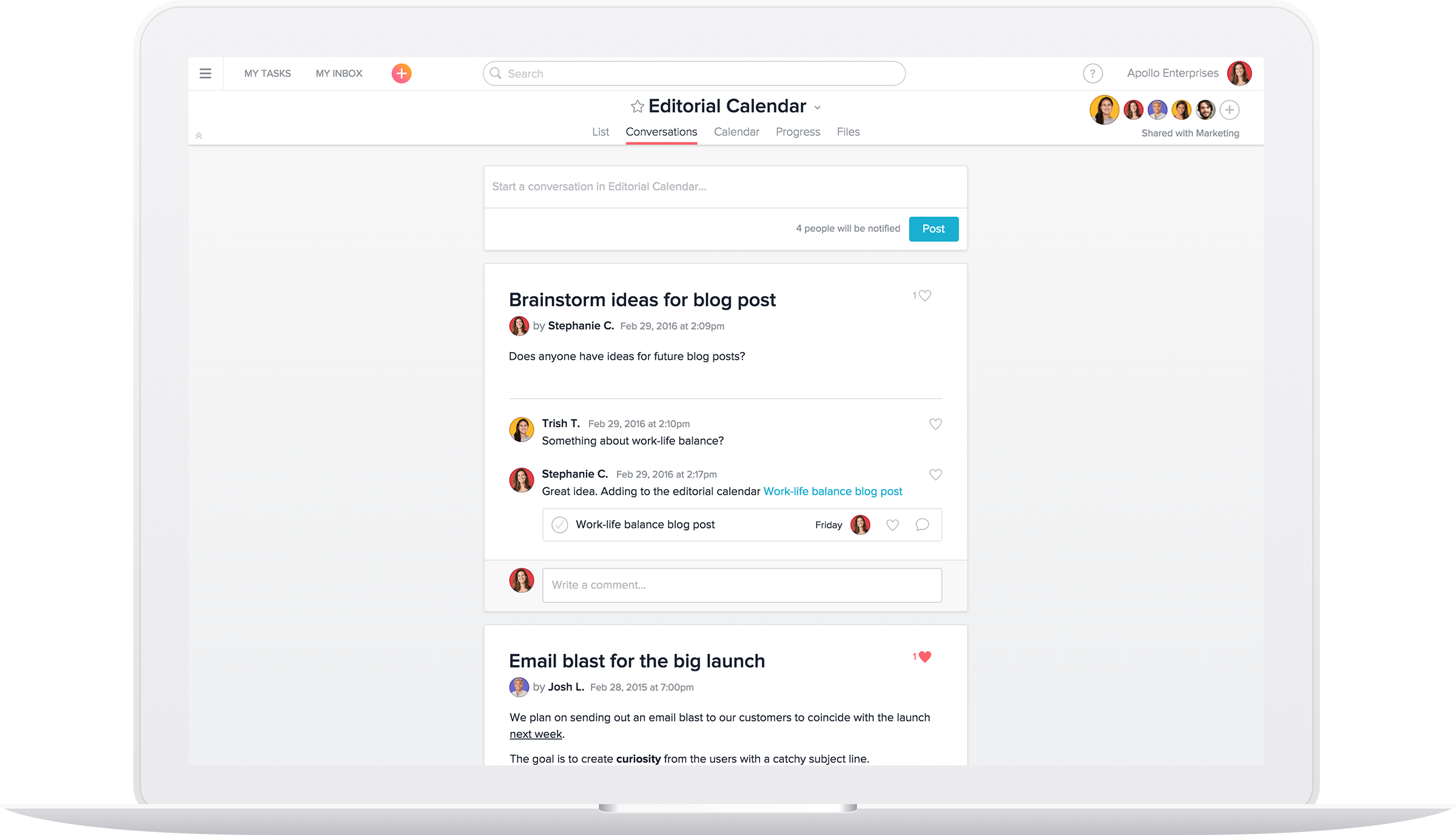
Asana is a web and mobile project management app. With tasks, projects, conversations, and dashboards, Asana lets an entire team know who's doing what by when, enabling workload balancing. Users can also add integrations for GANTT charts, time tracking and more.
$13.49
per month per user
Confluence
Score 8.1 out of 10
N/A
Confluence is a collaboration and content sharing platform used primarily by customers who are already using Atlassian's Jira project tracking product. The product appeals particularly to IT users.
$0
Free for 10 Users
Microsoft Planner
Score 7.6 out of 10
N/A
Microsoft Planner is presented as a solution to organize teamwork with intuitive, collaborative, visual task management. With it, users can create Kanban boards using task cards with files, checklists, and labels. Users can collaborate in Planner and Microsoft Teams and check visual status charts—all in the Microsoft cloud.
N/A
Pricing
Asana
Atlassian Confluence
Microsoft Planner
Editions & Modules
Starter
$13.49
per month per user
Advanced
$30.49
per month per user
Enterprise
Contact Sales
Personal
Free
Free
$0
Free for 10 Users
Standard
$6.40
per month per user
Premium
$12.30
per month per user
Data Center
220,000.00
40,001+ Users - Annually
Enterprise
Contact Sales
No answers on this topic
Offerings
Pricing Offerings
Asana
Confluence
Microsoft Planner
Free Trial
Yes
Yes
No
Free/Freemium Version
Yes
No
No
Premium Consulting/Integration Services
No
No
No
Entry-level Setup Fee
Optional
No setup fee
No setup fee
Additional Details
A discount is offered for annual billing.
Prices shown here reflect prices for deployments with 100 users or less. The prices decrease wien the user base surpasses 100.
Asana is a highly effective instrument for managing teams and projects. The paid edition provides a multitude of features that can be tailored and used in accordance with the organisation's specific requirements.
Email integration facilitates notifications that remind team …
Overall for the money Asana brings a lot of value for organizations who want to do more with less and need a task and project management solution as a small company is growing and scaling to get to the next level. In the space when we evaluated didn't find a lot of other …
Against Jira it offers a more modern experience with less complex user interfaces. The admin and setup experience is also way faster with less (or no) legacy complexity.
Against other modern players like Linear and Basecamp it offers way more integrations so we can pull in data …
Asana is a top-tier project management software that helps us organize and track projects from start to finish. It allows us to apply tasks/to-dos to multiple projects without duplication, divide complex projects into smaller tasks, and track project progress. It also helps us …
Asana provides a mix of features between notion and Jira. Unlike Notion, it helps ease up the collaboration on vast projects and between multiple teams. Jira proved to be a little expensive with similar set of features if not more and which is why we thought of going with Asana.
I believe that Asana is more professional than Trello. I used Trello a long time ago, but it looked more suitable for a student project rather than for a professional team or business environment. I believe it has great features to help companies in different stages and of …
Since I have tried the two applications and saw their advantages and disadvantages, I see that Asana is much better in terms of dealing with files, ease of use, and the many features and characteristics that it has. Also, I noticed that it does not consume much space on my …
Side by side with the other two Asana by far beats Monday.com and is comparable and slightly better than ClickUp. Monday is completely browser-based and is hard to navigate and figure out how to set up. Asana and ClickUp are the exact opposite. Both are easy to set up and …
I like how extensive the capabilities are for Asana. With other softwares it seems there are many things lacking. I feel like Asana is also a very user friendly platform and aesthetically pleasing which is important in a modern office. We have many young people entering our …
Asana compared to Jira is certainly better in terms of user experience, since most of the people can start using it basically without having any kind of training or previous explanation, which makes it really useful not only for people already used to project management but …
Asana is amazing for a remote team, that we are currently as its accessible seamlessly to all our team member no matter where they are in the world. Its very easy to onboard new members to this platform as its very intuitive and easy for new people to get a hang of it. It has …
Basecamp was a great tool, but it was paid and things like recurring tasks and opening new projects was a pain. Asana, as a free tool, has been better for our organization as it serves the basic functions very well and is not complicated otherwise. I really like the …
It has great features like integration and real time collaboration with new features like AI and automation. So it gives an edge over other tools I have used in the past few years. I am sure there are a lot of features which I have not explored yet, but the features I am using …
Atlassian Confluence has a more comprehensive and flexible set of capabilities that stand out and made the decision upfront more straightforward for our team. The tools we evaluated have knowledge management, task management and collaboration capabilities, however Atlassian …
Atlassian Confluence is way popular for a larger team and makes collaboration way easier. The community is strong and you get easier resolution against any request. It's integration with other Atlassian products like JIRA is an icing on the cake.
In my experience, Atlassian Confluence is at the top of these tools. I've had first hand experience with other tools and they are not at par with Atlassian Confluence. The versatility of the tool is very well recognized and utilized. Being a new user is not a probably as all …
Atlassian Confluence is a super handy hub for sharing ideas and keeping all your docs in one place. While Jira Service Management is more about handling tickets and support issues, Atlassian Confluence really makes teamwork easy. I feel Atlassian Confluence is user-friendly, …
We choose Atlassian Confluence because it is the reference for managing a SAAS wiki service. And having such a solution in our company to manage the knowledge and especially the knowledge transfer is crucial.
Confluence has a more robust set of capabilities compared to Dovetail and Trello and also was already approved by our legal and compliance teams, so it tends to keep its stickiness due to that. It's also widely known in the market as a knowledge management tool. I would say it …
Overall, Atlassian Confluence is a user-friendly tool and offers such a vast array of capabilities for project and knowledge management purposes and beyond. Other tools listed above have much more limited capabilities, although they are great tools for very specific needs and …
The main reason for moving to Atlassian Confluence was for: 1) Having 1 space that holds all of the org's documentation and knowledge sharing 2)We already used JSM and Jira so it would an organic move to have Atlassian Confluence as our main documentation hub 3) The cost …
Confluence, since it is part of the overall infrastructure of Atlassian, makes it immensely powerful internally, to build an internal knowledgebase, and is far ahead of its counterparts in Zendesk and Hubspot, which is more centered towards their customers. Confluence is just …
Sharepoint in out organisation was mostly used for collaborating on documents, which to some degree has been moved to Confluence, where the Confluence pages have replaced the specific documents.
Being a company which uses other Atlassian tools, Atlassian Confluence was a great fit; the natural and automatic linking of assets from other platforms made following paper trails seamless. Though the editing options aren't as advanced as some other options out there, it does …
We find Atlassian better for its ease of use, real time editing, integration with Jira for bug tracking, stores our security compliance documents in structured way, it is feature rich and have lots of capabilities.
In the past, I have used MediaWiki hosted locally as well as Microsoft Team Foundation Server. Wiki was simply a nightmare so all the money saved from paying for Atlassian subscriptions was lost in time while trying to use Wiki and format something properly. I haven't used …
Atlassian Confluence is better suited for documenting and acting as a repository for information than the more immediate what is currently being worked on things that are better suited for in Jira. In my opinion, Atlassian Confluence certainly has it's short comings but it is …
We still use Atlassian Confluence only for its integration with Jira and Bitbucket. For everything else, we moved away from it and are using more modern solutions.
We chose Atlassian Confluence over SharePoint because it's much more user-friendly and intuitive. Atlassian Confluence makes collaboration and knowledge sharing easier with its simpler interface and better search. While SharePoint can be powerful, it often feels clunky and …
The alternatives tested are based only on the whiteboarding functionality added by Confluence Whiteboard, and not the core Confluence functionality (documentation).
Again, Atlassian Confluence is efficient when paired with Jira and can do most of what a company needs it to do. But, I thi Spekit is better for "just-in-time" learning, Sharepoint is better for file hosting and organization, Asana is much better for project/task management, …
We were inclined to use Atlassian Confluence for its easy collaboration with Jira which is used for tracking project development tasks and issues. Using Atlassian Confluence, content creation became easy and even applying access control to the created content was possible. It …
Microsoft Planner is far superior and doesn't require expensive training to give people access to it. It is far easier to customize and allows for people to add projects and milestones without the cumbersome interface that Agility offers. I would far rather use Microsoft …
We tried to select software from various tools, and in the end we chose Planner both for economic reasons (it is included in the Microsoft 365 license we have in the company) and for its ease of use (we have no particular or specific needs, such as advanced scheduling or ticket …
Main reason is that it is cost efficient because we're already using Microsoft 365 and it's literally part of the ecosystem. No need to purchase any other software. Microsoft is also a well known company, credible for providing business solutions and has a strong enterprise …
Planner is free and integrated with other Microsoft products that we use. We don't have a need for something more sophisticated given the price it would have cost to purchase licenses for a dedicated task/project mgmt tool.
Microsoft Planner isn't as detailed for project planning as some of these. However, it is more user friendly. Anyone can learn how to use it. If you want simple and affordable for a diverse group, it's the way to go.
Our organization chose MS Planner because it is an included tool in the MS Suite, and since we are unfortunately replacing our current and much better project management tool due to a consolidation of the tech stack. However, it doesn't appear that any of the teams using the …
In my experience, Microsoft Planner has much less features and less effective than other project management tools. But, it's free and included as part of Microsoft 365, so senior management may think it's saving them money. However, the poor productivity and the inefficient …
The Planner has a more straightforward and intuitive interface, making it ideal for teams that want to get started quickly without a steep learning curve. Additionally, Planner is more budget-friendly, making it a better option for smaller teams like mine. Additionally, …
Microsoft Planner stands out for its seamless integration with Microsoft 365, making collaboration with tools like Teams, Outlook, and SharePoint effortless. Its user-friendly interface, with drag-and-drop features and color-coded labels, simplifies task management. Microsoft …
Compared to the other options, we already had access to Microsoft Planner, preconfigured accounts, and support and ordination from tech internally to use it. We previously used Wrike, I wanted to use Asana, and other people in the organisation either used Microsoft Project, or …
Microsoft Planner was included in our package of Microsoft email. Thus, we [don't] have to pay anything separately. This is was the main reason. However, the functionality we required was similar. [Microsoft] Planner also gives a schedule calendar where we can add tasks as per …
While Asana and Trello are mature products, Planner is getting there pretty quickly. Since our organization is on the Microsoft ecosystem, it helps to use SSO for most of the apps that are within the same license. It helps save money and does the work. For proper project …
Microsoft Planner won out over Todoist due to it's ability to integrate other software and allow us to be able to do more work in one software. The project management functions were superior as well. Probably the biggest advantage was the task management. We liked how it worked …
Have moved to JIRA in my recent project. I can say Microsoft plan is a good option but JIRA is more powerful compare to this tool. The only thing is its integration and easy communication feature between teams or assigned groups stand it out while comparing with the similar …
Microsoft Planner has a clear cut edge over all the other project planning software of having its native and extensive capability of integrating with the Office 365 apps which everyone uses heavily. Also, it is highly accessible and usable to a large extent through PDAs and …
Planner provides better integration with Microsoft products that are used across the organization as a whole. It provides better connection to SharePoint, MS Teams, MS Office products, and even in MS Outlook, which is the company's email client.
Many areas of the company still use Trello to organize their activities and tasks, but gradually Microsoft Planner must replace the activities. Users are often "attached" to familiar technologies, but Office 365 takes advantage of the more organized use of the tools. This year …
I would recommend Planner for light project / team management with strong MS Teams integration. For a PMO / large project with resources/cost/gantt management, I would really recommend MS Project.
Planner, tho its user interface could be improved, was leaps and bounds better than TYA suite. Their user interface is difficult for many at our job site to use, especially the older generation. The decision to bring it in was largely a corporate decision. Individuals likely …
Trello is better as a one off product, but if you use the Microsoft suite then Planner integrates better into the rest of your day-to-day apps. The integration into team members' calendars and mail makes the ease of assigning tasks across our organization well worth using the …
The usability of Asana is broad since it's available in a variety of platforms that are widely used nowadays. I think that it would be great for people who are constantly on the move and switching devices, since it has allowed me to work from my phone, too. I also think that Asana has proven itself to handle a large quantity of work
Atlassian Confluence is a great tool for housing important information and resources across the organization, as it's very easy to search and find content across different teams and departments. The search function is mostly very accurate and the additional tagging with keywords also helps in the search experience. It's also good at tagging other team members, which triggers an automated email to them. Atlassian Confluence also has an extensive template library for all kinds of purposes like project management, etc., which saves time overall.
Microsoft Planner is a user-friendly visual tool for organizing tasks and workflows. It’s great for team collaboration, integrates seamlessly with Microsoft 365 tools like Teams and Outlook, and offers flexibility for projects of all sizes. Additionally, it provides mobile and web access for seamless productivity on the go. That’s a big plus right there.
Its integration with Jira for tracking development and the bugs and work linked to detailed Confluence documentation.
We use it extensively for writing Software Product Requirement Documents, feature specs, architecture designs, and retrospectives.
Our company follows compliance very seriously, so it helps in streamlining all documentation for ISO27001/27017 compliance and security-related information.
Its integration with various tools allows us to create flow diagrams which are often required to make client and customer understand the overall flow of interactions across various modules of the design architecture
I just can't see us getting it off of Asana any time soon, despite the many headaches it has caused us. We have too much data in there, too much time & training invested into it, too much at stake to move. If we were just starting out today, fresh, I don't know for certain that I would absolutely go the same direction, but I *think* I still would. I just haven't seen anything better yet. Maybe if Podio's support staff hadn't treated me like a worthless nuisance to them, I might feel differently, but the fact is that their task management is simply inferior to Asana's. That can't be denied, and in fact Podio said it themselves: "Tasks are a simple function. They cannot be customized. Tasks in Podio can be used for quick to-do's for you and your team members." In our operation, however, prompt task completion is a big deal; one task can't be completed until another one is done first, and closing the gaps between those tasks is critical in meeting deadlines and servicing our customers. Asana gets us there, the others don't.
I am confident that Atlassian can come with additional and innovative macros and functions to add value to Confluence. In 6 months, Atlassian transformed a good collaborative tools into a more comprehensive system that can help manage projects and processes, as well as "talk" with other Atlassian products like Jira. We are in fact learning more about Jira to evaluate a possible fit to complement our tool box.
It is a very useful tool that brings teams in sync with one another. The integration with other Microsoft products makes it an obvious choice because you don't have to purchase a license for a completely different tool that doesn't have cross-functional capabilities with the software you already use on a daily basis.
It is very user-friendly. Takes a new employee an hour to start figuring out how the system works. That's an important factor. You don't want to encounter the issue where employees need a week to understand how the system works. For example, JIRA, I tried using it for a week and I still don't understand the complicated layout. Asana has a simple interface. Once you see it, you get it type of program.
It's very intuitive for most things, making it easy to jump in and start creating pages and collaborating. This makes it ideal for onboarding new members to the team. There are a few areas that could be a little smoother, but overall it's a great experience.
The tool is easy to use, but it is just as easy to set up. No specific skills are required, but its usefulness in our work is immediately apparent. Colors are very helpful in creating a clear interface and providing a very precise overview of the tasks to be performed.
We never worked against the tide while using Confluence. Everything loads considerably fast, even media components like videos (hosted on the platform or embed external videos from Youtube, for example). We are not using heavy media components a lot, but in the rare occasion we happen to use one we have no problems whatsoever.
I haven't had to use their support so I can't rate it. The fact that I haven't needed them reflects the ease of use of the product. I would recommend that any new users schedule a complete demo of the product to ensure that they are using it to it's fullest (there's a lot of useful features).
This rating is specifically for Atlassian's self-help documentation on their website. Often times, it is not robust enough to cover a complex usage of one of their features. Frequently, you can find an answer on the web, but not from Atlassian. Instead, it is usually at a power user group elsewhere on the net.
Asana is a top-tier project management software that helps us organize and track projects from start to finish. It allows us to apply tasks/to-dos to multiple projects without duplication, divide complex projects into smaller tasks, and track project progress. It also helps us organize work on Kanban boards or linear lists. It stands out from the crowd in a big way compared to the competition.
Atlassian Confluence is a super handy hub for sharing ideas and keeping all your docs in one place. While Jira Service Management is more about handling tickets and support issues, Atlassian Confluence really makes teamwork easy. I feel Atlassian Confluence is user-friendly, integrates smoothly with other Atlassian tools, and helps everyone stay in sync. It's great for brainstorming, and project planning as well. Overall, it is a great way to boost collaboration and ensure all team members are on the same page.
Our organization chose MS Planner because it is an included tool in the MS Suite, and since we are unfortunately replacing our current and much better project management tool due to a consolidation of the tech stack. However, it doesn't appear that any of the teams using the current program intend to use MS Planner due to its poor functionality. We will likely be pivoting to Jira instead.
Merging instances has saved search time - We used to have several instances of Atlassian Confluence, which means they're separate and so can't communicate with each other. We've since merged into one instance and now with the help of the search feature can find the documents you're looking for in seconds rather than several minutes.
Cross linking product assets streamlines following paper trails - Being able to click on a BitBucket link from a Confluence page which then links to a JIRA ticket means you can follow paper trails really easily; seconds rather than several minutes.
Saved over $1000 each year by not having to purchase a third party tool for our content planning
Not sure that I can provide a hard number to this, but having the oversight to see when something is coming due and making sure everything gets executed in time