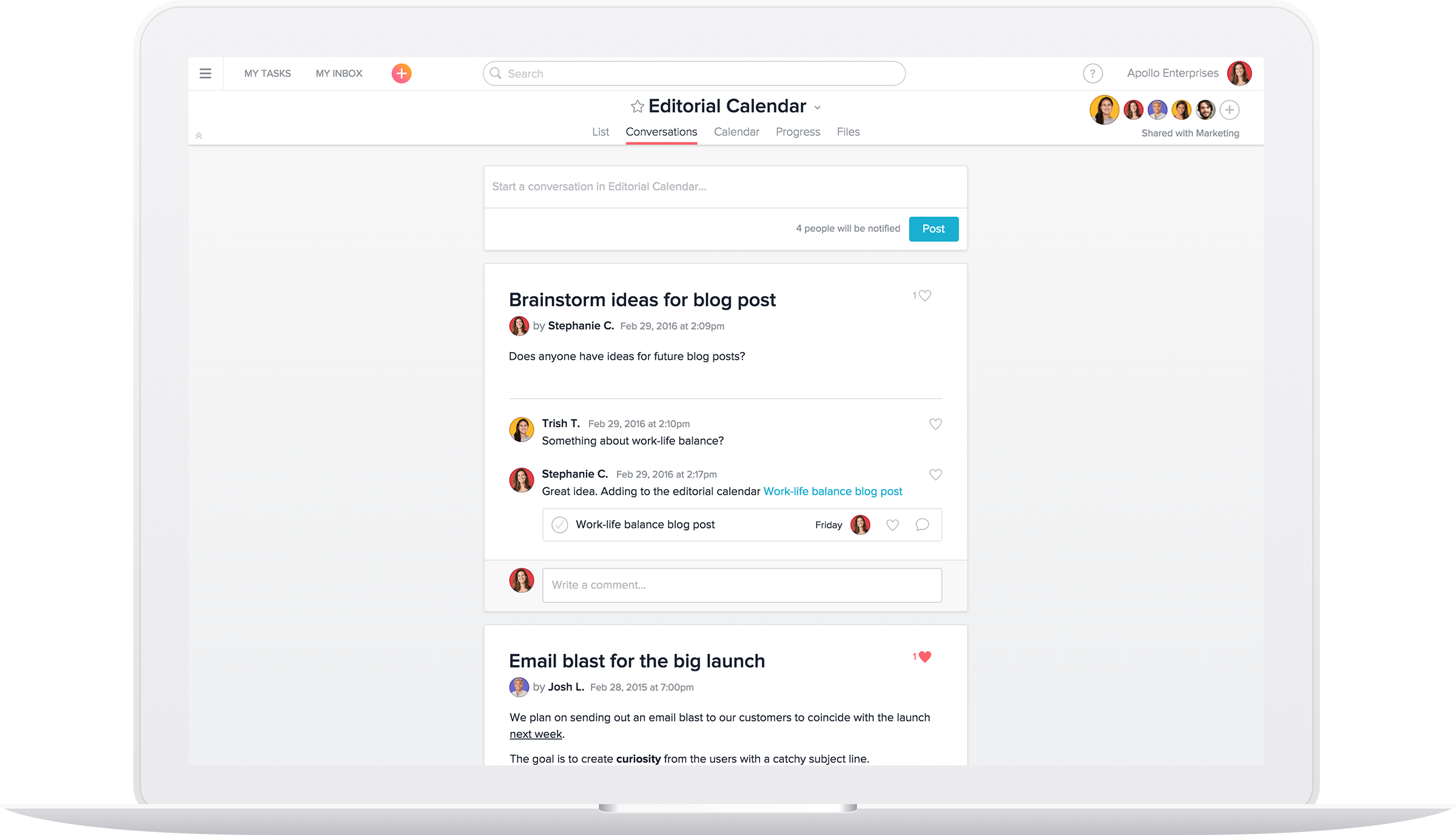
Asana is a web and mobile project management app. With tasks, projects, conversations, and dashboards, Asana lets an entire team know who's doing what by when, enabling workload balancing. Users can also add integrations for GANTT charts, time tracking and more.
$13.49
per month per user
Azure DevOps
Score 8.1 out of 10
N/A
Azure DevOps (formerly VSTS, Microsoft Visual Studio Team System) is an agile development product that is an extension of the Microsoft Visual Studio architecture. Azure DevOps includes software development, collaboration, and reporting capabilities.
$2
per GB (first 2GB free)
Pivotal Tracker
Score 5.0 out of 10
N/A
Pivotal Tracker is a project management program primarily for software developers. It is built from the ground up to facilitate the agile development cycle, and is optimized for structuring projects in sprints, or “stories.”
The solution is now owned and supported by VMware, and is part of the Pivotal / Tanzu product line up.
N/A
Pricing
Asana
Azure DevOps
Pivotal Tracker
Editions & Modules
Starter
$13.49
per month per user
Advanced
$30.49
per month per user
Enterprise
Contact Sales
Personal
Free
Azure Artifacts
$2
per GB (first 2GB free)
Basic Plan
$6
per user per month (first 5 users free)
Azure Pipelines - Self-Hosted
$15
per extra parallel job (1 free parallel job with unlimited minutes)
Azure Pipelines - Microsoft Hosted
$40
per parallel job (1,800 minutes free with 1 free parallel job)
Basic + Test Plan
$52
per user per month
No answers on this topic
Offerings
Pricing Offerings
Asana
Azure DevOps
Pivotal Tracker
Free Trial
Yes
No
Yes
Free/Freemium Version
Yes
No
No
Premium Consulting/Integration Services
Yes
No
No
Entry-level Setup Fee
Optional
No setup fee
No setup fee
Additional Details
A discount is offered for annual billing.
—
—
More Pricing Information
Community Pulse
Asana
Azure DevOps
Pivotal Tracker
Considered Multiple Products
Asana
No answer on this topic
Azure DevOps
Verified User
Program Manager
Chose Azure DevOps
One of the foremost reasons that acted in favor of Azure DevOps was its all-in-one packed web portal which enabled easy access to all the CI/CD tools and kits. Customizable screens, notifications via Teams/mails, project views, etc. Most other tools/products offer only part of …
Compared to other tools we have used, Microsoft STS has been a much more complete tool. Communication, collaboration, tracking, management, automation, testing, speed to production—all these areas have been improved since we started using Microsoft STS. We have been looking for …
JIRA is very complex, while tracker is more straightforward to use. Tracker requires less micromanagement and upkeep. Asana is pretty but not useful for product and engineering build. It is more geared towards design projects.
Pivotal Tracker, Asana and Trello all have free versions making them ideal for smaller companies to try out. All of them blast Kannan boards and issue tracking capabilities. While Trello and Asana are great products in themselves, Pivotal Tracker edges them out with its wealth …
I haven't used dev-specific tools other than Pivotal Tracker but it's useful because it is built for a specific use case. The simplicity of an Asana or Trello is great and they have their advantages, but the additional functionality mentioned was worthwhile and a compelling …
For my organization's needs, other tools such as Airtable, JIRA, and Asana have definitely been better. These tools provide more project management capabilities and configurability, so we are able to customize them to meet the team's needs. However, that also comes with a steep …
We selected Pivotal Tracker because of its simple, elegant workflow. This is the ideal; it's where we want to be. So we continue to improve, and as we get better, we get more out of the software.
The other software products we evaluated were too complex, and we found that …
We have had employees in the past look at Drupal, and other open source project management tools to assist in our needs. Unfortunately each solution took too much time to implement, design and configure that we could not stop the work we were doing for clients to complete a …
Compared to other task management tools, Pivotal Tracker has the best blend of functionality and cost. When you need something simpler than JIRA, and not solely focused on code or UI related tasks like BugHerd, and have a more direct approach to completing tasks than Trello - I …
Pivotal Tracker, for better or worse, provides a more structured and rigid workflow than most. That makes it easy to get started, but if you have your own workflow you want to integrate into it, it could mean it'll take longer to get used to or customize. It's still more …
The usability of Asana is broad since it's available in a variety of platforms that are widely used nowadays. I think that it would be great for people who are constantly on the move and switching devices, since it has allowed me to work from my phone, too. I also think that Asana has proven itself to handle a large quantity of work
Azure DevOps works well when you’ve got larger delivery efforts with multiple teams and a lot of moving parts, and you need one place to plan work, track it properly, and see how everything links together. It’s especially useful when delivery and development are closely tied and you want backlog items, code and releases connected rather than spread across tools. Where it’s less of a fit is for small teams or simple pieces of work, as it can feel like more setup and process than you really need, and non-technical users often struggle with the interface. It also isn’t great if you want instant, easy programme-level views or a very visual planning experience without putting time into configuration.
The UI of the Pivotal tracker is really beautiful and amazing, which looks trivial, but we have it open all the time, so it's nice for us. In Pivotal tracker for me its very Easy to create tasks or stories anytime without facing any problems. Pivotal tracker provides us a ton of features to track the tasks and manage a team and the projects. Pivotal tracker allows for a entire team to be on the same page of the tool in regards to where is the project right now, right status of every task, what is being worked on and by whom.
Through it, we were able to communicate and cooperate with the rest of the team to complete the work in the required manner and at the appropriate time.
I did mention it has good visibility in terms of linking, but sometimes items do get lost, so if there was a better way to manage that, that would be great.
The wiki is not the prettiest thing to look at, so it could have refinements there.
In-story task management is still a weak point. The ability to @mention users in tasks and mark tasks as 'in-progress' would go a long way.
Epics do not span projects. This becomes troublesome when scaling Pivotal Tracker's agile methodology to multiple teams.
Splitting stories is often confusing for team members as there is no concept of a 'parent' story with child stories that have split off of it. There are only two levels: Epic & Story.
I don't think our organization will stray from using VSTS/TFS as we are now looking to upgrade to the 2012 version. Since our business is software development and we want to meet the requirements of CMMI to deliver consistent and high quality software, this SDLC management tool is here to stay. In addition, our company uses a lot of Microsoft products, such as Office 365, Asp.net, etc, and since VSTS/TFS has proved itself invaluable to our own processes and is within the Microsoft family of products, we will continue to use VSTS/TFS for a long, long time.
It is very user-friendly. Takes a new employee an hour to start figuring out how the system works. That's an important factor. You don't want to encounter the issue where employees need a week to understand how the system works. For example, JIRA, I tried using it for a week and I still don't understand the complicated layout. Asana has a simple interface. Once you see it, you get it type of program.
It's a great help to get more information about new feature release and stay updated on what the dev team is working on. I like how easy it is to just login and read through the work items. Each work item has basic details: Title, Description, Assigned to, State, Area (what it belongs to), and iteration (when it’s worked on). See image above.They move through different states (New → Discovery → Ready for Prod → etc.).
It was generally easy to use once you got the hang of it. The searching and tagging of tickets was fine, commenting worked well, and release planning was good. However, it wasn't the most intuitive tool in the beginning. The UI is pretty outdated and could have used upgrades over time.
I haven't had to use their support so I can't rate it. The fact that I haven't needed them reflects the ease of use of the product. I would recommend that any new users schedule a complete demo of the product to ensure that they are using it to it's fullest (there's a lot of useful features).
When we've had issues, both Microsoft support and the user community have been very responsive. DevOps has an active developer community and frankly, you can find most of your questions already asked and answered there. Microsoft also does a better job than most software vendors I've worked with creating detailed and frequently updated documentation.
We've never had to request support in the 5 years I have been using it. A solid solution! Everything I have had questions about is on the website. New features are in their newsletter with more details on their website. Often I am using the new features within a few minutes of reading the article.
Asana is a top-tier project management software that helps us organize and track projects from start to finish. It allows us to apply tasks/to-dos to multiple projects without duplication, divide complex projects into smaller tasks, and track project progress. It also helps us organize work on Kanban boards or linear lists. It stands out from the crowd in a big way compared to the competition.
Microsoft Planner is used by project managers and IT service managers across our organization for task tracking and running their team meetings. Azure DevOps works better than Planner for software development teams but might possibly be too complex for non-software teams or more business-focused projects. We also use ServiceNow for IT service management and this tool provides better analysis and tracking of IT incidents, as Azure DevOps is more suited to development and project work for dev teams.
We have had employees in the past look at Drupal, and other open source project management tools to assist in our needs. Unfortunately each solution took too much time to implement, design and configure that we could not stop the work we were doing for clients to complete a full set up of a project tracker. Thankfully Pivotal is a predefined solution with no configuration needed. Simply input your projects, design your Stories with Tasks and begin your tracking.
We have saved a ton of time not calculating metrics by hand.
We no longer spend time writing out cards during planning, it goes straight to the board.
We no longer track separate documents to track overall department goals. We were able to create customized icons at the department level that lets us track each team's progress against our dept goals.
Time is money with development and a lot of things can fall through the cracks. Having a good system for making sure you're building the most relevant product for customers is really important so it was well worth it for us.
The process we used worked for us and it helped us streamline our development which reduced a lot of things falling through the cracks and headaches. I'm sure there are other products that can do the same job just as effectively but Pivotal Tracker worked well for us.