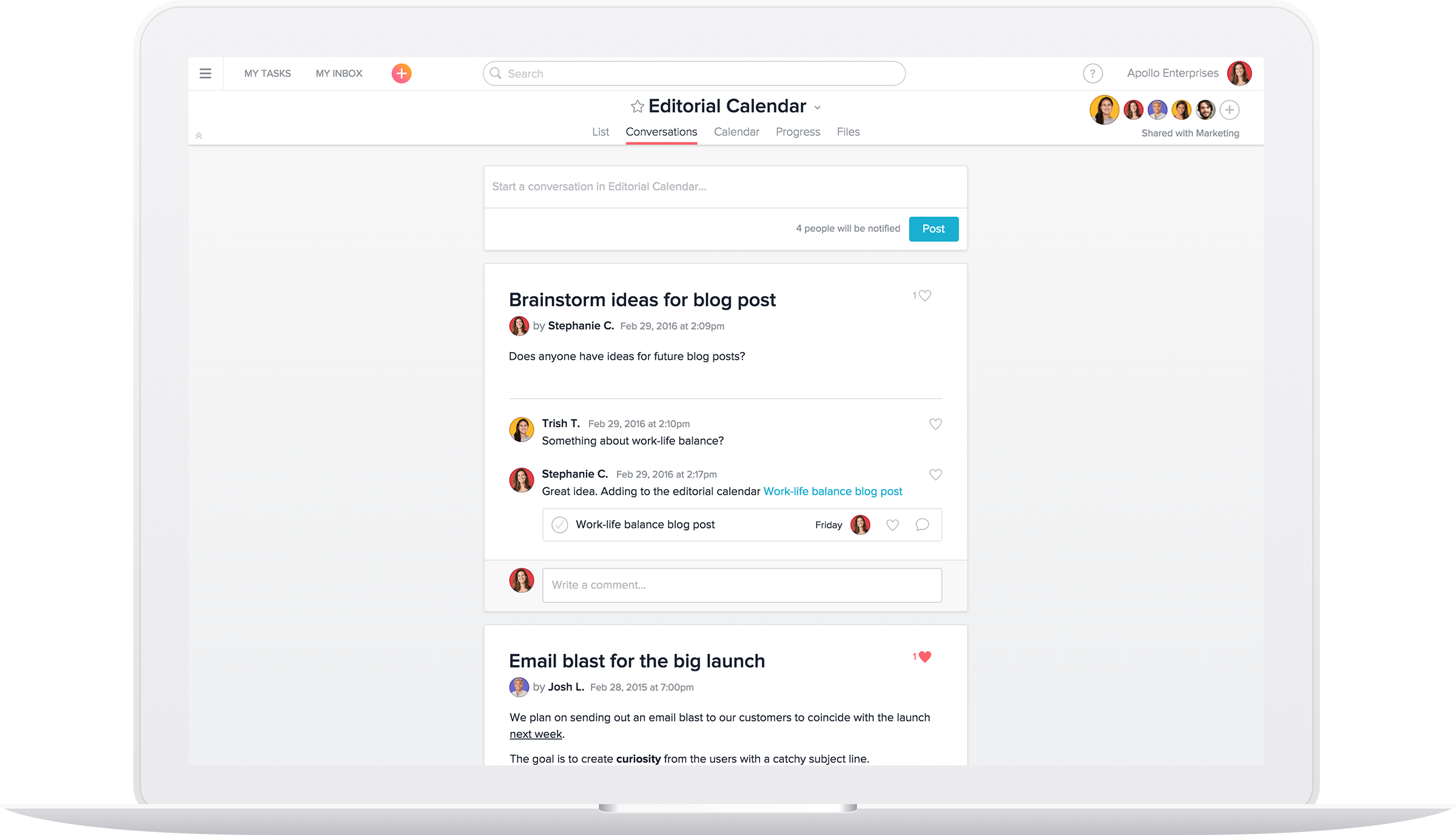
Asana is a web and mobile project management app. With tasks, projects, conversations, and dashboards, Asana lets an entire team know who's doing what by when, enabling workload balancing. Users can also add integrations for GANTT charts, time tracking and more.
$13.49
per month per user
Microsoft Planner
Score 7.5 out of 10
N/A
Microsoft Planner is presented as a solution to organize teamwork with intuitive, collaborative, visual task management. With it, users can create Kanban boards using task cards with files, checklists, and labels. Users can collaborate in Planner and Microsoft Teams and check visual status charts—all in the Microsoft cloud.
N/A
Planview PPM Pro
Score 9.0 out of 10
Enterprise companies (1,001+ employees)
Planview PPM Pro™ centralizes the management of projects and resources, facilitating governance, and providing visibility for improved decision making. Whether users are just getting started or advancing PMO to the next level, Planview PPM Pro is designed to provide the ability to collect, prioritize, and execute projects, enabling PMOs to focus resources on the work that delivers the most value.
N/A
Pricing
Asana
Microsoft Planner
Planview PPM Pro
Editions & Modules
Starter
$13.49
per month per user
Advanced
$30.49
per month per user
Enterprise
Contact Sales
Personal
Free
No answers on this topic
No answers on this topic
Offerings
Pricing Offerings
Asana
Microsoft Planner
Planview PPM Pro
Free Trial
Yes
No
No
Free/Freemium Version
Yes
No
No
Premium Consulting/Integration Services
Yes
No
Yes
Entry-level Setup Fee
Optional
No setup fee
Optional
Additional Details
A discount is offered for annual billing.
—
PPM Pro offers flexible pricing based on user types.
Asana had more useful features, is a more mature product and a better interface than Microsoft Planner while Microsoft Project was harder for the average person to learn and hit the ground running due to it complexity making Asana that nice middle ground for most persons to …
Asana does well at the assignment of tasks and task management, but it is not a resource planning tool. Other tools do better at resource planning and some principles of agile/scrum. It is simple and easy to use within the mobile application and on desktop, but it doesn't have …
Asana is the best for task management, it’s easy to use and streamlined for team members to use with minimal intervention. It’s a lot nicer to use compared to similar products like Projectplace although there is some difference in features. It has much better features in terms …
Asana is the best of both worlds because it allows multiple views of your tasks and dashboards for project managers to review. Some of the competitors only allow one way of working, which can be a roadblock for users who are less flexible in their workflow. Getting all users to …
While Asana and Trello are mature products, Planner is getting there pretty quickly. Since our organization is on the Microsoft ecosystem, it helps to use SSO for most of the apps that are within the same license. It helps save money and does the work. For proper project …
Compared to the other options, we already had access to Microsoft Planner, preconfigured accounts, and support and ordination from tech internally to use it. We previously used Wrike, I wanted to use Asana, and other people in the organisation either used Microsoft Project, or …
We tried to select software from various tools, and in the end we chose Planner both for economic reasons (it is included in the Microsoft 365 license we have in the company) and for its ease of use (we have no particular or specific needs, such as advanced scheduling or ticket …
Main reason is that it is cost efficient because we're already using Microsoft 365 and it's literally part of the ecosystem. No need to purchase any other software. Microsoft is also a well known company, credible for providing business solutions and has a strong enterprise …
Microsoft Planner isn't as detailed for project planning as some of these. However, it is more user friendly. Anyone can learn how to use it. If you want simple and affordable for a diverse group, it's the way to go.
Our organization chose MS Planner because it is an included tool in the MS Suite, and since we are unfortunately replacing our current and much better project management tool due to a consolidation of the tech stack. However, it doesn't appear that any of the teams using the …
In my experience, Microsoft Planner has much less features and less effective than other project management tools. But, it's free and included as part of Microsoft 365, so senior management may think it's saving them money. However, the poor productivity and the inefficient …
Microsoft Planner was included in our package of Microsoft email. Thus, we [don't] have to pay anything separately. This is was the main reason. However, the functionality we required was similar. [Microsoft] Planner also gives a schedule calendar where we can add tasks as per …
We have only used PPM PRO since we started Portfolio Management with Wake County back in 2015. The tool has served us well over the years and grown with us as we have expanded our strategic efforts. We recently implemented ProjectPlace and interfaced with PPM PRO to enhance …
Verified User
Analyst
Chose Planview PPM Pro
Planview PPM Pro integrates all of the PM features of other applications and then adds features on top of them. Other applications tend to offer a solution around as single "need", forcing users to "build their own solution".
Features
Asana
Microsoft Planner
Planview PPM Pro
Project Management
Comparison of Project Management features of Product A and Product B
Asana
8.3
179 Ratings
7% above category average
Microsoft Planner
-
Ratings
Planview PPM Pro
-
Ratings
Task Management
9.2179 Ratings
00 Ratings
00 Ratings
Resource Management
8.0152 Ratings
00 Ratings
00 Ratings
Gantt Charts
9.061 Ratings
00 Ratings
00 Ratings
Scheduling
8.4162 Ratings
00 Ratings
00 Ratings
Workflow Automation
9.0132 Ratings
00 Ratings
00 Ratings
Team Collaboration
9.4178 Ratings
00 Ratings
00 Ratings
Support for Agile Methodology
8.57 Ratings
00 Ratings
00 Ratings
Support for Waterfall Methodology
8.57 Ratings
00 Ratings
00 Ratings
Document Management
8.3150 Ratings
00 Ratings
00 Ratings
Email integration
8.3142 Ratings
00 Ratings
00 Ratings
Mobile Access
8.7149 Ratings
00 Ratings
00 Ratings
Timesheet Tracking
6.16 Ratings
00 Ratings
00 Ratings
Change request and Case Management
8.44 Ratings
00 Ratings
00 Ratings
Budget and Expense Management
7.077 Ratings
00 Ratings
00 Ratings
Professional Services Automation
Comparison of Professional Services Automation features of Product A and Product B
The usability of Asana is broad since it's available in a variety of platforms that are widely used nowadays. I think that it would be great for people who are constantly on the move and switching devices, since it has allowed me to work from my phone, too. I also think that Asana has proven itself to handle a large quantity of work
There are a few examples where MS Planner would be suitable for employees at a mature organization. In my opinion, if you have Outlook or Teams, you already have built-in calendars and to-do lists. If you need a project management tool, you have two options: either pay for MS Project or use an alternative tool like Monday, Asana, or Jira. Regardless, their free versions are much more sophisticated than Microsoft's (MS Planner). Any team wishing to put together a halfway-decent project management board will need to look elsewhere, as MS Planner is only suitable for a personal to-do list.
PPMPro is well suited for tracking new product introduction projects, as well as process changes. It serves to reliably track ongoing action items, issues, resource allocations for projects. Areas where PPMPro is less appropriate for use: Project to project dependencies, automating action item notifications on multiple platforms, integrations of PPMPro into other platforms PMO typically uses (like MS Projects, Teams, ppt, etc)
Through it, we were able to communicate and cooperate with the rest of the team to complete the work in the required manner and at the appropriate time.
New request workflow/kanban board helps visualize where new requests are in the process of the quote to cash/request to completion
The time tracking tool is tied directly to project tasks for seamless integration of time tracking, estimates, and actuals
The reporting capabilities and ease of use has allowed us visibility to data that we never had before
The tool is easily configurable by Administrators. We can add fields, change reports, add new dashboards within hours vs. days of trying to track things manually
Would be nice to see a calendar view instead of a list view
Permissions aren't configurable, anyone can delete any task at any time and there is no recycle bin
Notifications aren't great, you have to be attached as an owner to a task to see comments and be notified of changes, and even then notifications aren't shown for a lot of things
The base API is not a REST based interface and is difficult to use for integration with other systems in the enterprise.
The UI for the maintenance of the task schedule for projects can be a bit cumbersome , although the spreadsheet style editor helps somewhat. The Gantt view is not interactive.
The workflow engine is designed only for initial project intake, and does not allow for an integration of the work flow with the project from start to end, so it can't be used for routing artifacts like change requests, ancillary project approvals, etc.
It is a very useful tool that brings teams in sync with one another. The integration with other Microsoft products makes it an obvious choice because you don't have to purchase a license for a completely different tool that doesn't have cross-functional capabilities with the software you already use on a daily basis.
Because I never evaluated other tools, I would be open to considering others. Given our establishment with Innotas and the value it has provided us, separating from it would cause some organizational discomfort. However, if a tool existed with a more intuitive interface for manipulating the data and factors of projects and resources, I would be very interested.
It is very user-friendly. Takes a new employee an hour to start figuring out how the system works. That's an important factor. You don't want to encounter the issue where employees need a week to understand how the system works. For example, JIRA, I tried using it for a week and I still don't understand the complicated layout. Asana has a simple interface. Once you see it, you get it type of program.
The board-and-bucket layout makes it easy to organize tasks, track progress, and prioritize work at a glance, even for first-time users. I also appreciate how Planner seamlessly integrates with tools like Teams, Outlook, and SharePoint, enabling users to collaborate, schedule tasks, and access their plans without needing to switch platforms. I also like how it’s accessible not only on desktops, but also on mobile devices.
PPM Pro has very effective process capabilities around Project, Demand, and Resource Management as well as Reporting/Dashboards. Very stable platform, never any downtime. We now also have PPM Pro Sandbox which we have leveraged for any new major developments such as Request Management.
No issues with overall response time and performance. There have been some occasions where a Report could take few minutes to render but this is vary rare. No integration issues...
I haven't had to use their support so I can't rate it. The fact that I haven't needed them reflects the ease of use of the product. I would recommend that any new users schedule a complete demo of the product to ensure that they are using it to it's fullest (there's a lot of useful features).
Their ability to assist and answer questions when needed is incredible. They create innovative ways to share information and help customers trouble shoot. I didn't give it a ten because I believe they could do a better job of personally reaching out to customers and providing improvement guidance based on where the customer is at and their needs at the time
Asana is a top-tier project management software that helps us organize and track projects from start to finish. It allows us to apply tasks/to-dos to multiple projects without duplication, divide complex projects into smaller tasks, and track project progress. It also helps us organize work on Kanban boards or linear lists. It stands out from the crowd in a big way compared to the competition.
Many areas of the company still use Trello to organize their activities and tasks, but gradually Microsoft Planner must replace the activities. Users are often "attached" to familiar technologies, but Office 365 takes advantage of the more organized use of the tools. This year we will not renew the Trello contract.
Microsoft Project does not integrate the data or provide meaningful dashboards. We needed a tool that could manage a portfolio of projects versus just a single project view. In addition we needed a tool to track financials and internal effort all integrated into one product. Planview PPM Pro addressed all of our needs
We have always used PPM Pro across multiple Business Units and Business Functions and have never encountered any scalability issues. PPM Pro offers flexibility in how the various Entities are configured across the Enterprise
Very effective and flexible - we obtained a pool of consulting hours that we can use at any time over 12 month period. Consulting topics can vary as we explore new functionalities in PPM Pro. Very easy to schedule ad-hoc time with PPM Pro consultant
In my experience, productivity is negatively impacted because assigning subtasks aren't clear on Microsoft Planner
Managers aren't able to track direct reports' tasks across multiple boards -- leading to poor visibility for us
Notifications aren't always sent to inbox, so you rely on people's own project management skills to follow the communication on tasks they're assigned to. In my experience, this leads to missed deadlines impacting customer relationships.