Azure Synapse Analytics is described as the former Azure SQL Data Warehouse, evolved, and as a limitless analytics service that brings together enterprise data warehousing and Big Data analytics. It gives users the freedom to query data using either serverless or provisioned resources, at scale. Azure Synapse brings these two worlds together with a unified experience to ingest, prepare, manage, and serve data for immediate BI and machine learning needs.
$4,700
per month 5,000 Synapse Commit Units (SCUs)
Bitrix24
Score 7.3 out of 10
N/A
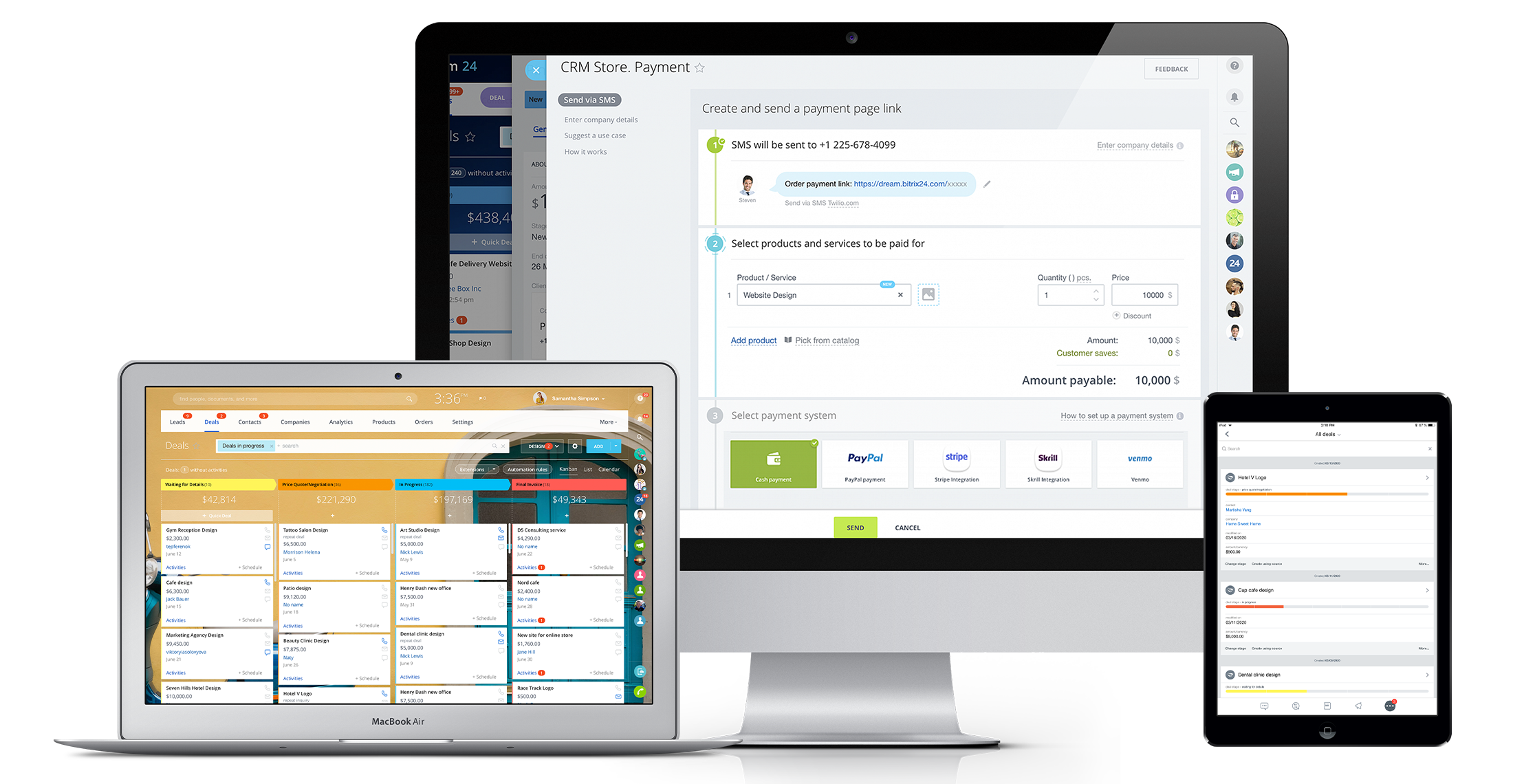
Bitrix24 is a local-hosted or cloud-based social intranet and project management platform that also contains core HR (HRMS) and CRM features. Bitrix24 also provides time management services and employee self-service.
$61
per month up to 5 users
HubSpot CRM
Score 8.3 out of 10
N/A
HubSpot’s CRM enables growth-minded businesses to optimize their relationships with leads and customers. Through harnessing the power of carefully crafted sales, marketing, customer service, content management, and operations tools, the software aims to make it easy to unify team strategy and drive conversion. Additionally, the software allows users to connect with over 875 integration apps, APIs, and solutions partners to create a customizable user experience that suits the way teams work.…
Synapse, in comparison has its ups and downs against the competitors. However, where it excels, and builds it's markets is the cheaper costs (compared to Redshift), low code platforms and an in house solution that does not need you to leave the Synapse workspace for end to end …
Databricks is a complete product with new features constantly coming out. This can be both good or bad, with a lot of innovation comes a responsibility to keep your code and pipelines fresh.
Our team evaluated multiple platform as I mentioned above , but we stacks up Azure Synapse Analytics because : 1. Easy UI and Unified platform advantage 2. Tight integrations with MS ecosystem.
They're all part of the Microsoft Azure family, so they are not exactly competitors. They overlap in functionality, but they're targeted at different levels of customers. Azure Data Factory is an excellent stand-alone PaaS (included in Synapse Analytics) for writing, scheduling, …
When client is already having or using Azure then it’s wise to go with Synapse rather than using Snowflake. We got a lot of help from Microsoft consultants and Microsoft partners while implementing our EDW via Synapse and support is easily available via Microsoft resources and …
In comparing Azure Synapse to the Google BigQuery - the biggest highlight that I'd like to bring forward is Azure Synapse SQL leverages a scale-out architecture in order to distribute computational processing of data across multiple nodes whereas Google BigQuery only takes into …
Director, eCommerce Analytics and Digital Marketing
Chose Azure Synapse Analytics
Azure Synapse Analytics stacks up well against the competitors I mentioned above. Technically, Azure SQL Datawarehouse is an upgraded version of the Azure SQL Database. So, the choice to move from one to the other depends on the processing needs of your company. If you need …
We also looked at Oracle Data Warehouse as part of our short list of products to implement as a solution. Oracle's product turned out to have less support by way of easily accessible internet blogs. Oracle was also considerably more expensive and we would have needed to hire …
SQL Data Warehousing is much easier to manage if you already have SQL Server experience and analysts who are familiar with its interface. We are currently piloting using NoSQL and Hadoop type databases but it is difficult to get set up properly. Additionally, we have to …
We use Zoho for our own firm and Bitrix24 for our client's firm. Overall, the key differences noted, so far, are 1. the user interface for Bitrix24 is much more visual 2. It has much better privacy and access controls 3. Customer service is faster 4. the mobile app is easier …
In fact, I use both, but in different ways, monday to control the internal agenda, Bitrix for all other parts within the company, such as task control, chat with employees and with calendar also for control in two systems. Bitrix is more complete and has many more features, …
1CRM was not so smart tool and firstly it took us a very long time to understand the basic working of 1CRM that is why I admire the ease Bitrix24 has provided us that its interface is clean and all the features are visible and obvious. We don’t have to spend much of our time in …
These other CRMs are very modular and this implies that each module has an additional cost associated with it, unlike Bitrix24 that has all the tools in one with a single annual or monthly payment.
The plethora of features and also the beta ones like CRM Analytics, Sales center, and Online Store. I forgot you can also build an online store too. For the value, ease of use, features, this is one of the best to use. It's a time saver from changing from one app to another, …
Salesforce will appear to cost more "out of the box" but due to the way B24 operates, Salesfoce will cost you less and consume much less of your time to deploy
We went with Bitrix because it avoided the per seat cost of large sales teams. We discovered you get what you pay for. We wasted $800 given their no refund policy, but more importantly lost 3 months of quality sales management.
Bitrix24 has the most comprehensive software package, that can grow with the business. Its free package is the same as the paid package in terms of functionalities. Its Gantt chart capability allows all of the users to visually see the progress of the projects, in a way that …
Bitrix stacks up beautifully and goes beyond others in certain features. Just like any other software it has its own pros and cons but overall is an excellent software to work on if it can satisfy majority of your needs. Overall it can do very well with just a few minor …
I've attempted various task administration/joint effort apparatuses including Asana, Basecamp, Wrike, Wunderlist, Zoho, Salesforce, and so on. I can't address the client support of Bitrix, as I haven't reached them. Up until now, the framework has been genuinely dependable. The …
Bitrix24 is less expensive but less flexible and less tailor made. It doesn’t allow Active Directory synchronization which is a must have for us. It has a worse user experience. Building workflows is complex.
Bitrix24 has a very wide functionality, compared to competitors. But the technical program is crude. It is very unstable work. Therefore, our company currently uses AmoCRM.
The choice of the B24 was prompted by the fact that in 2012 the company had a box version, but without the CMR. The license was expired, the version was no longer supported by B24. In the stages, the company's directorate drove the employees into tasks for B24, but with …
Bitrix24 is more complete in terms of features and suits better as a communication tool to work as an internal social network. It lets you test or use the product for free (not just for a small period of time).This trial is limited to 12 users (enough to get a good perception …
Bitrix24 is very well suited to our oranization as per our busineess function. We need something which partly does CRM function, share function, chat, meetings. In all, we found Bitrix24 better and cheaper than Sharepoint. Sharepoint is very good but it has his own way [of …
While selecting the best CRM we have evaluated 2 CRMs, one is Zoho CRM and the second is HubSpot, and we have selected HubSpot CRM because of 2 things, it's easy to use and it gets fit into the budget of most of the companies.
HubSpot CRM seemed way simpler and cleaner than zoho and salesforce CRM, which needed more setup and felt bilkier for daily use. Pipedrive was decent for tracking pipelines, HubSpot offered better e-mail logging, task management, and a more seamless workflow overall. I chose …
HubSpot CRM feels more economical that Salesforce, but both products have the same issue of seemingly requiring a full time person (or people) to set up and maintain the CRM. Both platforms are very powerful but end up being a major draw on resources to build team patterns to …
We used to use Outreach but we stopped because it wasn't as robust as HubSpot CRM. It also wasn't as easy to use. We couldn't store any client data in Outreach because it wasn't made for that. It also didn't integrate well with HubSpot CRM. So we got rid of it and I'm so glad …
At the end of the day, we realized we weren't going to make a change. It would be a massive lift right now to make a change to a totally new system. I like what Pipedrive offered, but the effort to actually make the change is not worth it to us.
Much simpler to set up (vs Salesforce) and much more usable than Zoho. We switched from HubSpot -> Zoho because Zoho was way cheaper, but you get what you pay for(!) and so we recently switched back to HubSpot. Everyone is very happy!
Velocify only sends automated emails so being able to send custom ones is really nice. Velocifys call and record feature was much better than HubSpot CRM. HubSpot CRM cannot show a different caller ID than the one it calls which velocity can do. It would be nice to have to ring …
Free starter package and easy set-up. The first task was to set up a lead pipeline. After I discovered many more features, such as a ticket system, chatbot, and email sending in HubSpot, our team is using them on a daily basis.
HubSpot+Salesforce is the most reliable and efficient combination I’ve ever used in a sales and marketing position. They complement each other perfectly, and I have nothing bad to say about it. And, thinking only about HubSpot, it’s quite friendly, which is really a stand-up …
I like Hubspot as a way to track emails to cold prospects, conversations with prospects/clients, tracking opportunities, etc. Like I shared, the ramp up period isn't long and it's a nice way to stay organized when new members are joining on to ensure organization for team …
Our team and senior managers deemed these products worth reviewing and requested that every team assess them, enabling our company to make an informed decision about the software to purchase. Everybody checked, and a survey was conducted among all those employees. We received …
Our company was using Zoho CRM earlier but when our company started growing and started having so many clients. It was not that much smooth for our operations that is why we switched to HubSpot CRM and we are really happy until now with its performance and operations. So, I …
I tested Microsoft Dynamics. Microsoft Dynamics was powerful but felt heavy and complex for our needs. Freshsales had good AI tools but lacked our needed integrations. easy start, built-in email tracking, and clear deal stages without building everything from scratch. HubSpot …
We tried other product Zoho CRM before using HubSpot CRM. Zoho CRM was too hard for our team to learn, and didn’t work well with our other tools. HubSpot CRM is easier to use and fits better with what we need every day. It helps our team work faster and keeps all customer …
We did analyze the Salesforce CRM analytics for our team, but all of our team members are not technical people, so they were having issues using it. So we decided to go with HubSpot CRM because our non-tech team was fine with it as well, and they were really happy with its …
My team was using Pipeline earlier, but that was not working according to our expectations, and our users were increasing, and Pipedrive was not able to handle that kind of number, so we switched to HubSpot CRM, and it has met our expectations as it is handling a very large …
Our team did use Zoho CRM in the past, and it was a user-friendly tool. It was cost-effective as well. However, we later decided to go with HubSpot CRM because it offered us some valuable features. Zoho CRM was not compatible or easy to use with our existing tools. However, …
I found that HubSpot CRM is the go to CRM solution on the market for sales.
I have tried other CRMs which I often found were lacking features meaning you couldn't do half the things you wanted to, or they were on the other end of the spectrum where they were too specialised in …
In terms of a well-suited scenario - the Azure Synapse can be used to capture data from multiple sources (especially from onPrem sources apart from Dataverse) and update the transformed data based on the given conditions (eg: refresh data based on the specified date/time ranges). Also, the transformed data can simply be transferred to Azure Data Lake for further processing by utilizing other analytics tools such as PowerBI.
Bitrix24 is a unified platform with all features in one place. It has a smooth deployment and implementation process. The software boosts teams' productivity and ensures flawless collaboration. Pricing of the software is incredibly affordable. It is highly customizable and a scalable CRM solution.
Most of our clients are either government institutions or Education sector clients, such as universities, colleges, Coaching Institutes, and Competitive boards. We store their data in a single place. That means we can keep our one client's data in one place without any confusion. Our data is always clear and understandable while it is in HubSpot CRM.
Keeping things "complicated, but simple"; [heterogeneous] data formats seen as just SQL tables to business experts used to use Power BI, Excel, and any other traditional SQL-oriented BI tools
Integration options using "Synapse pipelines", the application of ADFs
The greatly integrated solution of independent things (Spark MPP cluster, MPP SQL Servers, ADFs) - all sitting under one roof. Great job!
Integration with super-fast, globally replicated data. I really appreciate the integration of NoSQL databases (namely Core API and Mongo API under Cosmos DB) with purely batch-processed BI data
The ability to create marketing campaigns and have control over when to stop and when to send the next according to your cadence design is excellent. However the ability to see the performance and the history for each prospect is so simple and so accessible - I kicked myself for not getting it sooner.
Having one place to create companies and contacts as well as score leads and track all contract products means we don't have to miss any renewals.
The Deal tracker gives us the ability to track multiple pipelines as well as team and individual metrics like average sale, percentage of goal, contribution to team effort which when mixed with an activity tracker means the team stays lean and mean to crush all goals.
The real time chat feature means prospects can navigate to our landing page for info about us, levels of product availability, pricing and begin a quick chat with members of the sales and support team.
Intel features along with lead scoring, SEO integration, podcasts and white papers all combine to be the most comprehensive CRM you could need.
With Azure, it's always the same issue, too many moving parts doing similar things with no specialisation. ADF, Fabric Data Factory and Synapse pipeline serve the same purpose. Same goes for Fabric Warehouse and Synapse SQL pools.
Could do better with serverless workloads considering the competition from databricks and its own fabric warehouse
Synapse pipelines is a replica of Azure Data Factory with no tight integration with Synapse and to a surprise, with missing features from ADF. Integration of warehouse can be improved with in environment ETl tools
It's user interface can use some work. Although it doesn't take as long as some other software to learn, there is still a bit of a learning curve when it comes to day to day usage.
Bitrix offers a lot of features. It would be nice to have those features laid out in an easier-to-read layout, versus the long list at the side of the page.
It's mobile app functionality is quite limited. It can be difficult to work with other team members, solely off of their mobile app.
It has become the central nervous system of the business and has constantly proven to be of value. We are not just renewing but might even upgrade to advanced Bitrix24 plans and will be adding more user licenses in the next 3 months. Bitrix24 has a sharper learning curve initially. However once it is surpassed, it opens doors to a range of creative deployment strategies
To be honest there are some barriers due to which we are unable to use Hubspot at it's full potentials. The region that we work in has some restrictions that don't allow us to make calls or text which leaves us to just Email to the client.
The data warehouse portion is very much like old style on-prem SQL server, so most SQL skills one has mastered carry over easily. Azure Data Factory has an easy drag and drop system which allows quick building of pipelines with minimal coding. The Spark portion is the only really complex portion, but if there's an in-house python expert, then the Spark portion is also quiet useable.
This application is a complete scam and way over priced for what you are getting. They are filled full of false advertising and false statements regarding integrations. They claim to integrate with quickbooks and they DO NOT. This software accomplished nothing but making our day to day lives more difficult and wasted months of our time attempting to build out.
Once you are set up with HubSpot CRM, it becomes difficult to use any other tool, as it integrates you into the workflow and makes it a habit to log in to HubSpot to identify tasks for the day. The overall ease of use is also a brilliant factor in using HubSpot. They push you towards deal closure and revenue generation.
I can't recall any instance of unplanned outages over the past 1 year of use. Likewise for application errors. However note that, advanced users will have a learning curve
Microsoft does its best to support Synapse. More and more articles are being added to the documentation, providing more useful information on best utilizing its features. The examples provided work well for basic knowledge, but more complex examples should be added to further assist in discovering the vast abilities that the system has.
It comes with a lot of features for managing customers relation for making a dynamic marketing strategy. Sharing and attaching any type of file makes our work much easier for our portfolio. I personally don’t like its customer service that needs to be vigilant and should know the way they should treat their clients
Because when I needed help HubSpot responded immediately and provided me with the information I needed which enabled me to realize that HubSpot was even more customizable and easier to use than I thought! And I already thought HubSpot was very user friendly and easy to use, and then Support showed me how to manipulate the settings, columns and the appearance of the tool.
Overall the training was very comprehensive. The trainer did provider necessary additional reading materials as well. However the general approach at Bitrix24 is to divert users to self-help documentation and videos. It is recommended that atleast 1-2 personnel in the organization be "Bitrix24 experts" so that lower phases of training requirements are covered internally itself. Also the best part about Bitrix24 is that not all users need to go very deep while using it. We have multiple counsellors who started using it on day 2 without any major hiccups
If you've had any prior experience with cloud based marketing automation or group communication tools, you can do the implementation without paid outside support. Though getting to a SLA (service level agreement) would be best achieved with the help of a third party who can facilitate
They're all part of the Microsoft Azure family, so they are not exactly competitors. They overlap in functionality, but they're targeted at different levels of customers. Azure Data Factory is an excellent stand-alone PaaS (included in Synapse Analytics) for writing, scheduling, and monitoring pipelines. Azure SQL Database (and all the Azure SQL family) is excellent for traditional, SQL-based data warehouses, especially if you're migrating from on-premises. Combined with Azure Data Factory (that can run SSIS packages), it's a perfect solution for a simple path to the cloud. Azure Databricks is effectively the only internal "competitor" to Synapse Analytics but targeted more to a "platform-agnostic" audience. On the other hand, Synapse is more of a proprietary mix of products that are more tightly related to Microsoft technologies.
The plethora of features and also the beta ones like CRM Analytics, Sales center, and Online Store. I forgot you can also build an online store too. For the value, ease of use, features, this is one of the best to use. It's a time saver from changing from one app to another, just use one. It is a one-stop CRM. If you are a startup you can begin with this and then slowly get on a paying option. The free offers a lot too. This platform can grow with your business and help save time too.
Our team and senior managers deemed these products worth reviewing and requested that every team assess them, enabling our company to make an informed decision about the software to purchase. Everybody checked, and a survey was conducted among all those employees. We received the most votes for HubSpot CRM, as most employees preferred it.
The scalability and reliability is almost 9.5/10 to be honest. We istarted with Bitrix24 for just 2 functions and now have expanded its usage to 2 more. In terms of users, every full-time employee (FTE) now uses Bitrix24 without fail. We are also working on giving limited/partial access to external service providers
It definitely has a positive impact on ROI. We are able to use it to generate MORE revenue through predictive analytics and pricing optimization.
Because of the SQL Data Warehouse design, we're able to set up some self service reporting tools which allow our users to generate reports ad hoc instead of having a full time employee creating these by hand.
Having visibility into the data is very useful for management to make good business decisions.
Bitrix24's comprehensive communication and collaboration features have a positive impact on businesses by streamlining workflows, enhancing team coordination, and boosting productivity. By offering a centralized platform for project management and communication, Bitrix24 helps teams save time, minimize inefficiencies, and make well-informed decisions. This improved efficiency and collaboration result in better project outcomes, quicker time-to-market, and increased customer satisfaction, all of which contribute to a positive return on investment (ROI).
Negative Impact:
Despite the range of features and benefits, Bitrix24's complexity and learning curve can present challenges for new users. The initial investment of time and effort required for onboarding and becoming familiar with the platform may temporarily impact productivity. Additionally, if organizations do not fully leverage all the available features or if Bitrix24 doesn't align well with their specific business processes, it may result in a negative impact on the return on investment (ROI).
Gave a ton of visibility into user and sales funnel.
Able to get back to new signups or inbound leads much faster, sometimes within minutes. We have a Slack integration that's super helpful.
Saved hours each week that were earlier spent digging through emails or spreadsheets for context; meetings are a lot shorter because it is super easy to go through the created reports.