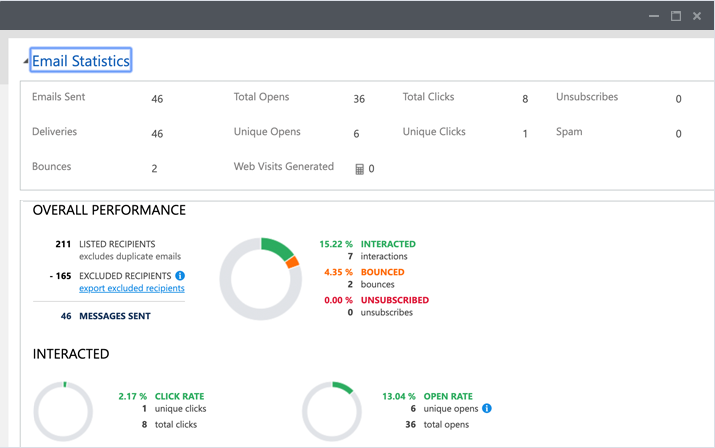
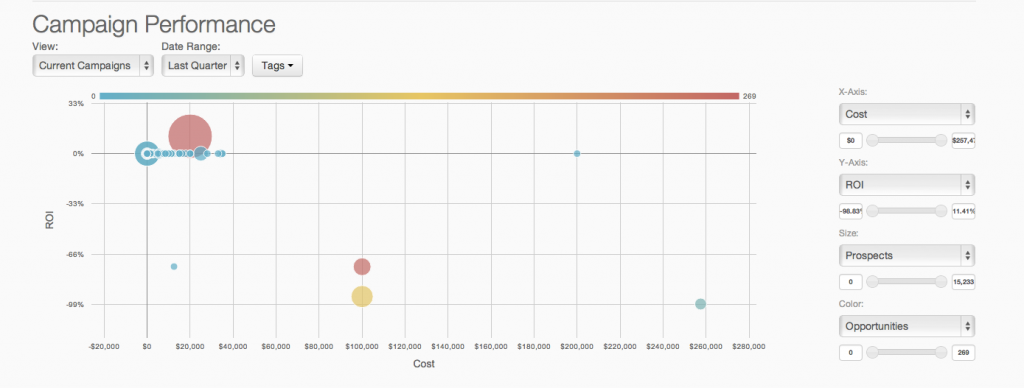
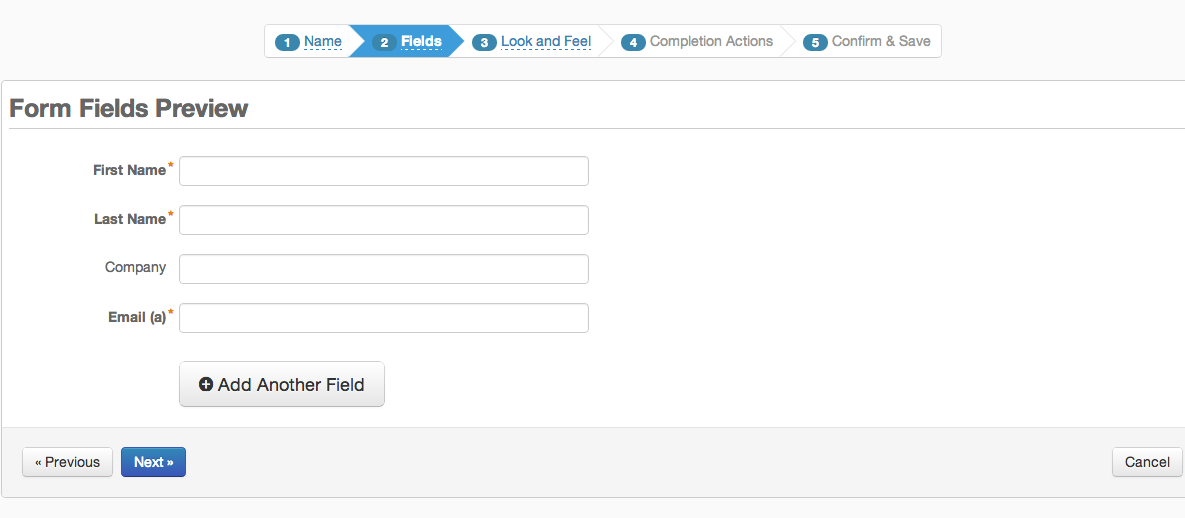
ClickDimensions is an email marketing and marketing automation platform for Microsoft Dynamics CRM. Features include email marketing, web tracking, lead scoring, social discovery, campaign tracking, and form capture.
N/A
Agentforce Marketing
Score 7.7 out of 10
N/A
Marketing Cloud is a cloud-based digital marketing platform, used by marketers can segment their audience, deliver personalized messages, track campaign performance, engage leads and accounts, and optimize strategies based on real-time insights.
$1,250
per month per installation
Storify (discontinued)
Score 8.0 out of 10
N/A
Storify was a social curation platform that collects updates from social networks, to create a new story format that is interactive, dynamic and social. It was acquired by Adobe, and has been retired (May 2018).
N/A
Pricing
ClickDimensions
Salesforce Agentforce Marketing
Storify (discontinued)
Editions & Modules
No answers on this topic
Account Engagement
$1,250
per month
Engagement
$1,250
per month
Intelligence
$3,000
per month
Loyalty Management
$20,000
per month
Personalization
$100,000
per year
Data Cloud for Marketing
$108,000
per year
No answers on this topic
Offerings
Pricing Offerings
ClickDimensions
Agentforce Marketing
Storify (discontinued)
Free Trial
No
Yes
No
Free/Freemium Version
No
No
No
Premium Consulting/Integration Services
No
Yes
No
Entry-level Setup Fee
No setup fee
No setup fee
No setup fee
Additional Details
—
—
—
More Pricing Information
Community Pulse
ClickDimensions
Salesforce Agentforce Marketing
Storify (discontinued)
Considered Multiple Products
ClickDimensions
No answer on this topic
Agentforce Marketing
Verified User
Manager
Chose Salesforce Agentforce Marketing
While Pardot's integration with Salesforce, segmentation functionality, and automation rules are much more robust than any of its competitors, the email builder lacks even compared to free versions of marketing automation software. For us, the integration and being able to …
ClickDimensions is great for SMB companies looking for an easy to use, robust platform especially in situations where there are only a few people within the Marketing Department.
I think the product, by definition, is meant for marketing — and we use it exactly for that, for running campaigns. That’s the best-suited use case for the product. I don’t think it’s really meant to be used for anything else — that’s just not how it’s designed.
I would advise that Storify is easy to use and includes many built-in resources, such as search tools, but that its application can be improved even more by combining it with other tools such as Google News (also accessible in Storify, but using standalone site is easy), Twitter (corporate and 3rd party) search tools and media management / "clipping" services like Vocus
The nurture campaign builder was great. Easy to use and to follow along with.
The drop and drag editor was easy to use and you could start using it with no training.
I always like when a service offers a certification for their product. ClickDimensions training was easy to follow, gave good content/tips/tricks and really helped me learn the platform.
In today's world, some stories break or even take place on social media. Storify allows journalists to easily curate these conversations about news and shape them into stories.
Storify's interface is easy to use and can be taught in minutes. My college journalism students take to it quickly and love working with it.
Storify can employ any social media that I can think of. If a story is being discussed in the social media world, you can find it in words, photos, videos, etc.
Telling stories through Storify is a creative process that I see becoming more prominent in the future.
Products you create in Storify are easy to embed or use for other purposes.
We like to live-tweet academic conferences and events. We think of it as collaborative note-taking. Storify is a great place to "file" these notes for later reference, but it falls a bit short as a place to go during the live-tweeted event. This is due to the fact that it is slow to refresh, if I add a tweet to the story, it can take up to a few minutes for it to appear for other users viewing that story. So we definitely use Storify in these events, but it's an after thought rather than an integrated part of the live activity.
Storify is not as powerful as other social media platforms when it comes to driving new audiences to our content. Facebook, Twitter, and Google + help us expand our networks. Storify is more functional as an organization tool that we can use to engage our existing network.
Each Storify story seems to exist in a silo. It does not make natural connections between stories that might be emerging around the same interest or topic. In academics for example, we have created Storify stories around the value of a Liberal Arts Education. It turns out that others were doing the same, but we only discovered that by accident; Storify was not connecting the dots for us.
I see no reason for us to deprecate use at this point. It is important for us as a business to maintain our partnership with them and keep on the pulse of leading technology. ClickDimensions is a marketplace leader for the world of marketing automation, and in coordination with CRM, it's all the more relevant.
As of right now we have not seen any other program that integrates as seamlessly into our Salesforce platform. We have barely scratched the surface of all the features and use cases. It would be irresponsible to make a move to another platform in the near future. We have not come up against any limitations that would prompt a need to switch
Storify is worth it if you and your organization is creating a lot of social media buzz. If there are less than 15 people that are a part of the social media conversation, you really don't need to use this tool. It's most effective as an organizational storytelling tool, so you need to find a way to get people talking about you before you implement it.
I want to stay neutral. It's not that this product doesn't have appealing features or capabilities, it's that they aren't consistent and stable. So you lose data or your data is not accurate. Or some connection fails and the workflow doesn't trigger as it is supposed to, or the visits or clicks or other metrics contain bad data one month, then the next they're back to normal. This company needs to focus on getting their core product right and not on new features.
You won't find another solution that has as many features as Salesforce Marketing Cloud Interaction Studio. We all know Salesforce, we all know how big they are and it's not for nothing... Their tools do most of the things you want, need and even imagine. Using it is complicated, but the usability is infinite.
From the day I first started using it, Storify has always made total sense. It's not the kind of product that forces you grit your teeth a lot or go into cumbersome customer support areas or fumble around forever only to be unhappy with the end result. I have been able to successfully use the product from the beginning
Upgrades and timing of the upgrades were communicated well and planned during off hours for our work. If we did have a campaign scheduled during that time, it would kick-off after the system was back active. There were a few unplanned system down times, but it was a rare occurrence and those times were also short in duration.
Though the make up of MA apps is not built this way today, it would be nice to see them become more real-time. The integration between Salesforce and Pardot is not a true real-time integration. If I modify something in Salesforce, those changes are not automatically reflected in Pardot immediately. There is a delay of about 15 minutes before the systems sync. This delay, although not long, is less than ideal We would love the systems to be integrated real time such that changes are propagated from one system to the other immediately.
You submit a ticket and they will always come back asking for more information. So the next time you try to be proactive and add that information to the original ticket, but then they come back and ask for something else. It gets to the point where you have to believe it is a stall tactic. You ask for more detail into their processes and you get the runaround. 9 times out of ten they will point the finger at Dynamics 365 as the culprit. It is like pulling teeth to get to Tier 2 support and then the questions start all over again, even if you send screenshots.
They are really responsive and more than not solve the problem or give you insight to how you can manage the solution yourself. I do find however sometimes a long delay on the more complex issues when they need to loop in other departments. but overall a good experience with support
The trainers at the Pardot user conference (Elevate and Connections) were very knowledgeable and presented the material well. Again, the content was targeted to more of a new user audience, and was not really relevant for folks who had been using the product for 2+ years.
Pardot's online training touches on all topics briefly and vaguely without much indepth exploration into how a final outcome could look, such as Nurturing Campaigns, Email templates, landing page templates, etc... The only true way to uncover Pardot's full capabilities is to have Front End design and coding experience. Without this key skill set, I would not recommend Pardot to another business.
From an IT perspective, once you set up the Javascript beacon and start collecting data there is a waiting game. During this time you can start labeling your site actions which can be labor intensive for a single person, but you don't really have the final end-users on the platform yet. We did a lot of training so users were experienced, but it wasn't until they had their first tasks to accomplish that they started using the system and had questions. I'd recommend setting up some immediate goals for an end-user to start segmenting for the purpose of displaying message campaigns so you can jump start end-user action.
Practice makes perfect. The more often any new tool is used, the more comfortable the implementer is with the tool. Also, there is a natural tendency with any new tool, to want to use it a great deal. Identifying proper uses as they relate to your overall marketing goals is key to any decision to use a tool.
Clickdimensions is severely impeded by its integration into Dynamics CRM. Consequently it lacks the Intuitiveness of HubSpot, and the straightforward usability of MailChimp. It is a perfect system if you want to exist entirely within Dynamics, but it requires a high degree of expertise in Dynamics to get maximum value out of it. We're currently migrating to HubSpot, and while the initial integration is proving challenging, I already sense we will be able to deliver a lot more of our marketing goals much more easily, and see an ROI.
We use Salesforce Marketing Cloud for lead management, generating reports, tracking customer and dealer information, inputting orders, and more. I prefer HubSpot for email marketing and automation because it is easier to use and the emails are designed much better. We currently use Salesforce and HubSpot, and we are very happy to have both, as they have different pros/cons.
I addressed this in an earlier comment, but Storify is truly the best that I have found for displaying things in a narrative form. Other alternatives are more visually pleasing (like Tint, RebelMouse), but don't handle the narrative form so well. Those other platforms also do not display text only social posts quite as well.
Prior to this, we had no solution and literally were doing things on paper in a world where technology is outpacing paper. Having this process optimized has made it easier for the sales and marketing people to change information. From the training perspective, it has allowed us to see holes in where we could create additional support training, so the ROI here has been a lot more than just the optimization of a process.
Salesforce Marketing Cloud allows us to more efficiently reach out to a higher number of prospects.
Salesforce Marketing Cloud allows us to nimbly communicate important messages in a timely fashion to facilitate conversion.
Salesforce Marketing Cloud allows us to track who is opening our messages so that we can stop sending to those not interested and focus on the most engaged audiences.
My Storify stories ran the gamut of thousands of readers to a few dozen. That was on me as far as how engaging the content was/interest in the topic I came up with, probably the length of the Storify stories as well, and how much my stories were shared by others. Those reader numbers were not unique by the way, and unfortunately counted when I looked at my own story (even though I was logged in and they could tell it was me).
My objectives were to let people in on a narrative story they may have missed and to cement a passing social conversation into something more long-lasting. These Storify stories are now a part of a Tumblr blog and thus can be more easily accessed. Those aren't hard and fast numbers, but Storify helped me reach my objectives nonetheless.
As somewhat of a disclaimer, my use of Storify was not conducted for a client but as a social media experiment so I could interact with some digital transmedia storytelling. Storify was simply one piece of an integrated online persona. That being said, it was easy to track how many people had seen my Storify stories to see which were the most popular.