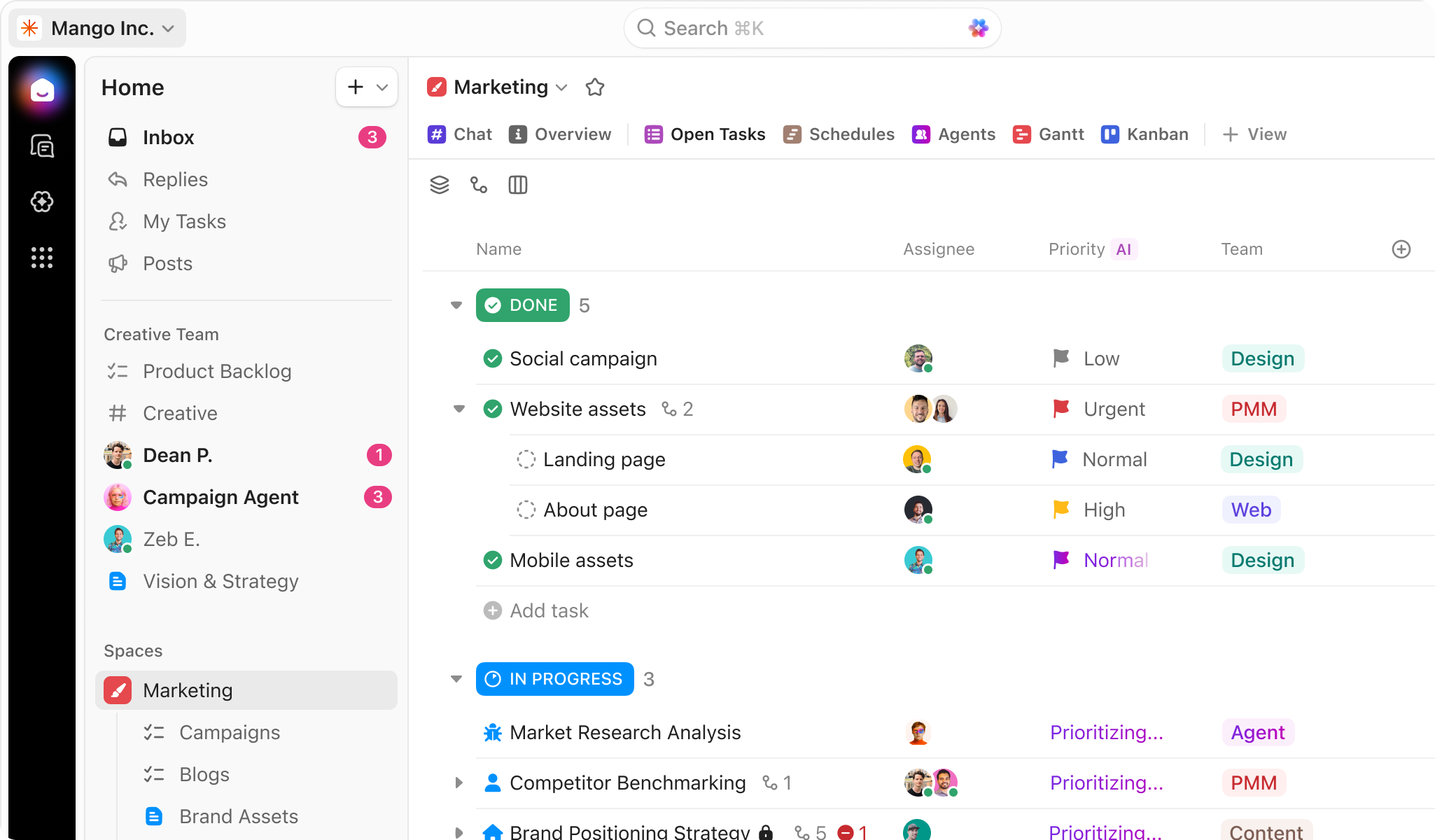
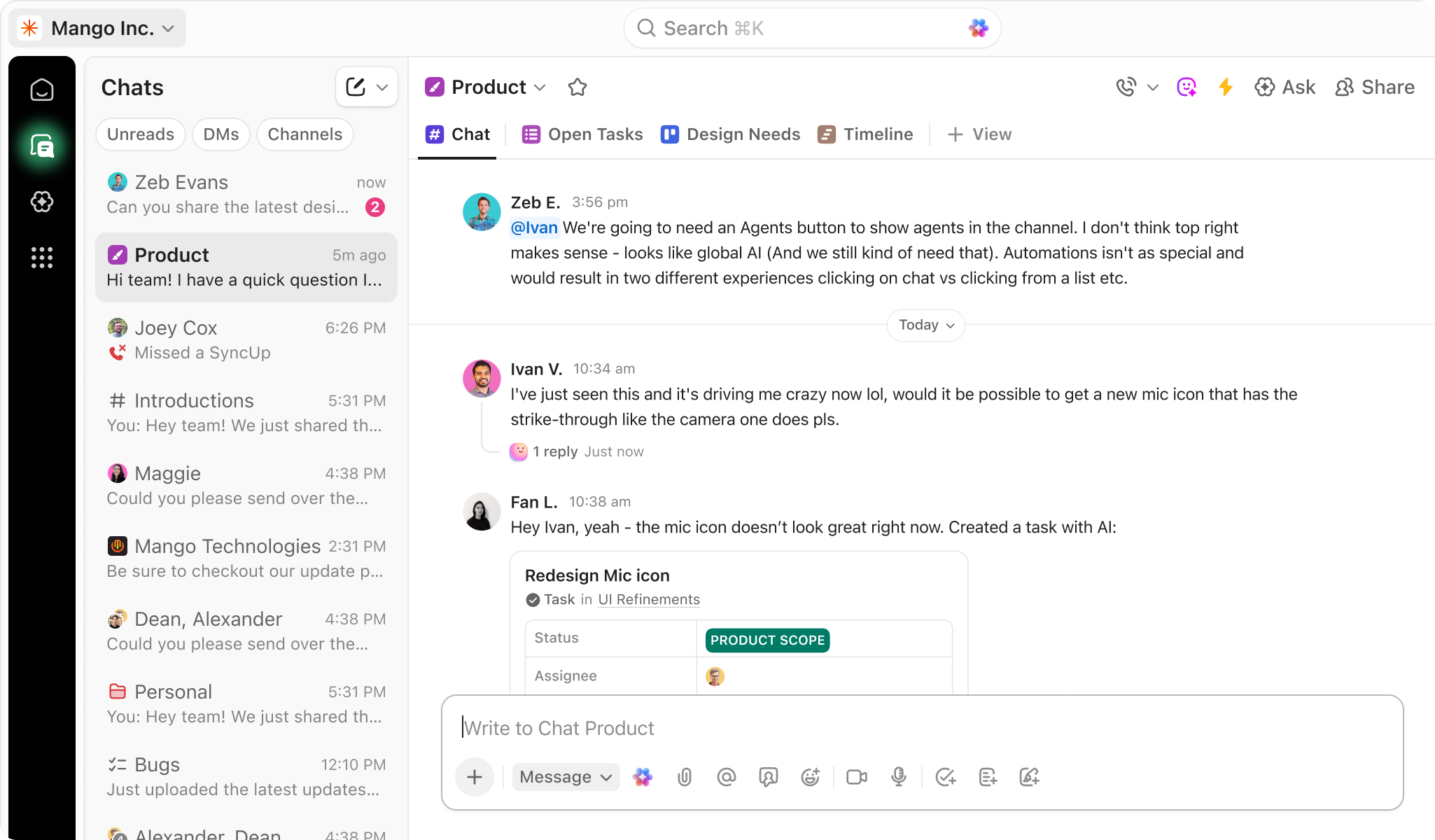
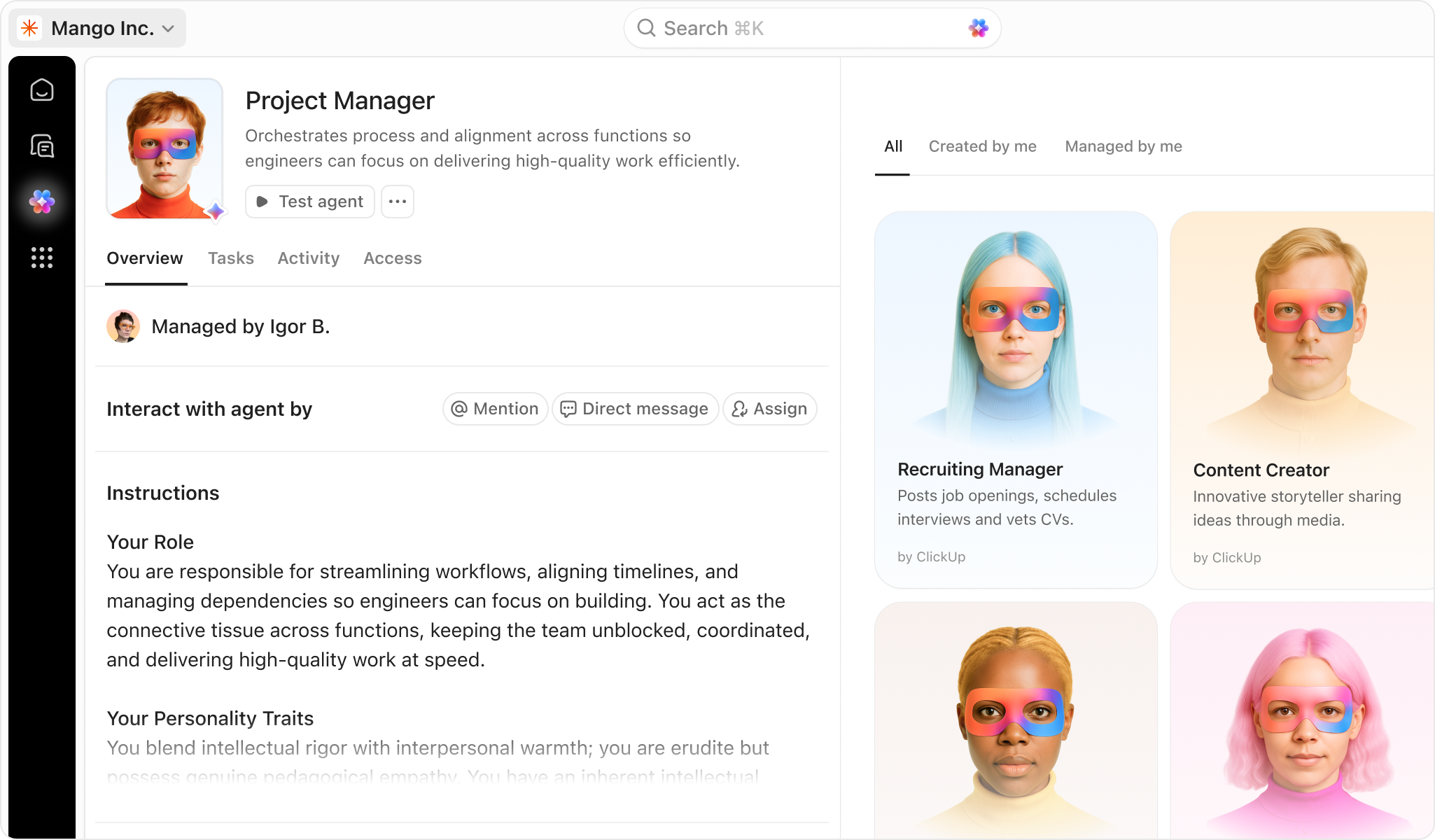
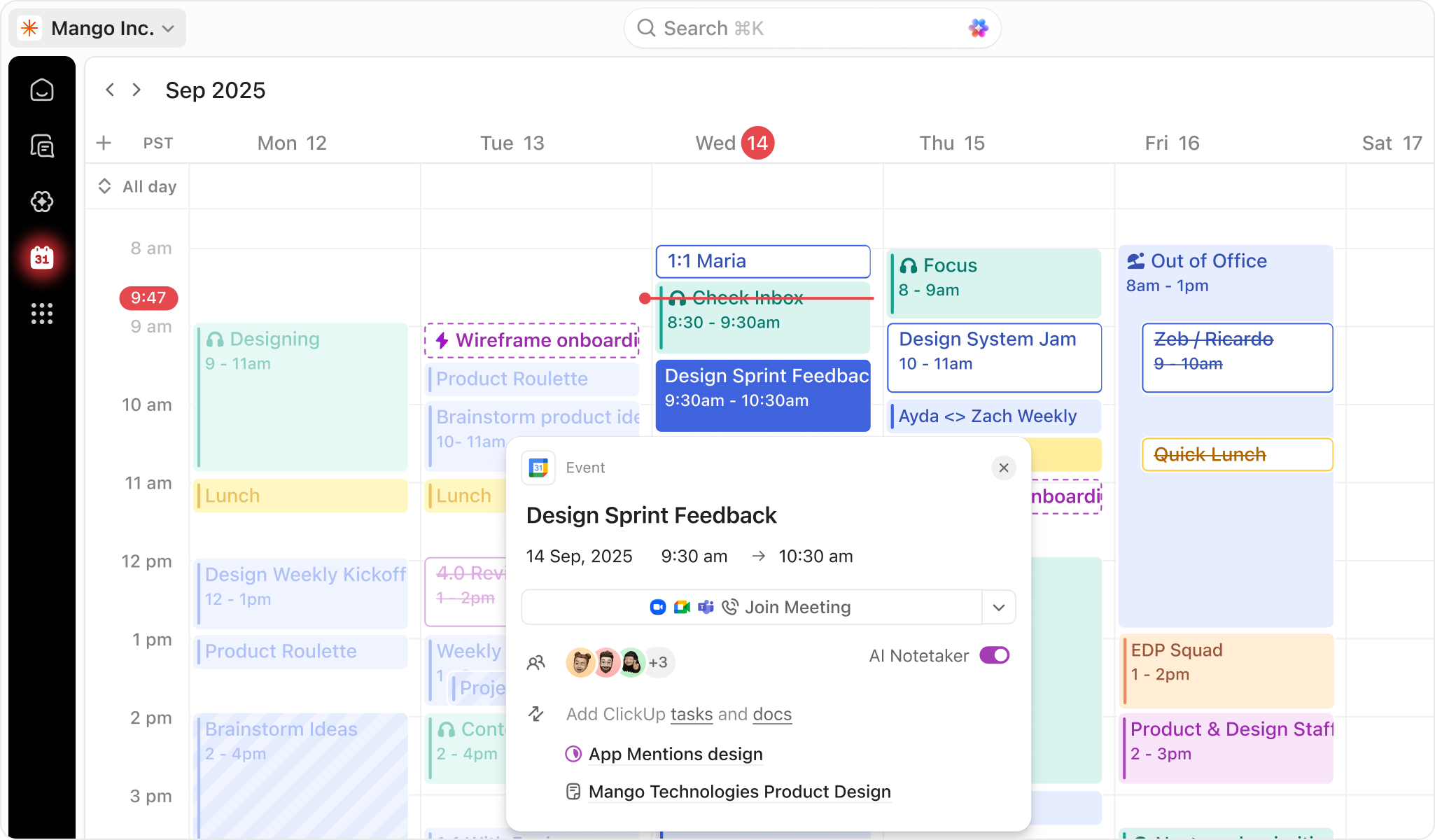
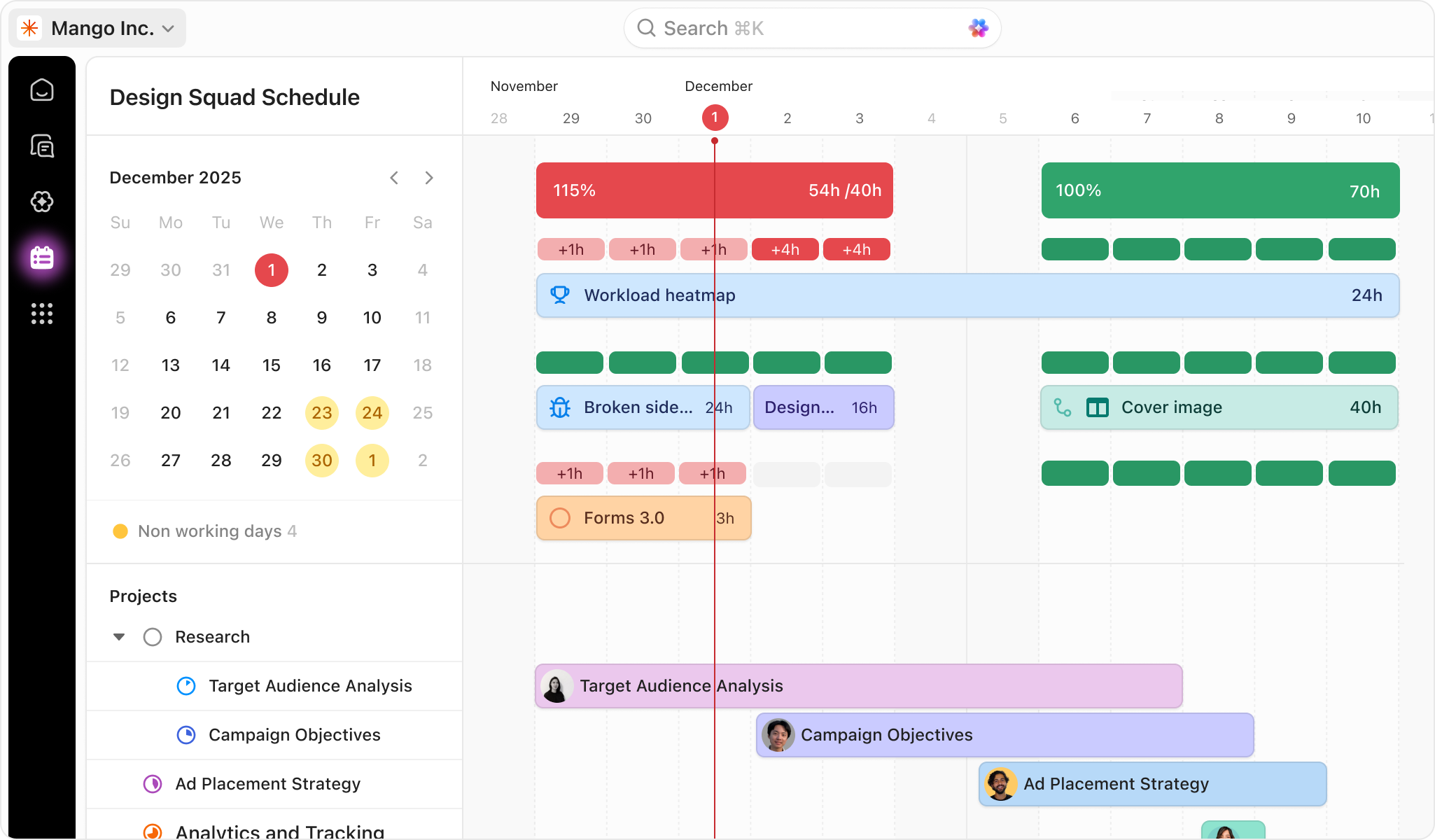
ClickUp is a productivity platform that brings together work apps, data, and workflows. Also presented as a Converged AI Workspace, ClickUp eliminates work sprawl to provide context and a single place for humans and agents to work together. The platform currently boasts over 20 million users worldwide. ClickUp Brain² is deeply embedded into the workspace, offering conversational intake for project scoping and autonomous task generation. It can transform brainstorming docs…
$10
per month per user
Quip
Score 8.3 out of 10
N/A
Quip is a collaboration tool, from Salesforce, that helps sales teams accelerate business in real-time with embedded documents, live Salesforce data, and other built-in collaboration features.
$25
per user per month
Wrike
Score 8.6 out of 10
Mid-Size Companies (51-1,000 employees)
Wrike is a project management and collaboration software. This solution connects tasks, discussions, and emails to the user’s project plan. Wrike is optimized for agile workflows and aims to help resolve data silos, poor visibility into work status, and missed deadlines and project failures.
$0
per month per user
Pricing
ClickUp
Quip
Wrike
Editions & Modules
Unlimited
$10
per month per user
Business
$19
per month per user
Enterprise
Custom
Enterprise
$25
per user per month
Starter
$120
per year per user
Plus
$300
per year per user
Advanced
$1,200
per year per user
Wrike Free
$0
per month per user
Wrike Team
$10
per month (billed annually) per user (2-15 users)
Wrike Business
$25
per month (billed annually) per user (5-200 users)
Apex
Request a quote
per month per user
Pinnacle
Request a quote
per month per user
Offerings
Pricing Offerings
ClickUp
Quip
Wrike
Free Trial
Yes
No
Yes
Free/Freemium Version
Yes
No
Yes
Premium Consulting/Integration Services
No
No
No
Entry-level Setup Fee
No setup fee
No setup fee
No setup fee
Additional Details
Discount available for annual billing.
All editions include unlimited personal documents and folders and a custom subdomain. Paid versions include unlimited document revision history, message archive and group sharing.
Every premium plan begins with a 14-day trial period.
I haven't used Asana very much at all but I wasn't any more impressed with it than ClickUp. However, I wasn't in it long enough to customize it to my liking so that could have been why.
ClickUp is way more robust than its competitors. Smartsheet is more of a simple spreadsheet-like tool. Asana has nowhere near the customizability. And Trello is too simple. ClickUp is like a mashup of all the PMIS tools out there, combining all of their features into a …
ClickUp is the best tool to use for teams that are scaling up because it comes with a lot of tools that you can eliminate out of the box and their advanced features (so many options for views, templates, custom fields) are unlike any other tool that I have used before.
ClickUp had the best and easiest user segmentation. Asana is a bit heavy to navigate sometimes. I also prefer the ClickUp List Views over the Monday.com list views.
Hard to describe it, but the way it connects everything so much better, that they layout is significantly easier to use, and the capabilities are significantly higher. Cleaner and easier to use than SalesForce, both in capability and in the way the workspace UX is presented is …
I've mentioned most of my thoughts in other comments, but in each of those listed softwares, I only get one main feature. In ClickUp, I consolidate all of the above into one. Pretty incredible.
I have never been the decision maker on software like this. They are always decided by someone else before I start working for a company. ClickUp seems like the one with the most features though. My co-worker especially loves it and is the one who insisted we use ClickUp over …
For me the customizability of ClickUp was unmatched. It really felt like there was no limit on what I could use it for and how I could organize things.
For specific features, their Docs are really my favorite part. The customizability and ability to directly link to related …
Mejor integracion y visualizacion de tareas, la contabilidad del tiempo por tareas/tickets es una de las partes mas robustas de ClickUp, la integration con gitlab es una ventaja y ayuda mucho a la organizacion del trabajo, la posibilidad de agrupar tareas por grupos o tipos …
both are people using it for project management and product development and follow the agile teams across the teams to complete the things on time. But in ClickUp, it's all in one platform for all the daily tasks happening in the company, from onboarding to the completion of …
Microsoft Teams is a good project however, there were also software glitches that became detrimental to our success. We tried working it out with the company but found that the product did not meet our needs. ClickUp does so much more and has fewer issues with glitches and …
I used Salesforce at my last job and would recommend ClickUp if utilizing the product for more than just sales. My last company tried using Salesforce for a number of other actions, such as department project tracking, client documentation, and outbound communication which did …
ClickUp offers more ways to set up a project. It's not just one or two ways - which makes it a bit more stealthy in its way to fit a variety of team sizes and project types. For us, having so many features within one tool makes it a no-brainer for our team.
The main reason I initially chose ClickUp over all of the others was price. Because we are a small nonprofit, our funds for this were basically $0. So the robust free version of ClickUp really sold me. Once I got in there and worked with it, I realized just how valuable this …
ClickUp has more features integrated and well organized. Especially the concept of having Spaces, folders and lists helps a lot in organizing the projects and each having its own workflows.
Confluence is one that I think is semi comparable. I think SharePoint is very similar in nature and OneNote would be comparable as well. I think from a collaboration standpoint it's probably the best out of them. Like I said, it's not very good for version control. I think …
Quip is simpler lighter and easier to use than the Atlassian products. Atlassian products could be more complete and have more functionalities, but it is hard to master all the functionalities.
1. We use it as an effective way of collaboration between teams. 2. Can be used as an online spreadsheet. 3. It helps in accessing the data by multiple teams hassle-free. 4. Can customize the action, like editing or locking the spreadsheet to the other users based on the …
Quip was easier to use than any options when we were looking (5 years ago now). Google didn't really offer offline options. OneDrive was (and still is) not great. ShareFile was only considered because we already were using it for file transfer. Quip didn't have any real …
It's easy to use and can be integrated with more 3rd-party software and documents--multiple formats are supported. And the unique feature of chatting makes it very useful, as you not need to switch to any other app for having a discussion with your team. Also data can be synced …
Quip is more robust because it pulls data in from Salesforce to allow you to collaborate with real information. You don't have to live in two systems, which is great. It also gives you access to share with external users, like these other solutions. However, it is not a 1-1 …
Notion was very good in my personal use of it; however, I have used Quip in a professional environment, and the integration of security control was superb. I think that Quip's version of tables and spreadsheets is better than Notion, but they are very similar in many aspects.
monday.com is a good product but lacks overall capabilities compared with Quip. Quip doesn't look visually appealing like monday.com but is more functional when it's broken down into real-time management categories and embedded files. You can easily assign files and tasks to …
Quip was much better. I often have difficulty formatting Google Docs the way I'd like and especially searching for what I need. Sometimes in Google Docs I'll search the exact title of something I'm searching for and it will not appear. That's not an issue with Quip.
We needed to find a way to work together on documents and, to get out of emailing and converge on a single solution. We tried to use our intranet tool, Jive, but that was too cumbersome and hard. Others used Google Docs, but that was not very secure. We looked within Salesforce …
Quip is the best in terms of collaborative features its robustness features are worse compared to the two software. I consider Quip as the big company to watch which will compete with big companies over time.
Main competitors for Quip are the Microsoft and Google product suites respectively. Quip wins in terms of collaborative features, but lags in robustness in comparison to the much large incumbents. Though I do see Quip as a company to watch, who will be capable of competing …
While Quip is a fine tool, I personally would recommend an organization leverage Google Work Suite for Docs, Slides, and Sheets over Quip. I found Quip's feature set to be limited in relation to Google, all things considered. However, Quip can be valuable if your company has …
It's like Google Docs or Microsoft Word, but more team-focused than either. It also reminds me of Slack a little bit in how you can add comments and everyone can view documents right in one place. There's also a side bar where chats can occur. I also really like that you can …
Google Drive is an obvious choice for a collaboration suite, but it still has this old-fashioned Windows 95 feel to it, with the standard file system hierarchy and spread-sheet like lists of files. Quip has a fresh take on the user interface, and the comments and discussion on …
We no longer use Teamwork but when we did, we tried to house documents but we'd always forget where they were. They weren't easy to access. Dropbox we still use sometimes, but if all our clients used quip, we would no longer need to use dropbox except for audio and video files …
Quip is a powerful yet simple software. It allows for all docs, spreadsheets and slides to be online, easily shareable and editable. Its interface is really easy to use and beautiful. Their templates ate AMAZING, including things like calendars!
slack is visually pleasant, has nice features. Its learning curve, the templates and documents management, and the team communication are also very good, and another point that stands out is the template feature (and I'm sure they will add more in future updates.) It helps gain …
Wrike has a broader application than task management apps like Toggl or Todoist. I do use Toggl as a basic time tracking software, however Wrike covers more ground. It is robust and user-friendly, and much less expensive than MS Project.
We used RoboHead prior to Wrike for document control and project management. Wrike is by far more advanced and interactive. It gives us so many more opportunities for communication.
Wrike's UI, combined with its low-cost solutions, has been the standout factor compared to the other options sought. They have multiple license types suited to different usage, a standout compared to others that don't leave you stuck paying high license fees for licenses you …
I utilized basecamp at my last position and I just remember it was extremely limited in what you could do. If I remember correctly there was no workflow integration of the platform, it was essentially just an app that you could create folders in that housed all of the files. No …
Cost and functionality. We were able to gain consensus on Wrike across numerous stakeholders. It may not be the best at everything but it's capable at a wide range of things.
Wrike was more capable that ProWorkflow (at least when we compared them several years ago) and more team/smaller workflow real time oriented than MS Project - where Project is better for detailed PM work. ClickUp is far more flexible and better value for a similar price at the …
our past products have been so hard to customize, streamline, and make work for all types of roles in the company. i feel like wrike is a great fit for everyone to work together well.
Honestly for me, it depends what you’re utilizing these tools for. In my experience, some of the other project management tools I’ve used the past such as Jira are way too complex for the use case we run into with our business. I feel like the overall goal of Wrike is to …
I think Wrike is very similar to other project management platforms such as Monday, Asana and Teamwork that I have used before. As they all provide strong tools for task and project organization, one feature particularly liked by me in TW was its time-tracking functionality, …
Monday wasn't as customizable as Wrike. Basecamp is great for tracking simple tasks and communicating with outside agencies, but isn't complex enough to track projects. Smartsheet is basically a fancy spreadsheet.
We have been using Wrike for over seven years, so I don't recall the specific reason why we chose it over Asana. I recall that the functions were similar, but I think we found that Wrike offered flexibility and structure that we felt would function the best for our department.
Wrike is more robust and suited for enterprise teams. Learning curve is more difficult and involved. Other platforms you can learn in a day or two. Wrike takes a month or two to get the hang of
Monday is a easier for project management and task tracking. Where Wrike excels is with the ticketing system for our IT, legal, or other specific teams.
It has been great for all of my needs - tracking elaborate tasks/subtasks and their timelines, instructions, time spent, reporting on time, etc. I did try to use it for lesson planning and time tracking for homeschool and it got too hard to view and keep track of all the automations I had set up and if they were firing at the right times. But that's the only time I can think of where it didn't really work for what I needed!
Well, they are suited. 1. We use it as an effective way of collaboration between teams. 2. Can be used as an online spreadsheet. 3. It helps in accessing the data by multiple teams hassle-free. 4. Can customize the action, like editing or locking the spreadsheet to the other users based on the business need. Less Suited/inappropriate: 1. The UI is very much outdated. 2. The number of rows to be added to the spreadsheet has limitations. & We have to create a new Quip every now & then once the row limits are reached. 3. Can't do a detailed analysis like pivots tables etc. 4. Other functions like sort & filter options in Quip are not so user-friendly, unlike other spreadsheets out there in the market.
I believe it's well suited if you have multiple jobs/projects that you need to keep organized. We work with multiple job types from print/creative to web, copy and digital ads so it helps us stay organized. I don't think it would be suitable for a company that doesn't have a lot of jobs to manage. We average over 1,200 requests a year.
Customization is huge for us! We do not have the aspects of standard project management, so having the ability to customize basically everything in ClickUp is amazing.
An outstanding free version of the software! We are a small nonprofit organization that cannot afford the robust levels of other software, so having access to SO MUCH for free is incredible.
The layout and organization of tasks, Spaces, folders, etc. is perfect. I love how I can see which task all of my subtasks belong to on my dashboard. And the option to change colors and icons for everything also really appeals to my obsessive brain.
Our experience with Quip has been nothing short of astounding; I love everything about this collaboration tool.
I love that it is cross-platform and works so well on mobile devices; it makes it unhindered to make progress on to-dos, take notes, export spreadsheets and documents, and have all my information organized within one environment.
I also love that it notifies me when someone has done something in shared documents and the incredible ease of linking documents in chats.
Quip's user interface is friendly and comfortably navigable; it feels right.
Update frequency - it feels like I need to update the application about twice a week. It's important to push new functionality and address bugs, but it often feels like the Quip team doesn't have their release schedule planned out very well. Constant updates are disruptive and counterproductive.
Automatic date reminders - Quip will automatically set a date into a reminder as you type it, which could be a useful feature, but it just ends up being annoying. More often than not I'm just typing today's date in a document to track meeting minutes, or potentially adding in an expected delivery date, for which I really don't need a reminder.
It has been a game-changer in terms of project tracking, as animation is a demanding product that requires multiple layers of analysis, revisions, tracking, scheduling, etc. ClickUp simplifies many approvals as anyone can easily add items, and you can tag the people who need to look at them.
I wish that Wrike had more drag and drop functionality that would be connected to assignee and also I wish that the finish date of a task would update to the date where you checked completed. It does not do that. Also finishing a task doesn't move the start date of the next task it "protects your time in that way", but our management team wants us to quickly see what we have down the pipeline rather than having to scroll down the list of upcoming tasks.
In general, I think the usability is probably great. The reason I didn't give it as high of a score is because at the last 2 companies I worked at, they each used different software. So I was already used to those. Learning their UI isn't hard, but always a little annoying to learn something new.
It is the best collaboration tool in my company. Through it, the organization has achieved better connectivity and efficiency in its communication. Primarily, the docs feature of this software is the most utilized in the company. Slowly, dash-boarding and project management features have also been utilized. Generally, it is the best tool, very easy and fairly streamlined
It does take some time and work to really understand and use it properly, but I think the accessibility to help and documentation make that completely feasible. Once you know how to use it, I find it to be very user-friendly, and have very few complaints.
For over a year ClickUp was unavailable to us just twice for a couple of hours. I would say for a system this big and working globally that was a minor issue. They managed to fix all the issues within a couple hours and then it was back up and running perfectly fine.
Over two years of (almost) daily usage without outages. Don't remember any errors. I give it 9 only because some Wrike plugins (for online document edit) are based on NPAPI architecture. These types of plugins are being phased out in new browsers, and NPAPI plugins are disabled by default in recent versions of Chrome so you have to do some browser adjustments when you switch browsers or move to another computer.
The speed of ClickUp is average to be honest. This is one of the biggest flaws of the system, sometimes it's also lagging a little bit but we also have a lot of documents, lists etc. on our workspace. However, with the next version of ClickUp I've seen they are planning to increase the speed by almost 500%, probably by changing the technology, so I am more than looking forward to it.
Wrike tasks loads fine, but I hate clicking files and wait for a bit of time since it is powerpoint or word, Wrike assumes I want to open those on Wrike. My suggestion is to link it to office 365 so we do not need Wrike based decoder for PPTX and DOCX
Support are genuinely helpful and really nice to deal with. I had a bug on my workspace that I’d been experiencing for a while. They looked into it for me and asked some questions. Once they found the issue and resolved it, they even filmed a video detailing how they’d fixed it. That level of support is fantastic.
I have never used Quip's support. To be fair, we hired someone who used to work for Quip before working at our company, and he implemented it and pushed it with the team. He was very biased toward the product, and yes it was better than Google Drive, but by how much?
Time and time again, Wrike has proved that they listen to their customers and put us first. From sales to support - they are quick to respond, encourcage community engagement and I never feel like i am callling a help center
There are multiple guides on literally all of the functions you can find within the system, therefore it's easy to learn anything you'd really like to use, starting from project and people management, down to Gantts, mind maps, time tracking, inviting Clients as guests to work with you on the projects and so much more.
I love the Wrike training options. Wrike Discover has tons of courses, learning plans, certifications, etc. This is an area where Wrike definitely shines! I wish these resources were more in your face for new people, because it seems like a lot of coworkers didn't know all of this training was available to them.
Start small. Don’t try to build the most elaborate plans first. Resist the urge to get into Gantt charts if no one is used to them. Just get work written, add dates and assignees, and start getting used to it. If you did not use a work management tool before, you need to be gracious with yourself about the fact that you likely do not have the muscle memory for working this way yet. But you will get there.
And leverage people who know it if possible. Look for ClickUp experts and vendors. They can really supercharge your effectiveness at building the tool out and speed up the process.
There are a lot of bells and whistles in Wrike, and not all of it is easy or intuitive to understand once it's plopped in your lap. It's easier when there are a few choice people who understand Wrike as a platform and articulate it in such a way where it makes it easy to pass it along to others in the group
Hard to describe it, but the way it connects everything so much better, that they layout is significantly easier to use, and the capabilities are significantly higher. Cleaner and easier to use than SalesForce, both in capability and in the way the workspace UX is presented is far more usable, the features are more rich and flexible than Monday (as well as billing and feature access across plans is way better), and the list + doc + spaces structure is miles ahead of Notion in terms of structure, layout, access, and usability.
Confluence is one that I think is semi comparable. I think SharePoint is very similar in nature and OneNote would be comparable as well. I think from a collaboration standpoint it's probably the best out of them. Like I said, it's not very good for version control. I think Confluence does a much better job of versioning control, but as far as all the other ones, I think it does way better than OneNote or SharePoint.
Wrike's UI, combined with its low-cost solutions, has been the standout factor compared to the other options sought. They have multiple license types suited to different usage, a standout compared to others that don't leave you stuck paying high license fees for licenses you won't use to that extent.
Scaling with ClickUp is superb. If you create a workflow best suited for your organization then it's all about creating new accounts and teaching the new employees the workflow you're using. It's that simple. There is no black magic when it comes to Clickup.
I’d go with a 9/10. It scales really well across teams and use cases, especially once you set things up properly. The only reason it’s not a full 10 is that it can take some effort to structure everything cleanly at the start.
Allow us to provide reports and updates via computer to leadership.
Leadership in our organization have praised IT for the use of ClickUp because the tool is exactly what was needed. Before, we were depending on spreadsheets to keep track of work.
ClickUp brings organizatins together in ways that other software has not. It provides everything we lacked and needed to get out organization up to the standard as other large universities.
Quip has increased the efficiency of our copywriters by making it easier to organize projects, eliminate emails (requesting for review), and eliminated version conflicts.
Quip has simplified the hand-off between copy and graphics. Instead of having to put together an email with all the copy and images, a Quip doc can house everything and a simple notification lets the designers know a project is ready for design.
Quip has allowed much easier visibility into the work of the copywriters in order for me to see when a project is ready to move along.