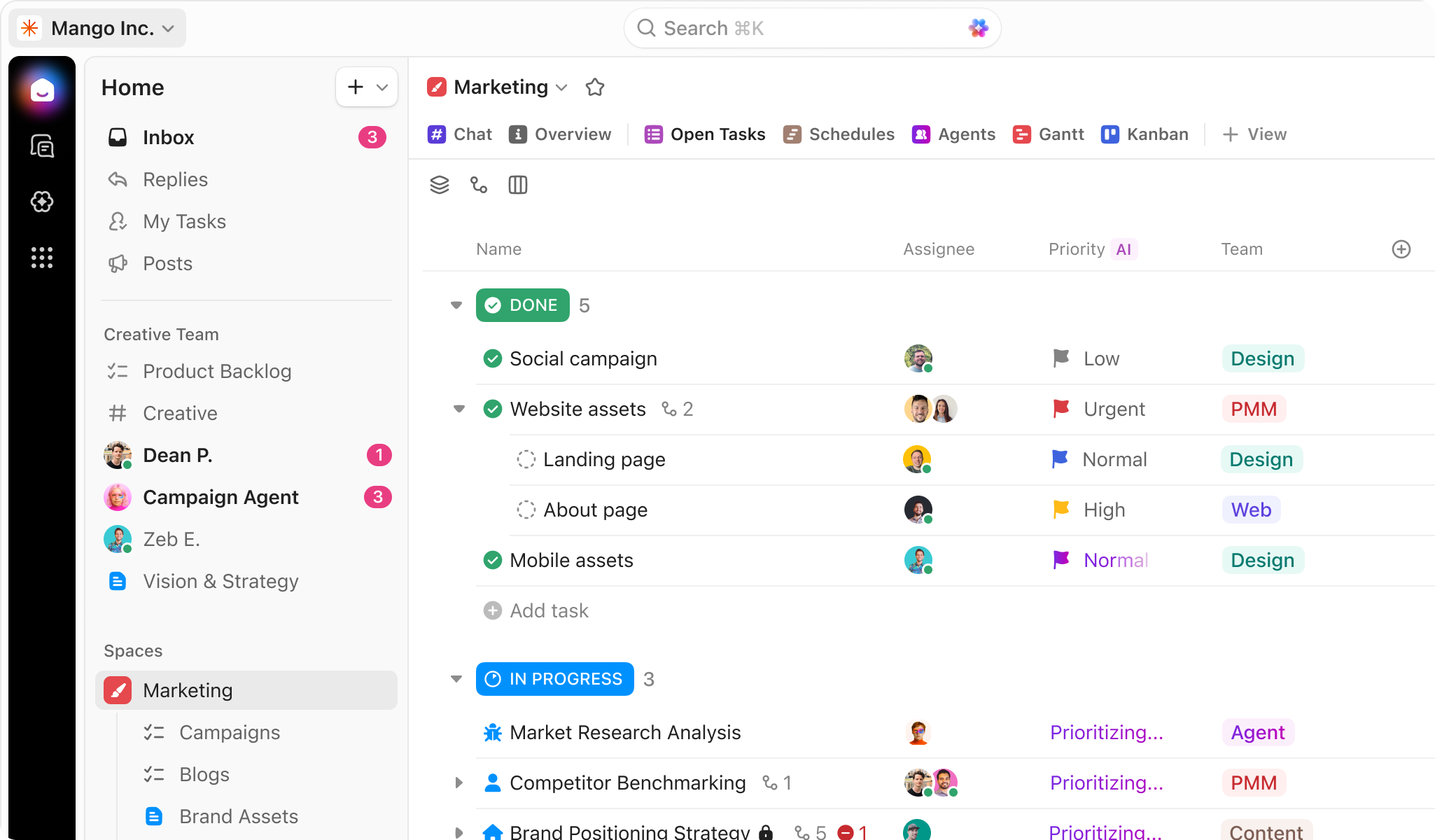
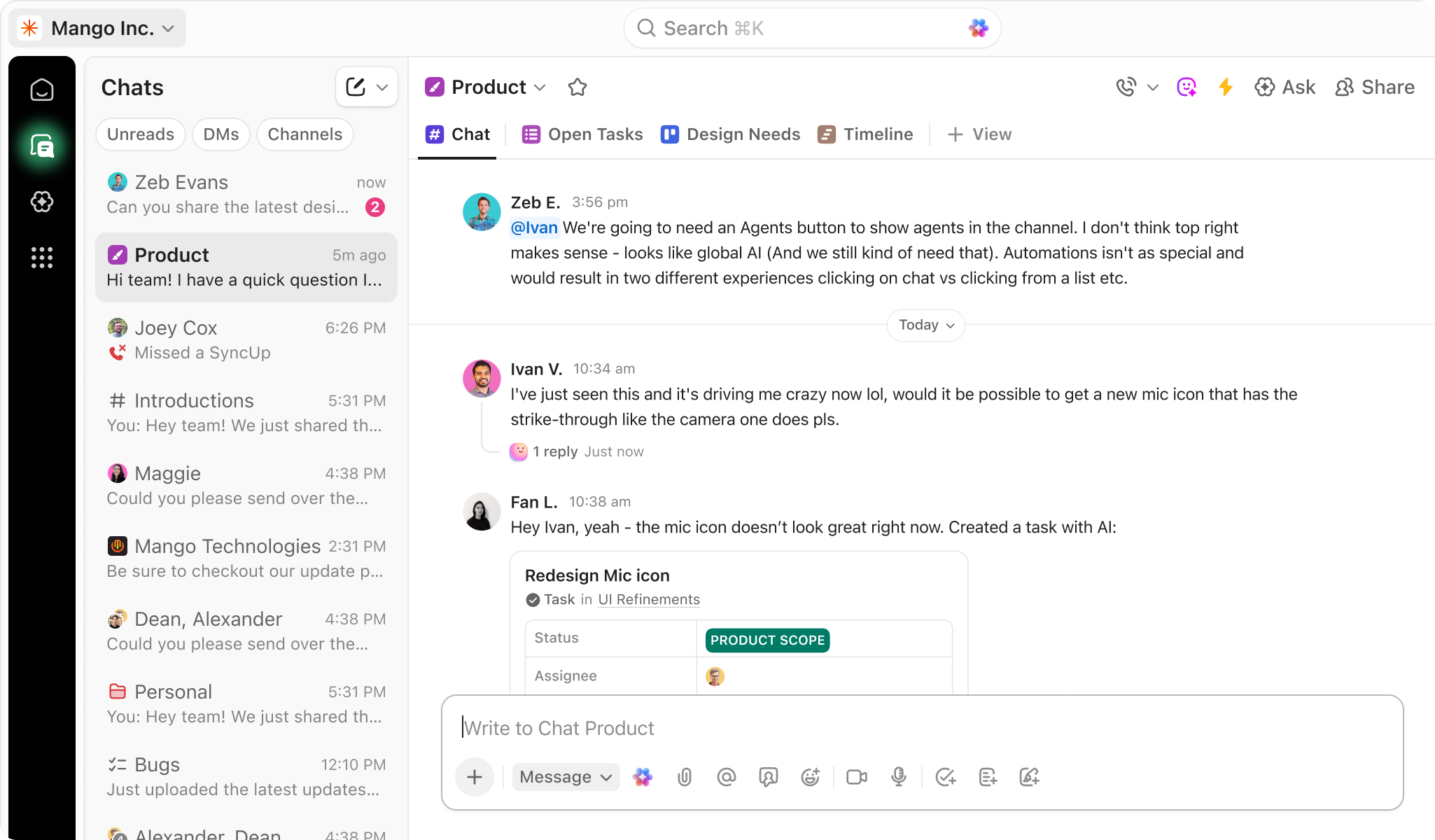
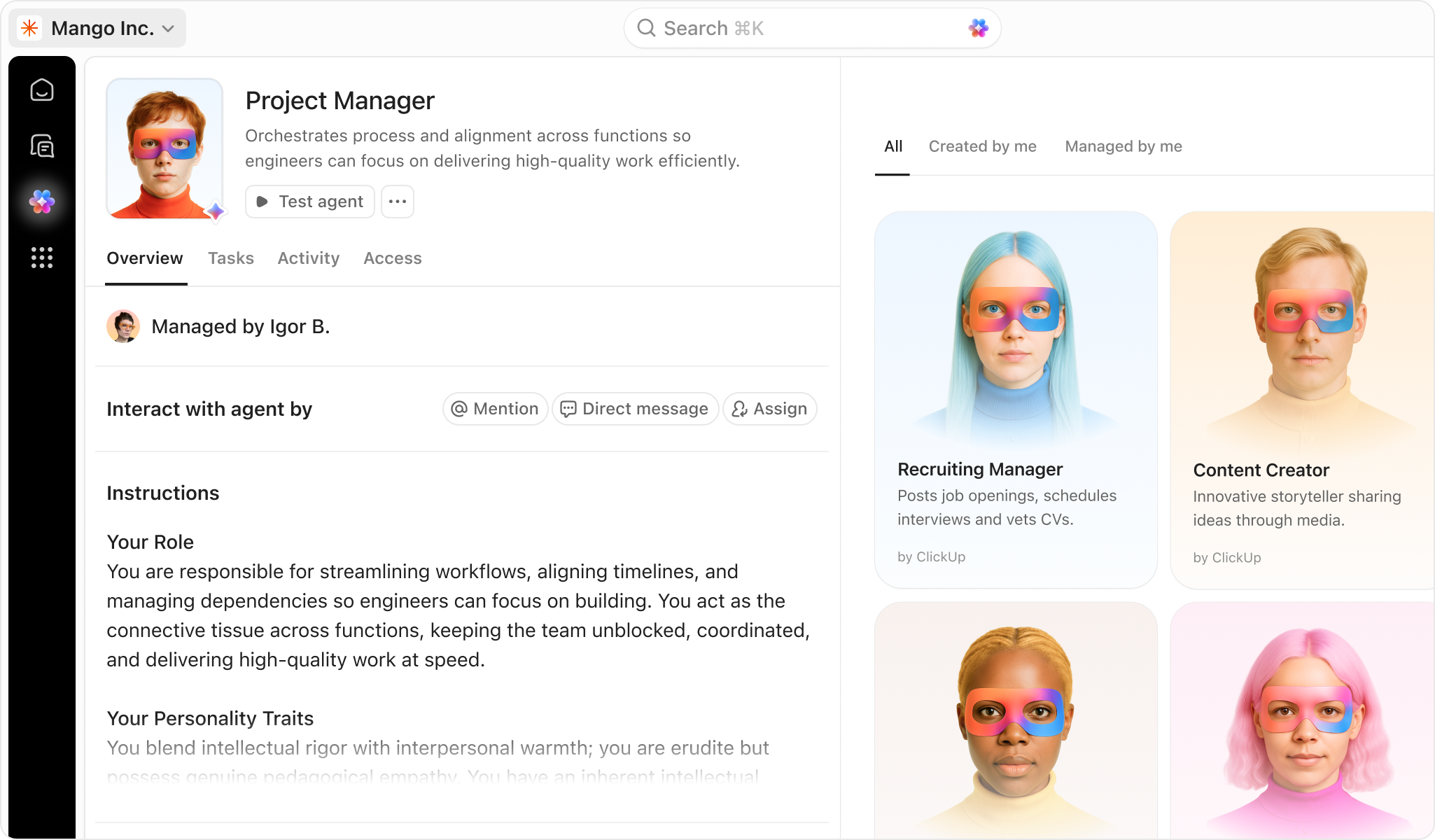
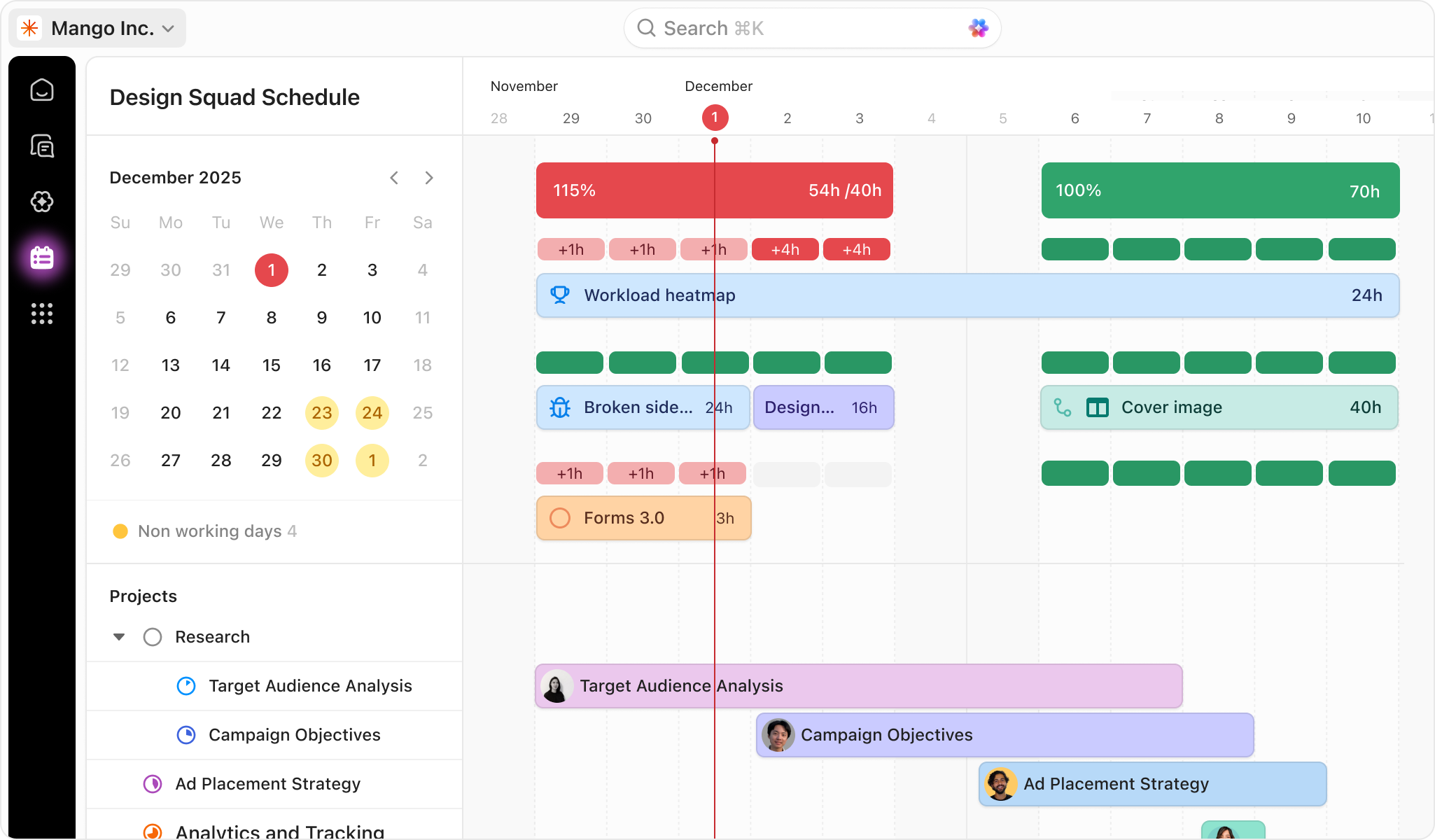
ClickUp is a productivity platform that brings together work apps, data, and workflows. Also presented as a Converged AI Workspace, ClickUp eliminates work sprawl to provide context and a single place for humans and agents to work together. The platform currently boasts over 20 million users worldwide. ClickUp Brain² is deeply embedded into the workspace, offering conversational intake for project scoping and autonomous task generation. It can transform brainstorming docs…
$0
per month per seat
Wrike
Score8.5 out of 10
Mid-Size Companies (51-1,000 employees)
Wrike is a project management and collaboration software. This solution connects tasks, discussions, and emails to the user’s project plan. Wrike is optimized for agile workflows and aims to help resolve data silos, poor visibility into work status, and missed deadlines and project failures.
$240
per year 2 users (minimum)
Pricing
ClickUp
Wrike
Editions & Modules
Unlimited
$10
per month per user
Business
$19
per month per user
Enterprise
Custom
Wrike Free
$0
per month per user
Wrike Team
$10
per month (billed annually) per user (2-15 users)
Wrike Business
$25
per month (billed annually) per user (5-200 users)
Apex
Request a quote
per month per user
Pinnacle
Request a quote
per month per user
Offerings
Pricing Offerings
ClickUp
Wrike
Free Trial
Yes
Yes
Free/Freemium Version
Yes
Yes
Premium Consulting/Integration Services
Yes
Yes
Entry-level Setup Fee
No setup fee
No setup fee
Additional Details
Discount available for annual billing.
Every premium plan begins with a 14-day trial period.
Computer and Information Systems Manager in Information Technology at XYZ (Internet, 51-200 employees)
Chose ClickUp
It may have changed when our company used it but Wrike did not have easy time tracking, the easy automated ticket creation or project workflow capability as ClickUp. It also removed certain user views while ClickUp allows easy view customization.
A de minimis incentive was given to thank the reviewer for their time. The incentive was not used to bias or drive a particular response, nor was the incentive contingent on a positive endorsement. More Info
Verified User
Chose ClickUp
ClickUp stands out against both monday.com and Wrike primarily due to its superior flexibility and comprehensive work management toolkit. While monday.com offers an intuitive interface and Wrike provides strong enterprise features, ClickUp delivers a more versatile all-in-one …
A de minimis incentive was given to thank the reviewer for their time. The incentive was not used to bias or drive a particular response, nor was the incentive contingent on a positive endorsement. More Info
Web Developer in Information Technology at InQuality SA (Computer Software, 11-50 employees)
Chose ClickUp
I think it stacks fairly well with them, Jira can feel really complex at times, but at the same time, it gives some edge to Jira. Expert users can do a lot with Jira, but if you factor in the price of Jira+Plugins, ClickUp has so much value all in one package. Wrike, on the …
A de minimis incentive was given to thank the reviewer for their time. The incentive was not used to bias or drive a particular response, nor was the incentive contingent on a positive endorsement. More Info
Verified User
Chose ClickUp
We are moving to Wrike for its superior reporting in my opinion. Our second choice was Forecast. Calculations can be done inside of fields. We can get instant sums and do customer reporting. The stand reports provide the basic minimum reporting of hours billable, detailed …
A de minimis incentive was given to thank the reviewer for their time. The incentive was not used to bias or drive a particular response, nor was the incentive contingent on a positive endorsement. More Info
A de minimis incentive was given to thank the reviewer for their time. The incentive was not used to bias or drive a particular response, nor was the incentive contingent on a positive endorsement. TR verified that a representative sample of customers was invited. More Info
Systems Specialist in Professional Services at IT Visionists (Information Technology & Services, 1-10 employees)
Chose ClickUp
The best feature of ClcikUp over others is it's customization as well as hierarchy. Departments, clients, operations become easier to manage if the hierarchy is setup in a good way that can allow your business scale without altering it repeatedly. Customization is another …
A de minimis incentive was given to thank the reviewer for their time. The incentive was not used to bias or drive a particular response, nor was the incentive contingent on a positive endorsement. More Info
Verified User
Chose ClickUp
Clickup does much more than all of the above, so avoids having to use multiple tools
A de minimis incentive was given to thank the reviewer for their time. The incentive was not used to bias or drive a particular response, nor was the incentive contingent on a positive endorsement. TR verified that a representative sample of customers was invited. More Info
Technical Writer in Professional Services at ANIME TOONS LTD. (Animation, 1-10 employees)
Chose ClickUp
Simple interface, good communication, and tagging system. The tool is robust beneath the mask, as it lets us share multiple things and hasn't reached a limit on the number of projects we handle at once. Also, the interface is lovely, as it keeps things simple enough for anyone …
A de minimis incentive was given to thank the reviewer for their time. The incentive was not used to bias or drive a particular response, nor was the incentive contingent on a positive endorsement. TR verified that a representative sample of customers was invited. More Info
Verified User
Chose ClickUp
We selected ClickUp firstly for the ease of use of the platform. It was very simple and easy to understand. We also liked how ClickUp offered "Guest" seats for free so we could allow many employees to only view information in ClickUp without having to pay for a full license. …
A de minimis incentive was given to thank the reviewer for their time. The incentive was not used to bias or drive a particular response, nor was the incentive contingent on a positive endorsement. More Info
Verified User
Chose ClickUp
ClickUp offers more flexibility and customization, and the ability to share tasks and items between people and projects.
A de minimis incentive was given to thank the reviewer for their time. The incentive was not used to bias or drive a particular response, nor was the incentive contingent on a positive endorsement. More Info
Verified User
Chose ClickUp
Simplier to use, better visuals, more automations.
A de minimis incentive was given to thank the reviewer for their time. The incentive was not used to bias or drive a particular response, nor was the incentive contingent on a positive endorsement. More Info
Online Business Manager in Professional Services at Cheniece Patrick OBM (Management Consulting, 1-10 employees)
Chose ClickUp
ClickUp has the exact same features, and often many more, than the other competitors, and at a much lower price point. I used ClickUp's freemium version and preferred it to an upgraded version of Asana for several reasons. The customization opportunities are so plentiful that I …
A de minimis incentive was given to thank the reviewer for their time. The incentive was not used to bias or drive a particular response, nor was the incentive contingent on a positive endorsement. More Info
Verified User
Chose ClickUp
For smaller organizations it's my #1! For larger and more complex user needs I generally lean towards Salesforce. But overall and even for personal use I recommend ClickUp. The fact they are always trying to improve their platform and offerings gives them leg up in my books. I …
A de minimis incentive was given to thank the reviewer for their time. The incentive was not used to bias or drive a particular response, nor was the incentive contingent on a positive endorsement. More Info
Chief of Staff at The Content House (Online Media, 1-10 employees)
Chose ClickUp
These apps are good, but ClickUp is GREAT. ClickUp even allows you to move all your existing work from other apps into their platform. I have used those other apps, but ClickUps power-packed features and ease of use in building in growing in its use is second to none in my …
A de minimis incentive was given to thank the reviewer for their time. The incentive was not used to bias or drive a particular response, nor was the incentive contingent on a positive endorsement. More Info
Verified User
Chose ClickUp
ClickUp is better than other project management tools because it's got everything you need in one place, it's super user-friendly, and it's more affordable compared to other all-in-one project management solutions out there. Plus, it integrates with tons of other tools you …
A de minimis incentive was given to thank the reviewer for their time. The incentive was not used to bias or drive a particular response, nor was the incentive contingent on a positive endorsement. More Info
Product Manager in Product Management at Specialty Silicone Products (Chemicals, 51-200 employees)
Chose ClickUp
Better/easy automation and setup for custom spaces and fields. More customization features such as ID numbers for tasks. Very simple onboarding while others needed large fees, months of setup and/or additional software requirements. Love that this is all web based.
A de minimis incentive was given to thank the reviewer for their time. The incentive was not used to bias or drive a particular response, nor was the incentive contingent on a positive endorsement. More Info
Ingeniero de Datos in Information Technology at CEEAD (Education Management, 51-200 employees)
Chose ClickUp
ClickUp is a very complete tool that brings together almost all the functions that other task managers contain. We know that there are some very simple and others more complex. ClickUp goes from the simple to the more complex. No matter the size of your project, ClickUp can …
A de minimis incentive was given to thank the reviewer for their time. The incentive was not used to bias or drive a particular response, nor was the incentive contingent on a positive endorsement. More Info
Verified User
Chose ClickUp
I was searching for a tool that managed various level of tasks folders (and subfolders) in order to organize a very diversified job. I was also looking for a tool with a view that allowed me to see what i have to do today (not perfect in ClickUp but better than in other)
A de minimis incentive was given to thank the reviewer for their time. The incentive was not used to bias or drive a particular response, nor was the incentive contingent on a positive endorsement. More Info
Communications Director at Dupage County Area Project (DuCAP) (Non-profit Organization Management, 11-50 employees)
Chose ClickUp
I love that there are more advanced features like checklists, subtasks, recurring due dates, custom fields, time-tracking, docs, task-linking, goals, dashboards, users & teams, email integration, integration customizations, automation, various view options, filtering & sorting, …
A de minimis incentive was given to thank the reviewer for their time. The incentive was not used to bias or drive a particular response, nor was the incentive contingent on a positive endorsement. More Info
Verified User
Chose ClickUp
ClickUp is better than the ones above. It is full of functionalities and is super fast at the same time. It allows clear management of work. It also allows clear communication between teams ensuring things do not get missed. No one should consider the above tools over ClickUp. …
A de minimis incentive was given to thank the reviewer for their time. The incentive was not used to bias or drive a particular response, nor was the incentive contingent on a positive endorsement. TR verified that a representative sample of customers was invited. More Info
Verified User
Chose ClickUp
Click Up is far more user-friendly than other products I have used. The customizations, integrations, and interface are more in-depth and savvy without making you feel overwhelmed by technology.
A de minimis incentive was given to thank the reviewer for their time. The incentive was not used to bias or drive a particular response, nor was the incentive contingent on a positive endorsement. More Info
Verified User
Chose ClickUp
ClickUp has a powerful and simple UI, that allows us to combine the effective components of other platforms into a single one.
A de minimis incentive was given to thank the reviewer for their time. The incentive was not used to bias or drive a particular response, nor was the incentive contingent on a positive endorsement. More Info
Director of Annual Giving at Ohio Wesleyan University (Higher Education, 201-500 employees)
Chose ClickUp
When our team evaluated potential project management tools, some of which individuals had used personally or in other work settings, we found that ClickUp offered the broadest range of features that were important to us. The different views, in particular, were a selling point …
A de minimis incentive was given to thank the reviewer for their time. The incentive was not used to bias or drive a particular response, nor was the incentive contingent on a positive endorsement. More Info
Manager, Digital Product Operations in Product Management at AVIXA (Non-profit Organization Management, 51-200 employees)
Chose ClickUp
ClickUp is advanced enough to support power users and project management professionals, while flexible enough to allow users with fewer requirements to get the job done in the same tool, and the same space.
A de minimis incentive was given to thank the reviewer for their time. The incentive was not used to bias or drive a particular response, nor was the incentive contingent on a positive endorsement. More Info
Wrike
Verified User
Chose Wrike
Wrike is completely customizable. I began my project management tool in Monday, but really established myself when I switched to ClickUp. I felt like I wanted to keep some similarities to how I worked in ClickUp when our company made the switch to Wrike, and I was able to mimic …
A de minimis incentive was given to thank the reviewer for their time. The incentive was not used to bias or drive a particular response, nor was the incentive contingent on a positive endorsement. More Info
Verified User
Chose Wrike
I'm in the process of evaluating ClickUp, and so far, it seems far more robust in the areas that matter (integrations, automation, speed, ease of use) where it could apply to small and medium orgs. I have another call with ClickUp and if their pricing holds, we may end up …
A de minimis incentive was given to thank the reviewer for their time. The incentive was not used to bias or drive a particular response, nor was the incentive contingent on a positive endorsement. More Info
Verified User
Chose Wrike
ClickUp and Wrike look very different - when I think of Wrike, I think of larger tasks, but ClickUp I used for smaller lists & used the calendar view more.
A de minimis incentive was given to thank the reviewer for their time. The incentive was not used to bias or drive a particular response, nor was the incentive contingent on a positive endorsement. More Info
Verified User
Chose Wrike
ClickUp does have nice features, and Asana used to be a much better interface. Frankly, Wrike can be a bit of a beast to administrate and setup more intricate pieces. The learning curve is steeper than something like ClickUp; but, it is cost effective and simply takes time to …
A de minimis incentive was given to thank the reviewer for their time. The incentive was not used to bias or drive a particular response, nor was the incentive contingent on a positive endorsement. More Info
Verified User
Chose Wrike
We didn't select Wrike, but it is what we need to use for a certain client. I don't think the user interface is as aesthetically pleasing as some of these programmes. I.e. I think all our stakeholders would appreciate a more visually appealing project plan.
A de minimis incentive was given to thank the reviewer for their time. The incentive was not used to bias or drive a particular response, nor was the incentive contingent on a positive endorsement. More Info
Verified User
Chose Wrike
Wrike does not stack up against Monday or ClickUp. That is why we left Wrike. Navigation in Monday and ClickUp is fast and easy. Creating tasks is a breeze and very easy to follow. Resourcing is easy. Creating different forms within each is simple and very useful. Integration …
A de minimis incentive was given to thank the reviewer for their time. The incentive was not used to bias or drive a particular response, nor was the incentive contingent on a positive endorsement. More Info
Verified User
Chose Wrike
I'm not sure how our company chose Wrike over other products like it when we first started using it. I know part of our company was using Asana and we transitioned everyone off of that platform onto Wrike. This not only saved us money at the time, but we were able to do more …
A de minimis incentive was given to thank the reviewer for their time. The incentive was not used to bias or drive a particular response, nor was the incentive contingent on a positive endorsement. More Info
Quality Manager in Quality Assurance at Wisconsin Metal Parts, Inc (Metal Stamping, Fabrication and CNC Machining) (Mining & Metals, 51-200 employees)
Chose Wrike
I evaluated Wrike against Monday, Asana, ClickUp, Kintone, and SmartSheets. Wrike had the most robust request form, approval process, and automation engine. All others fell short in 1 or more of those items. Wrike came built with all the necessary tools inside Wrike, other …
A de minimis incentive was given to thank the reviewer for their time. The incentive was not used to bias or drive a particular response, nor was the incentive contingent on a positive endorsement. More Info
Project Manager - Brand Creative in Marketing at Lunar Solar Group (Marketing & Advertising, 51-200 employees)
Chose Wrike
Personally, I have worked the most with Asana (almost four years). I love Asana, and I think their platform is really beautiful and user-friendly. It has a great UX and design to it, so as a creative, I favor it over the rest of the project management software. monday.com is …
A de minimis incentive was given to thank the reviewer for their time. The incentive was not used to bias or drive a particular response, nor was the incentive contingent on a positive endorsement. More Info
Technical Writer in Professional Services at ANIME TOONS LTD. (Animation, 1-10 employees)
Chose Wrike
Its scope is more focused and its implementation with email tools is what really puts it above the others. Sometimes softwares are too big for their own good and Wrike covered our main need of keeping track of tasks and having visibility across stakeholders much better than the …
A de minimis incentive was given to thank the reviewer for their time. The incentive was not used to bias or drive a particular response, nor was the incentive contingent on a positive endorsement. TR verified that a representative sample of customers was invited. More Info
A de minimis incentive was given to thank the reviewer for their time. The incentive was not used to bias or drive a particular response, nor was the incentive contingent on a positive endorsement. More Info
Product Marketing Manager in Marketing at Priority Dispatch Corp. (Public Safety, 201-500 employees)
Chose Wrike
Wrike has better options for in-task review and approval than anything I've used in the past. The available customization for dashboards and reports is powerful and useful. It's easy to use Wrike at a low level—taking the time to learn its specialized and more powerful features …
A de minimis incentive was given to thank the reviewer for their time. The incentive was not used to bias or drive a particular response, nor was the incentive contingent on a positive endorsement. More Info
A de minimis incentive was given to thank the reviewer for their time. The incentive was not used to bias or drive a particular response, nor was the incentive contingent on a positive endorsement. More Info
Verified User
Chose Wrike
Except Todoist, which is more geared toward a personal to do list (rather than team project management), every other similar product I've used is better than Wrike in every way. They're all more user friendly and intuitive and easier to visualize project progress.
A de minimis incentive was given to thank the reviewer for their time. The incentive was not used to bias or drive a particular response, nor was the incentive contingent on a positive endorsement. More Info
Verified User
Chose Wrike
I was most familiar with Wrike and knew that I could support our initial team of users during our rollout.
A de minimis incentive was given to thank the reviewer for their time. The incentive was not used to bias or drive a particular response, nor was the incentive contingent on a positive endorsement. More Info
Verified User
Chose Wrike
I think that Wrike is a better project management tool for mid-to-large size organizations because it's easier to use and offers better complex task management tools – and it's especially good for managing production projects that must meet certain deadlines to please investors.
A de minimis incentive was given to thank the reviewer for their time. The incentive was not used to bias or drive a particular response, nor was the incentive contingent on a positive endorsement. More Info
President in Marketing at The Simons Group (Marketing & Advertising, 11-50 employees)
Chose Wrike
The interfaces of the other PM systems have way too many layers to get to what you need. Wrike allows you to easily get to what you need without having to dig around too much.
A de minimis incentive was given to thank the reviewer for their time. The incentive was not used to bias or drive a particular response, nor was the incentive contingent on a positive endorsement. More Info
Head of operations in Corporate at Gigfunding CIC + Tough Cookie ltd (Professional Training & Coaching, 1-10 employees)
Chose Wrike
Please see the "Pros" that I gave Wrike. It's a very advanced, feature-rich, yet elegant piece of software that can grow with many companies as they complexify. Almost everything else that I use feels extremely limited and primitive by comparison, often slower and more buggy too.
A de minimis incentive was given to thank the reviewer for their time. The incentive was not used to bias or drive a particular response, nor was the incentive contingent on a positive endorsement. TR verified that a representative sample of customers was invited. More Info
Program Coordinator in Research & Development at Mount Carmel Health System (Hospital & Health Care, 10,001+ employees)
Chose Wrike
Wrike is loaded with collaboration features and information management capabilities that make the solution a one hub for all the teams work. The high level of security measures make it ideal for keeping project information secure and that no unauthorized personnel can access …
A de minimis incentive was given to thank the reviewer for their time. The incentive was not used to bias or drive a particular response, nor was the incentive contingent on a positive endorsement. More Info
I think it is great for task management and project management. It allows for much easier cross-team collaboration. Personally, I found it useful as a project and team manager to better keep track of all the deliverables that have been assigned to various members of the team. It is less appropriate to use as a CRM even though the website mentions it can be used as one, it still lacks many features which a full-fledged CRM would provide.
A de minimis incentive was given to thank the reviewer for their time. The incentive was not used to bias or drive a particular response, nor was the incentive contingent on a positive endorsement. More Info
Wrike helped us stitch PMO-related activities under one umbrella. The easy collaboration with multiple access types, combined with security access definitions, helped users across the organization contribute according to their roles. This helped provide the organization with multiple items to be reviewed in a single tool. This saved time in weekly review meetings by avoiding switching between multiple tools & files.
A de minimis incentive was given to thank the reviewer for their time. The incentive was not used to bias or drive a particular response, nor was the incentive contingent on a positive endorsement. More Info
Task Management - you can easily track details and notes of the tasks, deadlines and important dates, and notes and key links for the task. This has really leveled up how we manage projects and tasks.
Operational efficiency - by tracking where time goes the most or which tasks go the most, it enables you to identify areas where the most time is being spent and if that process needs to be improved or changed to streamline workflow.
SOP/Document storage - it is easy to create documents for standard operating procedures and processes and have a file to easily locate and reference them.
Files for projects or clients - ClickUp allows you to create separate files, folders, and subfolders to easily store and locate any corresponding tasks, projects, or important documents for that specific project or client.
AI overview - for tasks or documents with longer note sections or that have spanned more time and have more notes involved, ClickUp has an AI overview tool that helps with summarizing.
A de minimis incentive was given to thank the reviewer for their time. The incentive was not used to bias or drive a particular response, nor was the incentive contingent on a positive endorsement. More Info
A de minimis incentive was given to thank the reviewer for their time. The incentive was not used to bias or drive a particular response, nor was the incentive contingent on a positive endorsement. TR verified that a representative sample of customers was invited. More Info
A de minimis incentive was given to thank the reviewer for their time. The incentive was not used to bias or drive a particular response, nor was the incentive contingent on a positive endorsement. More Info
It has been a game-changer in terms of project tracking, as animation is a demanding product that requires multiple layers of analysis, revisions, tracking, scheduling, etc. ClickUp simplifies many approvals as anyone can easily add items, and you can tag the people who need to look at them.
A de minimis incentive was given to thank the reviewer for their time. The incentive was not used to bias or drive a particular response, nor was the incentive contingent on a positive endorsement. TR verified that a representative sample of customers was invited. More Info
I wish that Wrike had more drag and drop functionality that would be connected to assignee and also I wish that the finish date of a task would update to the date where you checked completed. It does not do that. Also finishing a task doesn't move the start date of the next task it "protects your time in that way", but our management team wants us to quickly see what we have down the pipeline rather than having to scroll down the list of upcoming tasks.
A de minimis incentive was given to thank the reviewer for their time. The incentive was not used to bias or drive a particular response, nor was the incentive contingent on a positive endorsement. More Info
ClickUp is generally very usable once the workspace is properly organized. The flexibility of views, custom fields, task structure, dashboards, and automations makes it easy to adapt the platform to different teams and workflows. The main reason I would no rate it a 10 is that the amount of functionality can make the interface overwhelming, specially for new users. large workspaces with many custom fields, notifications, views, and hierarchy levels can also require some training and ongoing governance.
A de minimis incentive was given to thank the reviewer for their time. The incentive was not used to bias or drive a particular response, nor was the incentive contingent on a positive endorsement. More Info
We have project templates set up based on what job type is selected in our work request form. This helps save time by having specific tasks already on each job as it is opened. Then it's just a matter of scheduling the tasks based on the job request and current workload. As long as a due date is flexible, it's easy to shift specific due dates as needed.
A de minimis incentive was given to thank the reviewer for their time. The incentive was not used to bias or drive a particular response, nor was the incentive contingent on a positive endorsement. TR verified that a representative sample of customers was invited. More Info
For over a year ClickUp was unavailable to us just twice for a couple of hours. I would say for a system this big and working globally that was a minor issue. They managed to fix all the issues within a couple hours and then it was back up and running perfectly fine.
A de minimis incentive was given to thank the reviewer for their time. The incentive was not used to bias or drive a particular response, nor was the incentive contingent on a positive endorsement. More Info
Over two years of (almost) daily usage without outages. Don't remember any errors. I give it 9 only because some Wrike plugins (for online document edit) are based on NPAPI architecture. These types of plugins are being phased out in new browsers, and NPAPI plugins are disabled by default in recent versions of Chrome so you have to do some browser adjustments when you switch browsers or move to another computer.
The speed of ClickUp is average to be honest. This is one of the biggest flaws of the system, sometimes it's also lagging a little bit but we also have a lot of documents, lists etc. on our workspace. However, with the next version of ClickUp I've seen they are planning to increase the speed by almost 500%, probably by changing the technology, so I am more than looking forward to it.
A de minimis incentive was given to thank the reviewer for their time. The incentive was not used to bias or drive a particular response, nor was the incentive contingent on a positive endorsement. More Info
Wrike tasks loads fine, but I hate clicking files and wait for a bit of time since it is powerpoint or word, Wrike assumes I want to open those on Wrike. My suggestion is to link it to office 365 so we do not need Wrike based decoder for PPTX and DOCX
A de minimis incentive was given to thank the reviewer for their time. The incentive was not used to bias or drive a particular response, nor was the incentive contingent on a positive endorsement. More Info
I started using ClickUp when it was what most would consider a baby company. There were the occasional bugs that made working in ClickUp a little bit of a headache, but the support feature allowed me to chat with a real persona and communicate my issues. I would always get prompt support and someone willing to really help me, not just point me to FAQ pages. Not feeling like a number really makes a difference.
A de minimis incentive was given to thank the reviewer for their time. The incentive was not used to bias or drive a particular response, nor was the incentive contingent on a positive endorsement. More Info
During my learning phase with Wrike, I initially struggled with setting up automation rules and request forms. However, Wrike support was always my go-to, resolving issues within seconds or minutes. Their assistance made the learning process much easier. My best experience was receiving step-by-step screenshots to follow, with the support team on standby until I was completely satisfied.
A de minimis incentive was given to thank the reviewer for their time. The incentive was not used to bias or drive a particular response, nor was the incentive contingent on a positive endorsement. More Info
A de minimis incentive was given to thank the reviewer for their time. The incentive was not used to bias or drive a particular response, nor was the incentive contingent on a positive endorsement. More Info
There are multiple guides on literally all of the functions you can find within the system, therefore it's easy to learn anything you'd really like to use, starting from project and people management, down to Gantts, mind maps, time tracking, inviting Clients as guests to work with you on the projects and so much more.
A de minimis incentive was given to thank the reviewer for their time. The incentive was not used to bias or drive a particular response, nor was the incentive contingent on a positive endorsement. More Info
I love the Wrike training options. Wrike Discover has tons of courses, learning plans, certifications, etc. This is an area where Wrike definitely shines! I wish these resources were more in your face for new people, because it seems like a lot of coworkers didn't know all of this training was available to them.
A de minimis incentive was given to thank the reviewer for their time. The incentive was not used to bias or drive a particular response, nor was the incentive contingent on a positive endorsement. More Info
Start small. Don’t try to build the most elaborate plans first. Resist the urge to get into Gantt charts if no one is used to them. Just get work written, add dates and assignees, and start getting used to it. If you did not use a work management tool before, you need to be gracious with yourself about the fact that you likely do not have the muscle memory for working this way yet. But you will get there.
And leverage people who know it if possible. Look for ClickUp experts and vendors. They can really supercharge your effectiveness at building the tool out and speed up the process.
A de minimis incentive was given to thank the reviewer for their time. The incentive was not used to bias or drive a particular response, nor was the incentive contingent on a positive endorsement. More Info
There are a lot of bells and whistles in Wrike, and not all of it is easy or intuitive to understand once it's plopped in your lap. It's easier when there are a few choice people who understand Wrike as a platform and articulate it in such a way where it makes it easy to pass it along to others in the group
ClickUp is more robust and customizable than the ones we tried. I like Notion's user interface but seems more powerful to track progress. We didn't need the timetracker part of Monday and Asana seemed a little too cumbersome. So ultimately we went with ClickUp because it had the most potential... potential that we still have yet to harness.
A de minimis incentive was given to thank the reviewer for their time. The incentive was not used to bias or drive a particular response, nor was the incentive contingent on a positive endorsement. More Info
Jira did not at all help us get our work done as content creators. I think that was because Jira wasn't quite right for our uses. Wrike fits our needs so much better. I can't tell you enough the relief I felt when we adopted Wrike and I never had to use Jira again.
A de minimis incentive was given to thank the reviewer for their time. The incentive was not used to bias or drive a particular response, nor was the incentive contingent on a positive endorsement. More Info
A de minimis incentive was given to thank the reviewer for their time. The incentive was not used to bias or drive a particular response, nor was the incentive contingent on a positive endorsement. More Info
Scaling with ClickUp is superb. If you create a workflow best suited for your organization then it's all about creating new accounts and teaching the new employees the workflow you're using. It's that simple. There is no black magic when it comes to Clickup.
A de minimis incentive was given to thank the reviewer for their time. The incentive was not used to bias or drive a particular response, nor was the incentive contingent on a positive endorsement. More Info
The sky is the limit for what can be done in Wrike. We started with 1 use case and within 5 months we migrated several key business practices over to Wrike because they were easier to manage. Use cases so far: process improvement, management review, corrective actions, maintenance requests, month-end financial closing, and document management. As we grow, it's easy to imagine putting even more into Wrike where it becomes a cornerstone for how we do business
A de minimis incentive was given to thank the reviewer for their time. The incentive was not used to bias or drive a particular response, nor was the incentive contingent on a positive endorsement. More Info
A de minimis incentive was given to thank the reviewer for their time. The incentive was not used to bias or drive a particular response, nor was the incentive contingent on a positive endorsement. More Info
Different teams (e.g., contracting, compliance, provider relations) can view updates in real time, comment directly on tasks, and escalate items when needed.
Wrike allows us to template the contracting process (from intake to signature) to ensure consistency across payers and reduce administrative overhead.
Leadership can see the status of negotiations at a glance, identify bottlenecks, and prioritize resources accordingly.
A de minimis incentive was given to thank the reviewer for their time. The incentive was not used to bias or drive a particular response, nor was the incentive contingent on a positive endorsement. More Info