Overview
ProductRatingMost Used ByProduct SummaryStarting Price
Datadog
Score 8.6 out of 10
N/A
Datadog is a monitoring service for IT, Dev and Ops teams who write and run applications at scale, and want to turn the massive amounts of data produced by their apps, tools and services into actionable insight.
$18
per month per host
Google Analytics
Score 8.2 out of 10
N/A
Google Analytics is perhaps the best-known web analytics product and, as a free product, it has massive adoption. Although it lacks some enterprise-level features compared to its competitors in the space, the launch of the paid Google Analytics Premium edition seems likely to close the gap.
$0
per month
Grafana
Score 8.6 out of 10
N/A
Grafana is a data visualization tool developed by Grafana Labs in New York. It is available open source, managed (Grafana Cloud), or via an enterprise edition with enhanced features. Grafana has pluggable data source model and comes bundled with support for popular time series databases like Graphite. It also has built-in support for cloud monitoring vendors like Amazon Cloudwatch, Microsoft Azure and SQL databases like MySQL. Grafana can combine data from many places into a single dashboard.
$0
Pricing
DatadogGoogle AnalyticsGrafana
Editions & Modules
Log Management
$1.27
per month (billed annually) per host
Infrastructure
$15.00
per month (billed annually) per host
Standard
$18
per month per host
Enterprise
$27
per month per host
DevSecOps Pro
$27
per month per host
APM
$31.00
per month (billed annually) per host
DevSecOps Enterprise
$41
per month per host
Google Analytics 360
150,000
per year
Google Analytics
Free
Grafana Cloud - Pro
$8
per month up to 1 active user
Grafana Cloud - Free
Free
10k metrics + 50GB logs + 50GB traces up to 3 active users
Grafana Cloud - Advanced
Volume Discounts
custom data usage custom active users
Grafana - Enterprise Stack
Custom Pricing
Offerings
Pricing Offerings
DatadogGoogle AnalyticsGrafana
Free Trial
YesNoYes
Free/Freemium Version
YesYesYes
Premium Consulting/Integration Services
NoNoNo
Entry-level Setup FeeOptionalNo setup feeNo setup fee
Additional DetailsDiscount available for annual pricing. Multi-Year/Volume discounts available (500+ hosts/mo).
More Pricing Information
Community Pulse
DatadogGoogle AnalyticsGrafana
Considered Multiple Products
Datadog
Chose Datadog
Dynatrace was cheaper but, in my opinion, its setup, features, and overall user experience do not come close to what Datadog can offer, making it more of a pain to use and not worth the cheaper cost over Datadog (especially if migrating away from Datadog to Dynatrace).

Grafana/…
Chose Datadog
we primarily use Kubernetes, and Prometheus is great for collecting time series metrics, especially in Kubernetes. and Grafana is used for dashboards. As these are open source, we host them and manage them internally. We choose Datadog because of its logs, traces, and …
Chose Datadog
All other tools dont have all the features which Datadog provides.
Easy to use from UI where other may have complicated UI or no UI at all to create monitors. Consider like AWS Grafana, we have limitation to create monitors from UI. There is no recurring downtime for monitors. …
Chose Datadog
Datadog is a more complex but complete solution than any of the other Log Aggregation, monitoring, or general observabilty tools that we have trialed. I found it easier to setup following useful and up-to-date documentation provided directly by Datadog instead of scattered …
Chose Datadog
Its the Enterprise level decision, definitely usability and features perspective Datadog is much more advanced.
Chose Datadog
I use Datadog because it concentrates all these features into a single tool, facilitating the learning curve that my platform and development engineering team needs in order to be able to set up the monitors/alerts/SLIs/SLOs as well as to diagnose a production issue. Its easier …
Chose Datadog
Kibana
Datadog
… because within our usecase we have all the events in Kibana but sampled traces in Datadog … but if we had all the traces it would have been much more useful
Chose Datadog
Datadog is best for cloud-native and fast-setup. It is more mature for infrastructure and real-time observability. The UI is more user-friendly and provides wide coverage of app insights.
Chose Datadog
I selected Datadog because of its features and the wide range of integration support. As I already told it supports more that 600+ integrations which helps and organization to keep everything in a single place and also its AI feature which is reducing the time for root cause …
Chose Datadog
ease of use and implementation, other than New Relic (which I think is terrible in every possible way), the other two support opentelemetry better, have more manageable costs and comparable basic services, but they do not have the breadt of services dd does.
Chose Datadog
Better performance and visibility than what I was able to obtain out of AppDynamics

Their OnCall offering is very fresh still, but is already almost at parity with Splunk On Call (VictorOps)
Chose Datadog
It's a one-stop solution for all our needs whereas in other open-source tools, we have an operational overhead to keep and manage the uptime of these tools as well and also manage their versioning, upgrade, and patching cycle. Also if there are any bugs then we have to raise an …
Chose Datadog
One of the most important reason is single agent configuration for all kinds of monitoring. It also proved an auto upgrade feature of agents that reduces the overhead. It also provides range of options when it comes to data visualization and dashboards. It also provide tagging …
Google Analytics

No answer on this topic

Grafana
Chose Grafana
Grafana has a direct plugin to Icinga monitoring solution and allowed for easy configuration for us. At the time of implementation, other services did not have such an integration. As we already had a very customized and heavily introduced monitoring solution in place, we …
Features
DatadogGoogle AnalyticsGrafana
Web Analytics
Comparison of Web Analytics features of Product A and Product B
Datadog
-
Ratings
Google Analytics
8.4
11 Ratings
4% above category average
Grafana
-
Ratings
Lead Conversion Tracking00 Ratings8.110 Ratings00 Ratings
Bounce Rate Measurement00 Ratings8.410 Ratings00 Ratings
Device and Browser Reporting00 Ratings9.211 Ratings00 Ratings
Pageview Tracking00 Ratings9.011 Ratings00 Ratings
Event Tracking00 Ratings8.311 Ratings00 Ratings
Reporting in real-time00 Ratings7.910 Ratings00 Ratings
Referral Source Tracking00 Ratings8.510 Ratings00 Ratings
Customizable Dashboards00 Ratings7.910 Ratings00 Ratings
BI Standard Reporting
Comparison of BI Standard Reporting features of Product A and Product B
Datadog
-
Ratings
Google Analytics
-
Ratings
Grafana
8.3
7 Ratings
3% above category average
Pixel Perfect reports00 Ratings00 Ratings7.97 Ratings
Customizable dashboards00 Ratings00 Ratings8.47 Ratings
Report Formatting Templates00 Ratings00 Ratings8.47 Ratings
Ad-hoc Reporting
Comparison of Ad-hoc Reporting features of Product A and Product B
Datadog
-
Ratings
Google Analytics
-
Ratings
Grafana
8.0
6 Ratings
3% above category average
Drill-down analysis00 Ratings00 Ratings8.06 Ratings
Formatting capabilities00 Ratings00 Ratings8.46 Ratings
Integration with R or other statistical packages00 Ratings00 Ratings7.76 Ratings
Report sharing and collaboration00 Ratings00 Ratings8.05 Ratings
Report Output and Scheduling
Comparison of Report Output and Scheduling features of Product A and Product B
Datadog
-
Ratings
Google Analytics
-
Ratings
Grafana
8.4
6 Ratings
3% above category average
Publish to Web00 Ratings00 Ratings8.26 Ratings
Publish to PDF00 Ratings00 Ratings8.66 Ratings
Report Versioning00 Ratings00 Ratings8.26 Ratings
Report Delivery Scheduling00 Ratings00 Ratings8.46 Ratings
Delivery to Remote Servers00 Ratings00 Ratings8.66 Ratings
Data Discovery and Visualization
Comparison of Data Discovery and Visualization features of Product A and Product B
Datadog
-
Ratings
Google Analytics
-
Ratings
Grafana
8.6
6 Ratings
10% above category average
Pre-built visualization formats (heatmaps, scatter plots etc.)00 Ratings00 Ratings8.66 Ratings
Location Analytics / Geographic Visualization00 Ratings00 Ratings9.06 Ratings
Predictive Analytics00 Ratings00 Ratings8.66 Ratings
Pattern Recognition and Data Mining00 Ratings00 Ratings8.34 Ratings
Best Alternatives
DatadogGoogle AnalyticsGrafana
Small Businesses
InfluxDB
InfluxDB
Score 8.8 out of 10
StatCounter
StatCounter
Score 9.0 out of 10
Supermetrics
Supermetrics
Score 9.7 out of 10
Medium-sized Companies
Sumo Logic
Sumo Logic
Score 8.8 out of 10
Optimal
Optimal
Score 9.1 out of 10
Supermetrics
Supermetrics
Score 9.7 out of 10
Enterprises
NetBrain Technologies
Score 9.2 out of 10
Optimal
Optimal
Score 9.1 out of 10
IBM Analytics Engine
Score 7.2 out of 10
All AlternativesView all alternativesView all alternativesView all alternatives
User Ratings
DatadogGoogle AnalyticsGrafana
Likelihood to Recommend
9.4
(55 ratings)
8.5
(192 ratings)
9.4
(7 ratings)
Likelihood to Renew
-
(0 ratings)
9.0
(51 ratings)
-
(0 ratings)
Usability
9.2
(34 ratings)
7.4
(19 ratings)
9.6
(3 ratings)
Availability
-
(0 ratings)
10.0
(4 ratings)
-
(0 ratings)
Performance
-
(0 ratings)
10.0
(2 ratings)
-
(0 ratings)
Support Rating
8.9
(6 ratings)
7.0
(42 ratings)
-
(0 ratings)
Online Training
-
(0 ratings)
10.0
(2 ratings)
-
(0 ratings)
Implementation Rating
-
(0 ratings)
9.0
(7 ratings)
-
(0 ratings)
Configurability
-
(0 ratings)
6.0
(2 ratings)
-
(0 ratings)
Ease of integration
-
(0 ratings)
10.0
(1 ratings)
-
(0 ratings)
Product Scalability
-
(0 ratings)
10.0
(2 ratings)
-
(0 ratings)
Vendor post-sale
-
(0 ratings)
10.0
(1 ratings)
-
(0 ratings)
Vendor pre-sale
-
(0 ratings)
9.0
(1 ratings)
-
(0 ratings)
User Testimonials
DatadogGoogle AnalyticsGrafana
Likelihood to Recommend
Datadog
Datadog may be better suited for teams that have a more out-of-the-box infrastructure, on the primary platforms Datadog supports. You may also have better results if you have a bigger team dedicated to devops and/or a bigger budget. We found that trying to adapt it to our use case (small team, .NET on AWS Fargate) wasn't feasible. We continually ran into roadblocks that required us to dig through documentation (and at times, having to figure out some documentation was wrong), go back and forth with support, and in my opinion, waste money on excessive and unintended usages due to opaque pricing models and inaccurate usage reports, as well as broken/non-functional rate sampling controls.
Read full review
Google
Google Analytics is particularly well suited for tracking and analyzing customer behavior on a grocery e-commerce platform. It provides a wealth of information about customer behavior, including what products are most popular, what pages are visited the most, and where customers are coming from. This information can help the platform optimize its website for better customer engagement and conversion rates. However, Google Analytics may not be the best tool for more advanced, granular analysis of customer behavior, such as tracking individual customer journeys or understanding customer motivations. In these cases, it may be more appropriate to use additional tools or solutions that provide deeper insights into customer behavior.
Read full review
Grafana Labs
Just about any organization with more than one server and more than one cluster as it scales very well. Configuration of the application takes time and finesse to fine tune to where the balance of load time and getting data quickly meets. The plugins add load time but fine tuning for the application to meet demand needs nailed down at implementation
Read full review
Pros
Datadog
  • The thing which Datadog does really well, one of them are its broad range of services integrations and features which makes it one step observability solution for all. We can monitor all types of our application, infrastructure, hosts, databases etc with Datadog.
  • Its custom dashboard feature which helps us to visualize the data in a better way . It supports different types of charts through those charts we can create our dashboard more attractive.
  • Its AI powered alerting capability though that we can easily identify the root cause and also it has a low noise alerting capability which means it correlated the similar type of issues.
Read full review
Google
  • Multiple reports to see website use and behavior
  • Allows you to customize reports with days, weeks, months, and years
  • You can build out a dashboard to easily view stats from multiple websites in one place
  • You can share analytics reports via the dashboard, automatically emailed PDFs or in other formats
Read full review
Grafana Labs
  • Alerting through many different medium as Slack, Email, Webhook etc
  • Beautiful and unlimited number of dashboards to view your metrics and tweak them as you please
  • Log aggregation and powerful Logql to filter and view your logs
  • Microservices monitoring
  • Large number of plugins and data sources to collect your metrics from almost anywhere
Read full review
Cons
Datadog
  • Alert windows cause lag in notifications (e.g. if the alert window is X errors in 1 hour, we won't get alerted until the end of the 1 hour range)
  • I would appreciate more supportive examples for how to filter and view metrics in the explorer
  • I would like a more clear interface for metrics that are missing in a time frame, rather than only showing tags/etc. for metrics that were collected within the currently viewed time frame
Read full review
Google
  • Data sampling is somewhat inaccurate on the free tier - this is addressed in premium but is expensive.
  • Some of the UI is very similar in naming when presenting different data, some in-situ information might be useful.
  • Gotchas around filtering and data validation.
  • Implementation can be tricky, it can take a lot of time and expertise to get a full, accurate picture of your metrics.
Read full review
Grafana Labs
  • There are some settings which we can't configure from UI (Web Console).
  • We've open[ed] up configuration files in command line text editors and manually do the settings e.g. LDAP/SSO configuration.
  • In terms of visualization, it's best, but it doesn't support log analysis otherwise it could destroy business of all other visualization tools.
Read full review
Likelihood to Renew
Datadog
Definitely will not revisit after our issues and, in my opinion, poor support.
Read full review
Google
We will continue to use Google Analytics for several reasons. It is free, which is a huge selling point. It houses all of our ecommerce stores' data, and though it can't account for refunds or fraud orders, gives us and our clients directional, real time information on individual and group store performance.
Read full review
Grafana Labs
No answers on this topic
Usability
Datadog
There are so many features that it can be hard to figure out where you need to go for your own use case. For example, RUM monitoring us buried in a "Digital Experience" sidebar setting when this is one of our key use cases that I sometimes struggle to find in the application. It appears that ECS + Fargate monitoring was recently released which is great because we had to build a lambda reporting solution for ephemeral task monitoring. But this new feature was never on my radar until I starting clicking around the application.
Read full review
Google
Google Analytics provides a wealth of data, down to minute levels. That is it's greatest detriment: find the right information when you need it can be a cumbersome task. You are able to create shortcuts, however, so it can mitigate some of this problem. Google is continually refining Analytics, so I do not doubt there will be improvements
Read full review
Grafana Labs
It is infinitely flexible. If you can imagine it, Grafana can almost certainly do it. Usability may be in the eye of the beholder however, as there is time needed to curate the experience and get the dashboards customized to how it makes sense to you. I know one thing they are working on are more templates, based on data sources
Read full review
Reliability and Availability
Datadog
No answers on this topic
Google
We all know Google is at top when it comes to availability. We have never faced any such instances where I can suggest otherwise. All you need is a Google account, a device and internet connection to use this super powerful tool for reporting and visualising your site data, traffic, events, etc. that too in real time.
Read full review
Grafana Labs
No answers on this topic
Performance
Datadog
No answers on this topic
Google
This has been a catalyst for improving our site's traffic handling capabilities. We were able to identify exit% from our sites through it and we used recommendations to handle and implement the same in our sites. We have been increasing the usage of Google Analytics in our sites and never had any performance related issues if we used Analytics
Read full review
Grafana Labs
No answers on this topic
Support Rating
Datadog
The support team usually gets it right. We did have a rather complicate issue setting up monitoring on a domain controller. However, they are usually responsive and helpful over chat. The downside would be I don’t think they have any phone support. If that is important to you this might not be a good fit.
Read full review
Google
The Google reps respond very quickly. However, sometimes they can overly call you to set up an apportionment. I'm very proficient and sometimes when I talk to reps, they give beginner tutorials and insights that are a waste of time. I wish Google would understand my level of expertise and assign me to a rep (long-term) that doesn't have to walk me through the basics.
Read full review
Grafana Labs
No answers on this topic
Online Training
Datadog
No answers on this topic
Google
love the product and training they provide for businesses of all sizes. The following list of links will help you get started with Google Analytics from setup to understanding what data is being presented by Google Analytics.
  1. How to Use Google Analytics for Beginners – Mahalo’s how-to guide for beginners.
  2. A beginner’s guide to Google Analytics – A free eBook walking you through Google Analytics from setup to understanding what data is being presented.
  3. Getting to Know Your Google Analytics Dashboard – The title says it all! This is a brief post with one goal: to introduce you to the Google Analytics dashboard.
  4. Google Analytics for Beginners: How to Make the Most of Your Traffic Reports– This guide doesn’t cover setup, but it does a great job of helping you to better understand the data being presented.
  5. Google Analytics Video Tutorial 1: Setup – A video presentation that walks you through Google Analytics setup.
  6. Google Analytics Video Tutorial 2: Essential Stats – A video presentation that introduces you to some of the most important data being presented in Google Analytics.
Read full review
Grafana Labs
No answers on this topic
Implementation Rating
Datadog
Documentation was difficult to work through, rollout was catastrophic (completely outage)
Read full review
Google
I think my biggest take away from the Google Analytics implementation was that there needs to be a clear understanding of what you want to achieve and how you want to achieve it before you start. Originally the analytics were added to track visitors, but as we became more savvy with the product, we began adding more and more functionality, and defining guidelines as we went along. While not detrimental to our success, this lack of an overarching goal resulted in some minor setbacks in implementation and the collection of some messy data that is unusable.
Read full review
Grafana Labs
No answers on this topic
Alternatives Considered
Datadog
Our logs are very important, and Datadog manages them exceptionally well. We frequently use Datadog services for our investigations. Use case: Monitor your apps, infrastructure, APIs, and user experience.


Key features:


Logs, metrics, and APM (Application Performance Monitoring)


Real-time alerting and dashboards


Supports Kubernetes, AWS, GCP, and other integrations


RUM (Real User Monitoring) and Synthetics


✅ Best for backend, server, and distributed systems monitoring.
Read full review
Google
I have not used Adobe Analytics as much, but I know they offer something called customer journey analytics, which we are evaluating now. I have used Semrush, and I find them much better than Google Analytics. I feel a fairly nontechnical person could learn Semrush in about a month. They also offer features like competitive analysis (on content, keywords, traffic, etc.), which is very useful. If you have to choose one among Semrush and Google Analytics, I would say go for Semrush.
Read full review
Grafana Labs
Grafana blows Nagios out of the water when it comes to customization. The ability to feed almost any data source makes it very versatile and the cost is great.
Read full review
Scalability
Datadog
No answers on this topic
Google
Google Analytics is currently handling the reporting and tracking of near about 80 sites in our project. And I am not talking about the sites from different projects. They may have way more accounts than that. Never ever felt a performance issue from Google's end while generating or customising reports or tracking custom events or creating custom dimensions
Read full review
Grafana Labs
No answers on this topic
Return on Investment
Datadog
  • Saved us (time & money) from developing our own monitoring utilities that would pale in comparison
  • Alerts allow us to remedy issues before our customers even know about them
  • Tracking resource usage over time allows us to better plan for future needs, before it becomes a pain-point.
Read full review
Google
  • It has helped us gain understanding of what is going on on our website.
  • It has helped us determine areas that need fixing (i.e. pages with extremely high bounce rates may need to be redone).
  • It has helped us understand our biggest avenues for bringing traffic to the website and business in general.
  • It has helped guide our website redesign.
Read full review
Grafana Labs
  • Grafana has replaced many higher priced tools
  • The integrations are seemless with multiple backends
  • Combining graphs and dashboards from multiple data sources is a game changer
Read full review
ScreenShots

Datadog Screenshots

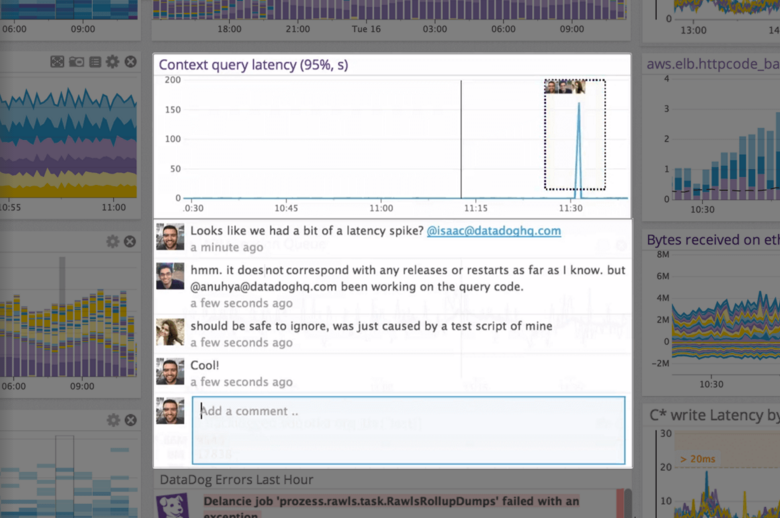
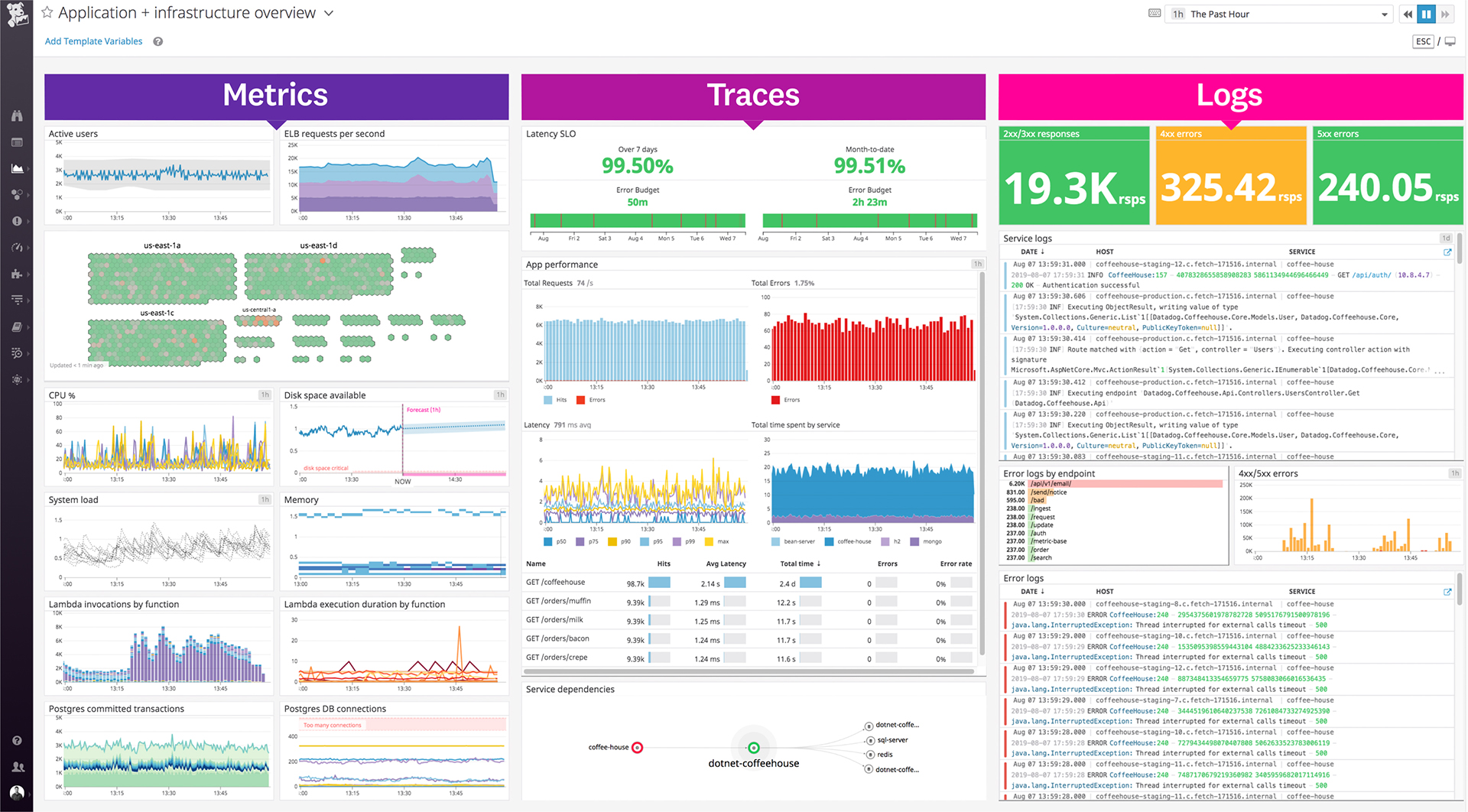
Screenshot of the out-of-the-box and customizable monitoring dashboards.Screenshot of Datadog's collaboration features, where users can discuss issues in-context with production data, annotate changes and notify their teams, see who responded to that alert before, and discover what was done to fix it.Screenshot of where Datadog unifies traces, metrics, and logs—the three pillars of observability.Screenshot of some of Datadog's 400+ built-in integrations.Screenshot of Datadog's Service Map, which decomposes an application into all its component services and draws the observed dependencies between these services in real timeScreenshot of centralized log data, pulled from any source.