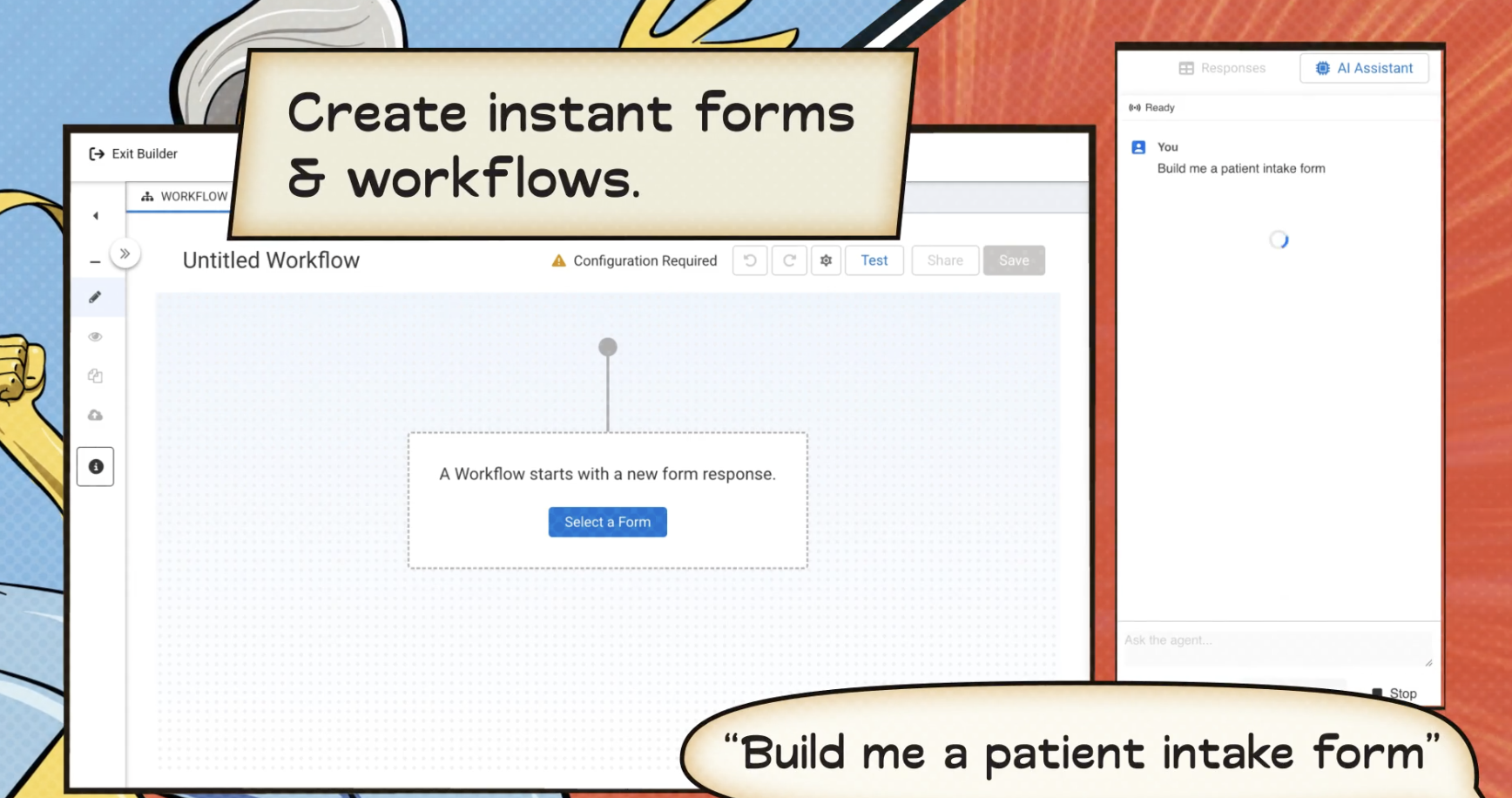
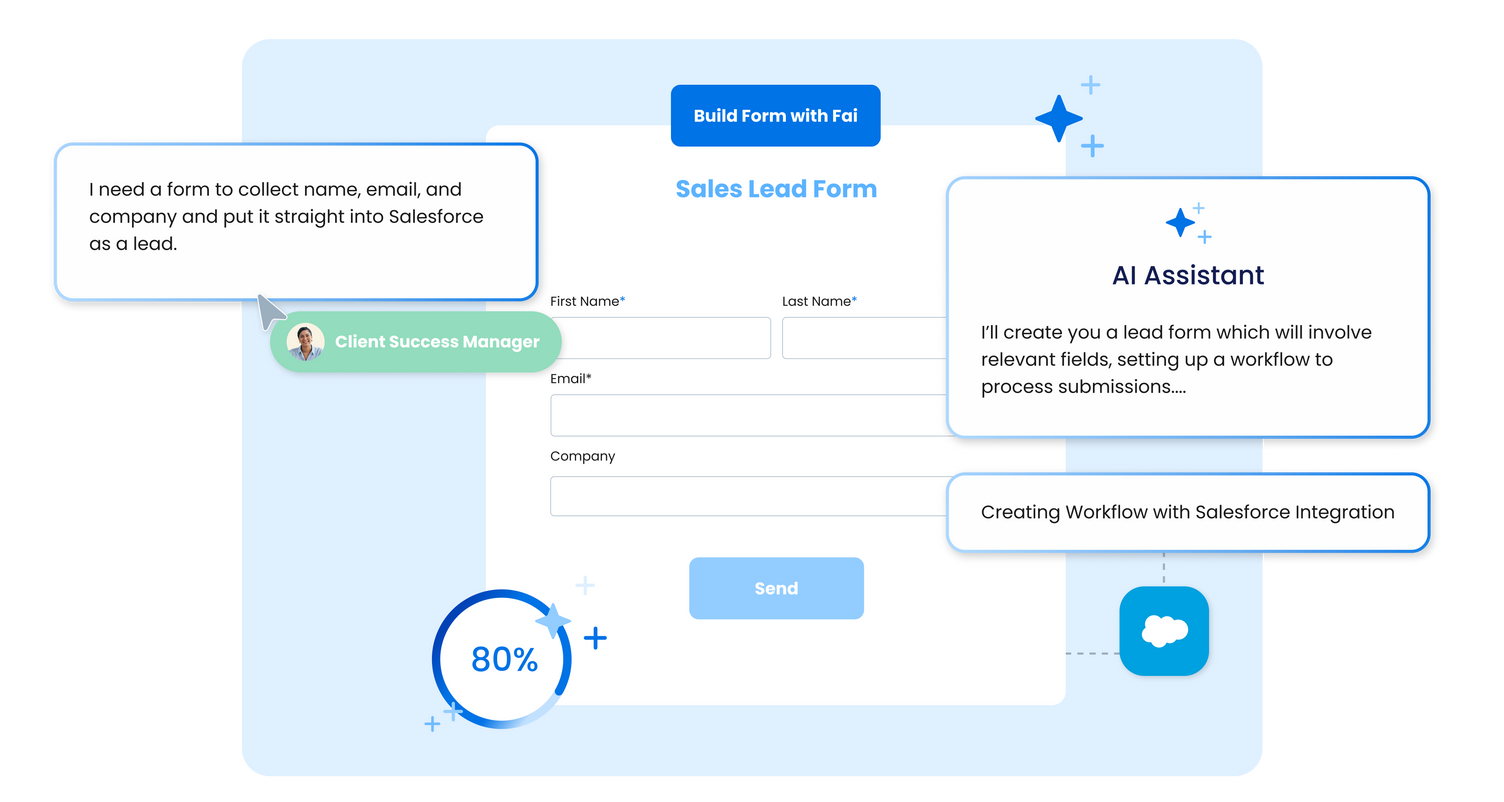
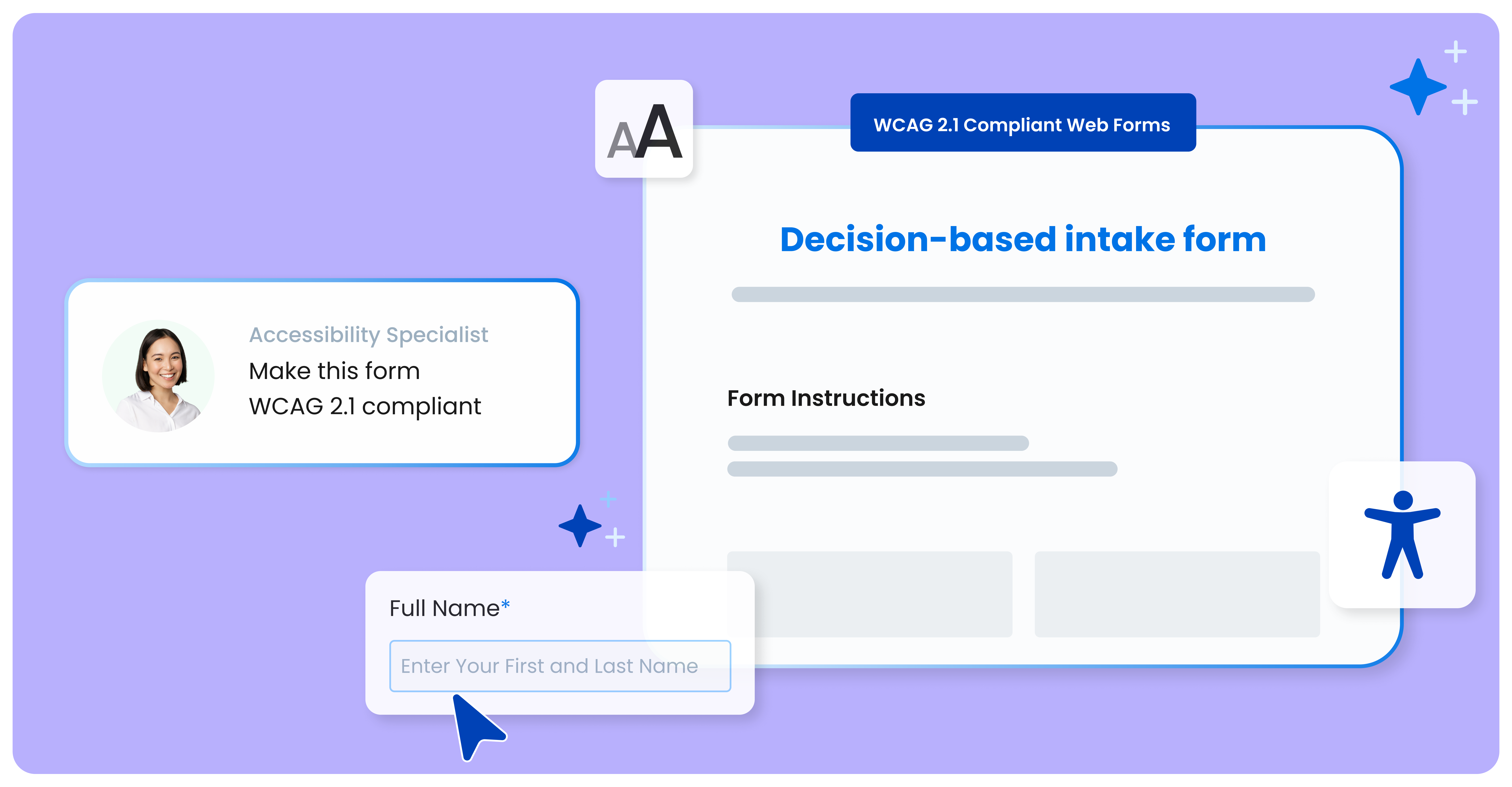
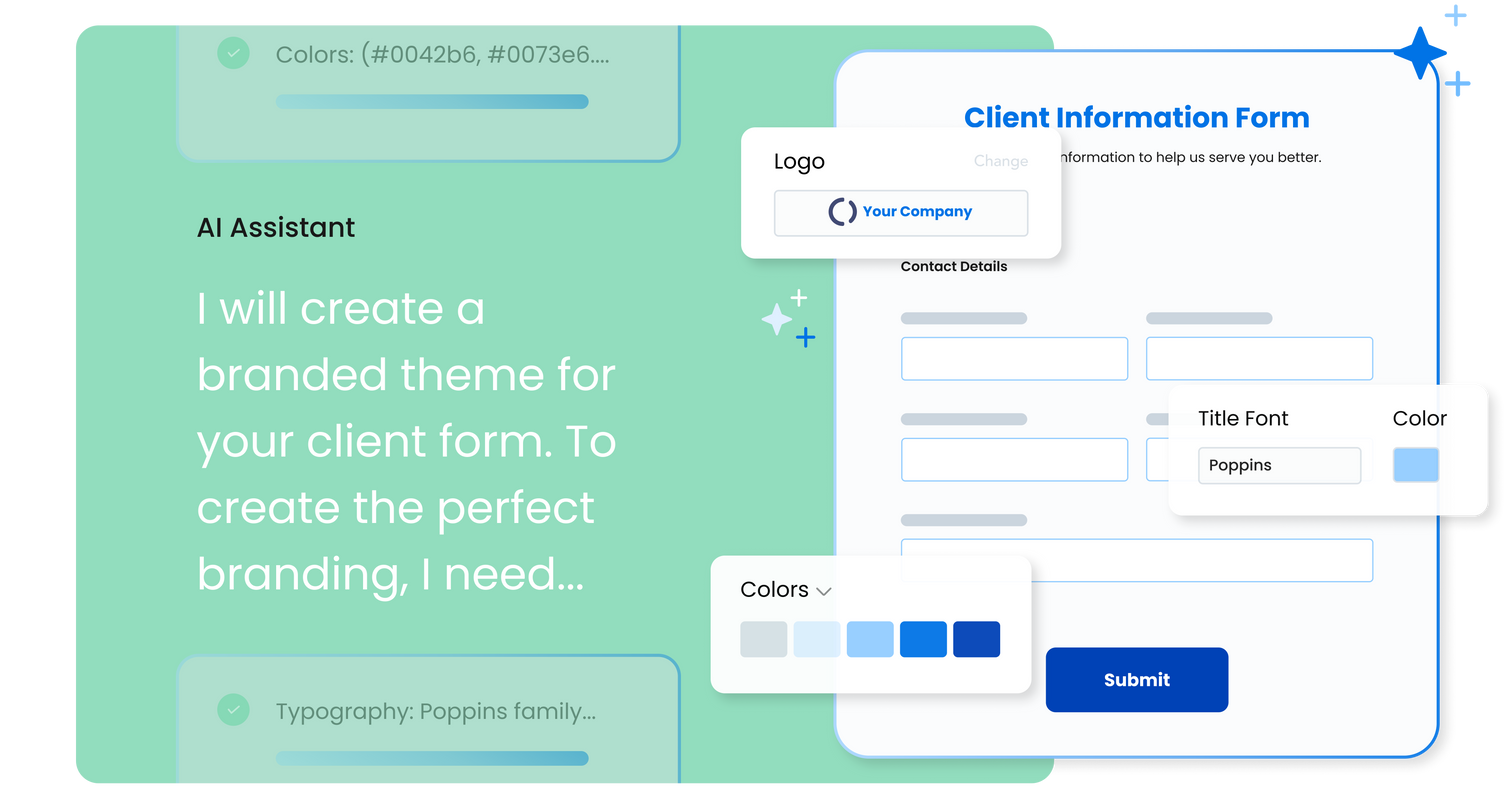
FormAssembly is an enterprise data collection and automation platform designed to enable organizations to capture clean, compliant data from the start. With the latest edition of the platform, FormAssembly Atlas, and its built-in AI assistant, Fai, forms and workflows build themselves, connect to Salesforce and other systems in just a few clicks, and ensure every record is structured, secure, and ready for automation or AI. In short, FormAssembly is designed to…
N/A
Formstack Forms
Score7.5 out of 10
N/A
Formstack is an online form building solution. Its drag-and-drop web form creator gives digital marketers a tool for online data collection and engagement. Users can collect payments and pass form data to popular marketing apps through third-party integrations. With Formstack, users can capture responses, store the information and share it with their teams.
$50
per month
Pricing
FormAssembly
Formstack Forms
Editions & Modules
Atlas Explorer
Contact Sales
per month
Atlas Team
Contact sales
Gov Cloud
Contact sales
Atlas Enterprise
Contact Sales
Enterprise
Contact sales team
Offerings
Pricing Offerings
FormAssembly
Formstack Forms
Free Trial
Yes
Yes
Free/Freemium Version
No
No
Premium Consulting/Integration Services
Yes
No
Entry-level Setup Fee
Optional
No setup fee
Additional Details
—
Plans start at $50/month (billed annually), including:
20 Digital Forms
1,000 Submissions Per Form
14,400 API Calls Per Day
Drag-and-Drop Form Builder
Custom Themes
Payment Integrations
Salesforce Integration
SSO User Management
Form Prefill
More options, better customization, and friendly to admins. All 3 of those products have their warts, but the biggest hurdle is that they just don't work as well as FormAssembly. FormStack is nice in SF, but the features are limited, and the styling options are way worse. Titan …
A de minimis incentive was given to thank the reviewer for their time. The incentive was not used to bias or drive a particular response, nor was the incentive contingent on a positive endorsement. More Info
Verified User
Chose FormAssembly
Overall we were looking specifically for a Salesforce-connected form provider, and found FormAssembly offered the most dynamic and powerful suite of Salesforce integrations across the form vendors we evaluated. I would specifically highlight that the logic a user can create …
A de minimis incentive was given to thank the reviewer for their time. The incentive was not used to bias or drive a particular response, nor was the incentive contingent on a positive endorsement. TR verified that a representative sample of customers was invited. More Info
Verified User
Chose FormAssembly
Form Assembly allows for advanced data mapping, pre-filling forms with Salesforce data, and working with custom objects. FormAssembly excels in Salesforce Integration, as it is highly specialized and deeply integrated. Often considered the industry leader for Salesforce forms, …
A de minimis incentive was given to thank the reviewer for their time. The incentive was not used to bias or drive a particular response, nor was the incentive contingent on a positive endorsement. More Info
Director of Operations at Camp Daniel (Non-profit Organization Management, 1-10 employees)
Chose FormAssembly
Our website couldn’t handle self-hosting Formidable Forms as a plug-in on our website and would frequently crash. Titan Forms had poor communication and was difficult to schedule customer service. Formstack was self-hosted on our Salesforce, but was overpriced for our use case …
A de minimis incentive was given to thank the reviewer for their time. The incentive was not used to bias or drive a particular response, nor was the incentive contingent on a positive endorsement. TR verified that a representative sample of customers was invited. More Info
A de minimis incentive was given to thank the reviewer for their time. The incentive was not used to bias or drive a particular response, nor was the incentive contingent on a positive endorsement. More Info
A de minimis incentive was given to thank the reviewer for their time. The incentive was not used to bias or drive a particular response, nor was the incentive contingent on a positive endorsement. More Info
Sr. Information Systems Manager in Information Technology at Build It Green (Program Development, 11-50 employees)
Chose FormAssembly
When we were researching options 2 years ago, FormAssembly beat other form tools hands down based on Salesforce integration features. The ability to declaratively set up prefill and post-submission data connectors supporting complex hierarchical data relationships was huge …
A de minimis incentive was given to thank the reviewer for their time. The incentive was not used to bias or drive a particular response, nor was the incentive contingent on a positive endorsement. More Info
A de minimis incentive was given to thank the reviewer for their time. The incentive was not used to bias or drive a particular response, nor was the incentive contingent on a positive endorsement. More Info
Well suited to get information into Salesforce. For the pricepoint you have to pay and the workflow you have to set up it is less appropriate when using Microsoft 365. The Google connector is very simple and you can use it with forms, it hinders us that is not an option unless a workflow is used.
A de minimis incentive was given to thank the reviewer for their time. The incentive was not used to bias or drive a particular response, nor was the incentive contingent on a positive endorsement. More Info
Formstack makes it easy to create a variety of forms. I have used it for event interest and registrations, email list sign-ups, and surveys. I have found it easy to customize, and easy to export data for import into other systems (e.g., CRM).
A de minimis incentive was given to thank the reviewer for their time. The incentive was not used to bias or drive a particular response, nor was the incentive contingent on a positive endorsement. TR verified that a representative sample of customers was invited. More Info
Integrating with Salesforce - mapping fields is straightforward, and custom formulas allow for some increased complexity in processing.
Scalability - we leverage the URL pre-fill and dynamic picklist features to use a single form for multiple different programs.
Simple form building via point-and-click is relatively easy. Hidden fields, conditionals, and repeat sections are useful features for more complex form needs.
Custom CSS option is useful - has allowed us to visually integrate FormAssembly forms onto our website via iframe.
A de minimis incentive was given to thank the reviewer for their time. The incentive was not used to bias or drive a particular response, nor was the incentive contingent on a positive endorsement. More Info
Allows for unique situations. As a school, we don't have the luxury of being cookie cutter. Neither do our forms.
Support. If we don't know how to do it, their support team has been very helpful and actually attempts to understand the issue on hand.
User friendliness. In our field we have a phrase: "what if you get hit by a bus?" With Formstack, you can "get hit by the bus" and someone else can jump in and still keep things running (this is used as a phrase for illness, not termination).
A de minimis incentive was given to thank the reviewer for their time. The incentive was not used to bias or drive a particular response, nor was the incentive contingent on a positive endorsement. More Info
FormAssembly could do a much better job supporting customers. As I mentioned, FormAssembly is critical to our day-to-day operations, so it is very important to us that support is prompt and reliable when we reach out. Unfortunately, this has not been our experience. For example, on more than one occasion, I had a support case open for months without hearing back, despite repeatedly following up.
FormAssembly could make troubleshooting and configuration updates easier by improving their user interface. Salesforce, for example, has a feature called "Where is this used?" for fields, which makes it easy to address bugs and make changes efficiently and effectively.
FormAssembly could benefit from improving training and support resources.
A de minimis incentive was given to thank the reviewer for their time. The incentive was not used to bias or drive a particular response, nor was the incentive contingent on a positive endorsement. TR verified that a representative sample of customers was invited. More Info
Setting up our multi-step form took some getting used to. Some of the branching logic configuration wasn't as intuitive as would be ideal.
Since we were pushing data directly into Hubspot, I found it cumbersome to deal with data storage limits within Formstack. I would get frequent notices that new responses were not being stored in Formstack and that I needed to upgrade or delete data. I got tired of that.
More/easier support for custom fonts would have been a huge plus. We were able to customize the form's appearance, but had to make some concessions in that regard.
A de minimis incentive was given to thank the reviewer for their time. The incentive was not used to bias or drive a particular response, nor was the incentive contingent on a positive endorsement. More Info
FormAssembly continues to meet our needs, and the product functionality continues to grow, providing us with new opportunities to utilize the software. We've built many forms and associated processes on FormAssembly. It would require a large effort to migrate to another platform. We have invested a lot of time in learning FormAssembly.
A de minimis incentive was given to thank the reviewer for their time. The incentive was not used to bias or drive a particular response, nor was the incentive contingent on a positive endorsement. More Info
Our user base has come to rely on Formstack to get forms done. The Formstack tools make it easy to start from scratch or copy an existing form to "quick start" a new, similar form. The price is right and frees up IT staff to do more transformative work.
A de minimis incentive was given to thank the reviewer for their time. The incentive was not used to bias or drive a particular response, nor was the incentive contingent on a positive endorsement. More Info
The UI is very intuitive and easy to use, even if you've never used a form building platform before. There is plenty of easy-to-find documentation so if you're unsure on anything, you can sense-check it. I also love the drag-and-drop form building. It is a breeze to use, especially compared to other form builders which are quite clunky, or where the functionality takes a lot of clicks to reach. Everything is easily accessible and ready to use with FormAssembly.
A de minimis incentive was given to thank the reviewer for their time. The incentive was not used to bias or drive a particular response, nor was the incentive contingent on a positive endorsement. More Info
It's easy to learn how to use, generally easy for clients to use, and overall I've never had an overwhelmingly negative experience with it. While there are a few tweaks that could make it really shine, Formstack Forms serves almost all our needs and we're super happy with it.
A de minimis incentive was given to thank the reviewer for their time. The incentive was not used to bias or drive a particular response, nor was the incentive contingent on a positive endorsement. More Info
While it's not a true development package and misses some features like ingestion of external data for lists, etc... the product is fast, stable, easy to use, and will suit the needs of anyone needing online form functionality with SalesForce and other connectors available for your marketing needs.
A de minimis incentive was given to thank the reviewer for their time. The incentive was not used to bias or drive a particular response, nor was the incentive contingent on a positive endorsement. More Info
The agents in the original group, especially the ones in cahoots with the developers, are really solid and know what they're talking about--I'm looking at you, Collin. The 'Tier 1' support agents that typically reply to the tickets are really spotty. If you have an overly technical question, i.e. bugfix, or describe a feature from a few years back that randomly disappeared, these agents typically will give you what feels like a generic reply and not know what you're talking about.
A de minimis incentive was given to thank the reviewer for their time. The incentive was not used to bias or drive a particular response, nor was the incentive contingent on a positive endorsement. More Info
A de minimis incentive was given to thank the reviewer for their time. The incentive was not used to bias or drive a particular response, nor was the incentive contingent on a positive endorsement. More Info
We implemented on one of the earlier versions. Through continuous engineering improvements, the interface keeps getting easier and more intuitive. Therefore, later implementations keep getting easier and better.
A de minimis incentive was given to thank the reviewer for their time. The incentive was not used to bias or drive a particular response, nor was the incentive contingent on a positive endorsement. More Info
FormAssembly's features were more expansive than SurveyMonkey, in my opinion. When doing a comparison, we really liked that we could set up formulas to calculate expenses for us and that they would be easy to update as needed for rates that change from year to year.
A de minimis incentive was given to thank the reviewer for their time. The incentive was not used to bias or drive a particular response, nor was the incentive contingent on a positive endorsement. More Info
Drupal is a much more customizable platform, however you must have someone build the forms first and then you can work with them if you do not have the programming knowledge. If you have any changes to make, it can sometimes be both a time consuming and difficult process. Formstack is much more efficient if you do not have an in house programmer.
A de minimis incentive was given to thank the reviewer for their time. The incentive was not used to bias or drive a particular response, nor was the incentive contingent on a positive endorsement. More Info
A de minimis incentive was given to thank the reviewer for their time. The incentive was not used to bias or drive a particular response, nor was the incentive contingent on a positive endorsement. More Info
Positive - ability to analyze submission trends - e.g. when a marketing email is sent, looking at increased form viewing and submissions in relation to the sending of the campaign.
Immediate response - those that submit forms receive immediate response that their form has been submitted.
A de minimis incentive was given to thank the reviewer for their time. The incentive was not used to bias or drive a particular response, nor was the incentive contingent on a positive endorsement. More Info