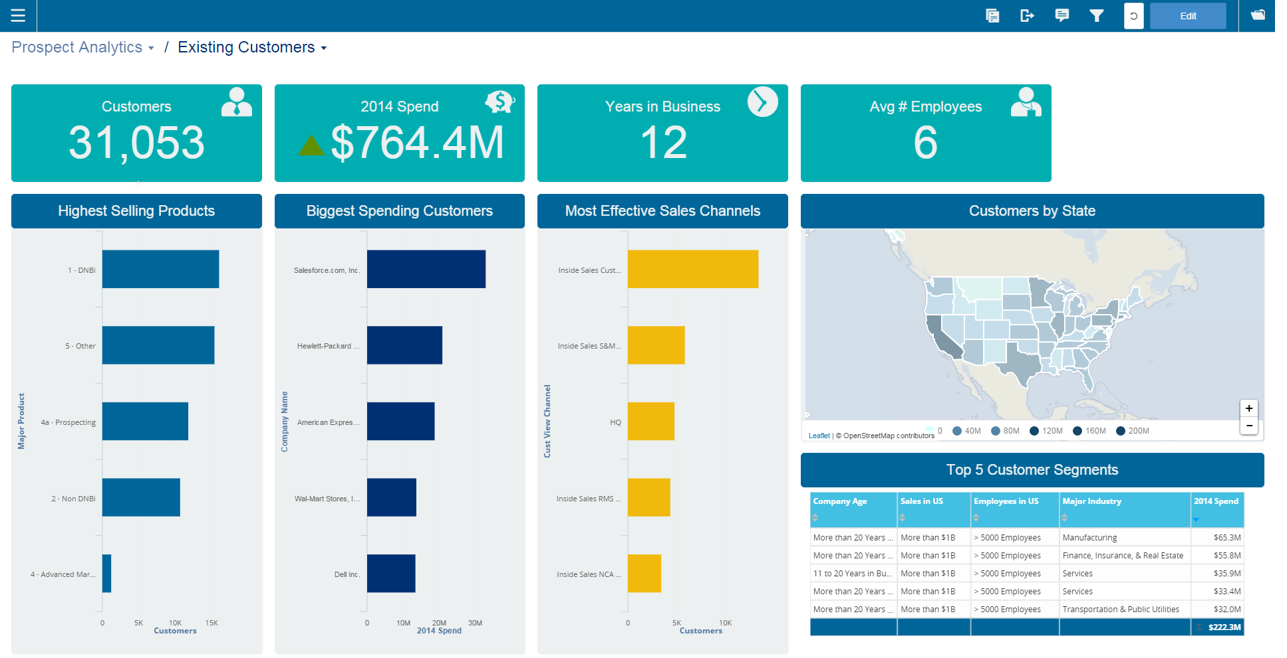
Infor Birst offers multi-tenant cloud BI for deployment in a public or private cloud, or on-premises. It provides an in-memory columnar data store and a BI layer comprising a reporting engine, predictive analytics tools, mobile native apps, dashboards, discovery tools, and an open client interface.
N/A
Microsoft BI (MSBI)
Score 8.9 out of 10
N/A
Microsoft BI is a business intelligence product used for data analysis and generating reports on server-based data. It features unlimited data analysis capacity with its reporting engine, SQL Server Reporting Services alongside ETL, master data management, and data cleansing.
$14
per month per user
Tableau Desktop
Score 8.4 out of 10
N/A
Tableau Desktop is a data visualization product from Tableau. It connects to a variety of data sources for combining disparate data sources without coding. It provides tools for discovering patterns and insights, data calculations, forecasts, and statistical summaries and visual storytelling.
We preferred to have an all-in-one cloud solution that could connect to Salesforce.com and on-premise servers. I thought the combination of ETL built into a star-schema was unmatched. QlikView could do something similar, but the resulting data file was not an enterprise grade …
Both Tableau and Qlik needed back end data preparation done before they could start. BIRST has that full process integrated. Most importantly, BIRST's fully integrated stack (we chose the cloud option) allows you to focus on delivering what your organization needs, without …
Birst lacks external modular components power bi has currently. New custom visuals, charts, statistical models created by third party vendors can be added to existing dashboard and enhanced.
Birst lacks interactive dashboard functionality and external inputs.
We evaluated and compared Birst, OBIEE 12c, and Tableau based on several criteria such as "Data Analysis & Discovery", "Data Integration", "Security model", "Data Visualization", "User Experience" or "Infrastructure & Architecture". The only point where Birst was rated higher …
We compared Birst vs Tableau and Lumirra and there's no question that Birst is the best option from a cost perspective. Additionally, the ease of use complemented with our support team has allowed us to innovate on the platform quickly
Birst is not as intuitive or flexible for cube design and aggregations as using SQL Analysis services - at times seems an odd mix between gui based, and required specific code. Power BI is the tool of choice internally, but is limited by security settings that we need to enable …
Birst provide a much better web UI and end user experience and distribution mechanism than both Tableau and SSRS. Power BI simply did not have the full complement of features that we needed at the time of our selection to be competitive and Pentaho was too custom and would have …
Tableau does not have a common semantic layer like BIRST does so we use Tableau for data discovery purposes and BIRST for enterprise BI. Within BIRST, we can increase the level of data governance.
Birst was better than Domo for our needs because we could get in and tinker with it. Our impression of Domo was that it had a lot of connectors and ready to go reports, but it made too many assumptions about applications we use. We customize too much to use a "ready to go" …
We originally selected Birst because they are a Partner of our ERP system provider. We re-evaluated and reconfirmed that decision after our new investment through a one week prototyping exercise that proved how quickly something that delivers real content and value can be built …
We selected Birst over all other options due to the one-stop-shop nature of their offering - it allows us to rapidly develop and deploy a complete product quickly within a single tool.
Visualizations between the two are comparable. Processing and data access seems to be a bit faster with MS. Building dashboards is about the same, with Birst seeming to be a bit simpler (but that might be because I use it more).
Have used Tableau and Spotfire and the …
Birst allows direct access to an internal data store, which none of the products we evaluated provided. We also found the birst ETL layer far more powerful than the other platforms we considered.
Birst back end is more powerful yet complicated while Tableau's front end is more user friendly
Verified User
Analyst
Chose Infor Birst
We chose birst for the cloud based collaboration feature
Verified User
Analyst
Chose Infor Birst
Tableau is the leader in visualizations, from animation to ease of use, it takes the cake. But they do not (did not) have the data modeling capabilities that were offered with Birst. The step back in visualizations from Birst is more than made up for in their modeling. Qlik is …
Microsoft BI (MSBI)
Verified User
Manager
Chose Microsoft BI (MSBI)
Tableau is a very feature rich tool, but it is also a pricey tool relative to Microsoft BI. Tableau's visualizations are very nice, but those features don't necessarily give us a strategic advantage or allow us get our work done any quicker. The monthly fee that you pay for …
Microsoft BI stacks up against Tableau because Tableau cannot blend various data sources easily. Tableau produces nice reports with a single data source. Today, it's not what we need. We need to easily combine multiple data sources. I would recommend either Microsoft BI or …
Microsoft BI is a great tool when it comes to various integration with line of business applications and its own ecosystem which contains office applications widely used all over the world. Hence, it is well suited for organizations that are complex and have global foot-print. …
Microsoft BI is very well suited to implement reporting and visualization within departments. Choosing Microsoft BI over tools like Tableau is the variety of third party apps it extracts data from. This functionality is limited in Tableau as it digests data from large data …
Conseiller à l'implantation, Solutions de performance et gestion de l'information
Chose Microsoft BI (MSBI)
For analysis and visualization, Power BI is aiming to take a large chunk of Tableau's market share. The rhythm of iterations at this time has in my opinion given the momentum to Power BI. The added functionalities in Excel also make it possible for intermediate users to get …
Unlike Oracle Business Intelligence Cloud Service (OBICS), Microsoft BI offers a good range of visualisation options. However, it falls behind in terms of data management capabilities. If your requirements are more data intensive and less reporting intensive, then Microsoft BI …
Tableau is very slow, and it's very complicated to use, whereas Microsoft BI is faster and more efficient.
Verified User
Manager
Chose Microsoft BI (MSBI)
Tableau's feature set is comparable to Microsoft BI at a potentially lower cost, however, Microsoft provides better integration into a Microsoft Environment and more flexible deployment options. Microsoft also provides better enterprise support than Tableau (although this may …
The biggest player against Microsoft BI (MSBI) was Tableau, which was acquired by Salesforce. Recently there have been other standalone software/applications that provide similar functionality to Microsoft BI (MSBI). Because my company is a Microsoft shop, we have not explored …
Better integration with Microsoft products is one of the advantages of using Business Intelligence (BI). It's simple to understand, and plenty of resources are available to outsource it. Many of our existing clients have Microsoft licensing agreements. It's an obvious path when …
Outsourcing work is easy to understand, and there are plenty of resources available in the marketplace. It is expensive, but it is still significantly less costly than the alternatives. Results from Microsoft BI (MSBI) are dependable; therefore, there is no problem with trust. …
MSBI is great for data collection and reporting, but it lacks the visual appeal and features of Power BI. Even though it's still useful, it falls short of Power BI in terms of features. There's no reason to doubt MSBI's findings. MSBI has a proactive customer service team that …
A lot of our existing client base has licensing agreements in place with Microsoft, couple that with decision-makers wanting to achieve the outcome with the least amount of additional licensing costs added, and it becomes an obvious path, however, it is very crucial to first …
Specific data displays are some of the strongest aspects of Microsoft BI when compared to alternate programs. It also does a superior job in compatibility with many programs, especially those from Microsoft. Since my company primarily uses Office 365 and other Microsoft …
The other programs listed are excellent. I have always been a fan of Google products because they are user-friendly and easily accessible by most. They also produce excellent data outputs. Google is still great for companies of any size but I believe Microsoft BI is an even …
The software stacks [well] because it has more graphics resolution and the colors are fresh and actualized. On the other hand, there is the Microsoft family software and this is an advantage. Microsoft has a lot of users around the world and it's like everyone knows how to do …
Microsoft BI is ideal for proficient Excel users, and it is the best choice in terms of visualizations. We decided to use Microsoft BI for these reasons.
With over 20 years in IT, I have experienced a full range of relational and non-relational data solutions, from Oracle and Informix to MongoDB and Hadoop. In my opinion, the Microsoft BI stack is the most complete, well-rounded, high performing data management system on the …
Microsoft is a distant me too in a world that is crowded and drowning in BI Me too products. Visualizations 5/10. Micro Strategy, ClickView, Domo, BOBJ etc will kill this product. The issue is cost and speed to implementation. The cost is far less than any of the previously …
I have been using the open source open standards BI tool 'Pentaho' before moving into the Microsoft space and I must admit I was surprised how much more difficult it is to do development in Microsoft. Having said that the cubes (SSAS) and reporting (SSRS) side does seem more …
While I haven't done a lot of work in Microsoft BI, I do think they are on the right road to being a great product but they definitely lag behind Tableau in the number of features available. Obviously, it does integrate well with Microsoft products, but it remains to be seen …
Tableau is so much better for data visualization and analysis than Microsoft Reporting Services, but lacks the other functionalities that are included on Microsoft BI (MBI). That's why we use MBI to extract and consolidate our data and Tableau to create some advanced reports.
Tableau supports more data sources that both Amazon QuickSight and Microsoft Power BI. It also created a much more sophisticated dashboard which is important for leadership and others who use it. However, we use other products like Toad Data Point and Alteryx and tools that …
It is very easy to use, we can create numbers of charts through it which I think other tools lack in. Lots of online communities are there which have provided solutions to the basic issues. Its ODS(output delivery system) is also very effective. We can use SQL in it for …
Tableau Desktop has many more features than other competitors. Comparing Birst, the layout is much more efficient. Power BI and QlikView are as easy as Tableau Desktop. The price for Tableau is a disadvantage when compared to Birst and QlikView, but not against Power BI. …
Tableau has a great community engagement, and it's really great to find and connect with other Tableau users. I think that really sets them apart from other tools, where Tableau has invested in empowering local user groups and supporting users online through the Tableau …
We were interested in expedience at reasonable cost and so didn't do any sort of bakeoff, but tried Tableau first as a potential solution for moving beyond Excel for large scale data analytics. We picked it because it more than met our functional needs at a very reasonable …
My current work environment uses both Tableau Online, MicroStrategy & SSRS in parallel. Tableau is much closer to the SSRS in terms of visualization tool where as MicroStrategy is an enterprise data modeling and reporting tool.
Based on the use case we use different tools. Here …
It is easier to start with Tableau. The out of the box ready feel is more with Tableau than any of the other BI products. Product scalability is at a steep cost with Tableau but it gives the possibility to begin small and then grow as it proves its capability as compared to all …
Cass evaluated Domo, QlikView and Birst prior to selecting Tableau. It came down to cost (and by a significant margin); the others have relatively high implementation, hosting and other costs. Additionally, based on a recent Gartner "Magic Quadrant", Tableau exceeds all others …
Excel is almost as good as Tableau. If you have a few thousand floating around just spring for the Tableau. QlikView is an abomination. Not much else to say there. SAS and friends are like ye olde-timey versions of Tableau in terms of their visualization abilities. Python, R, …
Tableau is the only tool that can be exposed to end users so that they can build their reports and dashboards and can publish these without the help of a dedicated developer.
Infor Birst OEM and embedded analytics are well suited for advanced analytics and business intelligence. It has flexible deployment features and a lot of configuration ability with low code - no coding ability. Ability to ingest data from multiple live data sources. Source data from multiple sources can be segregated into multiple sections based on business criteria. Easily searchable business terms (metadata) across all enterprise analytic content.
Microsoft BI is well suited for Stream analytics, easy data integration, report creation and UI/UX designs (limited but what all available are great ones) Microsoft BI may be less appropriate for handling huge number of datasets and difficult queries. It may also be difficult for a company with heavy data.
The best scenario is definitely to collect data from several sources and create dedicated dashboards for specific recipients. However, I miss the possibility of explaining these reports in more detail. Sometimes, we order a report, and after half a year, we don't remember the meaning of some data (I know it's our fault as an organization, but the tool could force better practices).
End-to-end solution, from raw source data, ETL, warehousing and reporting, Birst is able to do everything we need in one package instead of needing to develop and maintain multiple technologies
Intuitive report development. The drag and drop creation of reports is simple. More complicated queries are easy to generate.
Very user-friendly and interactive. A lot of nice features are available both for developers and end users to streamline the process of preparing and consuming data
Rich API which allows us to programmatically interact with Birst
An excellent tool for data visualization, it presents information in an appealing visual format—an exceptional platform for storing and analyzing data in any size organization.
Through interactive parameters, it enables real-time interaction with the user and is easy to learn and get support from the community.
The race to perfect gathering of Non-Traditional datasets is on-going; with Microsoft arguably not the leader of the pack in this category.
Licensing options for PowerBI visualizations may be a factor. I.e. if you need to implement B2C PowerBI visualizations, the cost is considerably high especially for startups.
Some clients are still resistant putting their data on the cloud, which restricts lots of functionality to Power BI.
We have been able to overcome any of the drawbacks we've found with Birst easily and it has fulfilled almost all of our analytic needs to date. Having seen their roadmap it would be highly unlikely we would move away from this platform any time soon. You simply can't beat the functionality that Birst provides for the price and the things I see coming out of the company solidify that our decision to choose Birst was the best possible choice. We have never regretted the decision.
Microsoft BI is fundamental to our suite of BI applications. That being said, Northcraft Analytics is focused on delighting our customers, so if the underlying factors of our decision change, we would choose to re-write our BI applications on a different stack. Luckily, mathematics are the fundamental IP of our technology... and is portable across all BI platforms for the foreseeable future.
Our use of Tableau Desktop is still fairly low, and will continue over time. The only real concern is around cost of the licenses, and I have mentioned this to Tableau and fully expect the development of more sensible models for our industry. This will remove any impediment to expansion of our use.
I would like to see additional usability put into the ETL scripting. Recently, Birst added a nice function reference inline to formula creation which has kept me from having to return to documentation so much. The same in ETL would be very beneficial. The interface problems related to the Flex framework are being addressed in a rewrite to HTML 5, but for now they are still a hindrance to a higher usability rating.
The Microsoft BI tools have great usability for both developers and end users alike. For developers familiar with Visual Studio, there is little learning curve. For those not, the single Visual Studio IDE means not having to learn separate tools for each component. For end-users, the web interface for SSRS is simple to navigate with intuitive controls. For ad-hoc analysis, Excel can connect directly to SSAS and provide a pivot table like experience which is familiar to many users. For database development, there is beginning to be some confusion, as there are now three tool choices (VS, SSMS, Azure Data Studio) for developers. I would like to see Azure Data Studio become the superset of SSMS and eventually supplant it.
Tableau Desktop has proven to be a lifesaver in many situations. Once we've completed the initial setup, it's simple to use. It has all of the features we need to quickly and efficiently synthesize our data. Tableau Desktop has advanced capabilities to improve our company's data structure and enable self-service for our employees.
We frequently experience -103 errors due to us using the Live Connect functionality, which does not seem to handle even minor interruptions in connectivity, and treats all future connection attempts or data requests as errors, even if the issue does not exist any longer
When used as a stand-alone tool, Tableau Desktop has unlimited uptime, which is always nice. When used in conjunction with Tableau Server, this tool has as much uptime as your server admins are willing to give it. All in all, I've never had an issue with Tableau's availability.
Everything runs very fast and smoothly. The only process that I wish was faster would be processing the data after uploading new data or making changes to the existing data model. It can take 15-20 minutes (roughly) to upload and process new data once you start getting into 10's of millions of rows. Given my experience with how long it takes me to pull the same data using SQL Server Management Studio, I don't think Birst is unreasonably slow - but for me to give a higher rating, I would want it to be unreasonably fast
SQL Server Reporting Services (SSRS) can drag at times. We created two report servers and placed them under an F5 load balancer. This configuration has worked well. We have seen sluggish performance at times due to the Windows Firewall.
Tableau Desktop's performance is solid. You can really dig into a large dataset in the form of a spreadsheet, and it exhibits similarly good performance when accessing a moderately sized Oracle database. I noticed that with Tableau Desktop 9.3, the performance using a spreadsheet started to slow around 75K rows by about 60 columns. This was easily remedied by creating an extract and pushing it to Tableau Server, where performance went to lightning fast
When we have an issue that is stopping our business from proceeding, I want answers sooner than later. While Birst does have a published response time for each case level, we always wish it could be quicker. What response improvement could there be with a larger support team? In response to first question: Blackhole of issues - Birst needs to improve upon closing issues that resolution was dependent upon code fixes or enhancements, perhaps someone to add a comment on all case tickets at least every 60 days. Escalation - I always have the ability to electronically or via phone escalate a ticket. I also have my Customer Success Manager through whom I can escalate topics.
While support from Microsoft isn't necessarily always best of breed, you're also not paying the price for premium support that you would on other platforms. The strength of the stack is in the ecosystem that surrounds it. In contrast to other products, there are hundreds, even thousands of bloggers that post daily as well as vibrant user communities that surround the tool. I've had much better luck finding help with SQL Server related issues than I have with any other product, but that help doesn't always come directly from Microsoft.
Tableau support has been extremely responsive and willing to help with all of our requests. They have assisted with creating advanced analysis and many different types of custom icons, data formatting, formulas, and actions embedded into graphs. Tableau offers a weekly presentation of features and assists with internal company projects.
I have attended two different training sessions. The first one was my initial training on the system. It was well paced, clear and concise. If there were questions that were not able to be answered by the instructor, he took down the question and actually followed up and provided us a response quickly. The second session was specific to the dashboard and report design components. This training was very good though there were some attendants who had little or no experience and their questions slowed the class.
It is admittedly hard to train a group of people with disparate levels of ability coming in, but the software is so easy to use that this is not a huge problem; anyone who can follow simple instructions can catch up pretty quickly.
Although I found the online resources helpful, a lack of appropriate examples for certain tasks key to report creation and advanced modeling make the online training/documentation less than perfect. For an inexperienced BI professional, the online training would not enable a streamlined launch of the product.
I have used on-line training from Microsoft and from Pragmatic Works. I would recommend Pragmatic Works as the best way to get up to speed quickly, and then use the Microsoft on-line training to deep dive into specific features that you need to get depth with.
I think the training was good overall, but it was maybe stating the obvious things that a tech savvy young engineer would be able to pick up themselves too. However, the example work books were good and Tableau web community has helped me with many problems
Have clean data! Birst flexibility allows - Start small, then introduce functionality and complexity along the way. If you try to present all the functionality [bells and whistles] and wow them, but bad data is uncovered, the end user blames the new application and turns away.
We are a consulting firm and as such our best resources are always billing on client projects. Our internal implementation has weaknesses, but that's true for any company like ours. My rating is based on the product's ease of implementation.
Again, training is the key and the company provides a lot of example videos that will help users discover use cases that will greatly assist their creation of original visualizations. As with any new software tool, productivity will decline for a period. In the case of Tableau, the decline period is short and the later gains are well worth it.
Birst was better than Domo for our needs because we could get in and tinker with it. Our impression of Domo was that it had a lot of connectors and ready to go reports, but it made too many assumptions about applications we use. We customize too much to use a "ready to go" solution like that. When we looked at Tableau, we liked its visualization capabilities, but it wasn't going to help us do the extractions, ETL, and warehousing of data. It may have come some distance since then.
We have used the built in ConnectWise Manager reports and custom reports. The reports provide static data. PowerBI shows us live data we can drill down into and easily adjust parameters. It's much more useful than a static PDF report.
I have used Power BI as well, the pricing is better, and also training costs or certifications are not that high. Since there is python integration in Power BI where I can use data cleaning and visualizing libraries and also some machine learning models. I can import my python scripts and create a visualization on processed data.
we can see that loading a lot of data can cause a noticable slow down in performance. Birst support indicated that they don't really consider anything less than 30 seconds to be an issue, but that is not the case for our customers, so we have had to change some of implementation to address this
Tableau Desktop's scaleability is really limited to the scale of your back-end data systems. If you want to pull down an extract and work quickly in-memory, in my application it scaled to a few tens of millions of rows using the in-memory engine. But it's really only limited by your back-end data store if you have or are willing to invest in an optimized SQL store or purpose-built query engine like Veritca or Netezza or something similar.
Being a manufacturing company we tend to lag behind technologically. But having all the data for different ERP systems in one place has been an eye opener for the executives. It has lessened the need to convert some legacy ERP systems.
Having such a simple reporting tool is a great asset to some of our sites that have traditionally had trouble gathering data from AS400 systems.
As a SaaS provider we see being able to provide self-service BI to our client users as a competitive advantage. In fact the MSSQL enabled BI is a contributing factor to many winning RFPs we have done for prospective client organisations.
However MSSQL BI requires extensive knowledge and skills to design and develop data warehouses & data models as a foundation to support business analysts and users to interrogate data effectively and efficiently. Often times we find having strong in-house MSSQL expertise is a bless.
Tableau was acquired years ago, and has provided good value with the content created.
Ongoing maintenance costs for the platform, both to maintain desktop and server licensing has made the continuing value questionable when compared to other offerings in the marketplace.
Users have largely been satisfied with the content, but not with the overall performance. This is due to a combination of factors including the performance of the Tableau engines as well as development deficiencies.