Adobe Dynamic Tag Management (DTM) was a tool used by marketers to manage tags, and for collecting and distributing data across digital marketing systems. Adobe DTM is a legacy, and it will not receive feature updates. Adobe invites users to upgrade to Launch on the Adobe Experience Platform.
N/A
Epsilon PeopleCloud
Score 8.0 out of 10
N/A
Epsilon PeopleCloud (formerly the Agility platform with Agility Harmony) is an enterprise-level email marketing and cross-channel campaign management platform competing with Responsys, Cheetah Mail, ExactTarget, etc. The vendor has a strong international presence with staff in 14 countries.
N/A
Tealium Customer Data Hub
Score 8.4 out of 10
Enterprise companies (1,001+ employees)
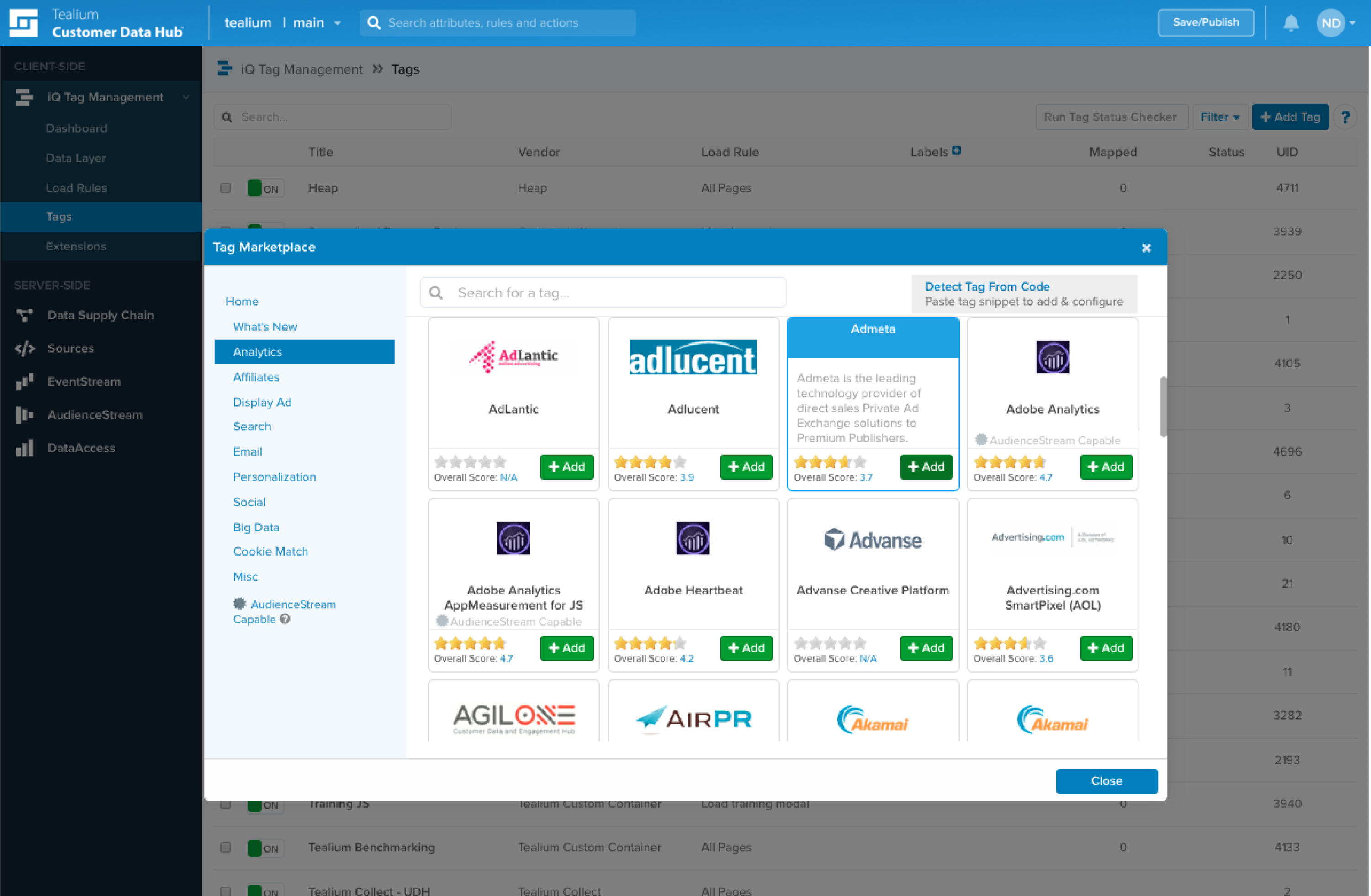
The Tealium Customer Data Hub powers capabilities across the data supply chain. Tealium universally collects customer data from any source including; websites, mobile applications, devices, kiosks, servers, and files. Data collected is then standardized in the data layer, which drives usage of data for customer engagement and analysis.
Google Tag Manager is free software from Google that allows you to deploy many different types of tags quickly and easily without utilizing web developers. Dynamic Tag Management, on the other hand, can only be acquired if you purchase an adobe solution. It too allows you to …
Adobe Dynamic Tag Management is no Tealium. However it doesn't need to be.
Epsilon PeopleCloud
No answer on this topic
Tealium Customer Data Hub
Verified User
Consultant
Chose Tealium Customer Data Hub
Tealium iQ Tag Management System is strictly Vendor independent. Tealium uses a multi-content delivery network and can therefore be reached from anywhere at any time. Tealium's support is focused, the community is very large, and Tealium has been a pioneer in the field of tag …
At the time of implementation, no one else was in consideration. We considered Adobe tag management later on during a transitional period but it was concluded that Tealium offered what we were looking for and provided the solution we were in need of.
Adobe Dynamic Tag Manager: this really seems like just a sales tool for Adobe. They don't have containers for many popular tags (some are competitors, for example). In addition, being tied to Adobe means that switching Analytics vendors will also require a change of tag …
Neither Adobe Tag Manager nor UberTags had what we considered to be an enterprise worthy platform at the time we evaluated them. Although I believe that's changed for both Adobe and UberTags, Tealium is highly focused on TM as well as being forward-looking regarding data …
Features
Adobe Dynamic Tag Management (discontinued)
Epsilon PeopleCloud
Tealium Customer Data Hub
Security
Comparison of Security features of Product A and Product B
Adobe Dynamic Tag Management (discontinued)
10.0
5 Ratings
18% above category average
Epsilon PeopleCloud
-
Ratings
Tealium Customer Data Hub
-
Ratings
Role-based user permissions
10.05 Ratings
00 Ratings
00 Ratings
Tag Management
Comparison of Tag Management features of Product A and Product B
Adobe Dynamic Tag Management (discontinued)
9.4
5 Ratings
15% above category average
Epsilon PeopleCloud
-
Ratings
Tealium Customer Data Hub
8.2
12 Ratings
0% above category average
Tag library
9.04 Ratings
00 Ratings
9.012 Ratings
Tag variable mapping
10.05 Ratings
00 Ratings
8.012 Ratings
Ease of writing custom tags
10.05 Ratings
00 Ratings
8.012 Ratings
Rules-driven tag execution
9.05 Ratings
00 Ratings
9.112 Ratings
Tag performance monitoring
10.04 Ratings
00 Ratings
4.311 Ratings
Page load times
10.05 Ratings
00 Ratings
8.911 Ratings
Mobile app tagging
10.04 Ratings
00 Ratings
8.05 Ratings
Library of JavaScript extensions
7.12 Ratings
00 Ratings
9.911 Ratings
Data Management & Integrity
Comparison of Data Management & Integrity features of Product A and Product B
Adobe Dynamic Tag Management (discontinued)
7.6
4 Ratings
7% below category average
Epsilon PeopleCloud
-
Ratings
Tealium Customer Data Hub
-
Ratings
Event tracking
10.04 Ratings
00 Ratings
00 Ratings
Mobile event tracking
10.04 Ratings
00 Ratings
00 Ratings
Data distribution management
7.03 Ratings
00 Ratings
00 Ratings
Universal data layer
10.04 Ratings
00 Ratings
00 Ratings
Automated error checking
1.03 Ratings
00 Ratings
00 Ratings
Best Alternatives
Adobe Dynamic Tag Management (discontinued)
Epsilon PeopleCloud
Tealium Customer Data Hub
Small Businesses
Google Tag Manager
Score 9.3 out of 10
Bloomreach - The Agentic Platform for Personalization
Score 8.9 out of 10
Bloomreach - The Agentic Platform for Personalization
Score 8.9 out of 10
Medium-sized Companies
Google Tag Manager
Score 9.3 out of 10
Bloomreach - The Agentic Platform for Personalization
Score 8.9 out of 10
Bloomreach - The Agentic Platform for Personalization
Score 8.9 out of 10
Enterprises
Tealium Customer Data Hub
Score 8.4 out of 10
Bloomreach - The Agentic Platform for Personalization
Score 8.9 out of 10
Bloomreach - The Agentic Platform for Personalization
If you're on the Adobe stack at all, you absolutely need DTM. It will make your life infinitely easier. It's so simple to update your Adobe Analytics code and have version control, and when we implemented Adobe Target, it took literally less than 15 minutes for me to do. I also think it's significantly simpler than Google Tag Manager. I went through all manner of difficulty when implementing tags on that and have not had similar problems on DTM. If you're frequently placing pixels, it's a great tool that will speed their deployment. The only situation in which I think a tag manager is not appropriate is if you have a dev with too much time on their hands. Otherwise, get a TMS and get DTM.
Appropriate for large organizations who want customization in their emails. The tool - while intuitive if you have previous background - is hefty and large in scope of capabilities. It's great for organizations who have multiple users and shows the name of person who last made changes. The reporting is really good - but may be a bit overwhelming for organizations who don't need a lot of detailed information
For more suited, I'll say highly regulated industry around data like healthcare, insurance, finance, where Tealium can be very helpful and for clients that don't have much different channels where they interact with their clients. So companies that only sell on internet and are a small company, I can see Tealium being the best usage for these clients, for these companies.
It is a rules based tag management system that allows the application of tracking pixels much easier than hard coding.
By placing 2 pieces of code on the top and bottom of each page of a website, we can create rules that track certain events and relay the information back to Adobe Media Optimizer and Google analytics.
It has simplified the coding process so one doesn't have to generate tons of gory javascript to deploy on each individual page to get tracking.
Simple tag management that is tough to beat. So many solutions that are incredibly simple to setup and gather data for.
Security around the data is key and Tealium excels in this area.
The speed impact of the tag setup is key to optimizing and allowing our web properties to run more effectively, which is a better experience for the end user.
The tool could be improved to "remember" where you last left off (specific user). Having to constantly retrace steps if you get logged out is annoying.
Hitting the "back" arrow sends you back to a main section, when it should send you back to where you previously were.
It would be nice to see performance reports available within the campaign itself, as well as within the reporting section.
Ability to NOT be able to change anything in a campaign after it has launched. This has happened multiple times. We usually copy a previous campaign to start a new one but often, we end up changing content on the version we are copying from -- this is very annoying and dangerous.
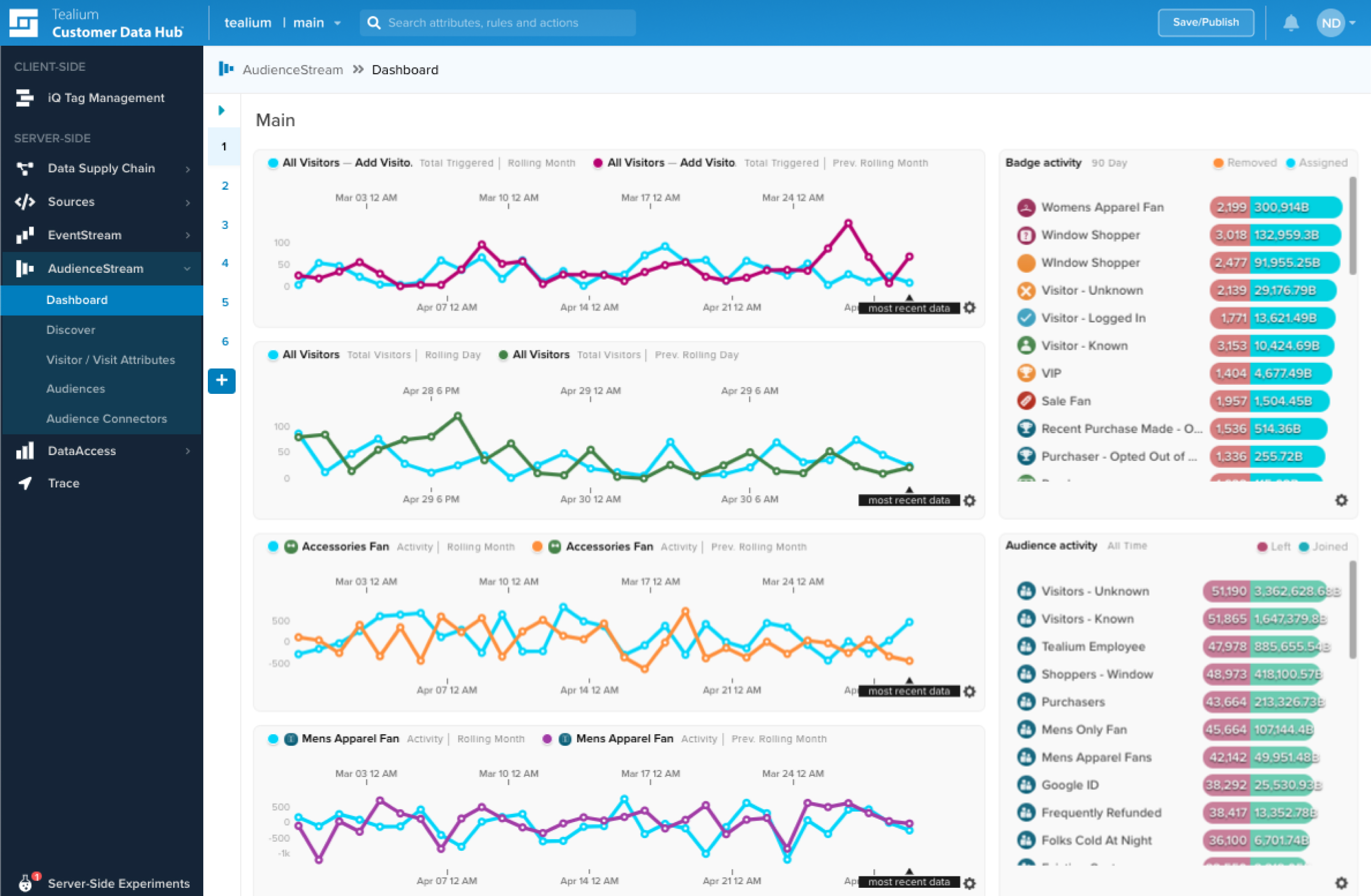
Audiences—don't they technically exist in Tealium? They are just streamed—no count, no backfill, etc.
Working backward to identify issues involves lots of clicking in the UI, going from audience to audience attribute, badge to event attribute, and so on.
You have to wait for a Real-Time event to see the payload. There is no sample or other option.
I already know that my company has no plans to discontinue use of Tealium. We are heavily reliant on it due to a huge number of product teams and developers we would have to work with to place tags across many pages. Tealium is already there on the pages, and our application/product teams are familiar with how to integrate it. It is just the simplest way to ensure that new data requirements are implemented in a timely manner.
Tealium iQ Tag Management System does exactly what it is intended for, it manages vendortags. Changes can be made to websites and apps in minutes. The frontend is well structured, updates are easy to carry out, and Tealium support is available at all times.
Although it is a newer product to Adobe, they seem to truly care about our challenges and are very proactive in making sure that we have the most knowledgeable support available in a timely manner.
The support team often is so quick to respond and so helpful when it comes to working with the needs of my clients and being able to resolve potential shortcomings or technical issues or surrounding the tool. There have been times more recently that I’ve gotten more generic service rather than the tailored experience that I have come to expect.
Implementation had some bumps in the road and it was new for all of us, but for the most part, it was easier than many other implementations we've done with other technologies.
Adobe DTM provides a more secure data analytics solution. It is customized and best used on large scale deployments of websites with pages 10,000+. The Adobe Analytics tool, once learned, is very easy to use and provides more robust, customized graphics and ability to export data to "securely" via FTP from the cloud to SQL database.
While both Epsilon Agility Harmony and Oracle Responsys are great for larger organizations that send a lot of emails, I think Epsilon Agility Harmony is more robust than Responsys and is easier to use. It is significantly more complex than HubSpot and requires previous knowledge of using an email tool that has content blocks and or dynamic content.
Tealium Customer Data Hub can do it all in one. Whereas, I think by using multiple Tealium Customer Data Hubs, we can utilize what each tool is really good at. In an ideal world, we'd like to use Tealium Customer Data Hub for everything, but one thing that we struggle with is Audience Segmentation, and we are looking for a one touch solution, without a lot of the work since the data is already there.
The key factor is that my devs are not tied up with petty things like adding JS or advertising pixels. Simple work like that can be handled by me while they work on feature development.
Release cycle is much shorter when a dev is needed, say for a direct call rule that involves JS being written. We don't have to go through the normal release cycle and can do it on an ad hoc basis without all the rigmarole of a hot fix.
There has been a near immeasurable return on customer data and improvement of our quality for our physical products due to be in tune with the customer. This has changed our way of doing things for the better to gain a better flow and overall workplace experience.
A negative is that Tealium AudienceStream becomes harder to manuever and use data analytics for when a database has been existing for a fairly large amount of time. It goes from an agile ship to a huge vessel that takes many components to be able to move.