Tealium Customer Data Hub Review
Use Cases and Deployment Scope
Pros
- Well, it’s easy to use first off, which is why I keep coming back, and this is my third time around with Tealium Customer Data Hub. But one of the most obvious wins for us has always been reducing the need, the reliance really, on product and engineering.
- Once we do get Tealium Customer Data Hub installed, it really empowers the marketing team and our marketing tech organization to move quicker, faster, plug into new partners, enable new APIs, and just do a lot more with our data without always having to go back to a data and analytics team or a data science organization or product and engineering and make request after request and wait for prioritization. We’re just able to do a lot more quickly.
Cons
- Yeah, one thing I would love to see added to the product is some alert-type features or notifications, especially when you end up seeing errors in an API request or one of your vendor partner integrations where you’re trying to send data downstream.
- If you start seeing either a large spike in volume, a massive drop in volume, a large number of errors, or a high error rate, it would be great to have some sort of automated notification process just to alert you and cue you in that this is something that needs to be looked at.
- Right now, that doesn’t exist, so it’s kind of a manual process of having to go in and check on it—whether daily or weekly, depending on each team—to understand if things are working and continuing to work as expected. Or if there is an issue, hopefully spotting it before it goes on for too long. Something like that is a feature that would make it better, absolutely.
Most Important Features
- The most important features, number one, source-agnostic data collection—so I can bring data in from anywhere: offline, online, mobile devices, living room devices, the website—and bring all that in and connect it to a single user. That’s definitely top of the list.
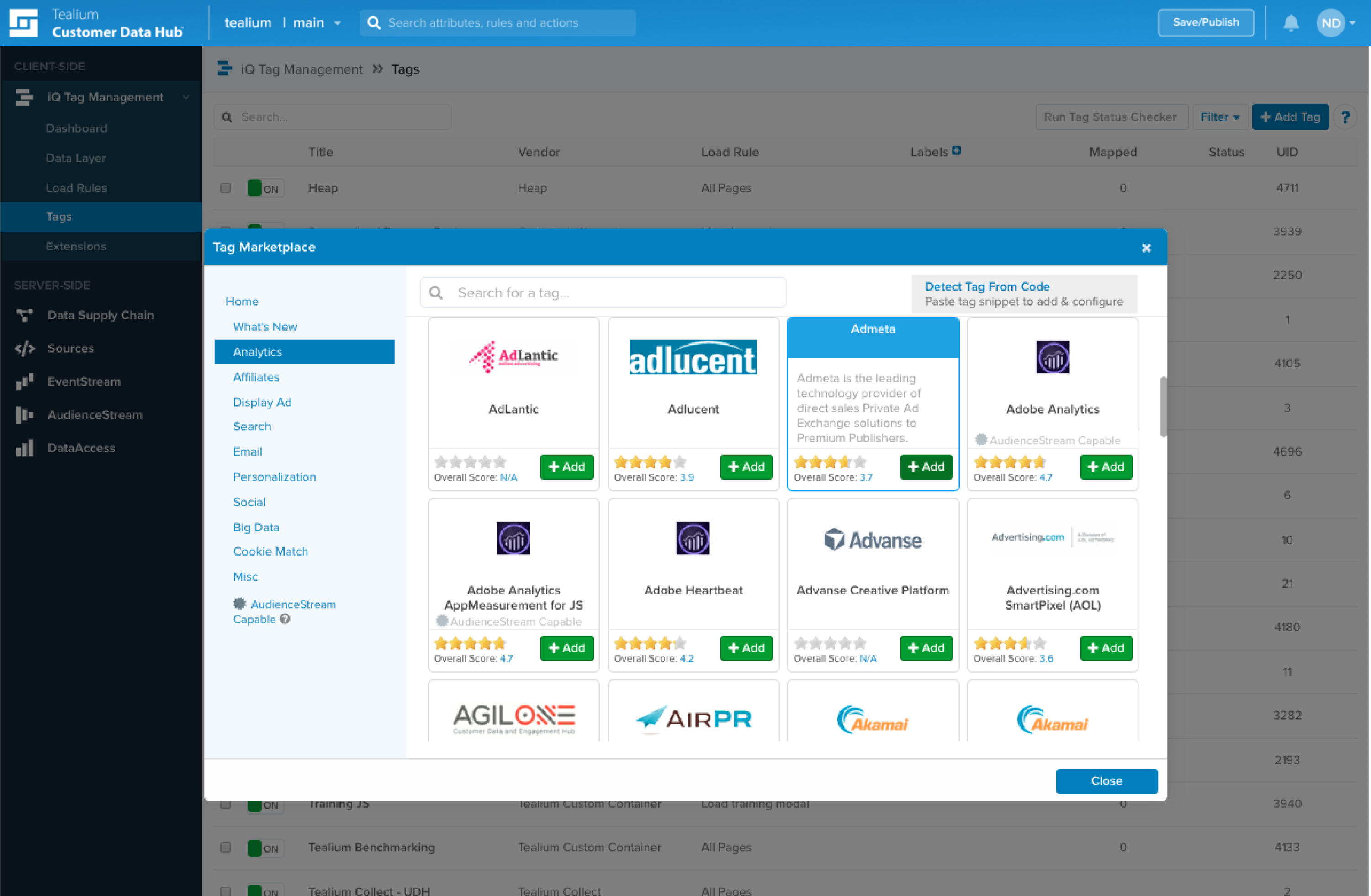
- But then also the out-of-the-box integrations they have—they’ve got a thousand-plus integrations now—and being able to turn those on with the flip of a switch, or a few flips of switches, certainly makes it a lot easier than having to go build into each one of those partners individually. So that goes back to the time savings and the fact that they keep those APIs updated.
- They’re always making sure they’re up to date with the latest and greatest that all these partners are offering, as opposed to trying to maintain all of that in-house, which I have done—and it is a nightmare.
Return on Investment
- We’ve definitely seen a lift in our revenue as a result of improved conversion rates. And I’d say it’s very much a flywheel where enabling Tealium Customer Data Hub and plugging into a lot of our paid media vendors and conversion APIs has improved our conversion rates.
- But then also, with that additional data and event coverage, it feeds the optimization algorithms that those paid media platforms use to optimize spend. So our budget’s actually become more efficient, we get more conversions, we become more efficient, we get more conversions—and so on.
- There’s been a significant double-digit lift in conversion volume across the board using the conversion APIs through Tealium Customer Data Hub. And then on the retention and lifecycle side, just being able to action customer issues in real time—going back to the real-time focus that Tealium Customer Data Hub emphasizes.
- If we see a customer struggling on our help site—and if they’re on our help site to begin with, they probably need help with something—so how do we get ahead of that? How can we proactively engage with the customer to say, “Hey, we see that you’re struggling with X…”