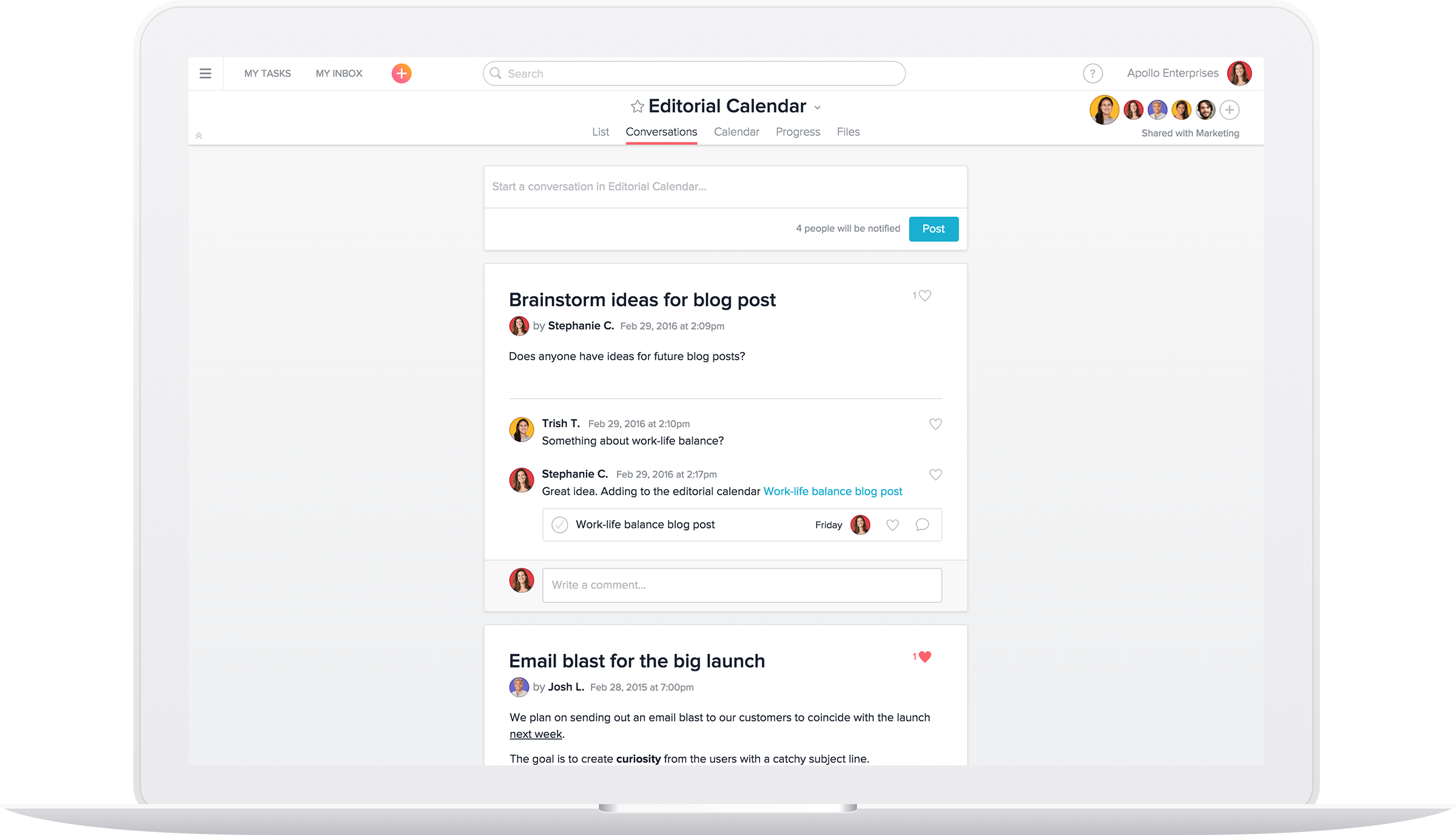
Asana is a web and mobile project management app. With tasks, projects, conversations, and dashboards, Asana lets an entire team know who's doing what by when, enabling workload balancing. Users can also add integrations for GANTT charts, time tracking and more.
$13.49
per month per user
Azure DevOps Server
Score 8.4 out of 10
N/A
Azure DevOps Server (formerly Team Foundation Server, or TFS) is the on-premise version of Azure DevOps. To license Azure DevOps Server an Azure DevOps license and a Windows operating system license (e.g. Windows Server) for each machine running Azure DevOps Server.
N/A
Miro
Score 9.1 out of 10
N/A
Miro is the AI Innovation Workspace that brings teams and AI together to plan, co-create, and build the next big thing, faster. With the canvas as the prompt, Miro's collaborative AI workflows keep teams in the flow of work, scale shifts in ways of working, and drive organization-wide transformation.
$10
per month per user
Pricing
Asana
Azure DevOps Server
Miro
Editions & Modules
Starter
$13.49
per month per user
Advanced
$30.49
per month per user
Enterprise
Contact Sales
Personal
Free
No answers on this topic
1. Free - To discover what Miro can do. Always free
$0
2. Starter - Unlimited and private boards with essential features
$8
per month (billed annually) per user
3. Business - Scales collaboration with advanced features and security
$16
per month (billed annually) per user
4. Enterprise - For work across the entire organization, with support, security and control, to scale
contact sales
annual billing per user
Offerings
Pricing Offerings
Asana
Azure DevOps Server
Miro
Free Trial
Yes
No
Yes
Free/Freemium Version
Yes
Yes
Yes
Premium Consulting/Integration Services
Yes
No
No
Entry-level Setup Fee
Optional
No setup fee
Optional
Additional Details
A discount is offered for annual billing.
—
Monthly billing also available at $10 per month for the Starter plan, or $20 for the Business plan.
Asana is the best for task management, it’s easy to use and streamlined for team members to use with minimal intervention. It’s a lot nicer to use compared to similar products like Projectplace although there is some difference in features. It has much better features in terms …
Asana is cross-platformed and is easy and quickly reachable via a web browser.
It has permissions, filters, reports, tags, comments, etc. All these features allow tracking day-by-day activities of the team as well as weekly/ monthly milestones and reporting.
I was new to the agile methodology when it was first introduced to the Enterprise. Different project teams opted to leverage different project management tools, two of the most common being Jira and DevOps. For someone overcoming a huge learning curve already, I felt that …
I selected Miro because it’s the only tool out of all that can combine visuals with collaboration, comment and feedback. Since we have people from all sub-divisions that need a shared workspace to collaborate, an easy to use tool with maximum impact would make the greatest …
We started our investigation with FigJam and analyzed it for a very long time, but after using it for some time, we found out it is not good for the medical industry, as it is designed mostly for IT. After that we used Miro and realized that it is the best for our industry, so …
We tested these tools and got some experience on them as well. But finally we cam to understand that Miro stood out by balancing structure with creativity, making it flexible enough for both system planning and cross-functional collaboration. So, Yes we tested so many tools …
We assessed these tools to gain a better understanding because they are excellent and have certain unique features. But in the end, we chose Miro since it offers all the features that ClickUp, Stormboard, and Conceptboard do. Additionally, it has a special feature that lets you …
Although it’s not a platform that does the same as Miro, I used it for similar things like showcasing my projects or work in an organized and visual way through a link where anyone could enter and see my personal space. However, Miro has many more functionalities that I can …
Miro was chose for its breadth of features, ease of use, integration simplicity for our SSO, and price. Overall the evaluation was fairly easy for us and we have been very happy so far and don't see us changing considering how they keep improving the product constantly while …
Miro is more user-friendly that Whimsical. I find it easier to create charts and diagrams and move things around. Everything feels smoother and easier to do
Miro utilizes a better software to generate frames which can be utilized to present concise, aesthetically pleasing and more interactive presentation Miro. With the lock ability, it also ensures unauthorized edits cannot be made nor can dragging items by mistake impact the …
I think we all found Miro a lot easier to use than Mural. It's a different concept entirely than Figma and InVision but it acts as the first step in our design process. We typically start in Miro before going to Figma.
We previously used LucidChart that is also a web-based diagramming application that allows users to visually collaborate on drawing and sharing. It's not as good as Miro as it only provided limited functionalities and cannot meet other requirements from the business. Basically, …
The usability of Asana is broad since it's available in a variety of platforms that are widely used nowadays. I think that it would be great for people who are constantly on the move and switching devices, since it has allowed me to work from my phone, too. I also think that Asana has proven itself to handle a large quantity of work
Azure DevOps is good to use if you are all-in on the Microsoft Azure stack. It's fully integrated across Azure so it is a point-and-click for most of what you will need to achieve. If you are new to Azure make sure you get some outside experience to help you otherwise it is very easy to overcomplicate things and go down the wrong track, or for you to manually create things that come out of the box.
Miro is the best tool for remote collaboration; it offers features that make teamwork feel natural and engaging regardless of our location. All-in-one and most reliable for visualizing ideas and workflows. It allows everyone to put ideas on one whiteboard that is easy for the entire team to have access, comments, and give updates, which eliminates the back-and-forth emails.
Through it, we were able to communicate and cooperate with the rest of the team to complete the work in the required manner and at the appropriate time.
Makes internal coordination between admin team and tutors extremely painless. It's like a single place where everyone can drop ideas, get updates and notes without loss of context which usually happens in long email threads.
Versioning and board history are handled very well, which drastically reduces the workload. They help me track how a policy or math guideline has evolved, and also make it easy to revert changes if something doesn't work.
Comments stick exactly where they are meant to, making internal reviews much clearer. Admins don't have to guess which note refers to which rule or section.
Exports are clean, so even non-Miro teammates get it instantly.
As a designer, I miss some more creative features. I can't even get really into designing small things (like paths). Many of my colleagues have already switched to the Figma board because it is possible there.
Things often get lost in the workflow, especially in teams. Working on the same file often leads to misunderstandings and can be frustrating. For example, if text is accidentally deleted and cannot be recovered, or if images become distorted.
The scale on the board is missing, which often leads to size differences.
Because we are a Microsoft Gold Partner we utilize most of their software and we have so much invested in Team Foundation Server now it would take a catastrophic amount of time and resources to switch to a different product.
I have advocate for the renew of Miro quite few times, however, it is not under my control as the decision is made in another team with their own budget. I would buy for my own entrepreneur projects (1-2 members) as I do know the value and work there 100%. So, I would pay out of my own pocket to get the value. However, If I wouldn't know the value it provides, it would be hard to decide with the current freemium features
It is very user-friendly. Takes a new employee an hour to start figuring out how the system works. That's an important factor. You don't want to encounter the issue where employees need a week to understand how the system works. For example, JIRA, I tried using it for a week and I still don't understand the complicated layout. Asana has a simple interface. Once you see it, you get it type of program.
For standard users the interface is friendly. but if you are a manager some tools are a little confusing to use, like the query system that you always need to create from scratch. Templates should be more helpful for queries and for standard procedures that you need to duplicate PBIs over time. The search history of Work Items is a little painful to use.
I love it. It should perhaps even be a 10, but there are only minor things that get me when it comes to trying to move around the images on the page and selecting images on the page. Nevertheless, I've used this tool randomly over various years numerous times.
I only give a 9/10 because of the speed at which it loads. I have never experienced issues with Miro logging me out early, or some other technical issue causing the program to crash, or even it just loading in perpetuity without ever actually coming up (unlike other programs such as SFDC). It take a minute for all of my boards to come up after I click on it in my favorites, but besides that, it's all good.
Sometimes it gets quite slow and there is a correlation between this and the size of the board. Hence we are trying to segment the boards based on product stages or projects so that the size doesn't go big. When you go from discovery to delivery on a simple board, it will get large and difficult to load, even crash or go white screen
I haven't had to use their support so I can't rate it. The fact that I haven't needed them reflects the ease of use of the product. I would recommend that any new users schedule a complete demo of the product to ensure that they are using it to it's fullest (there's a lot of useful features).
I have not had to use the support for Azure DevOps Server. There have never been any issues where I was not able to figure it out or quickly resolve. Our Scrum Master has used support before though, and the service has always been prompt and clear with a customer-focus
We have never reached out to or contacted support because Miro's platform has been incredibly intuitive and user-friendly. The comprehensive resources available, such as tutorials, documentation, and community forums, have provided all the guidance we needed. The seamless integration with our existing tools and the reliability of the platform have ensured that we rarely encounter issues that require external assistance. This self-sufficiency has allowed us to focus more on our projects and collaboration without interruptions. Overall, our experience with Miro has been smooth and efficient, eliminating the need for additional support
There was a series of webinars which Miro hosted with our organization that went over the basics, then progressively became more advanced with additional sections. The instructors were knowledgeable, and provided examples throughout the sessions, as well as answered peoples' questions. There was ample time and experience on the calls to cover a range of topics. The instructors were also very friendly and sociable, as well as honest. Of course Miro isn't a "God-tool" that does absolutely everything, but the instructors were aware and emphasized the strengths where Miro had them and sincerely accepted feedback.
Easy to learn, Miro has a series of videos on YouTube that effectively taught this program to my team members and me. The program is drag-and-drop and works excellently. People pick up on how to use it efficiently, and it's great for organizing ideas more freely. This product is more challenging for some older audiences who are not accustomed to using a touchpad, but for most, it was very easy to use.
Asana is a top-tier project management software that helps us organize and track projects from start to finish. It allows us to apply tasks/to-dos to multiple projects without duplication, divide complex projects into smaller tasks, and track project progress. It also helps us organize work on Kanban boards or linear lists. It stands out from the crowd in a big way compared to the competition.
In my opinion, DevOps covers the development process end to end way better than Jira or GitHub. Both competitors are nice in their specific fields but DevOps provides a more comprehensive package in my opinion. It is still crazy to see that the whole suite can be used for free. The productivity increase we realized with DevOps is worth real money!
I use both for different things really. Figma is better for design and prototype applications with coding being enabled in Figma (which isn't part of Miro's tools). As I said earlier, I use other programmes when there is a lack in Miro, in this case the coding element. Also Miro is better suited for BAU, so I can utilise this by bringing part of the business into using it. Figma isn't collaborative enough for this purpose. Miro overall has a better user experience
Maybe is possible now so... Could be useful to manage in some way source code for the projects? not to edit so when we make solutions with different components in MIro, maybe each component could redirect to the source code of this component
It has streamlined the pipeline and project management for our agile effort.
It has helped our agile team get organized since that is a new methodology being leveraged within the Enterprise.
The calendar has improved visibility into different OOOs across the project team since we all come from different departments across the larger organization.